Brazil Formwork Market Summary
The brazil formwork market was estimated at USD 389 Million in 2025 and is projected to reach USD 466 Million by 2032, growing at a CAGR of 3.1% from 2026 to 2032.
Brazil Formwork Market Year-wise Growth Rate and Key Drivers
This graph highlights how the Brazil Formwork Market has steadily grown over the years, supported by major growth factors.
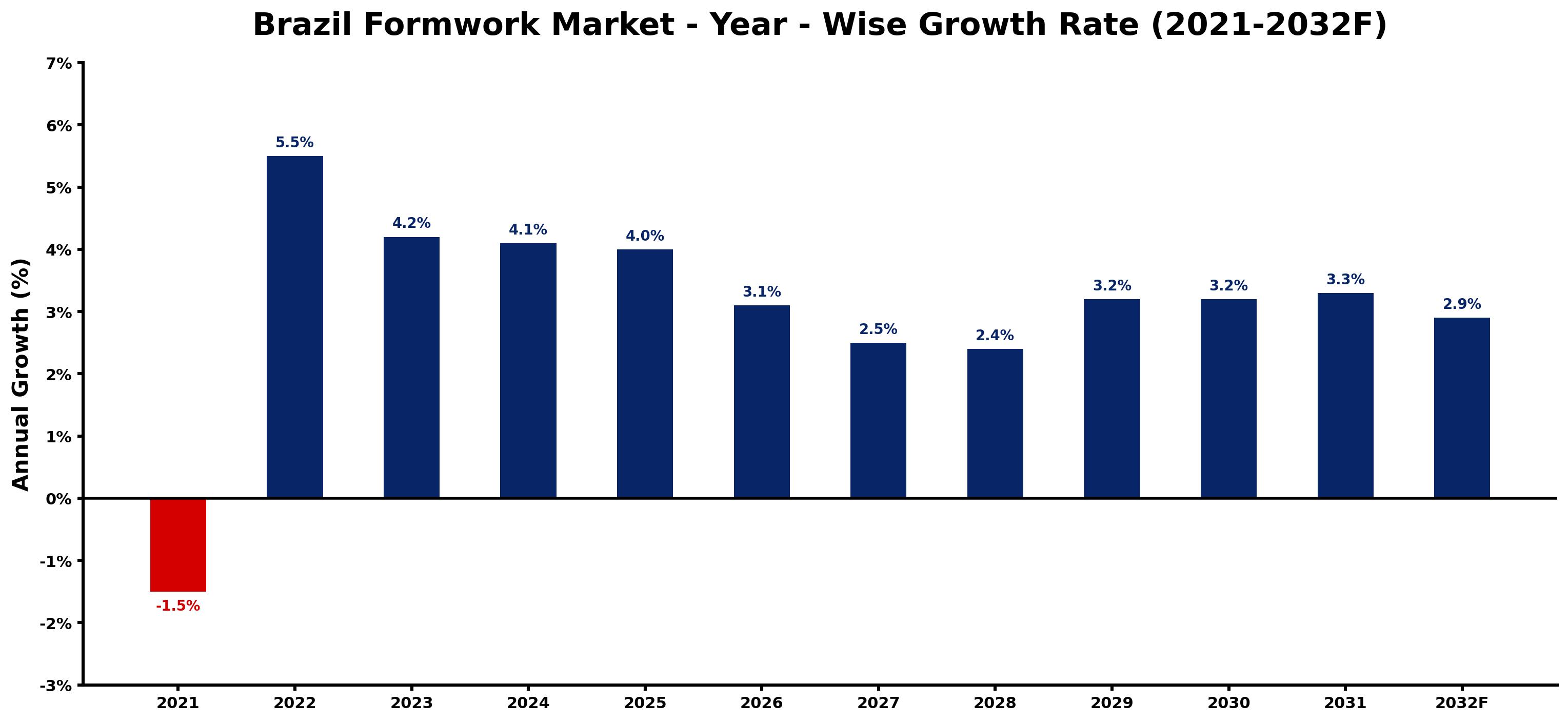
The table below presents the year wise growth rates along with the key drivers influencing the market
| Year | Growth Rate | Major Drivers |
| 2021 | -1.5% | Supply chain disruptions hindered project timelines, leading to decreased investments in construction and formwork solutions. |
| 2022 | 5.5% | Infrastructure modernization initiatives stimulate demand for innovative formwork solutions nationwide. |
| 2023 | 4.2% | Urbanization trends prompt a surge in high-rise building projects across Brazilian cities. |
| 2024 | 4.1% | Private sector participation in large-scale projects enhances the competitive formwork landscape. |
| 2025 | 4.0% | Sustainability concerns lead companies to explore eco-friendly formwork materials and methods. |
| 2026 | 3.1% | Technological advancements in prefabrication further solidify formwork's role in construction efficiency. |
| 2027 | 2.5% | Increased foreign direct investment bolsters domestic construction capabilities and formwork applications. |
| 2028 | 2.4% | Regional economic growth expands opportunities for advanced formwork systems in emerging markets. |
| 2029 | 3.2% | Collaborations between local firms and international players facilitate knowledge transfer and innovation. |
| 2030 | 3.2% | Government infrastructure funding focuses on transportation, directly benefiting the formwork sector. |
| 2031 | 3.3% | Digital twin technologies reshape project planning, driving demand for precise formwork solutions. |
| 2032 | 2.9% | Growing interest in smart buildings necessitates advanced formwork systems for complex designs. |
Note - Market size estimations and growth projections presented in this report are based on 6Wresearch's advanced forecasting approach, validated with industry datasets as of June 2026.
Brazil Formwork Market Synopsis
The Brazil Formwork Market is projected to reach 3.1% and witness significant growth during the forecast period (2026-2032). The anticipated compound annual growth rate (CAGR) of 6.8% is fueled by various factors, notably the escalating use of formworks in construction, infrastructure, and industrial projects. Significant investments in the residential sector further contribute to the market's expansion. Additionally, the rising demand for ready-mix concrete and precast components is expected to bolster growth opportunities across the sector. Various government initiatives aimed at enhancing rail transport systems also serve as critical drivers for the development of Brazil's formwork industry throughout the forecast period.
Brazil Formwork Market Growth Drivers
Several factors are propelling the growth of the Brazil Formwork Market. Firstly, the construction industry's vigorous demand for efficient and robust formwork solutions is foundational to market expansion. Secondly, there is a noticeable shift towards the adoption of innovative materials such as steel and aluminum, which are increasingly preferred for large-scale industrial projects, including bridges and tunnels. Furthermore, the resurgence of infrastructure development initiatives in Brazil has prompted stakeholders to invest heavily in formwork solutions.
- The burgeoning residential construction sector in Brazil is creating ample demand for diverse formwork systems, which are integral for ensuring the structural integrity of buildings.
- The rise in urbanization and population growth is driving the need for new housing and infrastructure, thereby escalating the need for advanced formwork systems.
- Growing investment in transportation infrastructure, such as highways and bridges, is leading to increased procurement of formwork solutions capable of meeting stringent performance requirements.
- The preference for precast concrete components continues to grow, providing a substantial boost to the formwork market as these components often require specific formwork solutions to optimize their production.
- Technological advancements in formwork design and construction processes are enhancing user efficiency and reducing labor costs, thereby attracting more investments in the market.
Brazil Formwork Market Trends and Opportunities
The Brazil Formwork Market is witnessing several trends that present valuable opportunities for stakeholders. A growing trend is the increasing emphasis on sustainability and eco-friendliness in construction practices. Many developers are seeking formwork solutions that minimize waste and use recyclable materials. Additionally, the market is experiencing a shift towards modular and reusable formwork systems, which not only enhance efficiency but also reduce costs over time.
- Increased integration of digital technologies in formwork solutions is streamlining project management and enhancing precision in construction activities.
- The demand for customized formwork solutions tailored to specific building requirements is on the rise, presenting opportunities for suppliers to innovate.
- There is a notable trend towards adopting advanced safety measures in formwork installations, which is expected to gain traction in response to regulatory requirements.
- The potential expansion of the residential and commercial real estate sectors across Brazilian urban areas is likely to further stimulate market demand.
- Investment in training and skill development concerning formwork application is expected to create a more knowledgeable workforce that can leverage advanced techniques and technologies.
Brazil Formwork Market Challenges and Restraints
Despite the promising growth trajectory, the Brazil Formwork Market faces certain challenges. One primary concern is the increasing competition among local manufacturers that offer competitively priced products, which may hinder the market share of international suppliers. High maintenance costs associated with certain formwork systems can deter potential users from investing in advanced solutions. Furthermore, fluctuations in the prices of raw materials can cause unpredictability in production costs, ultimately affecting the pricing strategies of formwork providers.
- Stringent environmental regulations and compliance standards may impose additional costs on formwork manufacturers, impacting profitability.
- The scarcity of skilled labor in the construction sector can affect the effective deployment and utilization of advanced formwork technologies.
- Economic uncertainties and fluctuations in public spending on infrastructure projects could lead to delays in project timelines, impacting formwork demand.
- Concerns regarding safety and injury prevention in formwork operations necessitate ongoing investment in safety training and equipment, which may present a financial burden.
- The volatility of currency exchange rates in Brazil may affect the import of essential materials and technologies, presenting challenges for international suppliers.
Brazil Formwork Market Government Investment and Initiatives
The Brazilian government is actively supporting the development of the formwork market through various investment initiatives and policy reforms. Key infrastructure projects, particularly in transportation, are receiving significant funding aimed at enhancing connectivity and economic growth. Government-backed programs encourage public-private partnerships (PPPs) in major infrastructure developments, which often necessitate the use of innovative formwork solutions.
- Government initiatives focused on improving urban infrastructure aim to stimulate the economy by increasing public spending, thus driving demand for formwork solutions.
- Incentives for green building practices have been introduced, promoting the use of sustainable materials and methodologies in construction projects.
- Investment in road and rail transport systems is expected to ramp up, fostering the adoption of advanced formwork technologies essential for large projects.
- Policies aimed at enhancing housing availability include provisions for affordable residential projects, further escalating the demand for formwork systems.
- Collaborative efforts between federal and state governments to streamline regulatory processes are likely to facilitate quicker project approvals, benefiting the formwork market.
Brazil Formwork Market Latest Developments (May 2025 - June 2026)
The period from May 2025 to June 2026 has seen several notable developments in the Brazil Formwork Market. Organizations are increasingly adopting digitally integrated formwork solutions, enhancing project management efficiency and accuracy. Additionally, there is a growing emphasis on the training of personnel regarding the use of advanced formwork systems, responding to the industry's need for skilled labor. Furthermore, Brazilian construction companies are increasingly exploring collaborations with international firms to gain access to innovative technologies and best practices.
- The industry is witnessing a surge in the adoption of modular formwork systems, which are recognized for their time-saving and cost-effective benefits in construction projects.
- Safety regulations surrounding formwork usage are becoming more stringent, prompting companies to invest in compliance measures and training.
- Technological advancements in formwork materials are leading to lighter and more durable products, enhancing ease of use and transportation on construction sites.
- Collaborations with educational institutions are being explored to enhance workforce training programs, aiming to address the skills gap in the construction sector.
- Positive trends in government spending on infrastructure projects are encouraging suppliers to expand their operations and product offerings in the Brazilian market.
Brazil Formwork Market - Key Attractiveness of the Report
- 10 Years of Market Numbers
- Historical Data Starting from 2022 to 2025
- Base Year: 2025
- Forecast Data until 2032
- Key Performance Indicators Impacting the Market
- Major Upcoming Developments and Projects
Key Highlights of the Report:
- Brazil Formwork Market Outlook
- Market Size of Brazil Formwork Market, 2025
- Forecast of Brazil Formwork Market, 2032F
- Historical Data and Forecast of Brazil Formwork Revenues & Volume for the Period 2022-2032F
- Brazil Formwork Market Trend Evolution
- Brazil Formwork Market Drivers and Challenges
- Brazil Formwork Price Trends
- Brazil Formwork Porter's Five Forces
- Brazil Formwork Industry Life Cycle
- Historical Data and Forecast of Brazil Formwork Market Revenues & Volume By Product Type for the Period 2022-2032F
- Historical Data and Forecast of Brazil Formwork Market Revenues & Volume By Traditional timber formwork for the Period 2022-2032F
- Historical Data and Forecast of Brazil Formwork Market Revenues & Volume By Engineered Formwork System for the Period 2022-2032F
- Historical Data and Forecast of Brazil Formwork Market Revenues & Volume By Re-usable plastic formwork for the Period 2022-2032F
- Historical Data and Forecast of Brazil Formwork Market Revenues & Volume By Others for the Period 2022-2032F
- Historical Data and Forecast of Brazil Formwork Market Revenues & Volume By Applications for the Period 2022-2032F
- Historical Data and Forecast of Brazil Formwork Market Revenues & Volume By Buildings for the Period 2022-2032F
- Historical Data and Forecast of Brazil Formwork Market Revenues & Volume By Transportation for the Period 2022-2032F
- Historical Data and Forecast of Brazil Formwork Market Revenues & Volume By Industrial Facilities for the Period 2022-2032F
- Brazil Formwork Import Export Trade Statistics
- Market Opportunity Assessment By Product Type
- Market Opportunity Assessment By Applications
- Brazil Formwork Top Companies Market Share
- Brazil Formwork Competitive Benchmarking By Technical and Operational Parameters
- Brazil Formwork Company Profiles
- Brazil Formwork Key Strategic Recommendations






































