Brazil Fuel Station Market Size, Share & Growth Rate
The Brazil Fuel Station Market was estimated at USD 191 Million in 2025 and is projected to reach USD 228 Million by 2032, growing at a CAGR of 2.6% from 2026 to 2032. This growth trajectory is primarily driven by the ongoing expansion of the transportation sector, as increasing vehicle ownership fuels the demand for convenient access to fuel. Coupled with significant urbanization and technological advancements like digital payment systems, these factors are reshaping the market's landscape.
Brazil Fuel Station Market Year-wise Growth Rate and Key Drivers
This graph highlights how the Brazil Fuel Station Market has steadily grown over the years, supported by major growth factors.
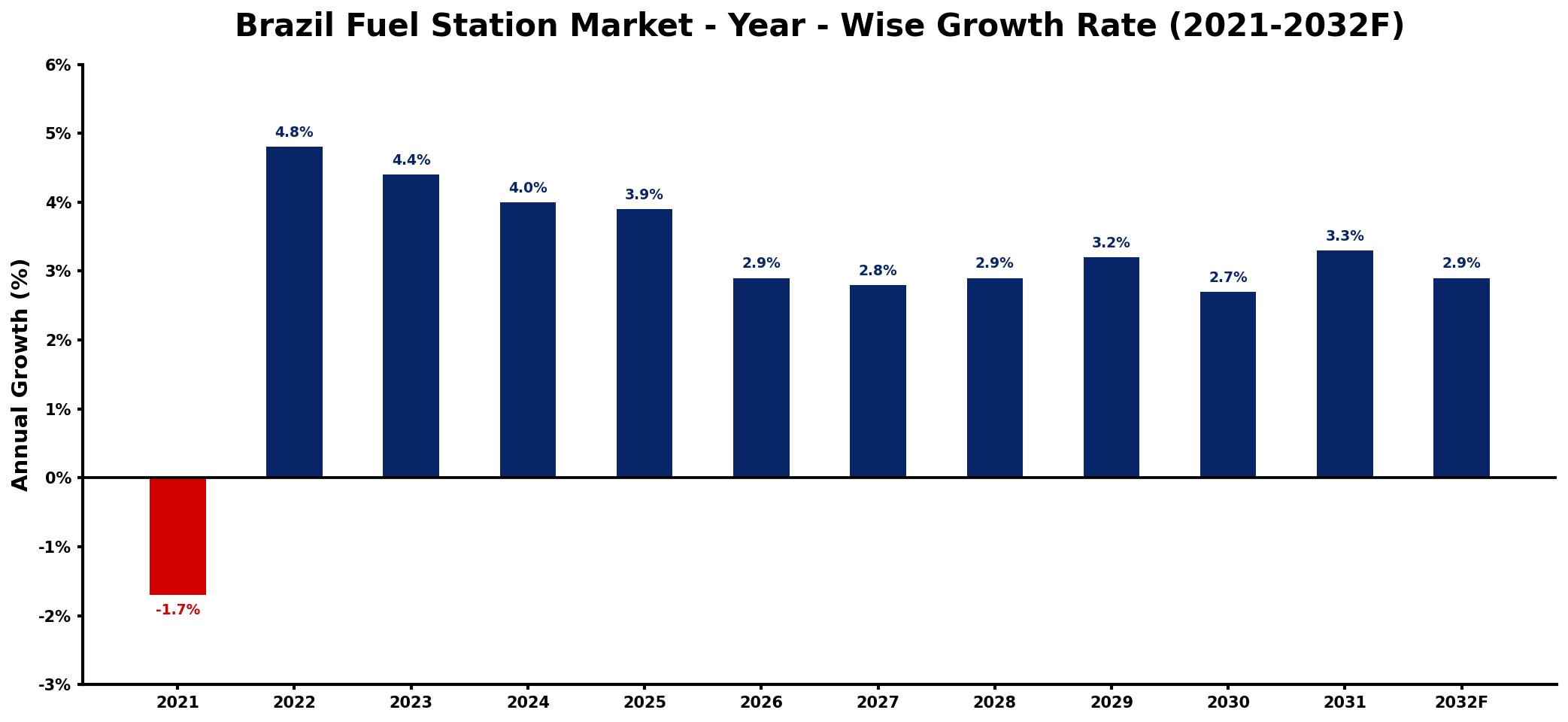
The table below presents the year‑wise growth rates along with the key drivers influencing the market
| Year | Growth Rate | Major Drivers |
| 2021 | -1.7% | decreased consumer travel activity |
| 2022 | 4.8% | rising consumer travel demand |
| 2023 | 4.4% | increased electric vehicle adoption |
| 2024 | 4.0% | expansion of renewable energy sources |
| 2025 | 3.9% | expanding healthcare application demand |
| 2026 | 2.9% | rising disposable income levels |
| 2027 | 2.8% | increase in logistics investments |
| 2028 | 2.9% | surge in tourism activities |
| 2029 | 3.2% | growing commercial sector adoption |
| 2030 | 2.7% | growing environmental awareness initiatives |
| 2031 | 3.3% | rising export shipment volumes |
| 2032 | 2.9% | increased government policy support |
Note: Market size estimations and growth projections presented in this report are based on 6Wresearch's proprietary forecasting methodology, utilizing the latest available industry data, government publications, and primary research inputs.
Brazil Fuel Station Market Synopsis
The Brazil Fuel Station Market has experienced a dynamic shift, adapting to the dual pressures of traditional fuel demand and emerging alternative energy solutions. As Brazil moves towards a more sustainable energy future, fuel stations are not merely sites for conventional fuel sales; they are evolving to become hubs for diverse energy options.
Looking forward, the market is set to navigate through significant transformations prompted by technological innovations and the rise of electric vehicles. This transition presents both opportunities for modernization and challenges for traditional fuel providers to maintain relevance.
Brazil Fuel Station Market Key Takeaways
- The market is poised for stable growth, influenced by infrastructural development and urbanization trends.
- Technological integration, especially in payment systems, is reshaping the customer experience at fuel stations.
- As electric vehicle adoption accelerates, the demand for alternative fuel options is becoming increasingly critical.
- Government policies are supportive of expanding accessibility and promoting fair competition among fuel providers.
- Competitive dynamics are intensifying as fuel stations diversify offerings to include renewable energy solutions.
Evaluation of Restraints in Brazil Fuel Station Market
Despite its growth potential, the Brazil Fuel Station Market faces significant restraints that could inhibit its progress. The rapid rise of electric vehicles challenges traditional fuel consumption patterns, forcing fuel stations to reconsider their operational strategies. Additionally, maintaining profitability while integrating alternative energy sources represents a complex challenge for many operators. The transition to a more sustainable energy framework may require substantial investment in new infrastructure and technology, which could strain financial resources. Furthermore, regional disparities in infrastructure development may also limit market reach in less urbanized areas, making comprehensive growth efforts more complicated.
Brazil Fuel Station Market Trends
Emerging trends in the Brazil Fuel Station Market are largely characterized by a shift towards sustainability and customer-centric innovations. The integration of eco-friendly fuel options, such as biofuels and hydrogen, is gaining traction among consumers. Additionally, digital solutions are becoming increasingly prevalent, enhancing the convenience and security of transactions. Fuel stations are also rethinking their layouts and services to accommodate diverse vehicle types, including electric and hybrid models, reflecting the changing landscape of transportation.
Brazil Fuel Station Market Opportunities
Investors and stakeholders in the Brazil Fuel Station Market are presented with significant growth opportunities as the demand for alternative energy solutions intensifies. The establishment of charging stations for electric vehicles can enhance the appeal and service range of existing fuel stations, attracting a new customer base. Furthermore, government initiatives aimed at expanding infrastructure into underserved regions offer potential avenues for expansion. As consumer preferences shift towards more sustainable energy consumption, fuel stations that can diversify their offerings stand to gain a competitive edge.
Government Initiatives in the Brazil Fuel Station Market
The Brazilian government has implemented various initiatives to support the fuel station market, focusing on infrastructure development and environmental sustainability. Policies promoting competition among fuel providers have been established to ensure fair pricing and access. Additionally, efforts are being made to enhance the network of fuel stations, particularly in remote and underserved areas. These initiatives are designed to facilitate greater access to fuel and alternative energy options, thus improving the efficiency of the country's fuel distribution system.
Future Insights of the Brazil Fuel Station Market
Between 2026 and 2032, the Brazil Fuel Station Market is expected to undergo significant transformations driven by technological advancements and shifts in consumer energy preferences. The increasing prevalence of electric vehicles will likely prompt fuel stations to adapt their services and infrastructure accordingly. As sustainability becomes a focal point in energy policy, fuel stations that invest in alternative energy solutions are positioned to thrive. This evolution will not only enhance service offerings but also redefine the role of fuel stations in Brazil's broader energy ecosystem.
Brazil Fuel Station Market Latest Developments (2025 - 2026)
Recent industry developments indicate a pronounced shift towards integrating alternative fuel sources into traditional fuel stations. Many operators are beginning to pilot electric vehicle charging stations alongside existing services, reflecting the market's responsiveness to changing consumer demands. Furthermore, there is a growing emphasis on enhancing digital payment options and consumer engagement technologies, which are anticipated to improve the overall customer experience in the upcoming years. Additionally, government regulatory efforts are increasingly focused on ensuring environmental compliance and safety standards across all fuel station operations.
Brazil Fuel Station Market - Key Attractiveness of the Report
- 10 Years of Market Numbers
- Historical Data Starting from 2022 to 2025
- Base Year: 2025
- Forecast Data until 2032
- Key Performance Indicators Impacting the Market
- Major Upcoming Developments and Projects
Key Highlights of the Report:
- Brazil Fuel Station Market Outlook
- Market Size of Brazil Fuel Station Market, 2025
- Forecast of Brazil Fuel Station Market, 2032
- Historical Data and Forecast of Brazil Fuel Station Revenues & Volume for the Period 2022-2032F
- Brazil Fuel Station Market Trend Evolution
- Brazil Fuel Station Market Drivers and Challenges
- Brazil Fuel Station Price Trends
- Brazil Fuel Station Porter's Five Forces
- Brazil Fuel Station Industry Life Cycle
- Historical Data and Forecast of Brazil Fuel Station Market Revenues & Volume By Fuel for the Period 2022-2032F
- Historical Data and Forecast of Brazil Fuel Station Market Revenues & Volume By Gasoline for the Period 2022-2032F
- Historical Data and Forecast of Brazil Fuel Station Market Revenues & Volume By Diesel for the Period 2022-2032F
- Historical Data and Forecast of Brazil Fuel Station Market Revenues & Volume By Gas for the Period 2022-2032F
- Historical Data and Forecast of Brazil Fuel Station Market Revenues & Volume By others for the Period 2022-2032F
- Historical Data and Forecast of Brazil Fuel Station Market Revenues & Volume By End-User for the Period 2022-2032F
- Historical Data and Forecast of Brazil Fuel Station Market Revenues & Volume By Road Transport Vehicles for the Period 2022-2032F
- Historical Data and Forecast of Brazil Fuel Station Market Revenues & Volume By Air Transport Vehicles for the Period 2022-2032F
- Historical Data and Forecast of Brazil Fuel Station Market Revenues & Volume By Water Transport Vehicles for the Period 2022-2032F
- Brazil Fuel Station Import Export Trade Statistics
- Market Opportunity Assessment By Fuel
- Market Opportunity Assessment By End-User
- Brazil Fuel Station Top Companies Market Share
- Brazil Fuel Station Competitive Benchmarking By Technical and Operational Parameters
- Brazil Fuel Station Company Profiles
- Brazil Fuel Station Key Strategic Recommendations






































