Brazil Gamification in Education Market Size & Growth Rate (2026-2032)
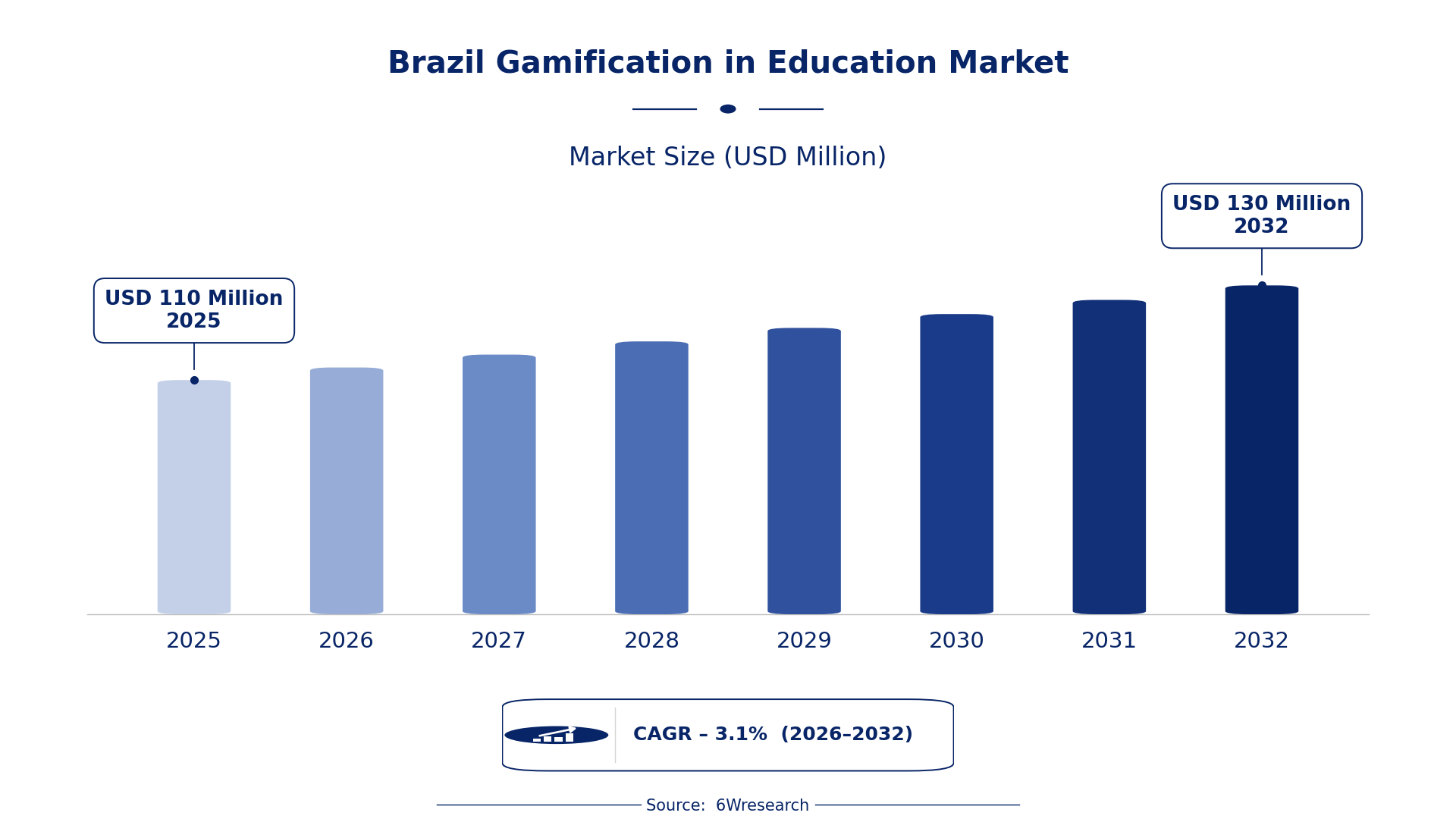
The Brazil Gamification in Education Market was estimated at USD 110 Million in 2025 and is projected to reach USD 130 Million by 2032, growing at a CAGR of 3.1% from 2026 to 2032.
Brazil Gamification in Education Market Synopsis
The drive towards innovative teaching methods is pushing Brazilian educators to adopt gamification as a way to improve student engagement and learning outcomes. The integration of gamified elements into educational curricula not only enriches the learning experience but also aligns with the digital transformation trends observed across various sectors in Brazil.
As the educational system evolves, the availability of gamification tools that cater specifically to local needs is becoming increasingly essential. This trend is supported by a growing awareness among educators of the benefits that gamification brings, including enhanced motivation, increased participation, and improved retention of knowledge among students.
Brazil Gamification in Education Market Year-wise Growth Rate and Key Drivers
This graph illustrates the annual growth rates of the Brazil Gamification in Education Market from 2021 to 2032, highlighting a steady upward trajectory and projected expansion over the forecast period.
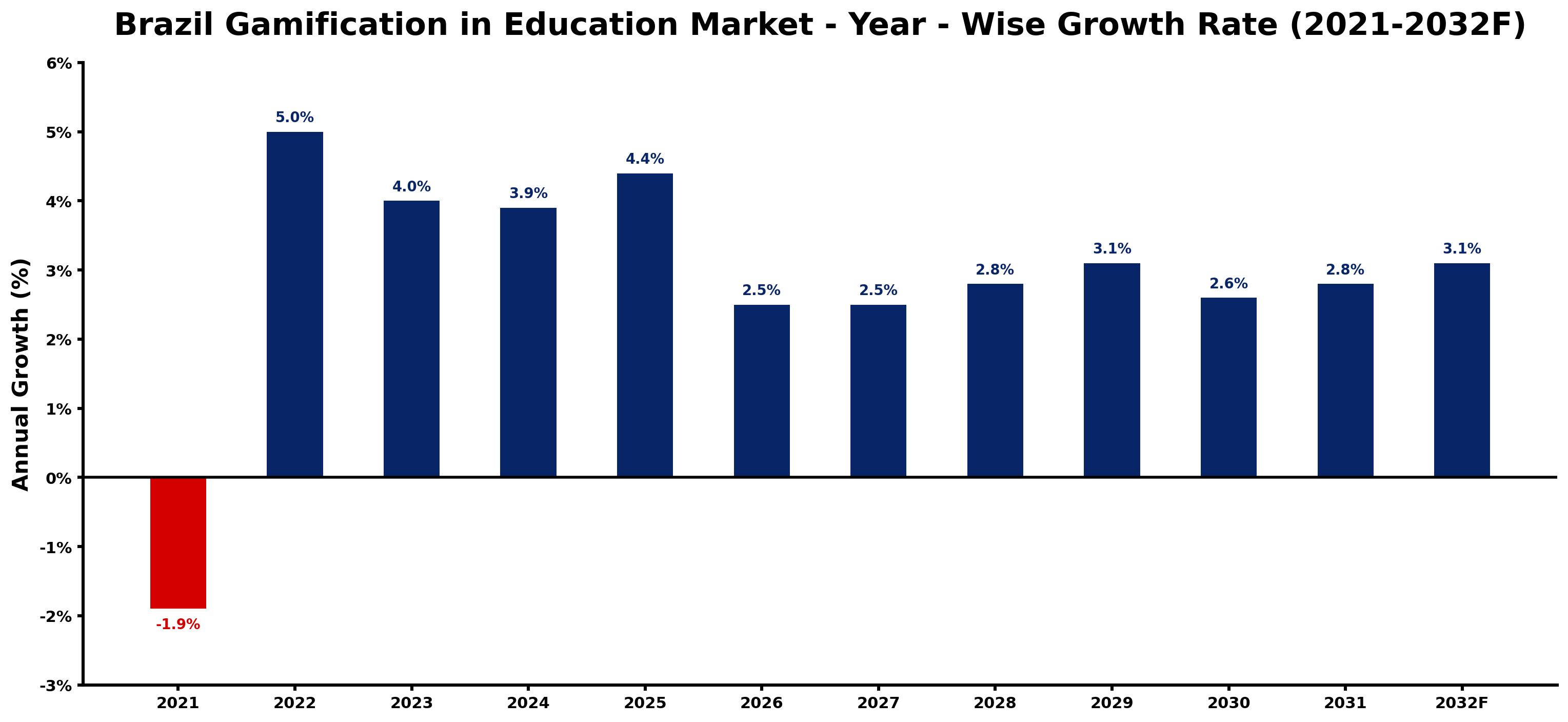
The table below presents the year‑wise growth rates along with the key drivers influencing the market
| Year | Growth Rate | Major Drivers |
| 2021 | -1.9% | Conservative education policies hindered gamification adoption. |
| 2022 | 5.0% | Investment in educational technology by Brazilian government |
| 2023 | 4.0% | Increase in remote learning adoption post-COVID-19 pandemic |
| 2024 | 3.9% | Growing interest in flexible learning through gamification methods |
| 2025 | 4.4% | Rise in digital literacy among Brazilian teachers and students |
| 2026 | 2.5% | Partnerships between schools and tech startups for gamified content |
| 2027 | 2.5% | Implementation of the National Education Plan encouraging innovation |
| 2028 | 2.8% | Increased availability of local gamification platforms for education |
| 2029 | 3.1% | Government grants promoting interactive learning tools in schools |
| 2030 | 2.6% | Surge in mobile device usage among Brazilian students |
| 2031 | 2.8% | Higher engagement levels reported in gamified classroom environments |
| 2032 | 3.1% | Recognition of gamification as a key educational strategy by MEC |
Note: Market size estimations and growth projections presented in this report are based on 6Wresearch's proprietary forecasting methodology, utilizing the latest available industry data, government publications, and primary research inputs.
Brazil Gamification in Education Market Key Takeaways
Below are some of the specific key takeaways from the market, including:
- Gamification is increasingly recognized as an effective method for enhancing student engagement in Brazil.
- The market is characterized by a shift towards integrating technology in classrooms to facilitate interactive learning experiences.
- Investments in gamified educational tools are expected to rise as institutions seek to modernize their teaching approaches.
- Brazilian educators are focusing on localizing content to better resonate with students, driving the demand for tailored gamification solutions.
- The government’s commitment to educational reform is propelling initiatives that support gamification adoption across schools.
Evaluation of Restraints in Brazil Gamification in Education Market
Despite its promising potential, the gamification market in Brazil faces notable restraints. One of the primary issues is the disparity in technological access among different regions, which hinders uniform adoption. Many educational institutions, particularly in rural areas, struggle with inadequate infrastructure, limiting their ability to integrate gamified learning solutions effectively. on top of that, resistance to change among some educators and administrative staff can slow the implementation process, as traditional teaching methods remain deeply entrenched in the educational culture.
Brazil Gamification in Education Market Trends
Several key trends are currently shaping the Brazil Gamification in Education Market. The rise of mobile learning platforms is making gamified educational tools more accessible, especially among younger demographics. Additionally, there is an increasing emphasis on data analytics in education, allowing educators to track student progress and tailor gamification strategies to meet individual learning needs. Collaborative learning environments are also gaining traction, promoting peer-to-peer interaction through gamified experiences.
Brazil Gamification in Education Market Opportunities
Opportunities for growth in the Brazil Gamification in Education Market are abundant. The increasing digitization of educational content presents a lucrative avenue for developers of gamification tools. on top of that, partnerships between educational institutions and technology providers can lead to innovative solutions that enhance interactive learning. As the government continues to prioritize educational improvements, funding opportunities for gamification initiatives are likely to expand, encouraging more institutions to invest in these transformative technologies.
Government Initiatives in the Brazil Gamification in Education Market
Government policy is playing a crucial role in shaping the Brazil Gamification in Education Market. The Brazilian government is actively promoting educational reforms that emphasize the integration of technology into learning environments. These initiatives are essential for ensuring that the educational system not only keeps pace with global trends but also meets the diverse needs of its student population.
- A national digital education strategy launched in early 2025 aims to increase access to technology in schools, fostering a more gamified learning environment.
- Currently, a pilot program is underway in select municipalities to evaluate the effectiveness of gamification tools in improving student performance.
- A planned initiative expected to roll out in 2026 will provide funding for schools to develop and implement customized gamification solutions.
- Recent policy changes have encouraged public-private partnerships to facilitate the development of educational technologies, including gamified platforms.
Future Insights of the Brazil Gamification in Education Market
Looking ahead to 2026-2032, the Brazil Gamification in Education Market is set to experience steady growth. Continued investment in educational technology and supportive government policies will likely drive the adoption of gamified learning solutions. As institutions become more adept at utilizing these tools, we can expect to see a shift in educational outcomes, with students benefitting from more engaging and personalized learning experiences. The future landscape will be defined by collaboration between educators, technologists, and policymakers, all working towards a common goal of enhancing education through gamification.
Brazil Gamification in Education Market Latest Developments
Recent activity in the Brazil Gamification in Education Market has highlighted a growing commitment to innovative educational practices. Over the past year, several key developments have emerged, indicating a vibrant and evolving market.
- A major technology vendor launched a new gamified learning platform in Q1 2025, designed to enhance student engagement in Brazilian classrooms.
- In mid-2025, an initiative was introduced that focuses on training teachers in the use of gamified tools, helping them integrate these methods into their teaching.
- A collaborative project between educational institutions and tech startups is currently underway, aiming to create localized gamified content tailored to Brazilian students.
- A rollout expected to begin in late 2026 will focus on expanding access to gamified learning resources in underserved regions.
Brazil Gamification in Education Market - Key Attractiveness of the Report
- 10 Years of Market Numbers
- Historical Data Starting from 2022 to 2025
- Base Year: 2025
- Forecast Data until 2032
- Key Performance Indicators Impacting the Market
- Major Upcoming Developments and Projects
Key Highlights of the Report:
- Brazil Gamification in Education Market Outlook
- Market Size of Brazil Gamification in Education Market, 2025
- Forecast of Brazil Gamification in Education Market, 2032
- Historical Data and Forecast of Brazil Gamification in Education Revenues & Volume for the Period 2022-2032F
- Brazil Gamification in Education Market Trend Evolution
- Brazil Gamification in Education Market Drivers and Challenges
- Brazil Gamification in Education Price Trends
- Brazil Gamification in Education Porter's Five Forces
- Brazil Gamification in Education Industry Life Cycle
- Historical Data and Forecast of Brazil Gamification in Education Market Revenues & Volume By Offering for the Period 2022-2032F
- Historical Data and Forecast of Brazil Gamification in Education Market Revenues & Volume By Software for the Period 2022-2032F
- Historical Data and Forecast of Brazil Gamification in Education Market Revenues & Volume By Services for the Period 2022-2032F
- Historical Data and Forecast of Brazil Gamification in Education Market Revenues & Volume By End User for the Period 2022-2032F
- Historical Data and Forecast of Brazil Gamification in Education Market Revenues & Volume By Academic for the Period 2022-2032F
- Historical Data and Forecast of Brazil Gamification in Education Market Revenues & Volume By Corporate Training for the Period 2022-2032F
- Historical Data and Forecast of Brazil Gamification in Education Market Revenues & Volume By Deployment Mode for the Period 2022-2032F
- Historical Data and Forecast of Brazil Gamification in Education Market Revenues & Volume By Cloud for the Period 2022-2032F
- Historical Data and Forecast of Brazil Gamification in Education Market Revenues & Volume By On-Premises for the Period 2022-2032F
- Brazil Gamification in Education Import Export Trade Statistics
- Market Opportunity Assessment By Offering
- Market Opportunity Assessment By End User
- Market Opportunity Assessment By Deployment Mode
- Brazil Gamification in Education Top Companies Market Share
- Brazil Gamification in Education Competitive Benchmarking By Technical and Operational Parameters
- Brazil Gamification in Education Company Profiles
- Brazil Gamification in Education Key Strategic Recommendations






































