Brazil Gamification Market Size, Share & Growth Rate
The Brazil Gamification Market was estimated at USD 86 Million in 2025 and is projected to reach USD 102 Million by 2032, growing at a CAGR of 2.5% from 2026 to 2032. This growth trajectory is propelled by an increasing recognition among Brazilian businesses of the importance of interactive experiences that not only enhance employee engagement but also drive customer loyalty. With the surge in digital transformation initiatives, organizations are adopting gamification as a strategic tool to create meaningful interactions.
Brazil Gamification Market Year-wise Growth Rate and Key Drivers
This graph highlights how the Brazil Gamification Market has steadily grown over the years, supported by major growth factors.
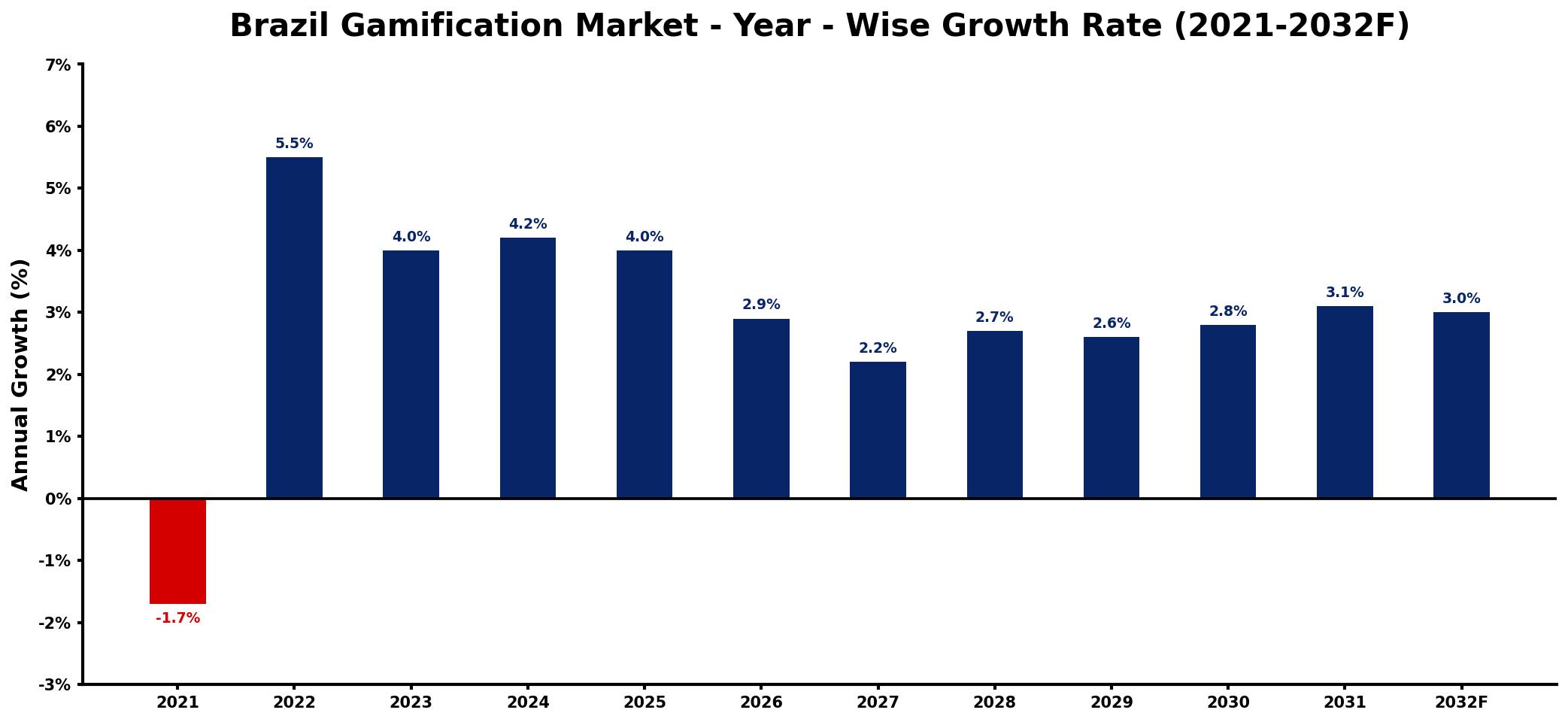
The table below presents the year‑wise growth rates along with the key drivers influencing the market
| Year | Growth Rate | Major Drivers |
| 2021 | -1.7% | decreased corporate training budgets |
| 2022 | 5.5% | increased mobile app adoption |
| 2023 | 4.0% | growing interest in e-learning |
| 2024 | 4.2% | expansion of loyalty programs |
| 2025 | 4.0% | rise in educational technology investments |
| 2026 | 2.9% | enhanced consumer engagement strategies |
| 2027 | 2.2% | broader application across industries |
| 2028 | 2.7% | increased focus on employee retention |
| 2029 | 2.6% | growth in remote work solutions |
| 2030 | 2.8% | enhanced digital marketing initiatives |
| 2031 | 3.1% | expanding industrial usage applications |
| 2032 | 3.0% | increased integration of AI technologies |
Note: Market size estimations and growth projections presented in this report are based on 6Wresearch's proprietary forecasting methodology, utilizing the latest available industry data, government publications, and primary research inputs.
Brazil Gamification Market Synopsis
In recent years, the Brazil Gamification market has witnessed significant momentum, as organizations embrace game-like strategies to captivate both customers and employees. This trend signals a shift from conventional methods toward innovative engagement techniques. Looking ahead, the market is poised for steady growth, driven by an evolving understanding of user engagement and the importance of tailored gamification strategies.
While the current enthusiasm presents vast opportunities, the future also demands strategic alignment with business objectives. Organizations must navigate the complexities of gamification design and implementation to leverage its full potential. The growing emphasis on data protection and ethical considerations will further shape how gamification solutions are developed and deployed in Brazil.
Brazil Gamification Market Key Takeaways
- The market is witnessing increased adoption of gamification strategies across various sectors, enhancing user engagement and interaction.
- Customization remains a key requirement, with businesses seeking tailored solutions that align with their specific goals and audiences.
- Measuring the effectiveness of gamification initiatives is critical for continuous improvement and justification of investments.
- Compliance with government regulations, particularly regarding data privacy, is essential for sustaining market growth.
- Emerging technologies are paving the way for innovative gamification solutions, further driving demand and engagement.
Evaluation of Restraints in Brazil Gamification Market
The Brazil Gamification Market faces several restraints that could temper its growth. One major concern is the challenge of designing effective gamification strategies that resonate with diverse target audiences. Many companies struggle to align these strategies with overarching business objectives, which can lead to underwhelming engagement outcomes. Additionally, measuring the effectiveness of gamified experiences remains a complex task, hindering organizations from demonstrating value and gaining buy-in from stakeholders. The ethical considerations surrounding gamification, particularly regarding user data and privacy, also pose significant challenges that organizations must navigate thoughtfully.
Brazil Gamification Market Trends
Currently, the Brazil Gamification Market is being shaped by trends that emphasize personalization and real-time feedback in gamified experiences. Businesses are increasingly leveraging data analytics to tailor gamification strategies to specific user preferences, thereby enhancing engagement. Furthermore, the integration of artificial intelligence and machine learning is enabling more dynamic and responsive gamification solutions, allowing for greater adaptability in user interactions. As organizations look to foster a culture of continuous learning and improvement, gamification is becoming an indispensable tool in employee training and development initiatives.
Brazil Gamification Market Opportunities
The potential for growth in the Brazil Gamification Market is substantial, particularly in sectors such as education, healthcare, and retail. As businesses in these industries seek innovative ways to drive engagement and improve outcomes, gamified solutions present a unique opportunity to differentiate themselves in a competitive landscape. Moreover, the rising demand for remote work and digital collaboration tools amplifies the need for effective gamification strategies that can enhance online participation and motivation. The intersection of gamification with emerging technologies like augmented reality (AR) and virtual reality (VR) also presents a frontier for new applications that can redefine user experiences.
Government Initiatives in the Brazil Gamification Market
In Brazil, government policies surrounding data protection and privacy are pivotal to the gamification market's development. Regulatory frameworks are evolving to ensure user privacy is maintained, particularly in digital applications. Moreover, public spending initiatives aimed at promoting digital transformation across various sectors encourage businesses to adopt innovative solutions, including gamification. As the government emphasizes the importance of ethical practices, market participants must remain vigilant in ensuring compliance while delivering engaging experiences.
Future Insights of the Brazil Gamification Market
Looking ahead to 2026-2032, the Brazil Gamification Market is expected to evolve significantly, driven by technological advancements and growing organizational awareness of gamification's potential. Companies will likely continue to refine their strategies to integrate gamification into their core processes, seeking to achieve both employee satisfaction and customer loyalty. The emphasis on personalization, real-time feedback, and adherence to regulatory standards will shape how gamification initiatives are implemented, fostering a more dynamic and responsive market environment.
Brazil Gamification Market Latest Developments (2025 - 2026)
Recent developments in the Brazil Gamification Market indicate a strong push toward integrating more sophisticated technologies into gamified solutions. Companies are increasingly investing in platforms that facilitate seamless interaction and engagement. Additionally, there is a noticeable trend toward collaborative gamification, where organizations are partnering to create shared experiences that enhance user involvement. As the market continues to mature, the focus will likely remain on balancing innovative engagement strategies with compliance to regulatory frameworks.
Brazil Gamification Market - Key Attractiveness of the Report
- 10 Years of Market Numbers
- Historical Data Starting from 2022 to 2025
- Base Year: 2025
- Forecast Data until 2032
- Key Performance Indicators Impacting the Market
- Major Upcoming Developments and Projects
Key Highlights of the Report:
- Brazil Gamification Market Outlook
- Market Size of Brazil Gamification Market, 2025
- Forecast of Brazil Gamification Market, 2032
- Historical Data and Forecast of Brazil Gamification Revenues & Volume for the Period 2022-2032F
- Brazil Gamification Market Trend Evolution
- Brazil Gamification Market Drivers and Challenges
- Brazil Gamification Price Trends
- Brazil Gamification Porter's Five Forces
- Brazil Gamification Industry Life Cycle
- Historical Data and Forecast of Brazil Gamification Market Revenues & Volume By Component for the Period 2022-2032F
- Historical Data and Forecast of Brazil Gamification Market Revenues & Volume By Solution for the Period 2022-2032F
- Historical Data and Forecast of Brazil Gamification Market Revenues & Volume By Services for the Period 2022-2032F
- Historical Data and Forecast of Brazil Gamification Market Revenues & Volume By Deployment for the Period 2022-2032F
- Historical Data and Forecast of Brazil Gamification Market Revenues & Volume By Cloud for the Period 2022-2032F
- Historical Data and Forecast of Brazil Gamification Market Revenues & Volume By On-premises for the Period 2022-2032F
- Historical Data and Forecast of Brazil Gamification Market Revenues & Volume By Organization Size for the Period 2022-2032F
- Historical Data and Forecast of Brazil Gamification Market Revenues & Volume By SMEs for the Period 2022-2032F
- Historical Data and Forecast of Brazil Gamification Market Revenues & Volume By Large Enterprises for the Period 2022-2032F
- Historical Data and Forecast of Brazil Gamification Market Revenues & Volume By End-User for the Period 2022-2032F
- Historical Data and Forecast of Brazil Gamification Market Revenues & Volume By Enterprise-Driven for the Period 2022-2032F
- Historical Data and Forecast of Brazil Gamification Market Revenues & Volume By Consumer-Driven for the Period 2022-2032F
- Brazil Gamification Import Export Trade Statistics
- Market Opportunity Assessment By Component
- Market Opportunity Assessment By Deployment
- Market Opportunity Assessment By Organization Size
- Market Opportunity Assessment By End-User
- Brazil Gamification Top Companies Market Share
- Brazil Gamification Competitive Benchmarking By Technical and Operational Parameters
- Brazil Gamification Company Profiles
- Brazil Gamification Key Strategic Recommendations






































