Peru Gamification Market Size, Share & Growth Rate
The Peru Gamification Market was estimated at USD 1107 Million in 2025 and is projected to reach USD 1619 Million by 2032, growing at a CAGR of 5.6% from 2026 to 2032. This trajectory is fueled by a rising awareness of gamification's potential benefits across diverse sectors, particularly in education and marketing, where engagement and retention are paramount. As technology evolves and becomes more integrated into daily operations, Peruvian businesses are increasingly adopting gamification to enhance user experiences and operational efficiency.
Peru Gamification Market Year-wise Growth Rate and Key Drivers
This graph highlights how the Peru Gamification Market has steadily grown over the years, supported by major growth factors.
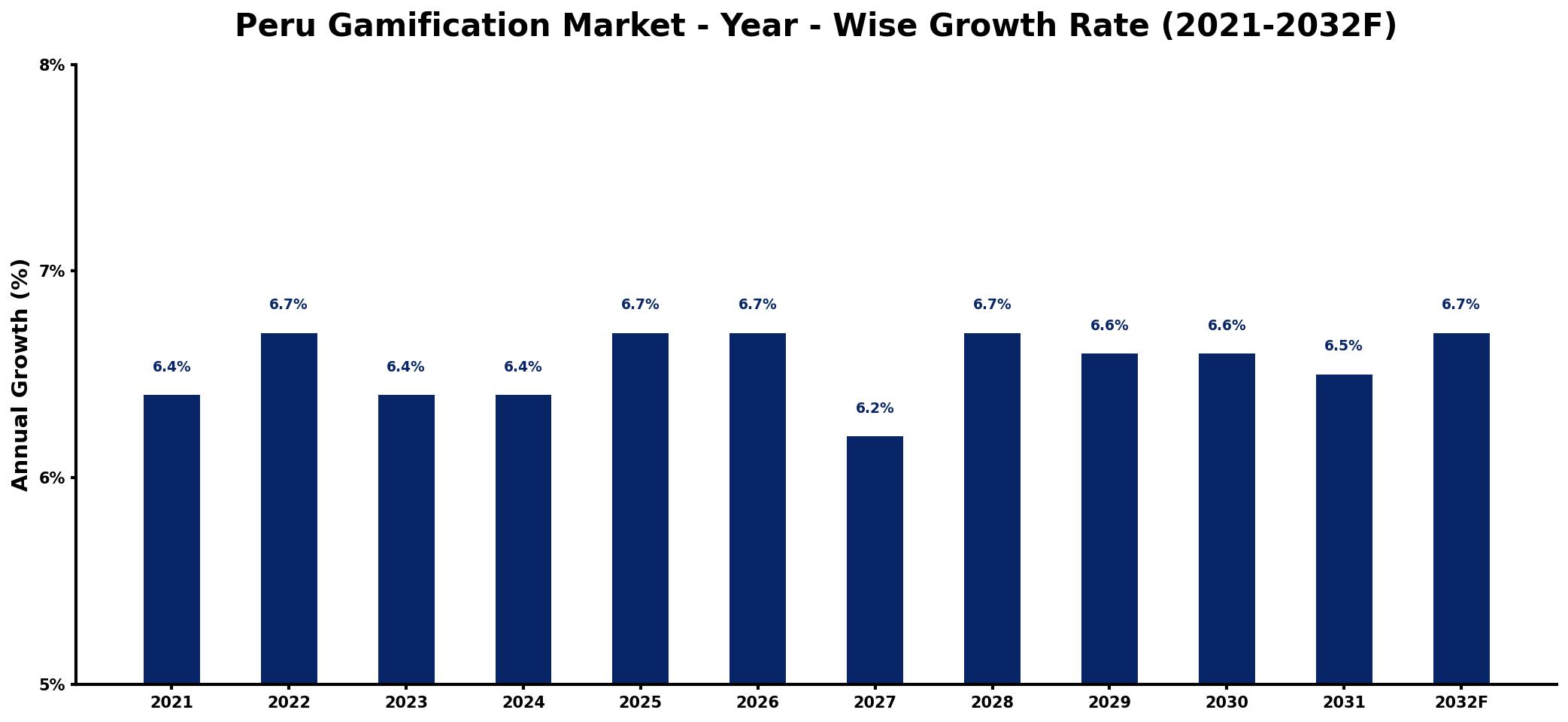
The table below presents the year‑wise growth rates along with the key drivers influencing the market
| Year | Growth Rate | Major Drivers |
| 2021 | 6.4% | Rising demand for digital engagement |
| 2022 | 6.7% | Increased investment in education technology |
| 2023 | 6.4% | Growth in mobile application usage |
| 2024 | 6.4% | Expansion of corporate training programs |
| 2025 | 6.7% | Emergence of new entertainment platforms |
| 2026 | 6.7% | Adoption of interactive marketing strategies |
| 2027 | 6.2% | Diversification of user engagement techniques |
| 2028 | 6.7% | increased domestic production output |
| 2029 | 6.6% | Focus on employee retention initiatives |
| 2030 | 6.6% | Enhancement of customer loyalty programs |
| 2031 | 6.5% | Development of personalized learning solutions |
| 2032 | 6.7% | Strengthening of community-building activities |
Note: Market size estimations and growth projections presented in this report are based on 6Wresearch's proprietary forecasting methodology, utilizing the latest available industry data, government publications, and primary research inputs.
Peru Gamification Market Synopsis
The current state of the Peru Gamification Market reflects an enthusiastic embrace of interactive solutions, particularly in fields like education and employee training. As organizations seek innovative ways to engage users, gamification strategies are emerging as indispensable tools that drive both participation and loyalty.
With a growing number of local and international vendors entering the market, companies are now presented with a diverse array of gamification platforms tailored to Peruvian needs. This evolution is reshaping how businesses approach customer engagement, transforming traditional methods into vibrant, gamified experiences that resonate with users.
Peru Gamification Market Key Takeaways
- The Peru Gamification Market is on a growth trajectory, driven by increasing applications across various sectors.
- Adoption of advanced technologies like augmented and virtual reality is enhancing the appeal of gamified solutions.
- Local businesses are becoming more aware of the benefits of gamification for employee training and marketing initiatives.
- Investment opportunities abound for innovative developers and startups focusing on gamified experiences.
- Educational institutions are increasingly implementing gamification to improve learning outcomes and engagement.
Evaluation of Restraints in Peru Gamification Market
Despite its promising growth, the Peru Gamification Market faces notable restraints that hinder broader adoption. Chief among these is the limited awareness of gamification's potential benefits, which can result in hesitance among businesses to incorporate these strategies into their operations. Furthermore, there is a pronounced shortage of professionals skilled in gamification design and implementation, creating obstacles for companies striving to effectively harness its power. Additionally, many organizations still perceive gamification as relevant only to niche sectors, which limits its application across a wider array of industries.
Peru Gamification Market Trends
The landscape of the Peru Gamification Market is shaped by current trends including the increasing demand for immersive experiences driven by mobile gaming and social media. Organizations are keen on incorporating game mechanics to foster better engagement, particularly in learning environments where retention of information is crucial. The rise of mobile devices also supports the shift toward more interactive solutions, as users expect accessibility and convenience. Furthermore, advancements in augmented reality and virtual reality are pushing the boundaries of how gamification is perceived, leading to innovative applications across various sectors.
Peru Gamification Market Opportunities
There are considerable opportunities for investment in the Peru Gamification Market, particularly in the realms of education, marketing, and employee training. Companies looking to enhance customer engagement and drive loyalty are increasingly recognizing the value of gamification solutions, leading to an influx of investment in e-learning platforms and engaging marketing campaigns. Additionally, the potential for gamified training programs tailored to local businesses presents a significant opportunity for growth, as companies seek effective methods to upskill their workforce. Local game development studios focused on innovative gamification solutions stand to benefit from this rising demand.
Government Initiatives in the Peru Gamification Market
While there are no specific government policies directly addressing the gamification market in Peru, various initiatives aimed at promoting technological innovation and entrepreneurship create a conducive environment for growth. The government supports technology startups through tax incentives and grants, while also working to enhance digital infrastructure and education. These efforts indirectly benefit the gamification sector by fostering a more tech-savvy populace capable of leveraging new technologies in business practices.
Future Insights of the Peru Gamification Market
Looking ahead to 2026-2032, the Peru Gamification Market is poised for substantial expansion as the awareness of gamification benefits continues to grow. Companies across various sectors, including healthcare and education, are likely to adopt gamification strategies to enhance user experiences and improve engagement. The increasing penetration of the internet and mobile technologies among the youth will further fuel demand for gamified solutions. Additionally, advancements in technologies such as augmented and virtual reality will present new avenues for gamification, encouraging innovation and differentiation in product offerings.
Peru Gamification Market Latest Developments (2025 - 2026)
Recent developments in the Peru Gamification Market have indicated a stronger shift towards integrating gamified elements within various business strategies. Companies are increasingly experimenting with gamification in training programs and customer loyalty initiatives, reflecting a growing recognition of its effectiveness. As digital tools evolve, there has been a marked rise in partnerships between educational institutions and technology firms, focusing on developing gamified learning modules. This trend is expected to continue, with more organizations exploring gamification as a fundamental component of their engagement strategies.
Peru Gamification Market - Key Attractiveness of the Report
- 10 Years of Market Numbers
- Historical Data Starting from 2022 to 2025
- Base Year: 2025
- Forecast Data until 2032
- Key Performance Indicators Impacting the Market
- Major Upcoming Developments and Projects
Key Highlights of the Report:
- Peru Gamification Market Outlook
- Market Size of Peru Gamification Market, 2025
- Forecast of Peru Gamification Market, 2032
- Historical Data and Forecast of Peru Gamification Revenues & Volume for the Period 2022-2032F
- Peru Gamification Market Trend Evolution
- Peru Gamification Market Drivers and Challenges
- Peru Gamification Price Trends
- Peru Gamification Porter's Five Forces
- Peru Gamification Industry Life Cycle
- Historical Data and Forecast of Peru Gamification Market Revenues & Volume By Component for the Period 2022-2032F
- Historical Data and Forecast of Peru Gamification Market Revenues & Volume By Solution for the Period 2022-2032F
- Historical Data and Forecast of Peru Gamification Market Revenues & Volume By Services for the Period 2022-2032F
- Historical Data and Forecast of Peru Gamification Market Revenues & Volume By Deployment for the Period 2022-2032F
- Historical Data and Forecast of Peru Gamification Market Revenues & Volume By Cloud for the Period 2022-2032F
- Historical Data and Forecast of Peru Gamification Market Revenues & Volume By On-premises for the Period 2022-2032F
- Historical Data and Forecast of Peru Gamification Market Revenues & Volume By Organization Size for the Period 2022-2032F
- Historical Data and Forecast of Peru Gamification Market Revenues & Volume By SMEs for the Period 2022-2032F
- Historical Data and Forecast of Peru Gamification Market Revenues & Volume By Large Enterprises for the Period 2022-2032F
- Historical Data and Forecast of Peru Gamification Market Revenues & Volume By End-User for the Period 2022-2032F
- Historical Data and Forecast of Peru Gamification Market Revenues & Volume By Enterprise-Driven for the Period 2022-2032F
- Historical Data and Forecast of Peru Gamification Market Revenues & Volume By Consumer-Driven for the Period 2022-2032F
- Peru Gamification Import Export Trade Statistics
- Market Opportunity Assessment By Component
- Market Opportunity Assessment By Deployment
- Market Opportunity Assessment By Organization Size
- Market Opportunity Assessment By End-User
- Peru Gamification Top Companies Market Share
- Peru Gamification Competitive Benchmarking By Technical and Operational Parameters
- Peru Gamification Company Profiles
- Peru Gamification Key Strategic Recommendations






































