Brazil Grape Wine Market Summary
The brazil grape wine market was estimated at USD 473 Million in 2025 and is projected to reach USD 567 Million by 2032, growing at a CAGR of 3.1% from 2026 to 2032.
Brazil Grape Wine Market Year-wise Growth Rate and Key Drivers
This graph highlights how the Brazil Grape Wine Market has steadily grown over the years, supported by major growth factors.
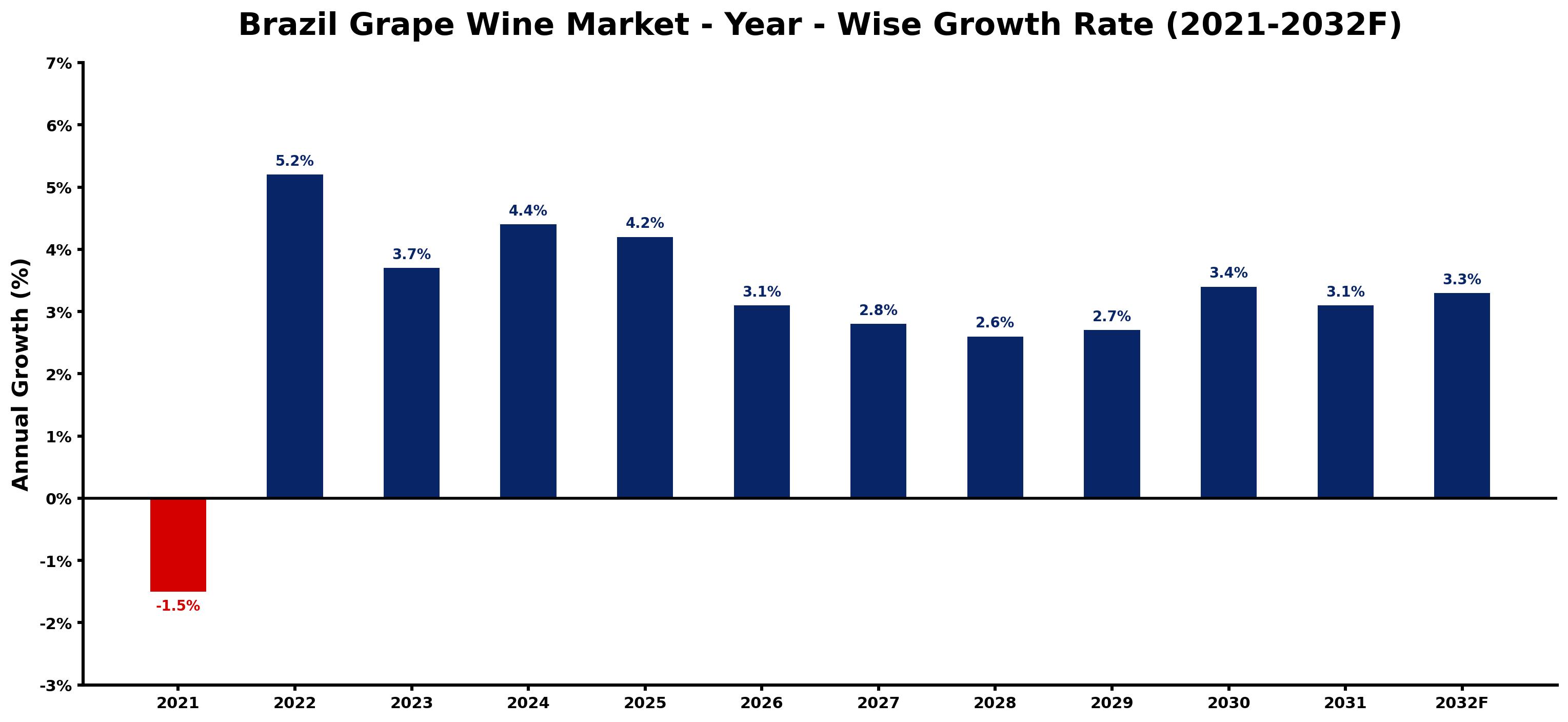
The table below presents the year wise growth rates along with the key drivers influencing the market
| Year | Growth Rate | Major Drivers |
| 2021 | -1.5% | Unfavorable weather conditions diminished grape yields, leading to reduced production and higher prices that deterred buyers. |
| 2022 | 5.2% | Emerging wineries leveraged social media for branding, captivating younger consumers effectively. |
| 2023 | 3.7% | Wine tourism expanded significantly, showcasing Brazil's diverse vineyards and unique terroirs. |
| 2024 | 4.4% | Sustainability practices gained traction, appealing to environmentally conscious wine drinkers. |
| 2025 | 4.2% | Collaborative projects between local wineries fostered innovation in unique grape varieties. |
| 2026 | 3.1% | Increased investments in bottling technology improved product quality and shelf life. |
| 2027 | 2.8% | Online retail channels thrived, making wine purchasing more convenient for consumers. |
| 2028 | 2.6% | Educational programs about wine appreciation flourished, enhancing consumer knowledge and interest. |
| 2029 | 2.7% | Greater export opportunities emerged, positioning Brazilian wine on the global stage. |
| 2030 | 3.4% | Domestic wine competitions encouraged quality improvements and recognition for local producers. |
| 2031 | 3.1% | Health-conscious trends shifted interest toward lower-alcohol and organic wine offerings. |
| 2032 | 3.3% | Culinary partnerships with local chefs highlighted wine pairings, boosting overall consumption rates. |
Note - Market size estimations and growth projections presented in this report are based on 6Wresearch's advanced forecasting approach, validated with industry datasets as of June 2026.
Brazil Grape Wine Market Synopsis
The Brazil Grape Wine Market is projected to reach 3.1% and witness significant growth during the forecast period (2026-2032). This growth is indicative of the nation's increasing appreciation for quality wines, a trend fueled by both local production and an influx of imports. The unique offerings from Brazilian vineyards are gaining recognition, reflecting a burgeoning wine culture that is becoming a notable part of the social fabric.
Brazil Grape Wine Market Growth Drivers
Several key factors are driving the growth of the Brazil Grape Wine Market. Firstly, the rise in disposable incomes has led to a greater demand for premium wines, both locally produced and imported. Brazilian consumers are becoming more discerning, seeking quality and unique flavor profiles. Secondly, the perception of wine as a celebratory beverage is further broadening the market, as consumers increasingly incorporate wine into their social occasions.
- The expansion of wine tourism in Brazil is a significant contributor to market growth, as more visitors are exploring local vineyards and wine regions.
- Changing consumer preferences toward diverse grape varieties are encouraging producers to innovate and diversify their offerings, appealing to a broader audience.
- There is a growing trend towards health consciousness, with many consumers acknowledging the potential health benefits of moderate wine consumption.
- Education initiatives and wine tasting events are promoting better understanding and appreciation of wine among Brazilian consumers.
- Social media and digital marketing campaigns are playing a pivotal role in influencing consumer choices, attracting a younger demographic to the wine category.
Brazil Grape Wine Market Challenges and Restraints
Despite the positive growth outlook, the Brazil Grape Wine Market faces certain challenges. Regulatory restrictions can impact vineyard management and wine production processes, sometimes limiting market potential. Furthermore, the market must contend with climate change, which poses risks to grape cultivation and may affect both the quality and quantity of wine produced.
- Competition from international wine producers can create pressures on local brands, necessitating a focus on quality and unique selling propositions.
- The changing preferences of consumers require constant adaptation from producers, which can strain resources and innovation capabilities.
- Economic fluctuations may influence disposable incomes and, consequently, the purchasing power of consumers regarding premium wines.
- Quality control remains critical; any lapse in standards can damage brand reputation and consumer trust.
- Logistical challenges in distribution and supply chain management are also present, affecting the availability of products across regions.
Brazil Grape Wine Market Government Investment and Initiatives
The Brazilian government has recognized the importance of the grape wine industry and has implemented several policies aimed at fostering growth. These initiatives focus on ensuring high standards of quality and safety in wine production, contributing to a more robust industry. Regulations surrounding vineyard management and production processes are in place to support sustainable practices, which enhance the market's reputation.
- Government initiatives are directed towards improving infrastructure in wine regions, which includes enhancing transportation networks for easier distribution.
- Public funding is being allocated to research and development in viticulture, helping producers adapt to climate challenges and improve crop yields.
- Educational programs aimed at consumers and producers are being supported to enhance understanding of wine quality and production techniques.
- The promotion of sustainable practices is a priority, with incentives for vineyards that adopt environmentally friendly methods.
- Regulatory frameworks are being refined to facilitate easier compliance for small and medium enterprises within the wine sector.
Brazil Grape Wine Market Latest Developments (May 2025 - June 2026)
Recent trends in the Brazil Grape Wine Market indicate a continuing shift towards premium offerings and innovative wine experiences. The market has seen an increase in wine tourism, with vineyard tours gaining popularity among both local and international visitors. In addition, there has been a noticeable uptick in the introduction of unique grape varieties as producers aim to differentiate themselves in an increasingly competitive market. Consumer engagement through social media platforms is enhancing brand visibility, while educational events are fostering a deeper appreciation for Brazilian wines. Regulatory support for sustainable practices is also becoming more pronounced, aligning with global trends towards environmentally conscious consumption.
Brazil Grape Wine Market - Key Attractiveness of the Report
- 10 Years of Market Numbers
- Historical Data Starting from 2022 to 2025
- Base Year: 2025
- Forecast Data until 2032
- Key Performance Indicators Impacting the Market
- Major Upcoming Developments and Projects
Key Highlights of the Report:
- Brazil Grape Wine Market Outlook
- Market Size of Brazil Grape Wine Market, 2025
- Forecast of Brazil Grape Wine Market, 2032
- Historical Data and Forecast of Brazil Grape Wine Revenues & Volume for the Period 2022-2032F
- Brazil Grape Wine Market Trend Evolution
- Brazil Grape Wine Market Drivers and Challenges
- Brazil Grape Wine Price Trends
- Brazil Grape Wine Porter's Five Forces
- Brazil Grape Wine Industry Life Cycle
- Historical Data and Forecast of Brazil Grape Wine Market Revenues & Volume By Type for the Period 2022-2032F
- Historical Data and Forecast of Brazil Grape Wine Market Revenues & Volume By Red Wine for the Period 2022-2032F
- Historical Data and Forecast of Brazil Grape Wine Market Revenues & Volume By White Wine for the Period 2022-2032F
- Historical Data and Forecast of Brazil Grape Wine Market Revenues & Volume By Rose Wine for the Period 2022-2032F
- Historical Data and Forecast of Brazil Grape Wine Market Revenues & Volume By Other for the Period 2022-2032F
- Historical Data and Forecast of Brazil Grape Wine Market Revenues & Volume By Applications for the Period 2022-2032F
- Historical Data and Forecast of Brazil Grape Wine Market Revenues & Volume By Commercial Consumption for the Period 2022-2032F
- Historical Data and Forecast of Brazil Grape Wine Market Revenues & Volume By Household Consumption for the Period 2022-2032F
- Historical Data and Forecast of Brazil Grape Wine Market Revenues & Volume By Other for the Period 2022-2032F
- Brazil Grape Wine Import Export Trade Statistics
- Market Opportunity Assessment By Type
- Market Opportunity Assessment By Applications
- Brazil Grape Wine Top Companies Market Share
- Brazil Grape Wine Competitive Benchmarking By Technical and Operational Parameters
- Brazil Grape Wine Company Profiles
- Brazil Grape Wine Key Strategic Recommendations






































