Brazil Greasy Wool Market Size, Share & Growth Rate
The Brazil Greasy Wool Market was estimated at USD 495 Million in 2025 and is projected to reach USD 594 Million by 2032, growing at a CAGR of 2.6% from 2026 to 2032. This upward trajectory is primarily fueled by the burgeoning textile and apparel sector in Brazil, which increasingly values natural fibers for their versatility and sustainability. Additionally, the nation's longstanding tradition of wool processing lends stability to the market, further driving demand.
Brazil Greasy Wool Market Year-wise Growth Rate and Key Drivers
This graph highlights how the Brazil Greasy Wool Market has steadily grown over the years, supported by major growth factors.
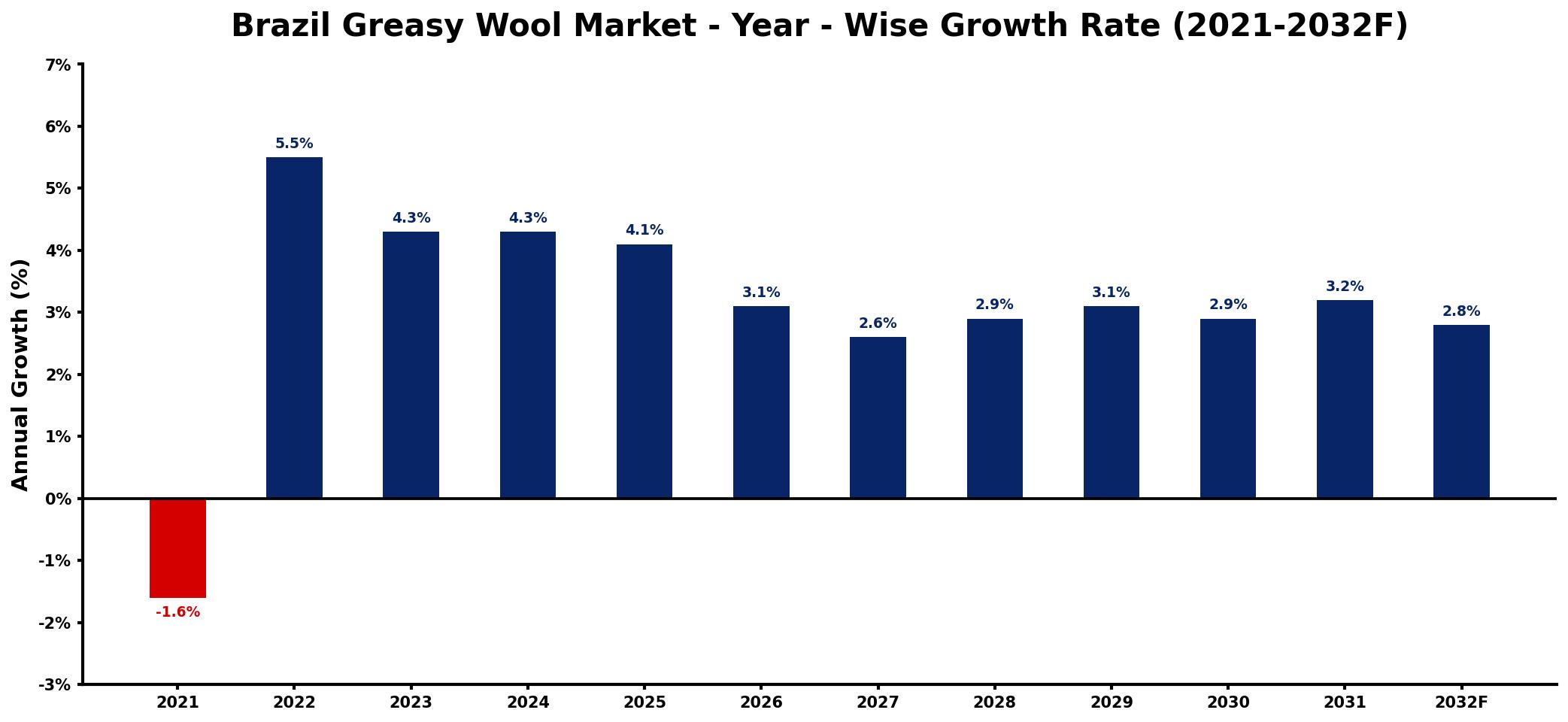
The table below presents the year‑wise growth rates along with the key drivers influencing the market
| Year | Growth Rate | Major Drivers |
| 2021 | -1.6% | decreased global textile demand |
| 2022 | 5.5% | increased domestic manufacturing capacity |
| 2023 | 4.3% | growing export market opportunities |
| 2024 | 4.3% | rising consumer interest sustainability |
| 2025 | 4.1% | expansion of e-commerce platforms |
| 2026 | 3.1% | enhanced supply chain efficiencies |
| 2027 | 2.6% | development of new applications |
| 2028 | 2.9% | strengthening international trade agreements |
| 2029 | 3.1% | increased investment in technology |
| 2030 | 2.9% | growing demand for natural fibers |
| 2031 | 3.2% | enhanced product quality standards |
| 2032 | 2.8% | rising awareness of eco-friendly products |
Note: Market size estimations and growth projections presented in this report are based on 6Wresearch's proprietary forecasting methodology, utilizing the latest available industry data, government publications, and primary research inputs.
Brazil Greasy Wool Market Synopsis
Despite recent momentum characterized by a revival in demand for natural textiles, the Brazil Greasy Wool market is poised for both challenges and opportunities. Factors such as fluctuating global wool prices and shifting consumer preferences are set against the backdrop of a resilient local processing infrastructure.
As the market progresses, stakeholders will need to balance traditional practices with modern sustainability demands. The rising consumer preference for environmentally friendly products may bolster the market, provided that producers adapt accordingly.
Brazil Greasy Wool Market Key Takeaways
- The market is significantly influenced by the growth of Brazil's textile industry, which emphasizes natural fibers.
- Quality standards and sustainable practices are becoming increasingly critical to maintaining market competitiveness.
- Global market fluctuations pose risks, yet they also create opportunities for innovation in production and processing.
- Government policies focusing on animal welfare and environmental impact are reshaping industry practices.
- Consumer demand for eco-friendly wool products is expected to drive future market growth.
Evaluation of Restraints in Brazil Greasy Wool Market
The Brazil Greasy Wool market is currently constrained by several key factors. Primarily, the volatility in international wool prices poses a significant challenge for local producers, making it difficult to ensure profitability amidst fluctuating demand. Furthermore, competition from synthetic fibers has intensified, compelling stakeholders to innovate and enhance the appeal of greasy wool. Environmental concerns regarding wool processing, including the industry's carbon footprint, are under increasing scrutiny, which calls for urgent improvements in production methodologies. Addressing these issues is vital for the sustained growth and acceptance of greasy wool products in both domestic and international markets.
Brazil Greasy Wool Market Trends
Several notable trends are shaping the Brazil Greasy Wool market. A heightened awareness of sustainability is pushing consumers towards natural fibers, prompting brands to emphasize ethical sourcing and environmentally friendly processing techniques. Additionally, technological advancements in wool processing are enhancing quality and reducing waste, thus improving overall production efficiency. The trend towards customized and artisanal wool products is also gaining traction, reflecting a broader shift in consumer preferences towards unique, high-quality offerings.
Brazil Greasy Wool Market Opportunities
The Brazil Greasy Wool market is ripe with opportunities for growth and investment. As sustainability continues to be a driving force, producers who invest in eco-friendly practices and technologies will likely capture a larger market share. There is also potential in expanding export markets, particularly to regions where demand for natural fibers is increasing. Collaborations between farmers and textile manufacturers can further create value-added products, enhancing the overall profitability of the greasy wool industry.
Government Initiatives in the Brazil Greasy Wool Market
In Brazil, government initiatives related to the greasy wool market are primarily focused on enhancing animal welfare standards and promoting sustainable farming practices. Policies aimed at reducing the environmental impact of wool production include guidelines for water usage and waste management. Additionally, government incentives for farmers adopting sustainable methods not only improve compliance but also enhance the overall market landscape, making Brazil more competitive in the global greasy wool market.
Future Insights of the Brazil Greasy Wool Market
Looking ahead to 2026-2032, the Brazil Greasy Wool market is expected to navigate a landscape marked by both challenges and opportunities. The continued integration of sustainability in production practices will likely be pivotal, as consumers increasingly prefer brands that prioritize eco-friendliness. Moreover, innovations in processing technology may further enhance product quality, setting Brazilian greasy wool apart in the international market. The interplay between traditional wool processing techniques and modern sustainability imperatives will shape the future dynamics of this essential market.
Brazil Greasy Wool Market Latest Developments (2025 - 2026)
In recent months, the Brazil Greasy Wool market has witnessed significant shifts as producers increasingly embrace sustainable practices. The focus on improving animal welfare standards is becoming more pronounced, driven by both consumer demand and regulatory requirements. Furthermore, advancements in processing technologies have emerged, aimed at reducing waste and enhancing product quality. As a result, stakeholders are better positioned to meet both domestic and international market demands effectively.
Brazil Greasy Wool Market - Key Attractiveness of the Report
- 10 Years of Market Numbers
- Historical Data Starting from 2022 to 2025
- Base Year: 2025
- Forecast Data until 2032
- Key Performance Indicators Impacting the Market
- Major Upcoming Developments and Projects
Key Highlights of the Report:
- Brazil Greasy Wool Market Outlook
- Market Size of Brazil Greasy Wool Market, 2025
- Forecast of Brazil Greasy Wool Market, 2032
- Historical Data and Forecast of Brazil Greasy Wool Revenues & Volume for the Period 2022-2032F
- Brazil Greasy Wool Market Trend Evolution
- Brazil Greasy Wool Market Drivers and Challenges
- Brazil Greasy Wool Price Trends
- Brazil Greasy Wool Porter's Five Forces
- Brazil Greasy Wool Industry Life Cycle
- Historical Data and Forecast of Brazil Greasy Wool Market Revenues & Volume By Application for the Period 2022-2032F
- Historical Data and Forecast of Brazil Greasy Wool Market Revenues & Volume By Apparel for the Period 2022-2032F
- Historical Data and Forecast of Brazil Greasy Wool Market Revenues & Volume By Sports for the Period 2022-2032F
- Historical Data and Forecast of Brazil Greasy Wool Market Revenues & Volume By Blazers for the Period 2022-2032F
- Historical Data and Forecast of Brazil Greasy Wool Market Revenues & Volume By Jacketing for the Period 2022-2032F
- Historical Data and Forecast of Brazil Greasy Wool Market Revenues & Volume By Others for the Period 2022-2032F
- Historical Data and Forecast of Brazil Greasy Wool Market Revenues & Volume By Upholstery Fabrics for the Period 2022-2032F
- Historical Data and Forecast of Brazil Greasy Wool Market Revenues & Volume By Blankets for the Period 2022-2032F
- Historical Data and Forecast of Brazil Apparel Greasy Wool Market Revenues & Volume By Flooring for the Period 2022-2032F
- Brazil Greasy Wool Import Export Trade Statistics
- Market Opportunity Assessment By Application
- Brazil Greasy Wool Top Companies Market Share
- Brazil Greasy Wool Competitive Benchmarking By Technical and Operational Parameters
- Brazil Greasy Wool Company Profiles
- Brazil Greasy Wool Key Strategic Recommendations






































