Brazil Groceries Market Summary
The brazil groceries market was estimated at USD 148 Million in 2025 and is projected to reach USD 175 Million by 2032, growing at a CAGR of 2.6% from 2026 to 2032.
Brazil Groceries Market Year-wise Growth Rate and Key Drivers
This graph highlights how the Brazil Groceries Market has steadily grown over the past five years, supported by major growth factors.
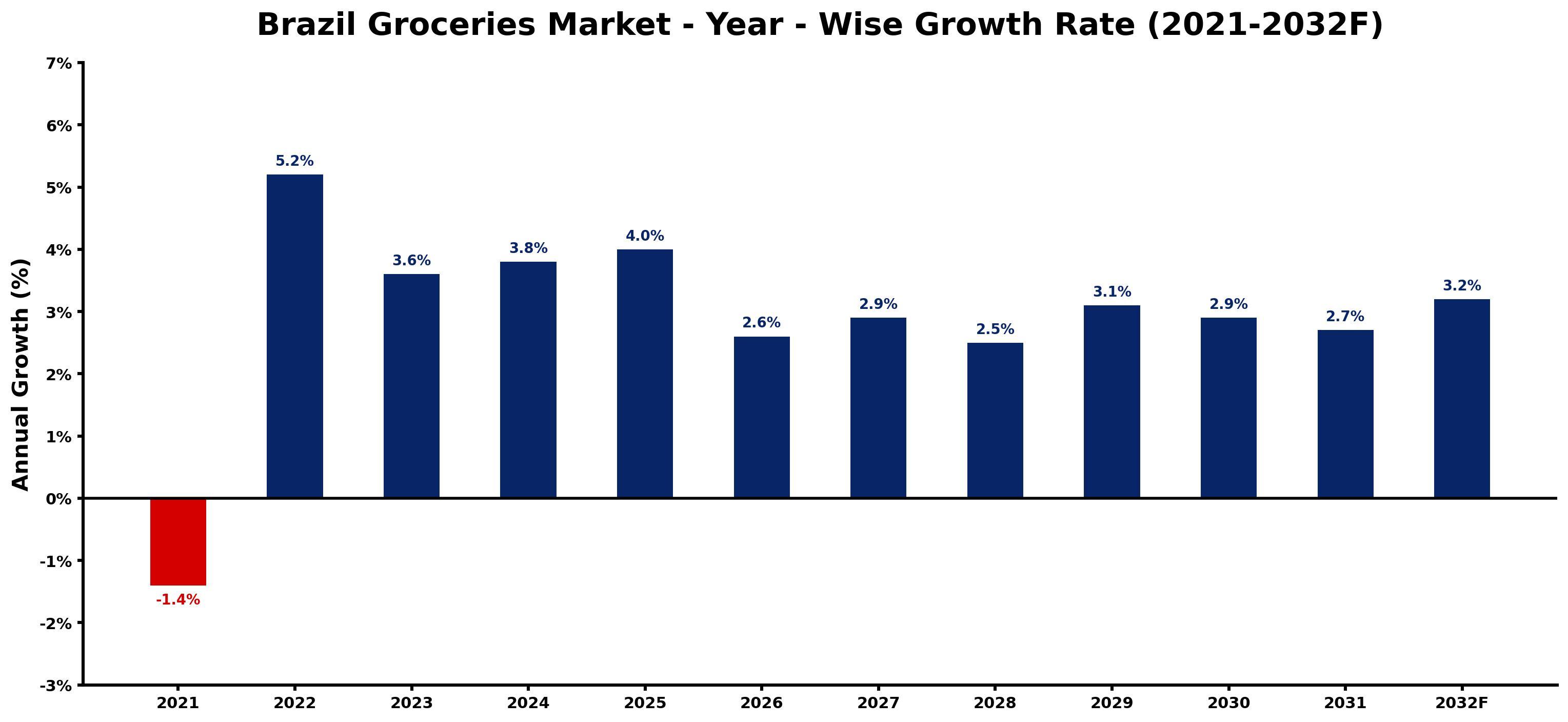
The table below presents the year wise growth rates along with the key drivers influencing the market
| Year | Growth Rate | Major Drivers |
| 2021 | -1.4% | Supply chain disruptions severely hindered product availability, leading to decreased consumer purchasing in the grocery sector. |
| 2022 | 5.2% | Local producers gained attention, influencing consumers toward organic and sustainable products. |
| 2023 | 3.6% | Rising urbanization rates necessitated efficient distribution channels in metropolitan areas. |
| 2024 | 3.8% | Shifts in consumer preferences emphasized healthier food options over processed alternatives. |
| 2025 | 4.0% | Technological integration streamlined supply chains, enhancing operational efficiencies in grocery stores. |
| 2026 | 2.6% | Economic recovery post-pandemic encouraged spending on premium grocery items. |
| 2027 | 2.9% | Younger demographics leaned towards online shopping, reshaping traditional grocery purchasing habits. |
| 2028 | 2.5% | Sustainability trends prompted retailers to offer more eco-friendly packaging solutions. |
| 2029 | 3.1% | Growing middle class fueled demand for diverse international grocery products. |
| 2030 | 2.9% | Local sourcing initiatives gained momentum, strengthening community ties and supporting farmers. |
| 2031 | 2.7% | Digital payment innovations transformed transactions, enhancing customer convenience and experience. |
| 2032 | 3.2% | Health crises heightened awareness of food safety, impacting purchasing criteria for groceries. |
Note - Market size estimations and growth projections presented in this report are based on 6Wresearch's advanced forecasting approach, validated with industry datasets as of June 2026.
Brazil Groceries Market Synopsis
The Brazil Groceries Market is projected to reach 2.6% and witness significant growth during the forecast period (2026-2032). This market exhibits a dynamic blend of traditional and contemporary elements, shaped by evolving consumer demands and lifestyle trends that influence grocery purchasing behavior. Increasing urbanization, along with a rising population, drives a fundamental transformation in the way consumers approach grocery shopping. E-commerce also plays a vital role, enhancing the shopping experience through improved accessibility and a wider variety of products.
Brazil Groceries Market Growth Drivers
Several key factors contribute to the growth of the Brazil Groceries Market. Firstly, population growth in urban areas leads to increased demand for diverse grocery options. Secondly, the popularity of e-commerce and online shopping platforms has fundamentally changed consumer purchasing habits, prompting traditional retailers to enhance their digital presence. Thirdly, there is a marked shift towards organic and health-conscious food choices, reflecting a broader trend towards healthier lifestyles among Brazilian consumers. Fourthly, the expansion of supermarket chains has provided consumers with greater access to both local and international groceries. Finally, innovations in supply chain management, such as improved logistics and inventory systems, are enabling retailers to meet consumer demand more efficiently.
Brazil Groceries Market Challenges and Restraints
Despite its growth potential, the Brazil Groceries Market faces notable challenges. Consumer preferences are becoming increasingly sophisticated, with a growing demand for organic and sustainable products that necessitate constant adaptation by retailers. Additionally, supply chain disruptions pose risks to product availability and pricing, particularly in times of natural disasters or economic fluctuations. Regulatory compliance remains another significant hurdle, particularly regarding food safety and labeling standards, which can complicate market dynamics. Companies must exhibit agility in their supply chain management to navigate these challenges effectively. Lastly, the competition from both traditional and emerging grocery platforms creates a need for continuous innovation and strategic differentiation.
Brazil Groceries Market Trends and Opportunities
The Brazil Groceries Market presents several emerging trends and opportunities for growth. One of the most significant trends is the increasing preference for health-oriented and organic products among consumers, which has created a lucrative market segment. The e-commerce boom continues to expand the reach of grocery retailers, allowing them to tap into previously underserved markets. Furthermore, technology adoption in supply chains, through automation and data analytics, is enhancing operational efficiencies and enabling retailers to better meet consumer expectations. Additionally, collaboration between grocery retailers and local farmers is strengthening supply chains and promoting sustainability, which resonates well with environmentally conscious consumers. All these factors signify a robust potential for companies to innovate and capture market share in the coming years.
Brazil Groceries Market Government Investment and Initiatives
Government policies play a crucial role in shaping the Brazil Groceries Market, focusing primarily on food safety and consumer protection. The Brazil Ministry of Agriculture oversees regulations that govern the production, labeling, and distribution of food products, ensuring compliance with safety standards. Public spending initiatives are aimed at improving infrastructure related to food distribution and logistics, which is essential for maintaining high-quality food supply chains. Additionally, the government promotes fair trade practices to benefit local producers, encouraging the consumption of locally sourced goods, which in turn supports regional economies. These policies are designed to safeguard public health while fostering a sustainable and resilient grocery sector.
Brazil Groceries Market Latest Developments (May 2025 - June 2026)
In the period from May 2025 to June 2026, the Brazil Groceries Market has observed several noteworthy developments. Retailers are increasingly investing in technology to enhance the online shopping experience, focusing on user-friendly interfaces and efficient delivery systems. Additionally, there is a marked increase in partnerships between grocery chains and local producers, aimed at offering fresher products while supporting community economies. The expansion of mobile payment systems has also simplified the buying process for consumers, leading to higher transaction volumes. Moreover, sustainability initiatives are gaining momentum, with an increasing number of retailers committing to environmentally friendly practices in packaging and sourcing. These trends point towards a more integrated and consumer-focused grocery market landscape.
Brazil Groceries Market - Key Attractiveness of the Report
- 10 Years of Market Numbers
- Historical Data Starting from 2022 to 2025
- Base Year: 2025
- Forecast Data until 2032
- Key Performance Indicators Impacting the Market
- Major Upcoming Developments and Projects
Key Highlights of the Report:
- Brazil Groceries Market Outlook
- Market Size of Brazil Groceries Market, 2025
- Forecast of Brazil Groceries Market, 2032
- Historical Data and Forecast of Brazil Groceries Revenues & Volume for the Period 2022-2032F
- Brazil Groceries Market Trend Evolution
- Brazil Groceries Market Drivers and Challenges
- Brazil Groceries Price Trends
- Brazil Groceries Porter's Five Forces
- Brazil Groceries Industry Life Cycle
- Historical Data and Forecast of Brazil Groceries Market Revenues & Volume By Product Types for the Period 2022-2032F
- Historical Data and Forecast of Brazil Groceries Market Revenues & Volume By Packaged Food for the Period 2022-2032F
- Historical Data and Forecast of Brazil Groceries Market Revenues & Volume By Unpackaged Food for the Period 2022-2032F
- Historical Data and Forecast of Brazil Groceries Market Revenues & Volume By Drinks for the Period 2022-2032F
- Historical Data and Forecast of Brazil Groceries Market Revenues & Volume By Tobacco for the Period 2022-2032F
- Historical Data and Forecast of Brazil Groceries Market Revenues & Volume By Household Products for the Period 2022-2032F
- Historical Data and Forecast of Brazil Groceries Market Revenues & Volume By Others for the Period 2022-2032F
- Historical Data and Forecast of Brazil Groceries Market Revenues & Volume By Distribution Channel for the Period 2022-2032F
- Historical Data and Forecast of Brazil Groceries Market Revenues & Volume By Supermarkets & Hypermarkets for the Period 2022-2032F
- Historical Data and Forecast of Brazil Groceries Market Revenues & Volume By Convenience Store for the Period 2022-2032F
- Historical Data and Forecast of Brazil Groceries Market Revenues & Volume By Online for the Period 2022-2032F
- Brazil Groceries Import Export Trade Statistics
- Market Opportunity Assessment By Product Types
- Market Opportunity Assessment By Distribution Channel
- Brazil Groceries Top Companies Market Share
- Brazil Groceries Competitive Benchmarking By Technical and Operational Parameters
- Brazil Groceries Company Profiles
- Brazil Groceries Key Strategic Recommendations






































