Brazil Guaifenesin Market Top 5 Importing Countries and Market Competition (HHI) Analysis
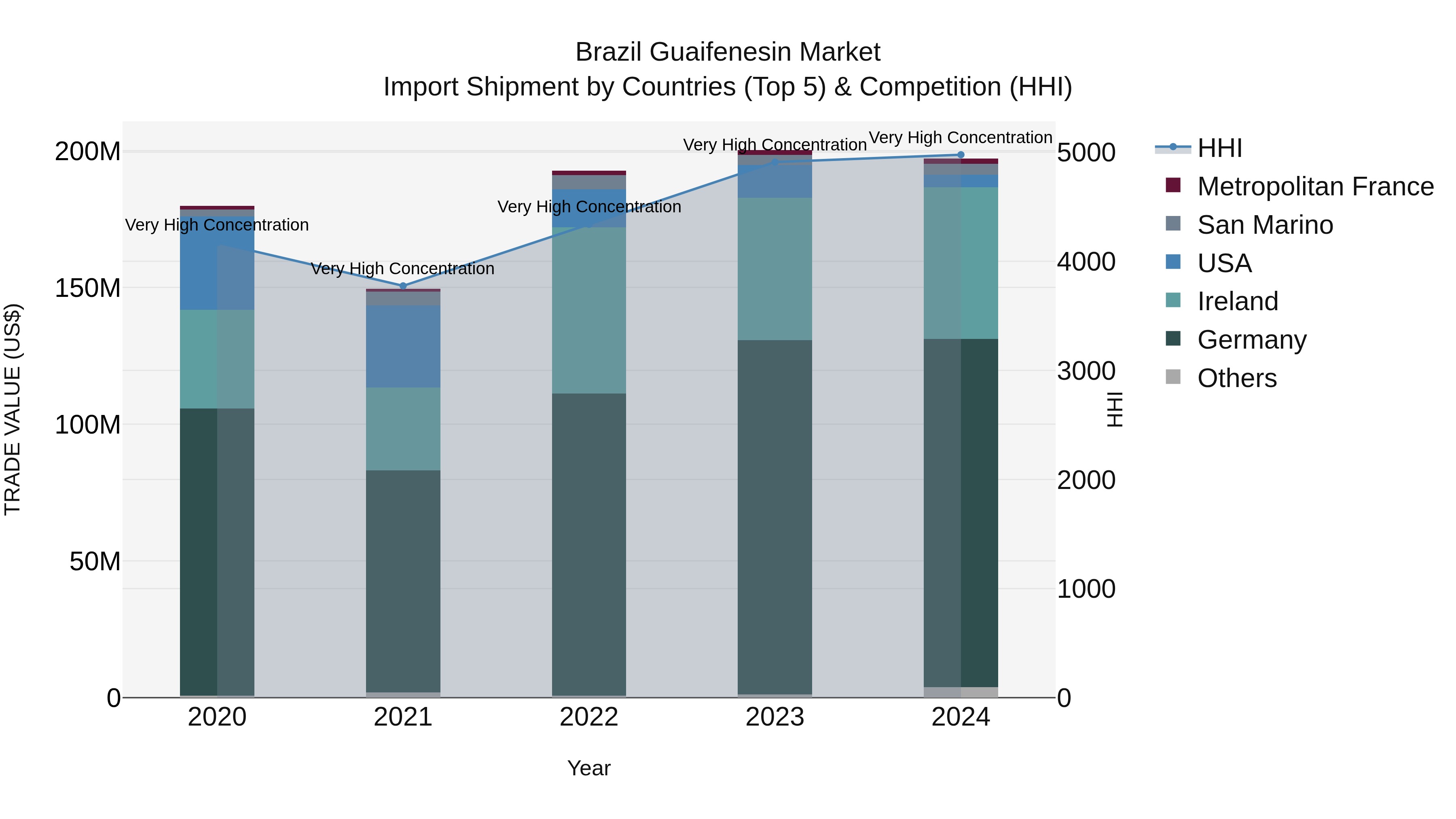
In 2024, Brazil continued to heavily rely on imports of guaifenesin, with top exporting countries being Germany, Ireland, USA, San Marino, and Italy. The market exhibited a high Herfindahl-Hirschman Index (HHI) concentration, indicating limited competition among suppliers. The compound annual growth rate (CAGR) from 2020 to 2024 stood at 2.32%, showcasing steady expansion. However, the growth rate witnessed a slight decline from 2023 to 2024 at -1.56%, suggesting a potential slowdown in import demand for guaifenesin in Brazil.
Brazil Guaifenesin Market Market Overview
The Brazil guaifenesin market is experiencing steady growth due to the increasing prevalence of respiratory disorders such as asthma, bronchitis, and COPD in the country. Guaifenesin, a commonly used expectorant, is in high demand for treating coughs and chest congestion associated with these conditions. The market is also benefiting from the rising awareness among consumers regarding the importance of respiratory health and the availability of over-the-counter guaifenesin products in pharmacies and drug stores. Key players in the Brazil guaifenesin market are focusing on product innovation, marketing strategies, and expanding distribution channels to cater to the growing demand. However, regulatory challenges and competition from alternative treatment options may present some obstacles to market growth in the coming years.
Brazil Guaifenesin Market Trends
The Brazil guaifenesin market is experiencing steady growth due to the increasing demand for expectorants and cough medications. Consumers are becoming more conscious of their health, leading to a rise in self-medication practices. There is also a growing prevalence of respiratory conditions such as asthma, bronchitis, and COPD, driving the need for guaifenesin-based products. Manufacturers are focusing on developing innovative formulations and flavors to cater to the preferences of different consumer segments. Additionally, the e-commerce boom in Brazil is providing a convenient platform for consumers to purchase guaifenesin products online, further boosting market growth. Overall, the Brazil guaifenesin market is expected to continue expanding as health awareness and respiratory issues remain prevalent among the population.
Brazil Guaifenesin Market Challenges
In the Brazil guaifenesin market, some key challenges include increasing competition from generic brands, pricing pressure due to the presence of low-cost alternatives, regulatory hurdles related to the approval and manufacturing of pharmaceutical products, and the need for continuous innovation to differentiate products and attract consumers. Additionally, fluctuations in currency exchange rates and economic instability can impact the overall market performance. Market players must navigate these challenges by investing in research and development, optimizing supply chain efficiency, and implementing effective marketing strategies to maintain a competitive edge in the Brazil guaifenesin market.
Brazil Guaifenesin Market Investment Opportunities
In the Brazil guaifenesin market, there are several investment opportunities to consider. One potential opportunity is to invest in pharmaceutical companies that manufacture and distribute guaifenesin-based products, as the demand for expectorants like guaifenesin is expected to remain steady due to the prevalent respiratory conditions in the region. Another option is to invest in the research and development of new formulations or delivery methods for guaifenesin to differentiate products in the market and cater to evolving consumer preferences. Additionally, investing in marketing and distribution channels to enhance product visibility and availability can also be a promising opportunity to capitalize on the growing health and wellness trends in Brazil. Overall, the Brazil guaifenesin market offers diverse investment opportunities for those looking to enter the pharmaceutical or healthcare sector in the country.
Brazil Guaifenesin Market Government Policy
The Brazilian government regulates the guaifenesin market through ANVISA (National Health Surveillance Agency), which oversees the registration, manufacturing, labeling, and advertising of guaifenesin products. ANVISA requires all guaifenesin medications to be registered before they can be marketed in Brazil, ensuring the products meet safety and efficacy standards. Additionally, the government controls the pricing of guaifenesin products through the Câmara de Regulação do Mercado de Medicamentos (CMED), which establishes maximum prices for pharmaceuticals in Brazil. These regulations aim to guarantee the quality and affordability of guaifenesin products in the Brazilian market, providing consumers with safe and effective options for treating respiratory conditions.
Brazil Guaifenesin Market Future Outlook
The future outlook for the Brazil guaifenesin market appears positive, with steady growth anticipated in the coming years. Factors driving this growth include the increasing prevalence of respiratory conditions such as coughs and colds, leading to a rising demand for over-the-counter medications like guaifenesin. Additionally, a growing awareness of the benefits of guaifenesin in relieving chest congestion and promoting respiratory health is expected to fuel market expansion. The market is also likely to benefit from ongoing product innovations, marketing efforts, and expanding distribution channels. Overall, with the consistent demand for respiratory remedies and the potential for product diversification, the Brazil guaifenesin market is poised for promising growth prospects in the foreseeable future.
Key Highlights of the Report:
- Brazil Guaifenesin Market Outlook
- Market Size of Brazil Guaifenesin Market,2024
- Forecast of Brazil Guaifenesin Market, 2031
- Historical Data and Forecast of Brazil Guaifenesin Revenues & Volume for the Period 2021-2031
- Brazil Guaifenesin Market Trend Evolution
- Brazil Guaifenesin Market Drivers and Challenges
- Brazil Guaifenesin Price Trends
- Brazil Guaifenesin Porter's Five Forces
- Brazil Guaifenesin Industry Life Cycle
- Historical Data and Forecast of Brazil Guaifenesin Market Revenues & Volume By Form for the Period 2021-2031
- Historical Data and Forecast of Brazil Guaifenesin Market Revenues & Volume By API (Active Pharmaceutical Ingredient) for the Period 2021-2031
- Historical Data and Forecast of Brazil Guaifenesin Market Revenues & Volume By Formulated Drugs for the Period 2021-2031
- Historical Data and Forecast of Brazil Guaifenesin Market Revenues & Volume By Bulk Powder for the Period 2021-2031
- Historical Data and Forecast of Brazil Guaifenesin Market Revenues & Volume By Purity Level for the Period 2021-2031
- Historical Data and Forecast of Brazil Guaifenesin Market Revenues & Volume By Above 99% for the Period 2021-2031
- Historical Data and Forecast of Brazil Guaifenesin Market Revenues & Volume By 95-99% for the Period 2021-2031
- Historical Data and Forecast of Brazil Guaifenesin Market Revenues & Volume By Below 95% for the Period 2021-2031
- Historical Data and Forecast of Brazil Guaifenesin Market Revenues & Volume By Application for the Period 2021-2031
- Historical Data and Forecast of Brazil Guaifenesin Market Revenues & Volume By Cough Syrups for the Period 2021-2031
- Historical Data and Forecast of Brazil Guaifenesin Market Revenues & Volume By Cold & Flu Medicines for the Period 2021-2031
- Historical Data and Forecast of Brazil Guaifenesin Market Revenues & Volume By Animal Healthcare for the Period 2021-2031
- Historical Data and Forecast of Brazil Guaifenesin Market Revenues & Volume By Industry for the Period 2021-2031
- Historical Data and Forecast of Brazil Guaifenesin Market Revenues & Volume By Healthcare for the Period 2021-2031
- Historical Data and Forecast of Brazil Guaifenesin Market Revenues & Volume By OTC & Prescription for the Period 2021-2031
- Historical Data and Forecast of Brazil Guaifenesin Market Revenues & Volume By Veterinary for the Period 2021-2031
- Historical Data and Forecast of Brazil Guaifenesin Market Revenues & Volume By Certification for the Period 2021-2031
- Historical Data and Forecast of Brazil Guaifenesin Market Revenues & Volume By FDA Approved for the Period 2021-2031
- Historical Data and Forecast of Brazil Guaifenesin Market Revenues & Volume By ISO 9001 for the Period 2021-2031
- Historical Data and Forecast of Brazil Guaifenesin Market Revenues & Volume By GMP Certified for the Period 2021-2031
- Brazil Guaifenesin Import Export Trade Statistics
- Market Opportunity Assessment By Form
- Market Opportunity Assessment By Purity Level
- Market Opportunity Assessment By Application
- Market Opportunity Assessment By Industry
- Market Opportunity Assessment By Certification
- Brazil Guaifenesin Top Companies Market Share
- Brazil Guaifenesin Competitive Benchmarking By Technical and Operational Parameters
- Brazil Guaifenesin Company Profiles
- Brazil Guaifenesin Key Strategic Recommendations






































