Brazil Hair Comb Market Size, Share & Growth Rate
The Brazil Hair Comb Market was estimated at USD 247 Million in 2025 and is projected to reach USD 340 Million by 2032, growing at a CAGR of 4.7% from 2026 to 2032. This robust growth trajectory is primarily driven by evolving personal grooming trends and a growing consumer emphasis on hair health. The increasing diversity of hair types and styling preferences among Brazilian consumers further fuels demand for various comb designs, sizes, and materials.
Brazil Hair Comb Market Year-wise Growth Rate and Key Drivers
This graph highlights how the Brazil Hair Comb Market has steadily grown over the years, supported by major growth factors.
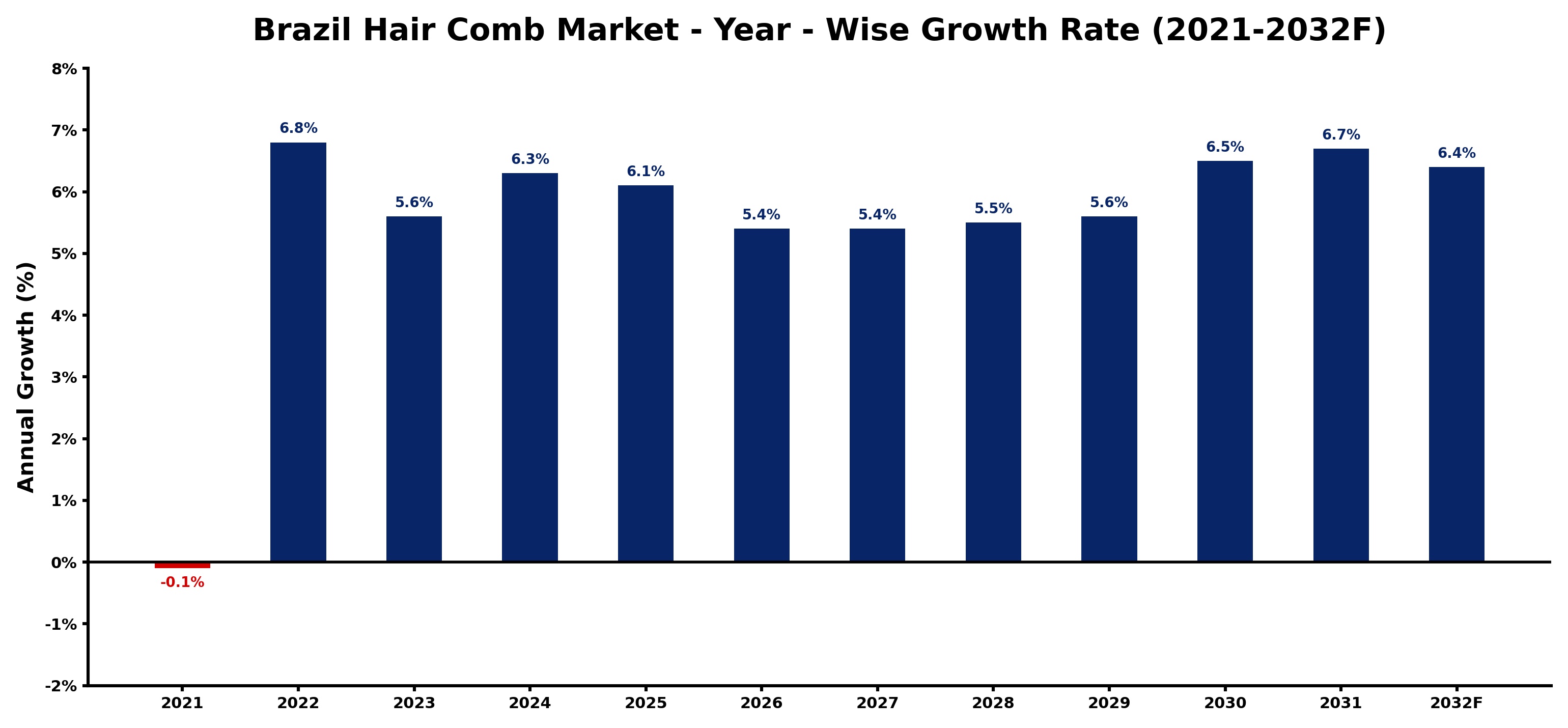
The table below presents the year‑wise growth rates along with the key drivers influencing the market
| Year | Growth Rate | Major Drivers |
| 2021 | -0.1% | Growing urbanization and commercial development |
| 2022 | 6.8% | Increasing smart city development projects |
| 2023 | 5.6% | Increasing industrial automation investments |
| 2024 | 6.3% | Increasing smart city development projects |
| 2025 | 6.1% | Expansion of transportation and logistics networks |
| 2026 | 5.4% | Rising electricity demand across industries |
| 2027 | 5.4% | Expansion of manufacturing activities |
| 2028 | 5.5% | Increasing smart city development projects |
| 2029 | 5.6% | Government infrastructure modernization initiatives |
| 2030 | 6.5% | Rapid growth in telecom and data center sectors |
| 2031 | 6.7% | Growing urbanization and commercial development |
| 2032 | 6.4% | Growing renewable energy integration projects |
Note - Market size estimations and growth projections presented in this report are based on 6Wresearch’s advanced forecasting approach, validated with industry datasets as of June 2026.
Brazil Hair Comb Market Synopsis
The Brazil Hair Comb Market has experienced a notable surge, primarily influenced by rising beauty consciousness and grooming habits among the population. However, as the market matures, it is anticipated to face challenges such as competition from alternative styling tools and shifting consumer preferences.
Looking ahead, the market is expected to embrace innovation in design and functionality, aligning with contemporary consumer values around sustainability and personalization. This momentum suggests a vibrant future, marked by opportunities for brands that can adapt swiftly to changing trends.
Brazil Hair Comb Market Key Takeaways
- The market shows steady growth driven by personal grooming habits and fashion influences.
- Consumer preferences are shifting towards eco-friendly and innovative comb designs.
- The diversity of hair types in Brazil creates a demand for specialized hair combs.
- Regulatory frameworks are ensuring safety and quality in consumer products.
- Brand differentiation remains essential amidst intense market competition.
Evaluation of Restraints in Brazil Hair Comb Market
Despite its growth potential, the Brazil Hair Comb Market faces significant restraints that could hinder its progress. One primary challenge is the presence of counterfeit products, which not only compromise consumer trust but also create pricing pressures for legitimate manufacturers. Additionally, the market's fragmented nature makes it challenging for brands to establish a distinct identity amid myriad options. Another concern lies in evolving consumer preferences; as trends shift rapidly, manufacturers must continuously innovate to stay relevant. Furthermore, environmental sustainability has emerged as a crucial factor, compelling companies to rethink materials and production processes to meet consumer expectations.
Brazil Hair Comb Market Trends
Current trends shaping the Brazil Hair Comb Market include an increasing preference for eco-friendly materials, such as bamboo and recycled plastics. Consumers are also gravitating towards multifunctional combs that facilitate both styling and detangling. Additionally, the rise of social media influencers promoting specific grooming routines has heightened awareness around hair care products, driving demand for stylish and functional hair combs. Personalized grooming experiences are becoming paramount, with brands focusing on designs that cater to specific hair types and styling needs.
Brazil Hair Comb Market Opportunities
The Brazil Hair Comb Market holds considerable growth opportunities, particularly in the realm of innovation and sustainability. Companies that invest in research and development can capitalize on emerging trends by creating unique, eco-friendly combs. Furthermore, expansion into untapped rural markets, where grooming habits are evolving, presents a significant avenue for growth. Collaboration with beauty salons and influencers can also enhance brand visibility and reach, fostering consumer engagement and driving sales.
Government Initiatives in the Brazil Hair Comb Market
Government policies in Brazil play a vital role in shaping the hair comb market. Regulations surrounding consumer product safety and quality standards ensure that hair combs are manufactured using safe materials and adhere to specified design parameters. Initiatives aimed at promoting local manufacturing and import regulations help protect consumers from subpar products while encouraging innovation within the domestic market. Furthermore, labeling and packaging regulations are enforced to enhance transparency and consumer awareness regarding product ingredients and safety.
Future Insights of the Brazil Hair Comb Market
From 2026 to 2032, the Brazil Hair Comb Market is expected to evolve significantly, driven by technological advancements and changing consumer expectations. A rising interest in personalized beauty solutions is likely to pave the way for niche product offerings that cater to specific hair types and preferences. Moreover, as sustainability becomes increasingly important, brands will likely pivot towards greener production methods, impacting product development. The integration of digital platforms for marketing and sales will further shape consumer interactions, creating a more dynamic and responsive market environment.
Brazil Hair Comb Market Latest Developments (May 2025 - June 2026)
Recently, the Brazil Hair Comb Market has seen a surge in new product launches, particularly those focusing on eco-friendly materials and designs. Brands are increasingly embracing digital marketing strategies, leveraging social media to engage with consumers and showcase innovative hair grooming solutions. Additionally, collaborations with local influencers have proven effective in boosting brand awareness and consumer trust. This period has also witnessed heightened regulatory scrutiny on product safety and quality, compelling manufacturers to align closely with government standards.
Brazil Hair Comb Market - Key Attractiveness of the Report
- 10 Years of Market Numbers
- Historical Data Starting from 2022 to 2025
- Base Year: 2025
- Forecast Data until 2032
- Key Performance Indicators Impacting the Market
- Major Upcoming Developments and Projects
Key Highlights of the Report:
- Brazil Hair Comb Market Outlook
- Market Size of Brazil Hair Comb Market, 2025
- Forecast of Brazil Hair Comb Market, 2032
- Historical Data and Forecast of Brazil Hair Comb Revenues & Volume for the Period 2022-2032F
- Brazil Hair Comb Market Trend Evolution
- Brazil Hair Comb Market Drivers and Challenges
- Brazil Hair Comb Price Trends
- Brazil Hair Comb Porter's Five Forces
- Brazil Hair Comb Industry Life Cycle
- Historical Data and Forecast of Brazil Hair Comb Market Revenues & Volume By Product Type for the Period 2022-2032F
- Historical Data and Forecast of Brazil Hair Comb Market Revenues & Volume By Natural Bristle Combs for the Period 2022-2032F
- Historical Data and Forecast of Brazil Hair Comb Market Revenues & Volume By Synthetic Bristle Combs for the Period 2022-2032F
- Historical Data and Forecast of Brazil Hair Comb Market Revenues & Volume By Mixed Bristle Combs for the Period 2022-2032F
- Historical Data and Forecast of Brazil Hair Comb Market Revenues & Volume By Applications for the Period 2022-2032F
- Historical Data and Forecast of Brazil Hair Comb Market Revenues & Volume By Human Use for the Period 2022-2032F
- Historical Data and Forecast of Brazil Hair Comb Market Revenues & Volume By Animal Use for the Period 2022-2032F
- Brazil Hair Comb Import Export Trade Statistics
- Market Opportunity Assessment By Product Type
- Market Opportunity Assessment By Applications
- Brazil Hair Comb Top Companies Market Share
- Brazil Hair Comb Competitive Benchmarking By Technical and Operational Parameters
- Brazil Hair Comb Company Profiles
- Brazil Hair Comb Key Strategic Recommendations






































