Brazil Hair Curlers Market Size, Share & Growth Rate
The Brazil Hair Curlers Market was estimated at USD 171 Million in 2025 and is projected to reach USD 234 Million by 2032, growing at a CAGR of 4.6% from 2026 to 2032. This growth trajectory is driven by the increasing number of fashion-conscious consumers and the rising influence of beauty influencers who promote diverse styling solutions. Additionally, as consumers seek ease and versatility in their hairstyling routines, demand for modern curling technologies continues to expand.
Brazil Hair Curlers Market Year-wise Growth Rate and Key Drivers
This graph highlights how the Brazil Hair Curlers Market has steadily grown over the years, supported by major growth factors.
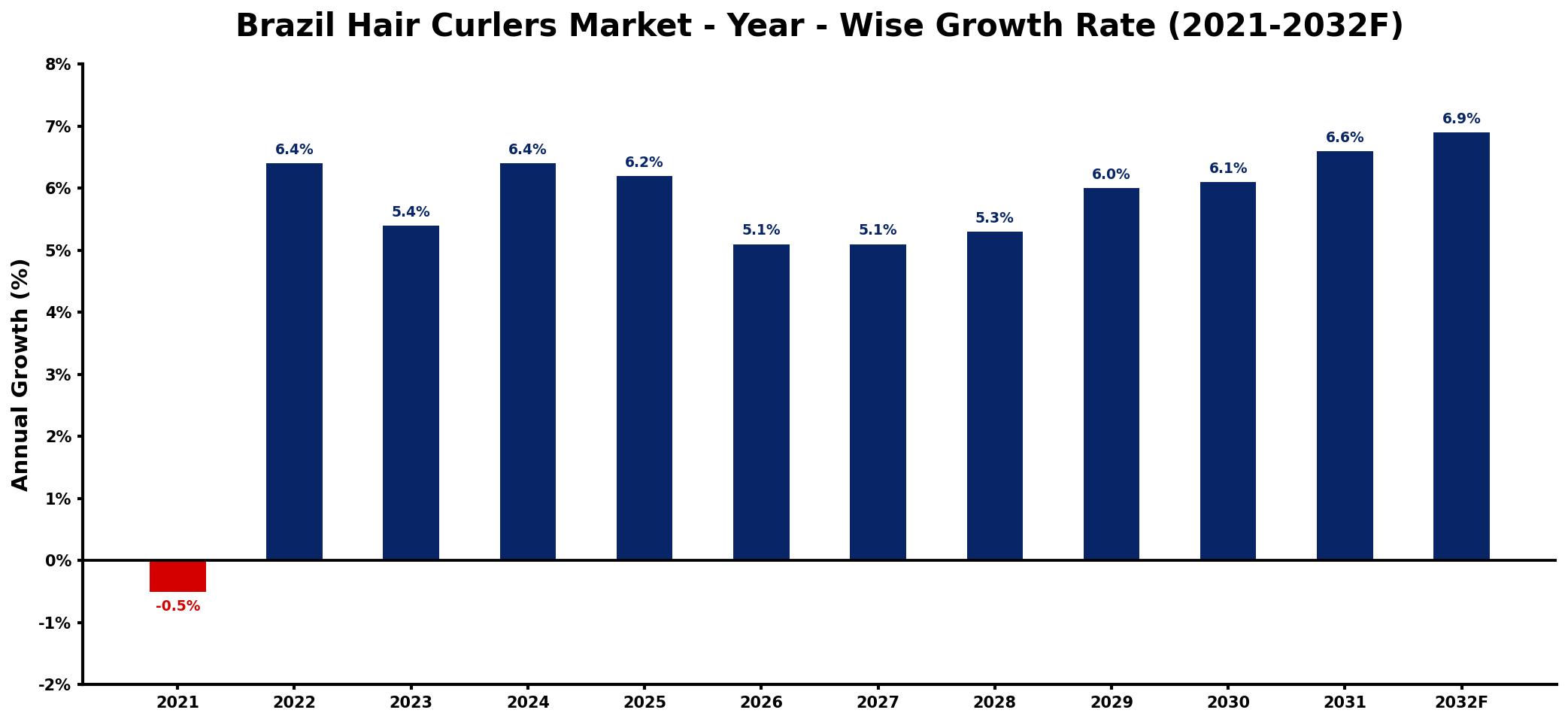
The table below presents the year‑wise growth rates along with the key drivers influencing the market
| Year | Growth Rate | Major Drivers |
| 2021 | -0.5% | decreased consumer spending on beauty |
| 2022 | 6.4% | increased demand for styling tools |
| 2023 | 5.4% | growing popularity of home styling |
| 2024 | 6.4% | rise in online beauty sales |
| 2025 | 6.2% | expansion of beauty retail channels |
| 2026 | 5.1% | increased investment in beauty technology |
| 2027 | 5.1% | growth in social media influence |
| 2028 | 5.3% | surge in beauty subscription services |
| 2029 | 6.0% | enhanced focus on personal care |
| 2030 | 6.1% | rising trend of personalized beauty |
| 2031 | 6.6% | growing commercial sector adoption |
| 2032 | 6.9% | increase in beauty influencer partnerships |
Note: Market size estimations and growth projections presented in this report are based on 6Wresearch's proprietary forecasting methodology, utilizing the latest available industry data, government publications, and primary research inputs.
Brazil Hair Curlers Market Synopsis
The strongest force currently shaping the Brazil Hair Curlers Market is the growing preference for convenient and effective styling tools among consumers. This demand is further intensified by the dynamic nature of fashion trends, pushing brands to innovate and diversify their product offerings to cater to various hairstyle preferences.
Moreover, the substantial impact of social media and beauty influencers cannot be overstated, as they significantly sway consumer purchasing decisions. As such, the Brazilian market is experiencing a surge in demand for hair curlers that are not only user-friendly but also minimize potential hair damage.
Brazil Hair Curlers Market Key Takeaways
- Technological advancements are enhancing user experience in hair curling devices.
- Consumer demand is increasingly leaning towards damage-free styling options.
- Fashion trends heavily influence consumer preferences and purchasing behavior.
- The role of beauty salons continues to shape market dynamics and consumer choices.
- Regulatory oversight ensures product safety and quality standards in the market.
Evaluation of Restraints in Brazil Hair Curlers Market
While the Brazil Hair Curlers Market is poised for growth, it faces significant restraints that may hinder its potential. A primary concern is the consumer awareness surrounding the risks associated with frequent use of curling products, particularly regarding hair damage. Many users may not fully understand the importance of proper usage and care, which can limit their willingness to invest in premium products. Furthermore, competition from alternative hairstyling solutions, such as straighteners and natural styling methods, poses a threat to market expansion. Economic fluctuations also play a role, as they directly influence consumer spending habits in beauty and personal care.
Brazil Hair Curlers Market Trends
Currently, the Brazil Hair Curlers Market is experiencing trends characterized by an increasing integration of technology in styling tools. Heated styling devices equipped with advanced features, such as smart temperature control and rapid heating capabilities, are gaining popularity. Additionally, the focus on sustainability is driving brands to innovate and create eco-friendly curling products using sustainable materials. As the demand for more customizable styling experiences grows, manufacturers are likely to continue exploring innovations that cater to individual consumer needs.
Brazil Hair Curlers Market Opportunities
Significant growth opportunities in the Brazil Hair Curlers Market lie in the development of products that emphasize ease of use and hair health. Brands that can successfully merge innovative technology with user-friendly design are well-positioned to capture the interest of consumers seeking efficiency without compromising hair integrity. Furthermore, expanding online distribution channels and engaging with beauty influencers can enhance brand visibility and drive sales, opening doors for both established brands and new entrants into the market.
Government Initiatives in the Brazil Hair Curlers Market
Government policies relevant to the Brazil Hair Curlers Market primarily focus on consumer safety and product quality. Regulatory bodies such as ANVISA are likely to enforce strict standards regarding the materials utilized in hair curlers, ensuring that they comply with health and safety regulations. Furthermore, government initiatives may promote consumer awareness campaigns regarding proper usage and care for hair styling tools, aiming to reduce potential risks associated with hair damage.
Future Insights of the Brazil Hair Curlers Market
Looking ahead to 2026-2032, the Brazil Hair Curlers Market is expected to continue its growth trajectory fueled by innovative product offerings and a strong consumer focus on hair health. The influence of social media will likely persist as a critical driver of market trends, promoting new styling ideas and products. As the market matures, we may also see an increased emphasis on personalization, where brands offer customizable curling solutions that align with individual hair types and styling preferences.
Brazil Hair Curlers Market Latest Developments (2025 - 2026)
Recent developments in the Brazil Hair Curlers Market indicate a shift towards more advanced technological features in styling tools. Brands are introducing products with enhanced functionalities, such as automatic curling mechanisms and built-in hair protection features. The rise of e-commerce platforms has also transformed the retail landscape, with an increasing number of consumers opting to purchase styling tools online, driven by convenience and accessibility.
Brazil Hair Curlers Market - Key Attractiveness of the Report
- 10 Years of Market Numbers
- Historical Data Starting from 2022 to 2025
- Base Year: 2025
- Forecast Data until 2032
- Key Performance Indicators Impacting the Market
- Major Upcoming Developments and Projects
Key Highlights of the Report:
- Brazil Hair Curlers Market Outlook
- Market Size of Brazil Hair Curlers Market, 2025
- Forecast of Brazil Hair Curlers Market, 2032
- Historical Data and Forecast of Brazil Hair Curlers Revenues & Volume for the Period 2022-2032F
- Brazil Hair Curlers Market Trend Evolution
- Brazil Hair Curlers Market Drivers and Challenges
- Brazil Hair Curlers Price Trends
- Brazil Hair Curlers Porter's Five Forces
- Brazil Hair Curlers Industry Life Cycle
- Historical Data and Forecast of Brazil Hair Curlers Market Revenues & Volume By Product for the Period 2022-2032F
- Historical Data and Forecast of Brazil Hair Curlers Market Revenues & Volume By Spiral Iron for the Period 2022-2032F
- Historical Data and Forecast of Brazil Hair Curlers Market Revenues & Volume By Hair Wand for the Period 2022-2032F
- Historical Data and Forecast of Brazil Hair Curlers Market Revenues & Volume By Standard Curling Iron for the Period 2022-2032F
- Historical Data and Forecast of Brazil Hair Curlers Market Revenues & Volume By Hair Tongs for the Period 2022-2032F
- Historical Data and Forecast of Brazil Hair Curlers Market Revenues & Volume By Curling Iron with Brush Attachment for the Period 2022-2032F
- Historical Data and Forecast of Brazil Hair Curlers Market Revenues & Volume By Applications for the Period 2022-2032F
- Historical Data and Forecast of Brazil Hair Curlers Market Revenues & Volume By Personal Use for the Period 2022-2032F
- Historical Data and Forecast of Brazil Hair Curlers Market Revenues & Volume By Barber Shops for the Period 2022-2032F
- Brazil Hair Curlers Import Export Trade Statistics
- Market Opportunity Assessment By Product
- Market Opportunity Assessment By Applications
- Brazil Hair Curlers Top Companies Market Share
- Brazil Hair Curlers Competitive Benchmarking By Technical and Operational Parameters
- Brazil Hair Curlers Company Profiles
- Brazil Hair Curlers Key Strategic Recommendations






































