Brazil Higher Education Market Size & Growth Rate (2026-2032)
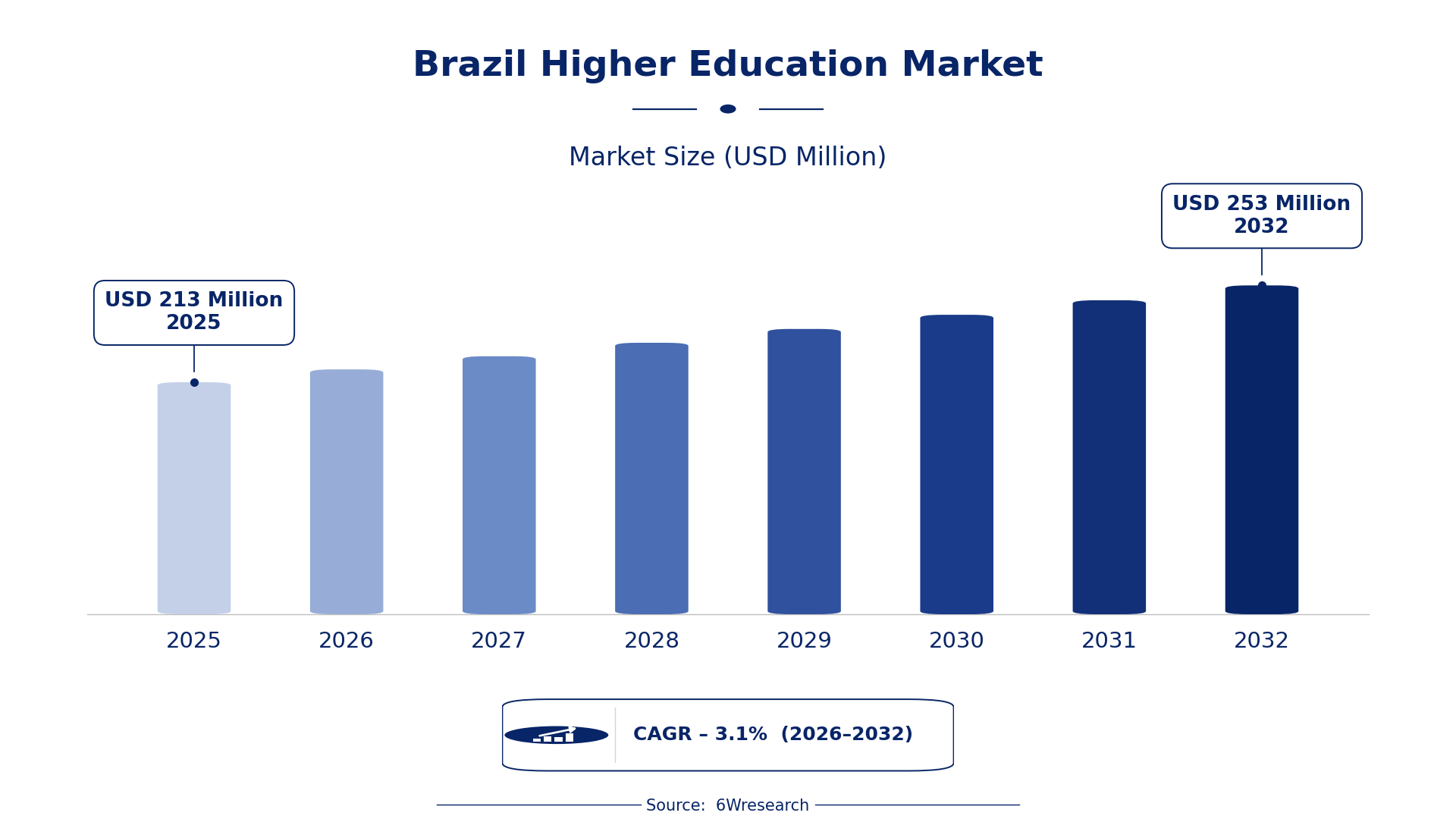
The Brazil Higher Education Market was estimated at USD 213 Million in 2025 and is projected to reach USD 253 Million by 2032, growing at a CAGR of 3.1% from 2026 to 2032.
Brazil Higher Education Market Synopsis
Brazil's higher education market is currently experiencing a noteworthy transformation, driven by an increasing demand for skilled professionals and innovative educational solutions. The integration of technology in learning environments is reshaping how students engage with their education, paving the way for a more dynamic future.
Despite this progress, challenges remain, particularly in terms of access and quality. Socio-economic disparities continue to pose obstacles for many aspiring students, underscoring the need for targeted policies and initiatives to ensure equitable educational opportunities across the country.
Brazil Higher Education Market Year-wise Growth Rate and Key Drivers
This graph illustrates the annual growth rates of the Brazil Higher Education Market from 2021 to 2032, highlighting a steady upward trajectory and projected expansion over the forecast period.
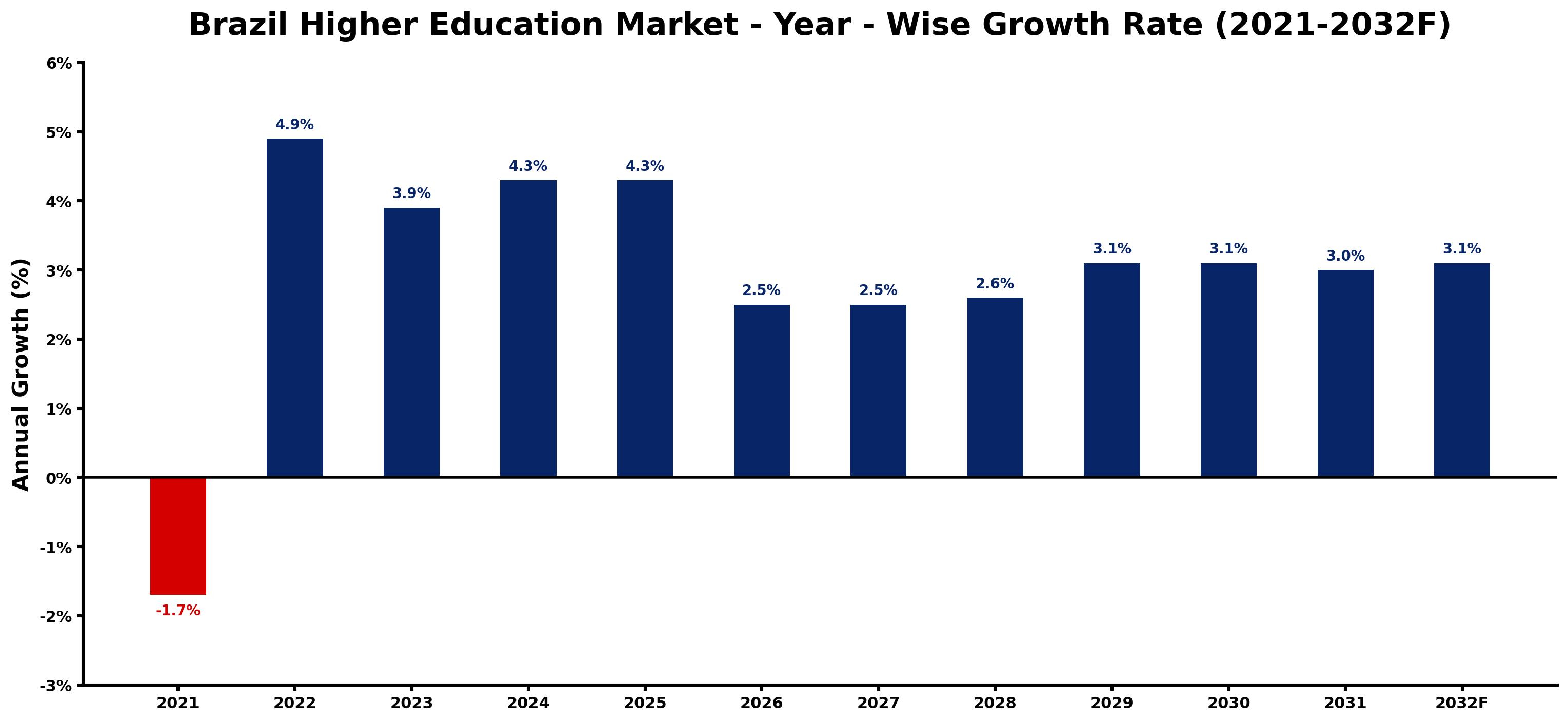
The table below presents the year‑wise growth rates along with the key drivers influencing the market
| Year | Growth Rate | Major Drivers |
| 2021 | -1.7% | Reduced enrollments due to budget cuts by MEC. |
| 2022 | 4.9% | Increasing student enrollment in online degree programs. |
| 2023 | 3.9% | Government incentives for private higher education institutions. |
| 2024 | 4.3% | Growing emphasis on bilingual education and language proficiency. |
| 2025 | 4.3% | Investment in sustainable campus infrastructure initiatives. |
| 2026 | 2.5% | Boost in international student applications from Latin America. |
| 2027 | 2.5% | Adoption of educational technology in remote learning environments. |
| 2028 | 2.6% | Enhanced collaboration between universities and tech companies. |
| 2029 | 3.1% | Rise in public awareness of higher education benefits. |
| 2030 | 3.1% | Emerging fields of study tailored to local job market. |
| 2031 | 3.0% | Increased scholarship availability for underrepresented students. |
| 2032 | 3.1% | Focus on research partnerships with local industry leaders. |
Note: Market size estimations and growth projections presented in this report are based on 6Wresearch's proprietary forecasting methodology, utilizing the latest available industry data, government publications, and primary research inputs.
Brazil Higher Education Market Key Takeaways
Below are some of the specific key takeaways from the market, including:
- Significant growth driven by rising enrollment and government support for education.
- Increased adoption of online learning platforms and technology-enhanced education.
- Collaborations between institutions and tech providers are becoming more common.
- Persistent socio-economic gaps in access to quality education remain a concern.
- Government initiatives are focusing on enhancing educational quality and accessibility.
Evaluation of Restraints in Brazil Higher Education Market
The Brazilian higher education market is hindered by several systemic issues. A key restraint is the persistent access gap, where affordability remains a barrier for many prospective students. This socio-economic divide results in inequitable access to quality education, limiting the pool of skilled professionals entering the workforce. on top of that, the reluctance of some traditional institutions to embrace technological advancements further complicates the market's evolution. There is an urgent need for investment in infrastructure to support modern educational methodologies and bridge these gaps.
Brazil Higher Education Market Trends
Several trends are shaping the Brazilian higher education market. The surge in e-learning has redefined classroom experiences, with many institutions now offering hybrid models that combine in-person and online instruction. Additionally, a growing emphasis on research and development is influencing curricula, as institutions strive to align academic programs with industry needs. There is also an increasing focus on lifelong learning, as professionals seek to upskill in a rapidly changing job market.
Brazil Higher Education Market Opportunities
Opportunities abound in Brazil's higher education sector, particularly in online learning. As demand for flexible educational solutions rises, institutions that can effectively harness technology stand to benefit significantly. Additionally, partnerships with private sector players can foster innovation, creating new pathways for research and collaboration. The government’s commitment to increasing access through scholarships and funding initiatives also presents a chance for institutions to expand their reach and impact.
Government Initiatives in the Brazil Higher Education Market
The Brazilian government is actively shaping the higher education landscape through various initiatives aimed at improving access, quality, and innovation. Recent policies have focused on enhancing infrastructure and promoting digital learning, reflecting a commitment to a modernized educational framework. These initiatives are crucial for ensuring that Brazil's higher education system meets the evolving needs of its population and economy.
- A national digital infrastructure upgrade program launched in early 2025 aims to enhance internet connectivity in educational institutions.
- Currently ongoing is a public-private partnership focused on expanding access to online learning resources for underprivileged communities.
- A planned regulatory framework expected to roll out by 2027 will mandate transparency in tuition fees across all higher education institutions.
- Government initiatives include scholarships aimed at increasing enrollment among low-income students, initiated in mid-2025 and continuing through 2028.
- Recently completed programs focused on teacher training in digital skills are now being evaluated for effectiveness and potential scale-up.
Future Insights of the Brazil Higher Education Market
From 2026 to 2032, the Brazil higher education market is expected to continue evolving as technology integrates deeper into educational practices. Institutions that adapt quickly will likely thrive, particularly those that prioritize accessibility and quality. The collaboration between academia and industry will become increasingly important, as both sectors work together to address workforce demands and foster innovation.
Brazil Higher Education Market Latest Developments
In the past year, the Brazil higher education market has witnessed a surge in initiatives aimed at enhancing educational delivery and accessibility. Institutions are increasingly exploring partnerships with technology providers to create a more engaging learning environment. These developments highlight a clear trend toward modernization and responsiveness to student needs.
- A major technology vendor launched an online assessment tool in Q3 2025, which is now being adopted by various universities across Brazil.
- An initiative that began in early 2025 focused on integrating virtual classrooms is currently underway at multiple institutions, enhancing remote learning capabilities.
- Upcoming plans for a nationwide scholarship program are set to be unveiled by the government in late 2026, aiming to support underrepresented students.
- A partnership between regional universities and tech startups initiated in mid-2025 is ongoing, focusing on collaborative research projects.
- In early 2025, several universities completed upgrades to their digital infrastructure, improving access to online resources for students.
Brazil Higher Education Market - Key Attractiveness of the Report
- 10 Years of Market Numbers
- Historical Data Starting from 2022 to 2025
- Base Year: 2025
- Forecast Data until 2032
- Key Performance Indicators Impacting the Market
- Major Upcoming Developments and Projects
Key Highlights of the Report:
- Brazil Higher Education Market Outlook
- Market Size of Brazil Higher Education Market, 2025
- Forecast of Brazil Higher Education Market, 2032
- Historical Data and Forecast of Brazil Higher Education Revenues & Volume for the Period 2022-2032F
- Brazil Higher Education Market Trend Evolution
- Brazil Higher Education Market Drivers and Challenges
- Brazil Higher Education Price Trends
- Brazil Higher Education Porter's Five Forces
- Brazil Higher Education Industry Life Cycle
- Historical Data and Forecast of Brazil Higher Education Market Revenues & Volume By Component for the Period 2022-2032F
- Historical Data and Forecast of Brazil Higher Education Market Revenues & Volume By Solutions for the Period 2022-2032F
- Historical Data and Forecast of Brazil Higher Education Market Revenues & Volume By Services for the Period 2022-2032F
- Historical Data and Forecast of Brazil Higher Education Market Revenues & Volume By Deployment Type for the Period 2022-2032F
- Historical Data and Forecast of Brazil Higher Education Market Revenues & Volume By On-premises for the Period 2022-2032F
- Historical Data and Forecast of Brazil Higher Education Market Revenues & Volume By Cloud for the Period 2022-2032F
- Historical Data and Forecast of Brazil Higher Education Market Revenues & Volume By Vertical for the Period 2022-2032F
- Historical Data and Forecast of Brazil Higher Education Market Revenues & Volume By State Universities for the Period 2022-2032F
- Historical Data and Forecast of Brazil Higher Education Market Revenues & Volume By Community Colleges for the Period 2022-2032F
- Historical Data and Forecast of Brazil Higher Education Market Revenues & Volume By Private Colleges for the Period 2022-2032F
- Brazil Higher Education Import Export Trade Statistics
- Market Opportunity Assessment By Component
- Market Opportunity Assessment By Deployment Type
- Market Opportunity Assessment By Vertical
- Brazil Higher Education Top Companies Market Share
- Brazil Higher Education Competitive Benchmarking By Technical and Operational Parameters
- Brazil Higher Education Company Profiles
- Brazil Higher Education Key Strategic Recommendations






































