Brazil Home Appliances Market Summary
The brazil home appliances market was estimated at USD 405 Million in 2025 and is projected to reach USD 483 Million by 2032, growing at a CAGR of 3.2% from 2026 to 2032.
Brazil Home Appliances Market Year-wise Growth Rate and Key Drivers
This graph highlights how the Brazil Home Appliances Market has steadily grown over the past five years, supported by major growth factors.
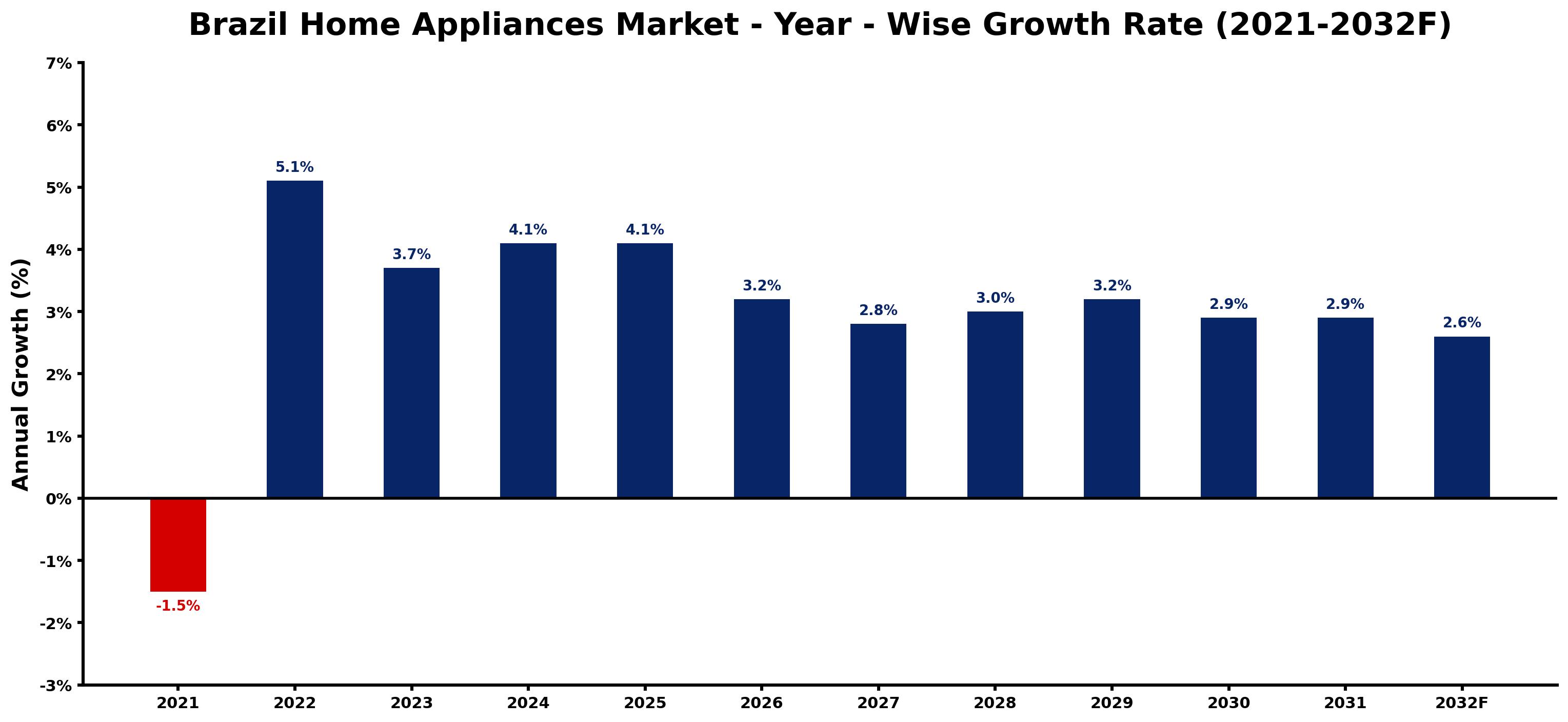
The table below presents the year wise growth rates along with the key drivers influencing the market
| Year | Growth Rate | Major Drivers |
| 2021 | -1.5% | Supply chain disruptions, exacerbated by the pandemic, hindered product availability and dampened consumer purchases in 2021. |
| 2022 | 5.1% | Urban migration patterns fueled demand for compact, multifunctional home appliance designs. |
| 2023 | 3.7% | E-commerce platforms expanded product availability, enhancing consumer access and choice. |
| 2024 | 4.1% | Rising disposable incomes encouraged consumers to invest in energy-efficient appliances. |
| 2025 | 4.1% | Increased brand competition led to diverse product offerings tailored to local needs. |
| 2026 | 3.2% | Technological shifts, including IoT integration, captivated the tech-savvy consumer segment. |
| 2027 | 2.8% | Sustainability trends prompted manufacturers to explore eco-friendly materials and designs. |
| 2028 | 3.0% | Urbanization contributed to a preference for smart homes, influencing appliance purchases. |
| 2029 | 3.2% | Investment in infrastructure improved distribution channels across urban and rural areas. |
| 2030 | 2.9% | Consumer financing options expanded, making premium appliances more accessible to households. |
| 2031 | 2.9% | Post-pandemic lifestyle changes encouraged more home cooking and appliance upgrades. |
| 2032 | 2.6% | Continued urban development projects stimulated demand for modern and efficient home solutions. |
Note - Market size estimations and growth projections presented in this report are based on 6Wresearch's advanced forecasting approach, validated with industry datasets as of June 2026.
Brazil Home Appliances Market Synopsis
The Brazil Home Appliances Market is projected to reach 3.2% and witness significant growth during the forecast period (2026-2032). This dynamic segment of the consumer goods industry includes a broad spectrum of appliances designed to cater to the evolving needs of households across the country. With urban lifestyles becoming increasingly common, there is a strong demand for a variety of appliances, including refrigerators, ovens, washing machines, and air purifiers, all of which enhance convenience and energy efficiency for the modern consumer.
Brazil Home Appliances Market Growth Drivers
The demand dynamics within the Brazil Home Appliances Market are significantly influenced by several key growth drivers:
- Urbanization is driving higher demand for home appliances, as more consumers move into metropolitan areas and seek products that align with contemporary living standards.
- Increase in disposable income allows consumers to invest in higher-quality, technologically advanced appliances, which enhance daily living experiences.
- The proliferation of smart technology and IoT-enabled devices is encouraging consumers to adopt appliances that integrate seamlessly with their digital lifestyles.
- A growing emphasis on energy efficiency is reflected in consumer preferences, with many opting for appliances that contribute to lower utility costs and environmental sustainability.
- Convenience remains a paramount factor, as busy lifestyles prompt the demand for appliances that simplify household tasks and save time.
Brazil Home Appliances Market Challenges and Restraints
While the Brazil Home Appliances Market presents numerous opportunities, it also faces several challenges that could hinder growth:
- Technological advancements are accelerating rapidly, leaving some manufacturers struggling to keep pace while ensuring their products remain affordable for the average consumer.
- Consumer education is essential, as many advanced features of modern appliances go underutilized due to a lack of understanding of their benefits and functionalities.
- Economic fluctuations can lead to uncertainties in consumer spending, potentially impacting sales of non-essential home appliances.
- Sustainability issues are increasingly coming to the forefront, with consumers demanding more eco-friendly options and manufacturers needing to adapt their production processes accordingly.
- Competition from both local and international brands creates a crowded marketplace, complicating brand positioning and marketing strategies.
Brazil Home Appliances Market Government Investment and Initiatives
Brazilian government policies play a significant role in shaping the home appliances market, influencing both industry standards and consumer behavior. Key initiatives include:
- Regulatory frameworks emphasizing product safety and energy efficiency have been established, ensuring that home appliances meet high quality and performance standards.
- Government incentives for manufacturers that invest in eco-friendly technologies and practices are designed to promote sustainable development within the industry.
- Public spending directives focus on promoting local manufacturing capabilities, which can enhance both job creation and economic growth in the home appliances sector.
- Consumer rights initiatives ensure that buyers have access to warranties and protection against malfunctions, fostering trust and confidence in purchasing decisions.
- Programs aimed at consumer education are essential for informing the public about energy-efficient appliances and their long-term cost benefits, driving greater acceptance of advanced home technologies.
Brazil Home Appliances Market Latest Developments (May 2025 - June 2026)
Recent developments in the Brazil Home Appliances Market indicate a shift towards greater innovation and sustainability. There has been a noticeable increase in the introduction of smart appliances, reflecting a consumer preference for connectivity and automation in household tasks. Manufacturers are prioritizing energy-efficient designs to comply with evolving regulations and meet consumer demand for environmentally friendly products. Additionally, social media and online platforms have become integral for marketing campaigns, as brands look to engage younger demographics who are more attuned to digital trends. Economic recovery efforts post-pandemic are also expected to boost consumer confidence, potentially enhancing sales in the home appliances sector. Furthermore, collaborations between tech companies and traditional appliance manufacturers are emerging, leading to innovative products that seamlessly integrate modern technologies.
Brazil Home Appliances Market - Key Attractiveness of the Report
- 10 Years of Market Numbers
- Historical Data Starting from 2022 to 2025
- Base Year: 2025
- Forecast Data until 2032
- Key Performance Indicators Impacting the Market
- Major Upcoming Developments and Projects
Key Highlights of the Report:
- Brazil Home Appliances Market Outlook
- Market Size of Brazil Home Appliances Market, 2025
- Forecast of Brazil Home Appliances Market, 2032
- Historical Data and Forecast of Brazil Home Appliances Revenues & Volume for the Period 2022-2032F
- Brazil Home Appliances Market Trend Evolution
- Brazil Home Appliances Market Drivers and Challenges
- Brazil Home Appliances Price Trends
- Brazil Home Appliances Porter's Five Forces
- Brazil Home Appliances Industry Life Cycle
- Historical Data and Forecast of Brazil Home Appliances Market Revenues & Volume By Product Types for the Period 2022-2032F
- Historical Data and Forecast of Brazil Home Appliances Market Revenues & Volume By Kitchen Appliances for the Period 2022-2032F
- Historical Data and Forecast of Brazil Home Appliances Market Revenues & Volume By Washing Appliances for the Period 2022-2032F
- Historical Data and Forecast of Brazil Home Appliances Market Revenues & Volume By Entertainment Appliances for the Period 2022-2032F
- Historical Data and Forecast of Brazil Home Appliances Market Revenues & Volume By Air Conditioner for the Period 2022-2032F
- Historical Data and Forecast of Brazil Home Appliances Market Revenues & Volume By Others for the Period 2022-2032F
- Historical Data and Forecast of Brazil Home Appliances Market Revenues & Volume By Technology for the Period 2022-2032F
- Historical Data and Forecast of Brazil Home Appliances Market Revenues & Volume By Wi-Fi for the Period 2022-2032F
- Historical Data and Forecast of Brazil Home Appliances Market Revenues & Volume By Bluetooth for the Period 2022-2032F
- Historical Data and Forecast of Brazil Home Appliances Market Revenues & Volume By ZigBee for the Period 2022-2032F
- Historical Data and Forecast of Brazil Home Appliances Market Revenues & Volume By Radio Frequency Identification for the Period 2022-2032F
- Historical Data and Forecast of Brazil Home Appliances Market Revenues & Volume By Cellular Technology for the Period 2022-2032F
- Historical Data and Forecast of Brazil Home Appliances Market Revenues & Volume By IoT for the Period 2022-2032F
- Historical Data and Forecast of Brazil Home Appliances Market Revenues & Volume By Distribution Channel for the Period 2022-2032F
- Historical Data and Forecast of Brazil Home Appliances Market Revenues & Volume By Retail for the Period 2022-2032F
- Historical Data and Forecast of Brazil Home Appliances Market Revenues & Volume By E-commerce for the Period 2022-2032F
- Historical Data and Forecast of Brazil Home Appliances Market Revenues & Volume By Others for the Period 2022-2032F
- Brazil Home Appliances Import Export Trade Statistics
- Market Opportunity Assessment By Product Types
- Market Opportunity Assessment By Technology
- Market Opportunity Assessment By Distribution Channel
- Brazil Home Appliances Top Companies Market Share
- Brazil Home Appliances Competitive Benchmarking By Technical and Operational Parameters
- Brazil Home Appliances Company Profiles
- Brazil Home Appliances Key Strategic Recommendations






































