Brazil Household furniture Market Summary
The brazil household furniture market was estimated at USD 91 Million in 2025 and is projected to reach USD 108 Million by 2032, growing at a CAGR of 2.8% from 2026 to 2032.
Brazil Household furniture Market Year-wise Growth Rate and Key Drivers
This graph highlights how the Brazil Household furniture Market has steadily grown over the past five years, supported by major growth factors.
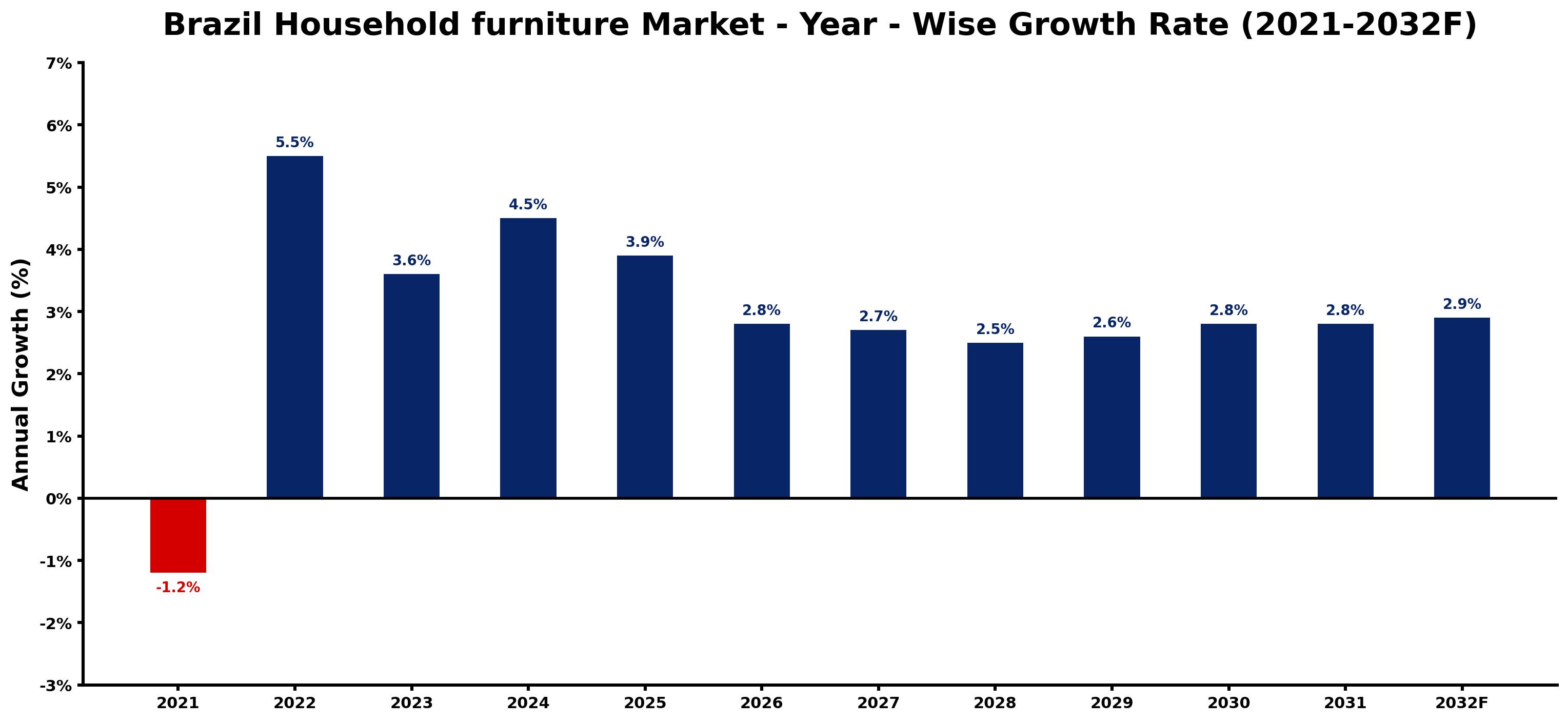
The table below presents the year wise growth rates along with the key drivers influencing the market
| Year | Growth Rate | Major Drivers |
| 2021 | -1.2% | Supply chain disruptions hindered the availability of key materials, stifling production and limiting retail inventory. |
| 2022 | 5.5% | Shifts in lifestyle encouraged consumers to invest more in comfort and aesthetics. |
| 2023 | 3.6% | Online retail platforms expanded furniture market access, engaging new customer demographics. |
| 2024 | 4.5% | Sustainable materials gained traction, appealing to eco-conscious Brazilian consumers increasingly. |
| 2025 | 3.9% | Rising disposable incomes among the middle class fostered higher spending on furniture. |
| 2026 | 2.8% | Urbanization trends prompted demand for space-saving and multifunctional furniture solutions. |
| 2027 | 2.7% | Home office setups gained popularity, leading to increased sales in ergonomic furniture. |
| 2028 | 2.5% | Design collaborations with local artists attracted attention and enhanced product uniqueness. |
| 2029 | 2.6% | Technological integration in manufacturing improved production efficiency and customization options. |
| 2030 | 2.8% | Increased tourism boosted short-term rental markets, driving demand for stylish furnishings. |
| 2031 | 2.8% | Home renovation incentives encouraged investments in modern and durable furniture styles. |
| 2032 | 2.9% | Consumer preferences shifted towards smart furnishings, integrating technology with traditional designs. |
Note - Market size estimations and growth projections presented in this report are based on 6Wresearch's advanced forecasting approach, validated with industry datasets as of June 2026.
Brazil Household furniture Market Synopsis
The Brazil Household furniture Market is projected to reach 2.8% and witness significant growth during the forecast period (2026-2032). This market is characterized by a rich tapestry of cultural influences, reflecting the diverse tastes and preferences of Brazilian consumers. Traditional craftsmanship coexists with contemporary design trends, resulting in a broad spectrum of furniture offerings that cater to various aesthetic and functional needs. The interplay of economic factors such as real estate development and disposable income levels plays a pivotal role in shaping the market landscape.
Brazil Household furniture Market Growth Drivers
Several key factors are driving the expansion of the Brazil Household furniture Market. Urbanization continues to accelerate, leading to increased demand for residential spaces equipped with functional and stylish furniture. The rising disposable income among the Brazilian population enhances the purchasing power for household items, with consumers prioritizing aesthetics and quality. Home renovation projects are becoming more commonplace, driven by trends in interior design that emphasize personalization and comfort. Furthermore, the growing acceptance of online retail platforms allows consumers to access a diverse range of furniture options conveniently, facilitating market growth. Lastly, changing lifestyle preferences are pushing consumers toward integrated furniture solutions that maximize space efficiency without compromising on style.
Brazil Household furniture Market Challenges and Restraints
Despite robust growth potential, the Brazil Household furniture Market faces several challenges. Economic instability poses a threat, impacting consumer confidence and spending on non-essential goods like furniture. Variability in disposable income is particularly concerning, as it affects purchasing decisions during economic downturns. Additionally, consumer preferences are shifting toward multifunctional and sustainable furniture, which necessitates significant adjustments in design and manufacturing processes. Manufacturers must engage in continuous innovation to keep pace with evolving market demands while maintaining affordability. Lastly, increased competition in the sector compels businesses to rethink their strategies, further complicating market dynamics.
Brazil Household furniture Market Trends and Opportunities
The Brazil Household furniture Market presents numerous trends and opportunities for stakeholders. The proliferation of smart home technology is influencing furniture design, with an emphasis on integration and connectivity. Eco-friendly materials are gaining traction, leading manufacturers to explore sustainable sourcing options to meet consumer demands for environmentally responsible products. Customization is becoming essential, as consumers seek personalized furniture solutions that reflect their unique tastes and lifestyles. Additionally, collaborations between furniture designers and local artisans are fostering the revival of traditional crafts, blending modern aesthetics with cultural heritage. As the market evolves, focusing on these trends can unlock new revenue streams and enhance brand loyalty.
Brazil Household furniture Market Regional Analysis
The Brazil Household furniture Market is notably diverse across its geographical regions. Urban centers such as São Paulo and Rio de Janeiro showcase a heightened demand for contemporary furniture designs influenced by global trends. In contrast, rural areas may continue to favor traditional styles, reflecting local culture and craftsmanship. Regional variations in disposable income and urbanization rates further influence consumer preferences and purchasing behaviors. The government's infrastructure investments in housing projects across various states also support regional growth in the household furniture market, creating localized opportunities for expansion and innovation.
Brazil Household furniture Market Government Investment and Initiatives
Government policies in Brazil play an instrumental role in shaping the Household furniture Market. Initiatives focused on consumer safety and quality standards are crucial in building trust and ensuring that products meet rigorous manufacturing criteria. Investments in housing and real estate development enhance market conditions for furniture retailers, as new residential projects generate increased demand for household furnishing. Public spending in infrastructure also indirectly supports the furniture market by boosting economic growth and consumer spending power. Furthermore, the government is encouraging sustainable practices among manufacturers, promoting eco-friendly materials and processes that align with global sustainability goals.
Brazil Household furniture Market Latest Developments (May 2025 - June 2026)
Recent developments in the Brazil Household furniture Market from May 2025 to June 2026 indicate significant shifts in consumer behavior and industry practices. The demand for online purchasing has surged, propelled by advancements in e-commerce platforms and an increase in consumer comfort with digital transactions. New design trends have emerged, prioritizing functionality and sustainability, prompting manufacturers to innovate rapidly. Collaborations between tech companies and furniture designers have begun to reshape product offerings, integrating smart technology into traditional furniture frameworks. Moreover, government support for sustainable manufacturing initiatives has gained momentum, encouraging enterprises to adopt greener practices which resonate well with the eco-conscious consumer base.
Brazil Household furniture Market - Key Attractiveness of the Report
- 10 Years of Market Numbers
- Historical Data Starting from 2022 to 2025
- Base Year: 2025
- Forecast Data until 2032
- Key Performance Indicators Impacting the Market
- Major Upcoming Developments and Projects
Key Highlights of the Report:
- Brazil Household furniture Market Outlook
- Market Size of Brazil Household furniture Market, 2025
- Forecast of Brazil Household furniture Market, 2032
- Historical Data and Forecast of Brazil Household furniture Revenues & Volume for the Period 2022-2032F
- Brazil Household furniture Market Trend Evolution
- Brazil Household furniture Market Drivers and Challenges
- Brazil Household furniture Price Trends
- Brazil Household furniture Porter's Five Forces
- Brazil Household furniture Industry Life Cycle
- Historical Data and Forecast of Brazil Household furniture Market Revenues & Volume By Types for the Period 2022-2032F
- Historical Data and Forecast of Brazil Household furniture Market Revenues & Volume By Wood Furniture for the Period 2022-2032F
- Historical Data and Forecast of Brazil Household furniture Market Revenues & Volume By Metal Furniture for the Period 2022-2032F
- Historical Data and Forecast of Brazil Household furniture Market Revenues & Volume By Plastic Furniture for the Period 2022-2032F
- Historical Data and Forecast of Brazil Household furniture Market Revenues & Volume By Others for the Period 2022-2032F
- Historical Data and Forecast of Brazil Household furniture Market Revenues & Volume By Area of Use for the Period 2022-2032F
- Historical Data and Forecast of Brazil Household furniture Market Revenues & Volume By ?Bedroom Furniture for the Period 2022-2032F
- Historical Data and Forecast of Brazil Household furniture Market Revenues & Volume By Living Room Furniture for the Period 2022-2032F
- Historical Data and Forecast of Brazil Household furniture Market Revenues & Volume By Dining Room Furniture for the Period 2022-2032F
- Historical Data and Forecast of Brazil Household furniture Market Revenues & Volume By Household Furniture for the Period 2022-2032F
- Historical Data and Forecast of Brazil Household furniture Market Revenues & Volume By Others for the Period 2022-2032F
- Brazil Household furniture Import Export Trade Statistics
- Market Opportunity Assessment By Types
- Market Opportunity Assessment By Area of Use
- Brazil Household furniture Top Companies Market Share
- Brazil Household furniture Competitive Benchmarking By Technical and Operational Parameters
- Brazil Household furniture Company Profiles
- Brazil Household furniture Key Strategic Recommendations






































