Brazil Hyaluronic Acid Market Top 5 Importing Countries and Market Competition (HHI) Analysis
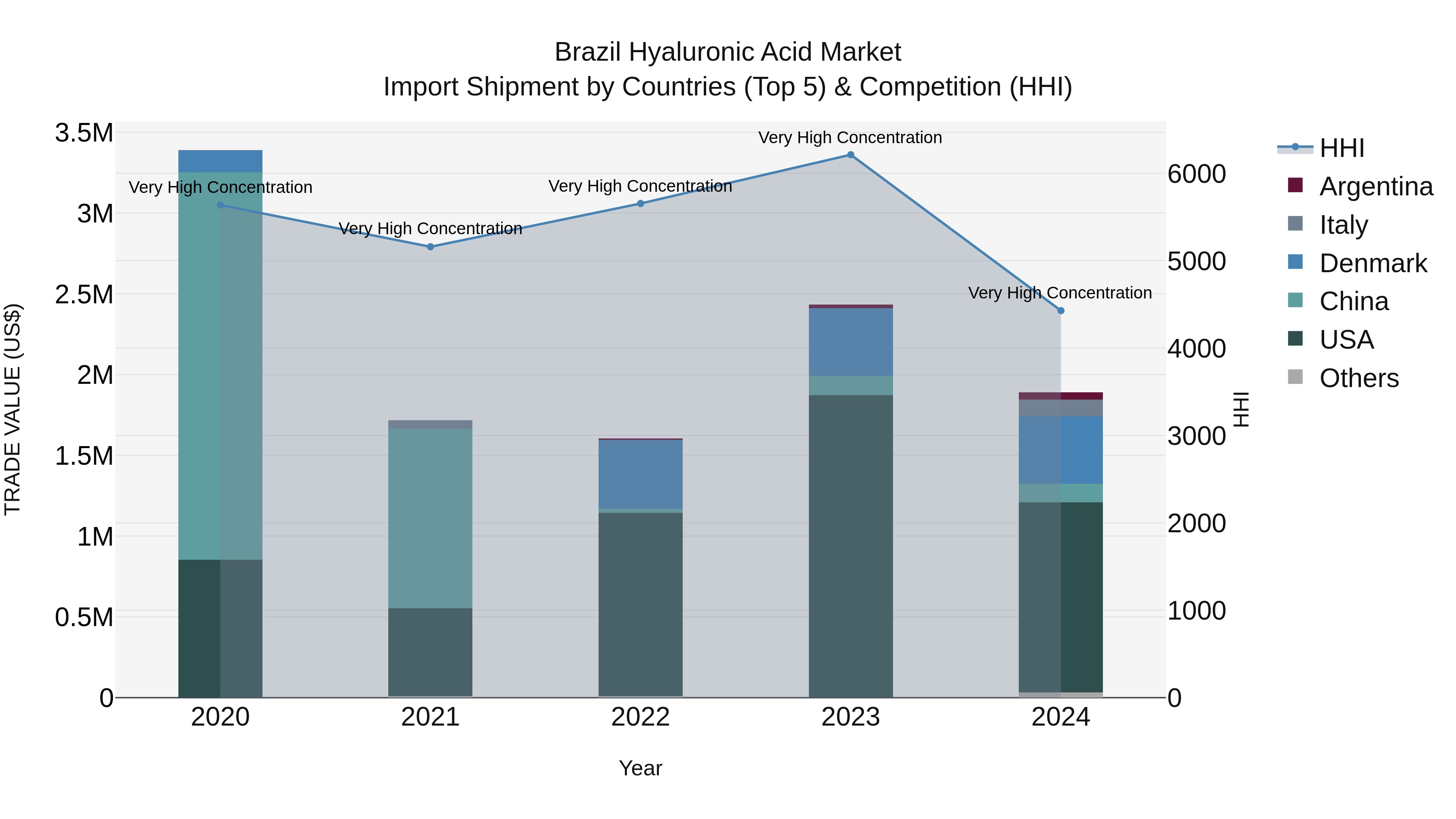
Brazil continues to rely heavily on imports of hyaluronic acid, with the USA, Denmark, China, Italy, and Argentina being the top exporting countries in 2024. Despite the high concentration of imports, the industry experienced a significant decline with a CAGR of -13.59% from 2020 to 2024. The negative growth trend continued into 2024 with a rate of -22.34%. This data suggests a challenging market environment for hyaluronic acid importers in Brazil, highlighting the need for strategic adjustments and market diversification strategies to navigate the evolving landscape.
Brazil Hyaluronic Acid Market Overview
The hyaluronic acid market in Brazil is experiencing steady growth due to increasing demand in the cosmetic, pharmaceutical, and healthcare industries. The market is driven by the rising popularity of hyaluronic acid-based dermal fillers for anti-aging treatments, as well as its use in wound healing and ophthalmic surgeries. Key players in the Brazilian market include both domestic manufacturers and international companies, offering a wide range of hyaluronic acid products to cater to different applications. The market is also benefiting from the growing awareness among consumers about the benefits of hyaluronic acid in skincare products. With a favorable regulatory environment and a growing emphasis on beauty and wellness, the Brazil hyaluronic acid market is poised for further expansion in the coming years.
Brazil Hyaluronic Acid Market Trends
The Brazil hyaluronic acid market is currently experiencing growth driven by increasing awareness about skincare and anti-aging products among consumers. There is a rising demand for hyaluronic acid in various cosmetic and personal care products due to its hydrating and anti-aging properties. The market is also benefiting from the growing popularity of non-invasive cosmetic procedures such as dermal fillers that use hyaluronic acid. Additionally, the trend towards natural and organic ingredients in skincare products is further fueling the demand for hyaluronic acid derived from natural sources. Manufacturers are focusing on product innovation and developing new formulations to cater to the diverse needs of consumers, which is expected to drive the market growth in the coming years.
Brazil Hyaluronic Acid Market Challenges
In the Brazil hyaluronic acid market, some of the key challenges faced include increasing competition from both domestic and international manufacturers, pricing pressures due to the presence of low-cost alternatives, regulatory hurdles related to approvals and registrations, as well as the lack of awareness among consumers about the benefits of hyaluronic acid products. Additionally, the market is also impacted by economic fluctuations and currency exchange rates, which can affect the cost of importing raw materials. Companies operating in this market need to navigate these challenges by focusing on product differentiation, investing in marketing and educational campaigns to raise awareness, maintaining competitive pricing strategies, and ensuring compliance with regulatory requirements to sustain growth and profitability in the Brazilian market.
Brazil Hyaluronic Acid Market Investment Opportunities
In the Brazil hyaluronic acid market, there are several investment opportunities worth considering. With the increasing demand for hyaluronic acid in the cosmetics and healthcare industries, investing in companies involved in the production, distribution, or research of hyaluronic acid products could be lucrative. Additionally, investing in companies that specialize in developing innovative applications for hyaluronic acid, such as in wound healing, osteoarthritis treatment, or drug delivery systems, could offer significant growth potential. As the market continues to expand, there is also potential for investment in companies focused on sustainable and eco-friendly production methods for hyaluronic acid, as environmental concerns become more prominent in consumer decision-making. Overall, the Brazil hyaluronic acid market presents diverse investment opportunities for those looking to capitalize on the growing demand for this versatile ingredient.
Brazil Hyaluronic Acid Market Government Policy
In Brazil, the government regulates hyaluronic acid products through the National Health Surveillance Agency (ANVISA). ANVISA classifies hyaluronic acid as a health product and requires companies to register their products before they can be marketed in the country. The registration process involves submitting detailed information on the product`s safety, efficacy, and quality. Additionally, ANVISA sets guidelines for labeling, advertising, and distribution of hyaluronic acid products to ensure consumer protection and product quality standards. Compliance with ANVISA regulations is essential for companies operating in the Brazilian hyaluronic acid market to avoid penalties or market exclusion. The government`s oversight aims to safeguard public health and maintain the integrity of the hyaluronic acid market in Brazil.
Brazil Hyaluronic Acid Market Future Outlook
The future outlook for the Brazil hyaluronic acid market appears promising, driven by the increasing consumer awareness of its benefits in skincare and the growing demand for cosmetic procedures. The market is expected to experience steady growth due to the rising aging population seeking anti-aging solutions and the expanding beauty and personal care industry in Brazil. Furthermore, the advancements in technology and the introduction of innovative hyaluronic acid-based products are anticipated to fuel market growth. With a focus on research and development to cater to evolving consumer preferences and a rising trend towards natural and organic products, the Brazil hyaluronic acid market is poised for expansion in the coming years.
Key Highlights of the Report:
- Brazil Hyaluronic Acid Market Outlook
- Market Size of Brazil Hyaluronic Acid Market,2024
- Forecast of Brazil Hyaluronic Acid Market, 2031
- Historical Data and Forecast of Brazil Hyaluronic Acid Revenues & Volume for the Period 2021-2031
- Brazil Hyaluronic Acid Market Trend Evolution
- Brazil Hyaluronic Acid Market Drivers and Challenges
- Brazil Hyaluronic Acid Price Trends
- Brazil Hyaluronic Acid Porter's Five Forces
- Brazil Hyaluronic Acid Industry Life Cycle
- Historical Data and Forecast of Brazil Hyaluronic Acid Market Revenues & Volume By Type for the Period 2021-2031
- Historical Data and Forecast of Brazil Hyaluronic Acid Market Revenues & Volume By High Molecular Weight for the Period 2021-2031
- Historical Data and Forecast of Brazil Hyaluronic Acid Market Revenues & Volume By Medium Molecular Weight for the Period 2021-2031
- Historical Data and Forecast of Brazil Hyaluronic Acid Market Revenues & Volume By Low Molecular Weight for the Period 2021-2031
- Historical Data and Forecast of Brazil Hyaluronic Acid Market Revenues & Volume By Cross-Linked for the Period 2021-2031
- Historical Data and Forecast of Brazil Hyaluronic Acid Market Revenues & Volume By Non-Cross-Linked for the Period 2021 - 2029
- Historical Data and Forecast of Brazil Hyaluronic Acid Market Revenues & Volume By Application for the Period 2021-2031
- Historical Data and Forecast of Brazil Hyaluronic Acid Market Revenues & Volume By Dermatology for the Period 2021-2031
- Historical Data and Forecast of Brazil Hyaluronic Acid Market Revenues & Volume By Ophthalmology for the Period 2021-2031
- Historical Data and Forecast of Brazil Hyaluronic Acid Market Revenues & Volume By Orthopedics for the Period 2021-2031
- Historical Data and Forecast of Brazil Hyaluronic Acid Market Revenues & Volume By Wound Healing for the Period 2021-2031
- Historical Data and Forecast of Brazil Hyaluronic Acid Market Revenues & Volume By Cosmetics for the Period 2021 - 2029
- Historical Data and Forecast of Brazil Hyaluronic Acid Market Revenues & Volume By End Use for the Period 2021-2031
- Historical Data and Forecast of Brazil Hyaluronic Acid Market Revenues & Volume By Personal Care for the Period 2021-2031
- Historical Data and Forecast of Brazil Hyaluronic Acid Market Revenues & Volume By Pharmaceuticals for the Period 2021-2031
- Historical Data and Forecast of Brazil Hyaluronic Acid Market Revenues & Volume By Dietary Supplements for the Period 2021-2031
- Historical Data and Forecast of Brazil Hyaluronic Acid Market Revenues & Volume By Food & Beverages for the Period 2021-2031
- Historical Data and Forecast of Brazil Hyaluronic Acid Market Revenues & Volume By Biotech Research for the Period 2021 - 2029
- Historical Data and Forecast of Brazil Hyaluronic Acid Market Revenues & Volume By Form for the Period 2021-2031
- Historical Data and Forecast of Brazil Hyaluronic Acid Market Revenues & Volume By Powder for the Period 2021-2031
- Historical Data and Forecast of Brazil Hyaluronic Acid Market Revenues & Volume By Liquid for the Period 2021-2031
- Historical Data and Forecast of Brazil Hyaluronic Acid Market Revenues & Volume By Gel for the Period 2021-2031
- Historical Data and Forecast of Brazil Hyaluronic Acid Market Revenues & Volume By Solution for the Period 2021-2031
- Historical Data and Forecast of Brazil Hyaluronic Acid Market Revenues & Volume By Injectable for the Period 2021 - 2029
- Historical Data and Forecast of Brazil Hyaluronic Acid Market Revenues & Volume By Source for the Period 2021-2031
- Historical Data and Forecast of Brazil Hyaluronic Acid Market Revenues & Volume By Synthetic for the Period 2021-2031
- Historical Data and Forecast of Brazil Hyaluronic Acid Market Revenues & Volume By Natural (Fermentation) for the Period 2021-2031
- Historical Data and Forecast of Brazil Hyaluronic Acid Market Revenues & Volume By Animal-Based for the Period 2021-2031
- Historical Data and Forecast of Brazil Hyaluronic Acid Market Revenues & Volume By Plant-Based for the Period 2021 - 2029
- Historical Data and Forecast of Brazil Hyaluronic Acid Market Revenues & Volume By Microbial Fermentation for the Period 2021 - 2029
- Brazil Hyaluronic Acid Import Export Trade Statistics
- Market Opportunity Assessment By Type
- Market Opportunity Assessment By Application
- Market Opportunity Assessment By End Use
- Market Opportunity Assessment By Form
- Market Opportunity Assessment By Source
- Brazil Hyaluronic Acid Top Companies Market Share
- Brazil Hyaluronic Acid Competitive Benchmarking By Technical and Operational Parameters
- Brazil Hyaluronic Acid Company Profiles
- Brazil Hyaluronic Acid Key Strategic Recommendations






































