Brazil IDaaS Market Size & Growth Rate (2026-2032)
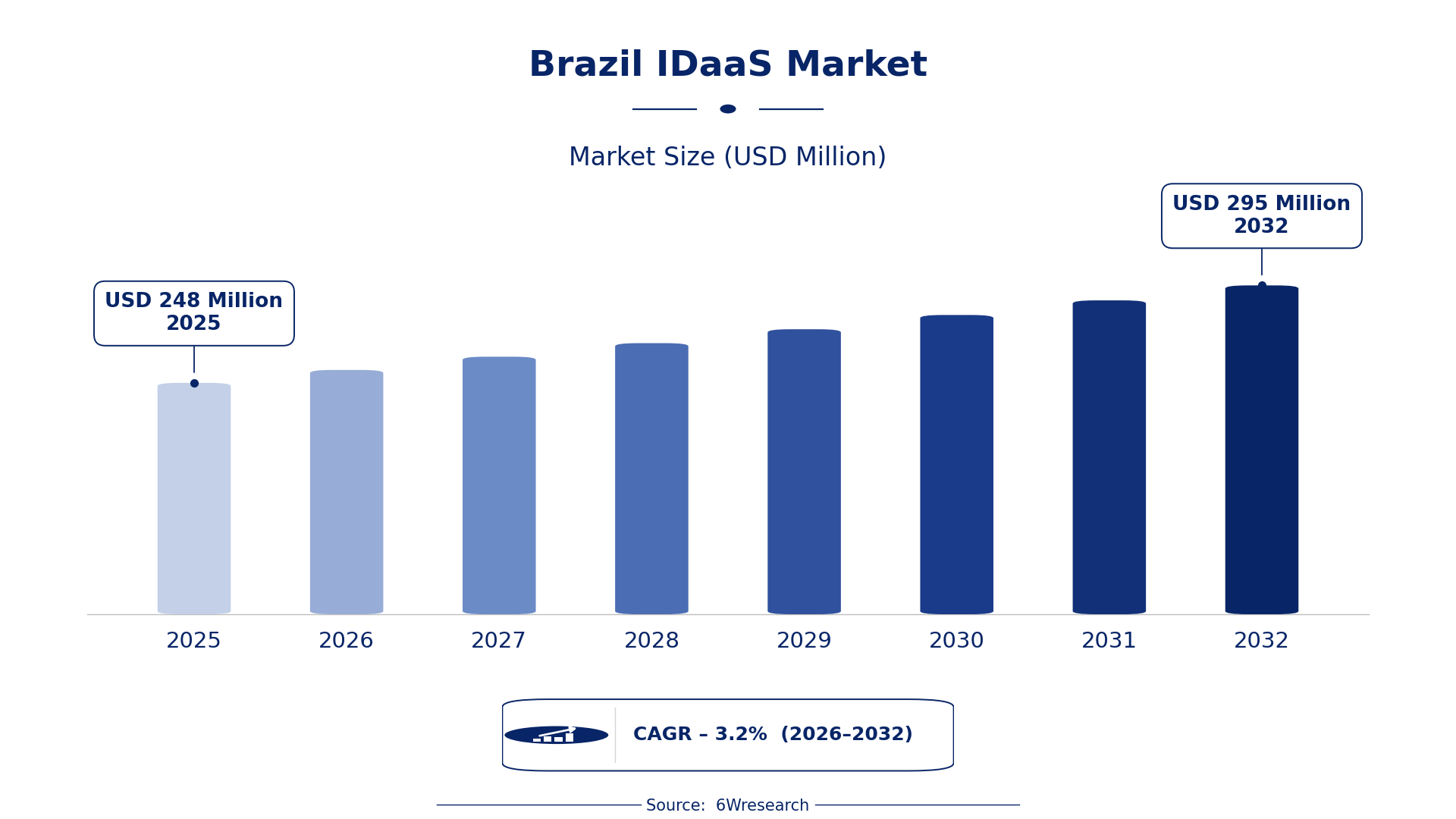
The Brazil IDaaS Market was estimated at USD 248 Million in 2025 and is projected to reach USD 295 Million by 2032, growing at a CAGR of 3.2% from 2026 to 2032.
Brazil IDaaS Market Synopsis
The Brazil Identity as a Service (IDaaS) market has seen notable growth as organizations adapt to a digital-first strategy. Yet, as this momentum continues, businesses must tackle pressing issues such as data privacy and regulatory compliance to fully realize the potential of IDaaS solutions.
Looking ahead, companies in Brazil are increasingly focused on cloud-based identity solutions. This trend reflects a broader recognition of the need for secure, scalable, and user-friendly identity management systems. The coming years will likely reshape the market as enterprises seek to streamline access control and enhance compliance with evolving regulations.
Brazil IDaaS Market Year-wise Growth Rate and Key Drivers
This graph illustrates the annual growth rates of the Brazil IDaaS Market from 2021 to 2032, highlighting a steady upward trajectory and projected expansion over the forecast period.
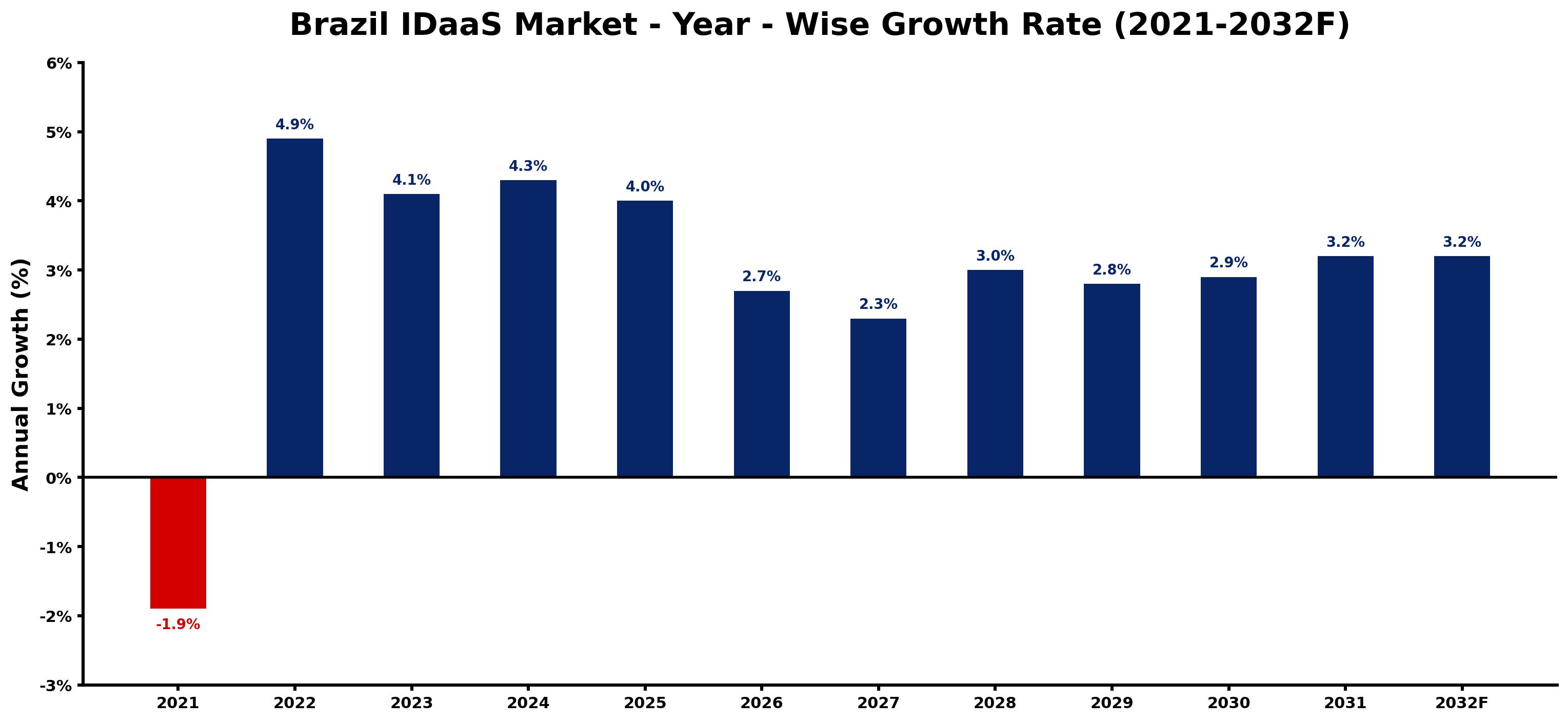
The table below presents the year‑wise growth rates along with the key drivers influencing the market
| Year | Growth Rate | Major Drivers |
| 2021 | -1.9% | Compliance challenges with LGPD hindered market growth. |
| 2022 | 4.9% | Increased demand for digital identity verification services. |
| 2023 | 4.1% | Government digital transformation initiatives boosting IDaaS adoption. |
| 2024 | 4.3% | Rise in e-commerce driving authentication service requirements. |
| 2025 | 4.0% | Growing focus on cybersecurity regulations for businesses. |
| 2026 | 2.7% | Investments in fintech solutions necessitating secure identity services. |
| 2027 | 2.3% | Expanded smartphone penetration enhancing mobile ID adoption. |
| 2028 | 3.0% | Increased online fraud leading to stronger KYC measures. |
| 2029 | 2.8% | Growing use of biometrics in financial services applications. |
| 2030 | 2.9% | Local startups promoting innovative identity solutions and technologies. |
| 2031 | 3.2% | Strengthened privacy laws enhancing importance of secure identities. |
| 2032 | 3.2% | Partnerships between tech firms and banks boosting IDaaS consumption. |
Note: Market size estimations and growth projections presented in this report are based on 6Wresearch's proprietary forecasting methodology, utilizing the latest available industry data, government publications, and primary research inputs.
Brazil IDaaS Market Key Takeaways
Below are some of the specific key takeaways from the market, including:
- The demand for IDaaS solutions is being driven by the shift towards cloud-based technologies.
- Companies are prioritizing security features to address rising data privacy concerns.
- Compliance with local and international regulations is a key factor influencing adoption.
- Seamless integration with existing IT infrastructure remains a challenge for many organizations.
- The increasing complexity of identity management processes pushes organizations towards IDaaS for simplification.
Evaluation of Restraints in Brazil IDaaS Market
Despite its growth potential, the Brazil IDaaS market faces significant restraints that could hinder its expansion. Foremost among these is the pervasive concern regarding data privacy and protection. Organizations must grapple with local and international regulatory standards that can be complex and burdensome.
Furthermore, many businesses struggle with integrating IDaaS solutions into their existing IT infrastructure. This challenge can impede a smooth transition to cloud-based services, ultimately delaying the expected benefits of enhanced identity management. Companies must address these issues proactively to unlock the market's full potential.
Brazil IDaaS Market Trends
The shift towards cloud-based identity management continues to shape the Brazil IDaaS market. Organizations are increasingly looking for scalable solutions that allow flexibility in managing user identities across various platforms.
Additionally, there's a growing emphasis on advanced security features such as multi-factor authentication and biometric verification. These trends respond to heightened concerns about data breaches and identity theft, pushing companies to adopt more sophisticated IDaaS offerings.
Brazil IDaaS Market Opportunities
There are genuine opportunities for growth within the Brazil IDaaS market, particularly for solutions that prioritize regulatory compliance and user security. As more organizations transition to cloud technologies, demand for comprehensive identity management solutions will surge.
Investment in integration services and user experience design also presents a lucrative avenue for businesses aiming to differentiate themselves. Organizations offering tailored solutions can capitalize on the increasing complexity of identity management demands.
Government Initiatives in the Brazil IDaaS Market
Government policies are instrumental in shaping the Brazil IDaaS market, focusing on regulatory frameworks and compliance standards that promote secure digital transactions. Policymakers are aware that robust identity management is crucial for building trust in digital services. Their initiatives aim to enhance data protection while enabling technological innovation.
- A regulatory framework introduced in 2025 mandates stronger data privacy measures for identity management solutions.
- A national digital infrastructure upgrade programme, currently underway, aims to improve connectivity and access to digital services across urban and rural areas.
- Ongoing discussions around enhancing e-government services focus on implementing IDaaS solutions for streamlined access to public services.
- A planned public-private partnership is expected to develop a standardized ID management framework, which is expected to launch in 2028.
Future Insights of the Brazil IDaaS Market
From 2026 to 2032, the Brazil IDaaS market is set to evolve as organizations refine their identity management strategies. With increasing regulatory pressure, companies will have to invest in compliant solutions that address data privacy and security risks.
As businesses seek to enhance user experiences, the demand for scalable, flexible, and user-friendly IDaaS options will likely rise. This evolution will not only contribute to market growth but also encourage innovation among service providers looking to meet the unique needs of Brazilian enterprises.
Brazil IDaaS Market Latest Developments
In the past year, the Brazil IDaaS market has experienced a flurry of activity as organizations prioritize enhanced identity management. The focus has been on integrating advanced security features and ensuring compliance with evolving regulations.
- A new partnership between regional service providers was announced in early 2025, aimed at developing integrated IDaaS solutions tailored for small to medium-sized enterprises.
- A technology vendor launched an upgraded version of its IDaaS platform in Q3 2025, featuring improved user interfaces and enhanced security protocols.
- Current initiatives are focused on expanding access to cloud identity solutions across various sectors, ensuring that organizations of all sizes can benefit.
- A government-backed project aimed at enhancing digital identity verification processes is set to kick off in mid-2026, promoting trust in online transactions.
Brazil IDaaS Market - Key Attractiveness of the Report
- 10 Years of Market Numbers
- Historical Data Starting from 2022 to 2025
- Base Year: 2025
- Forecast Data until 2032
- Key Performance Indicators Impacting the Market
- Major Upcoming Developments and Projects
Key Highlights of the Report:
- Brazil IDaaS Market Outlook
- Market Size of Brazil IDaaS Market, 2025
- Forecast of Brazil IDaaS Market, 2032
- Historical Data and Forecast of Brazil IDaaS Revenues & Volume for the Period 2022-2032F
- Brazil IDaaS Market Trend Evolution
- Brazil IDaaS Market Drivers and Challenges
- Brazil IDaaS Price Trends
- Brazil IDaaS Porter's Five Forces
- Brazil IDaaS Industry Life Cycle
- Historical Data and Forecast of Brazil IDaaS Market Revenues & Volume By Component for the Period 2022-2032F
- Historical Data and Forecast of Brazil IDaaS Market Revenues & Volume By Provisioning for the Period 2022-2032F
- Historical Data and Forecast of Brazil IDaaS Market Revenues & Volume By Single-Sign-On for the Period 2022-2032F
- Historical Data and Forecast of Brazil IDaaS Market Revenues & Volume By Advanced Authentication for the Period 2022-2032F
- Historical Data and Forecast of Brazil IDaaS Market Revenues & Volume By Audit, Compliance, and Governance for the Period 2022-2032F
- Historical Data and Forecast of Brazil IDaaS Market Revenues & Volume By Directory Services for the Period 2022-2032F
- Historical Data and Forecast of Brazil IDaaS Market Revenues & Volume By Password Management for the Period 2022-2032F
- Historical Data and Forecast of Brazil IDaaS Market Revenues & Volume By Organization Size for the Period 2022-2032F
- Historical Data and Forecast of Brazil IDaaS Market Revenues & Volume By SMEs for the Period 2022-2032F
- Historical Data and Forecast of Brazil IDaaS Market Revenues & Volume By Large Enterprises for the Period 2022-2032F
- Historical Data and Forecast of Brazil IDaaS Market Revenues & Volume By Deployment Type for the Period 2022-2032F
- Historical Data and Forecast of Brazil IDaaS Market Revenues & Volume By Public cloud for the Period 2022-2032F
- Historical Data and Forecast of Brazil IDaaS Market Revenues & Volume By Private cloud for the Period 2022-2032F
- Historical Data and Forecast of Brazil IDaaS Market Revenues & Volume By Hybrid cloud for the Period 2022-2032F
- Historical Data and Forecast of Brazil IDaaS Market Revenues & Volume By Vertical for the Period 2022-2032F
- Historical Data and Forecast of Brazil IDaaS Market Revenues & Volume By BFSI for the Period 2022-2032F
- Historical Data and Forecast of Brazil IDaaS Market Revenues & Volume By IT and ITeS for the Period 2022-2032F
- Historical Data and Forecast of Brazil IDaaS Market Revenues & Volume By Energy and Utilities for the Period 2022-2032F
- Historical Data and Forecast of Brazil IDaaS Market Revenues & Volume By Government for the Period 2022-2032F
- Historical Data and Forecast of Brazil IDaaS Market Revenues & Volume By Manufacturing for the Period 2022-2032F
- Historical Data and Forecast of Brazil IDaaS Market Revenues & Volume By Healthcare for the Period 2022-2032F
- Historical Data and Forecast of Brazil IDaaS Market Revenues & Volume By Retail and Consumer Goods for the Period 2022-2032F
- Historical Data and Forecast of Brazil IDaaS Market Revenues & Volume By Other Verticals (Education, Media and entertainment, Transportation and logistics, Travel and hospitality, and Aerospace and defense) for the Period 2022-2032F
- Brazil IDaaS Import Export Trade Statistics
- Market Opportunity Assessment By Component
- Market Opportunity Assessment By Organization Size
- Market Opportunity Assessment By Deployment Type
- Market Opportunity Assessment By Vertical
- Brazil IDaaS Top Companies Market Share
- Brazil IDaaS Competitive Benchmarking By Technical and Operational Parameters
- Brazil IDaaS Company Profiles
- Brazil IDaaS Key Strategic Recommendations






































