Brazil Industrial Dryers for Agricultural Products Market Size, Share & Growth Rate
The Brazil Industrial Dryers for Agricultural Products Market was estimated at USD 252 Million in 2025 and is projected to reach USD 301 Million by 2032, growing at a CAGR of 2.6% from 2026 to 2032. This growth trajectory is primarily driven by the increasing demand for processed agricultural products, which necessitates advanced drying technologies for effective post-harvest management. Furthermore, the expansion of the agro-processing sector is pivotal, as it seeks innovative solutions to enhance efficiency and quality while minimizing waste.
Brazil Industrial Dryers for Agricultural Products Market Year-wise Growth Rate and Key Drivers
This graph highlights how the Brazil Industrial Dryers for Agricultural Products Market has steadily grown over the years, supported by major growth factors.
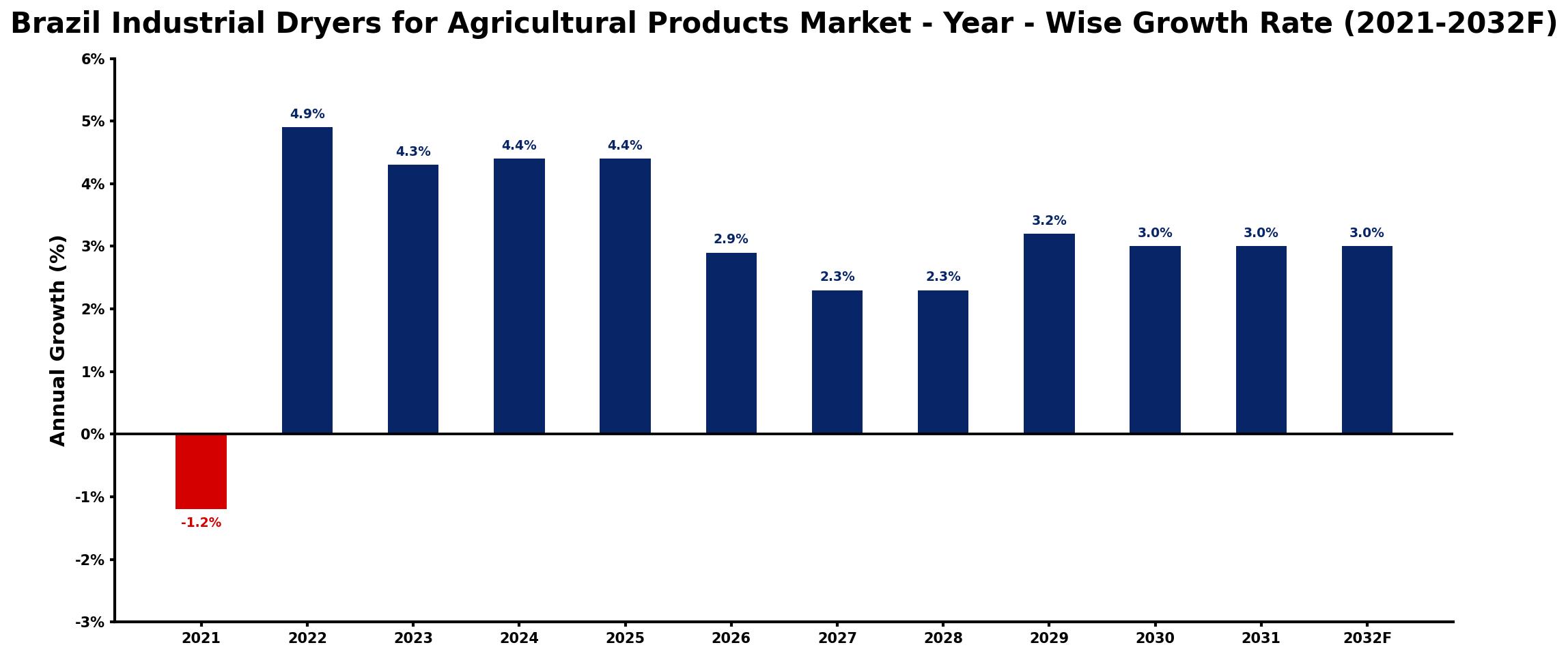
The table below presents the year‑wise growth rates along with the key drivers influencing the market
| Year | Growth Rate | Major Drivers |
| 2021 | -1.2% | decreased investment in production technologies |
| 2022 | 4.9% | rising demand for efficient solutions |
| 2023 | 4.3% | growing focus on sustainability practices |
| 2024 | 4.4% | expansion of export markets opportunities |
| 2025 | 4.4% | increased automation in processing facilities |
| 2026 | 2.9% | enhanced technology adoption in operations |
| 2027 | 2.3% | growing interest in energy efficiency |
| 2028 | 2.3% | increased diversification of supply chains |
| 2029 | 3.2% | increased domestic production output |
| 2030 | 3.0% | rising consumer demand for quality |
| 2031 | 3.0% | increased investment in research initiatives |
| 2032 | 3.0% | growing importance of climate resilience |
Note: Market size estimations and growth projections presented in this report are based on 6Wresearch's proprietary forecasting methodology, utilizing the latest available industry data, government publications, and primary research inputs.
Brazil Industrial Dryers for Agricultural Products Market Synopsis
The foremost force currently shaping the Brazil Industrial Dryers for Agricultural Products Market is the robust growth within the agro-processing industry. As consumers increasingly favor processed goods, the need for effective drying solutions that ensure product integrity and longevity becomes paramount.
Moreover, advancements in dryer technology are a significant driver of market evolution. Innovations are leading to faster drying processes with higher energy efficiency, enabling processors to meet stringent food safety and quality standards, which are crucial for market acceptance.
Brazil Industrial Dryers for Agricultural Products Market Key Takeaways
- The market is set for steady growth, with a focus on improved technologies driving efficiency.
- Government support initiatives are fostering innovation and investment in drying technologies.
- Energy efficiency and product quality remain critical factors influencing equipment selection.
- The diversity of agricultural products presents unique challenges and opportunities for manufacturers.
- Consumer demand for processed agricultural products is increasing, boosting market potential.
Evaluation of Restraints in Brazil Industrial Dryers for Agricultural Products Market
Despite the positive outlook, the Brazil Industrial Dryers for Agricultural Products Market faces significant restraints. The sheer diversity of agricultural products means that varying drying methods are required, which can complicate the manufacturing process. Additionally, ensuring energy efficiency while keeping production costs manageable is a persistent challenge for equipment providers. The necessity to balance affordability with high-performance standards also creates barriers to widespread adoption of advanced drying technologies across different agricultural sectors.
Brazil Industrial Dryers for Agricultural Products Market Trends
Several trends are currently influencing the Brazil Industrial Dryers for Agricultural Products Market. The shift towards automation and mechanization in drying processes is gaining momentum, driven by the need for higher productivity and consistency in product quality. Furthermore, there is a growing interest in sustainable practices, with an emphasis on energy-efficient dryers that reduce the carbon footprint associated with agricultural processing.
Brazil Industrial Dryers for Agricultural Products Market Opportunities
The market presents significant growth and investment opportunities, particularly in the development of customizable drying solutions tailored to specific agricultural commodities. As awareness of post-harvest loss reduction rises, investment in advanced technologies that enhance drying efficiency and product quality will likely attract attention from stakeholders seeking to gain a competitive edge. Additionally, the increasing adoption of IoT and smart technology in agriculture opens new avenues for innovative drying systems that can optimize operations and monitor quality in real-time.
Government Initiatives in the Brazil Industrial Dryers for Agricultural Products Market
Brazilian government initiatives aimed at boosting agricultural productivity and enhancing food security have a direct impact on the industrial dryers for agricultural products market. Programs promoting post-harvest management practices, including support for drying technology adoption, encourage farmers and food processors to invest in modern equipment. Regulatory frameworks emphasizing food safety and quality standards further drive demand for hygienic and efficient drying solutions, creating a conducive environment for market growth.
Future Insights of the Brazil Industrial Dryers for Agricultural Products Market
Looking ahead to 2026-2032, the Brazil Industrial Dryers for Agricultural Products Market is positioned for gradual expansion. Advances in technology will likely play a critical role in enhancing dryer efficiency and product quality, enabling producers to meet the evolving demands of consumers and regulatory bodies alike. Additionally, as the agro-processing industry continues to flourish, the integration of sustainable practices into drying operations will become increasingly important, shaping the competitive landscape.
Brazil Industrial Dryers for Agricultural Products Market Latest Developments (2025 - 2026)
Recent developments in the Brazil Industrial Dryers for Agricultural Products Market reflect a strong push towards innovation and sustainability. Industry stakeholders are increasingly focusing on developing advanced drying solutions that prioritize energy efficiency and lower environmental impact. Collaborative efforts between technology providers and agricultural businesses are also becoming more prevalent, aimed at refining drying techniques to enhance productivity and quality, meeting both consumer and regulatory demands.
Brazil Industrial Dryers for Agricultural Products Market - Key Attractiveness of the Report
- 10 Years of Market Numbers
- Historical Data Starting from 2022 to 2025
- Base Year: 2025
- Forecast Data until 2032
- Key Performance Indicators Impacting the Market
- Major Upcoming Developments and Projects
Key Highlights of the Report:
- Brazil Industrial Dryers for Agricultural Products Market Outlook
- Market Size of Brazil Industrial Dryers for Agricultural Products Market, 2025
- Forecast of Brazil Industrial Dryers for Agricultural Products Market, 2032
- Historical Data and Forecast of Brazil Industrial Dryers for Agricultural Products Revenues & Volume for the Period 2022-2032F
- Brazil Industrial Dryers for Agricultural Products Market Trend Evolution
- Brazil Industrial Dryers for Agricultural Products Market Drivers and Challenges
- Brazil Industrial Dryers for Agricultural Products Price Trends
- Brazil Industrial Dryers for Agricultural Products Porter's Five Forces
- Brazil Industrial Dryers for Agricultural Products Industry Life Cycle
- Historical Data and Forecast of Brazil Industrial Dryers for Agricultural Products Market Revenues & Volume By Type for the Period 2022-2032F
- Historical Data and Forecast of Brazil Industrial Dryers for Agricultural Products Market Revenues & Volume By Hot Air Drying Equipment for the Period 2022-2032F
- Historical Data and Forecast of Brazil Industrial Dryers for Agricultural Products Market Revenues & Volume By Heated Surface Drying Equipment for the Period 2022-2032F
- Historical Data and Forecast of Brazil Industrial Dryers for Agricultural Products Market Revenues & Volume By Application for the Period 2022-2032F
- Historical Data and Forecast of Brazil Industrial Dryers for Agricultural Products Market Revenues & Volume By Conveyer Drying Equipment for the Period 2022-2032F
- Historical Data and Forecast of Brazil Industrial Dryers for Agricultural Products Market Revenues & Volume By Cabinet Drying Equipment for the Period 2022-2032F
- Brazil Industrial Dryers for Agricultural Products Import Export Trade Statistics
- Market Opportunity Assessment By Type
- Market Opportunity Assessment By Application
- Brazil Industrial Dryers for Agricultural Products Top Companies Market Share
- Brazil Industrial Dryers for Agricultural Products Competitive Benchmarking By Technical and Operational Parameters
- Brazil Industrial Dryers for Agricultural Products Company Profiles
- Brazil Industrial Dryers for Agricultural Products Key Strategic Recommendations






































