Brazil Industrial Flooring Market Size, Share & Growth Rate
The Brazil Industrial Flooring Market was estimated at USD 250 Million in 2025 and is projected to reach USD 296 Million by 2032, growing at a CAGR of 2.4% from 2026 to 2032. This growth trajectory is significantly driven by the expansion of Brazil's manufacturing sector, which necessitates robust and high-performance flooring solutions that can endure the rigors of industrial environments. Additionally, the increasing awareness of workplace safety and hygiene standards compels industries to invest in quality flooring materials, thereby propelling market demand.
Brazil Industrial Flooring Market Year-wise Growth Rate and Key Drivers
This graph highlights how the Brazil Industrial Flooring Market has steadily grown over the years, supported by major growth factors.
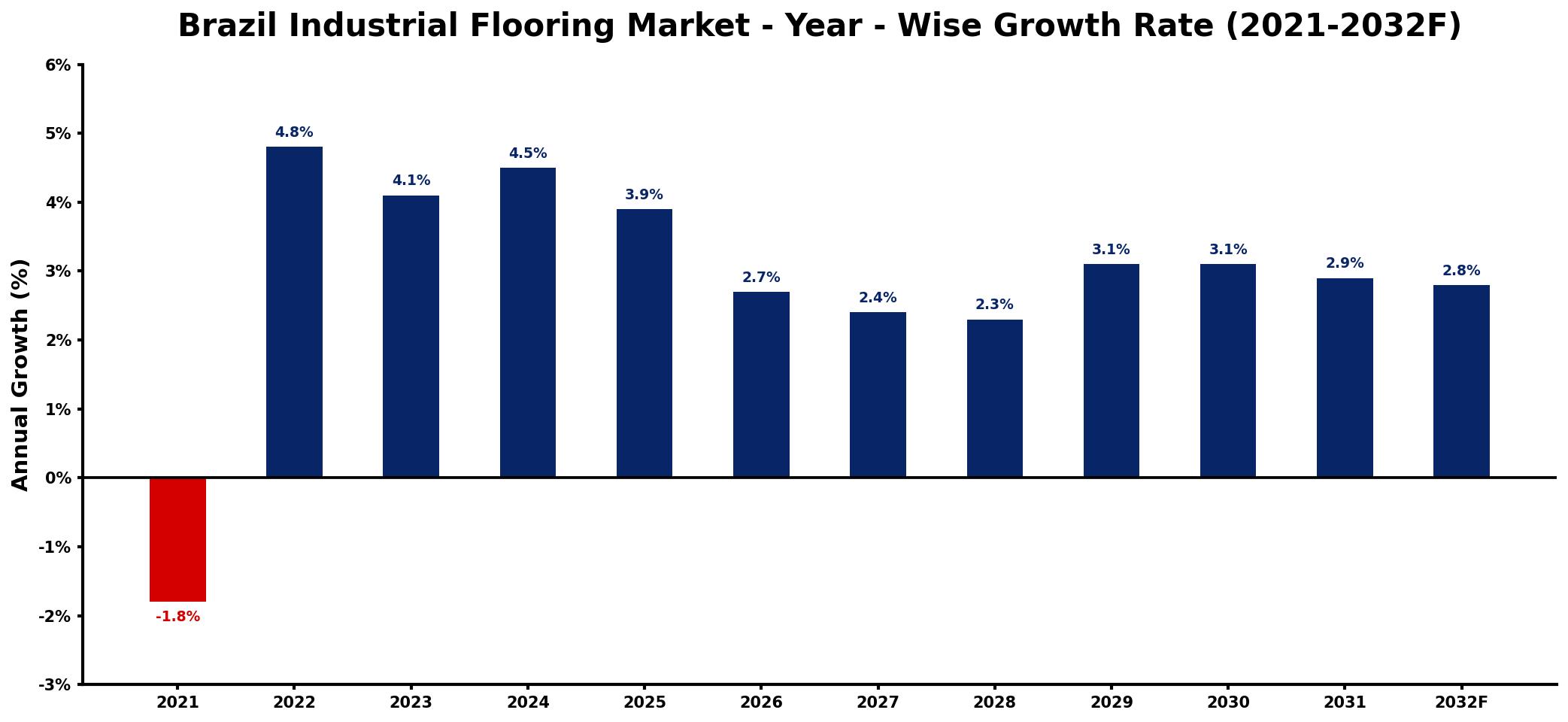
The table below presents the year‑wise growth rates along with the key drivers influencing the market
| Year | Growth Rate | Major Drivers |
| 2021 | -1.8% | decreased manufacturing output levels |
| 2022 | 4.8% | increased construction sector investments |
| 2023 | 4.1% | growing logistics and warehousing needs |
| 2024 | 4.5% | expansion of renewable energy projects |
| 2025 | 3.9% | rising demand for safety standards |
| 2026 | 2.7% | growth in food processing facilities |
| 2027 | 2.4% | increased automation in manufacturing |
| 2028 | 2.3% | increased domestic production output |
| 2029 | 3.1% | growing demand for sustainable practices |
| 2030 | 3.1% | increased focus on urban development |
| 2031 | 2.9% | rising investments in export facilities |
| 2032 | 2.8% | improved raw material availability |
Note: Market size estimations and growth projections presented in this report are based on 6Wresearch's proprietary forecasting methodology, utilizing the latest available industry data, government publications, and primary research inputs.
Brazil Industrial Flooring Market Synopsis
While the Brazil Industrial Flooring Market has shown considerable momentum recently, its future outlook appears even more promising. The combined effects of evolving technology in flooring materials and a rising demand for sustainable practices are reshaping the landscape, steering the market toward innovative solutions.
The industrial flooring sector is poised for transformation, with stakeholders eager to explore new technologies and materials. This proactive approach reflects a broader trend of adaptation to modern industrial requirements, positioning Brazil as a dynamic player in the global flooring market.
Brazil Industrial Flooring Market Key Takeaways
- Expanding industrial sectors drive the demand for durable flooring solutions.
- Workplace safety regulations significantly influence market growth.
- Technological advancements are enhancing product performance and sustainability.
- Intense competition necessitates innovation and differentiation in offerings.
- Government policies increasingly focus on safety and durability standards.
Evaluation of Restraints in Brazil Industrial Flooring Market
The Brazil Industrial Flooring Market faces notable restraints, primarily linked to the stringent durability and safety standards necessary for industrial applications. Flooring products must withstand heavy loads and resist chemical exposure while maintaining compliance with regulatory requirements. These standards can create barriers for both manufacturers and installers, necessitating a focus on quality assurance and continuous improvements. Moreover, the competitive landscape adds pressure on companies to differentiate themselves through innovative solutions, posing challenges to profit margins and market entry for new players.
Brazil Industrial Flooring Market Trends
A significant trend shaping the Brazil Industrial Flooring Market is the increasing shift toward sustainable and eco-friendly materials. As industries become more aware of their environmental impact, the demand for sustainable flooring options is on the rise. Furthermore, the adoption of advanced technologies such as smart flooring solutions is emerging, providing enhanced durability and functionality that meet modern industrial needs.
Additionally, there is a growing preference for customized flooring solutions tailored to specific industry requirements. This shift is fostering innovation among manufacturers who seek to provide bespoke options that cater to the diverse operational needs of their clients.
Brazil Industrial Flooring Market Opportunities
The Brazilian market presents numerous growth and investment opportunities, particularly in the realm of sustainable flooring technologies. Companies that focus on developing eco-friendly materials stand to gain a competitive edge in an increasingly conscientious market. Moreover, expanding into less saturated regional markets could yield significant returns for manufacturers looking to diversify their operations. The integration of technology in flooring solutions, such as smart monitoring systems, also offers new avenues for innovation and growth.
Government Initiatives in the Brazil Industrial Flooring Market
Brazilian government policies aimed at enhancing industrial safety standards play a critical role in shaping the industrial flooring market. Regulatory measures ensure that flooring materials and installation practices adhere to safety and durability requirements. In addition to promoting compliance, the government encourages investment in modern infrastructure through various incentives and public spending initiatives, further stimulating the growth of the industrial flooring sector.
Future Insights of the Brazil Industrial Flooring Market
Looking ahead to 2026-2032, the Brazil Industrial Flooring Market is expected to continue its growth trajectory, driven by advancements in materials technology and the increasing demand for safer, more efficient industrial environments. The emphasis on sustainability will likely push companies to innovate and adapt, thus reshaping product offerings. As Brazil's manufacturing and logistics sectors evolve, the industrial flooring market will need to respond dynamically to the changing landscape, ensuring alignment with the needs of modern industrial applications.
Brazil Industrial Flooring Market Latest Developments (2025 - 2026)
Recent developments in the Brazil Industrial Flooring Market indicate a growing inclination toward innovative and sustainable flooring solutions. Manufacturers are increasingly focusing on research and development, aiming to enhance product performance through advanced materials. Additionally, there has been a noticeable rise in collaborations between flooring companies and technology providers to create smart flooring systems that offer enhanced functionality. The competitive landscape continues to evolve, with companies adapting to regulatory changes and customer preferences, positioning themselves for future success.
Brazil Industrial Flooring Market - Key Attractiveness of the Report
- 10 Years of Market Numbers
- Historical Data Starting from 2022 to 2025
- Base Year: 2025
- Forecast Data until 2032
- Key Performance Indicators Impacting the Market
- Major Upcoming Developments and Projects
Key Highlights of the Report:
- Brazil Industrial Flooring Market Outlook
- Market Size of Brazil Industrial Flooring Market, 2025
- Forecast of Brazil Industrial Flooring Market, 2032
- Historical Data and Forecast of Brazil Industrial Flooring Revenues & Volume for the Period 2022-2032F
- Brazil Industrial Flooring Market Trend Evolution
- Brazil Industrial Flooring Market Drivers and Challenges
- Brazil Industrial Flooring Price Trends
- Brazil Industrial Flooring Porter's Five Forces
- Brazil Industrial Flooring Industry Life Cycle
- Historical Data and Forecast of Brazil Industrial Flooring Market Revenues & Volume By End User Industry for the Period 2022-2032F
- Historical Data and Forecast of Brazil Industrial Flooring Market Revenues & Volume By Chemical for the Period 2022-2032F
- Historical Data and Forecast of Brazil Industrial Flooring Market Revenues & Volume By Food and Beverages for the Period 2022-2032F
- Historical Data and Forecast of Brazil Industrial Flooring Market Revenues & Volume By Healthcare for the Period 2022-2032F
- Historical Data and Forecast of Brazil Industrial Flooring Market Revenues & Volume By Transportation and Aviation for the Period 2022-2032F
- Historical Data and Forecast of Brazil Industrial Flooring Market Revenues & Volume By Others for the Period 2022-2032F
- Historical Data and Forecast of Brazil Industrial Flooring Market Revenues & Volume By Thickness for the Period 2022-2032F
- Historical Data and Forecast of Brazil Industrial Flooring Market Revenues & Volume By Light duty for the Period 2022-2032F
- Historical Data and Forecast of Brazil Industrial Flooring Market Revenues & Volume By Medium Duty for the Period 2022-2032F
- Historical Data and Forecast of Brazil Industrial Flooring Market Revenues & Volume By Heavy Duty for the Period 2022-2032F
- Historical Data and Forecast of Brazil Industrial Flooring Market Revenues & Volume By Material Type for the Period 2022-2032F
- Historical Data and Forecast of Brazil Industrial Flooring Market Revenues & Volume By Epoxy for the Period 2022-2032F
- Historical Data and Forecast of Brazil Industrial Flooring Market Revenues & Volume By Polyaspartic for the Period 2022-2032F
- Historical Data and Forecast of Brazil Industrial Flooring Market Revenues & Volume By Polyurethane for the Period 2022-2032F
- Historical Data and Forecast of Brazil Industrial Flooring Market Revenues & Volume By Anhydrite for the Period 2022-2032F
- Historical Data and Forecast of Brazil Industrial Flooring Market Revenues & Volume By Others for the Period 2022-2032F
- Brazil Industrial Flooring Import Export Trade Statistics
- Market Opportunity Assessment By End User Industry
- Market Opportunity Assessment By Thickness
- Market Opportunity Assessment By Material Type
- Brazil Industrial Flooring Top Companies Market Share
- Brazil Industrial Flooring Competitive Benchmarking By Technical and Operational Parameters
- Brazil Industrial Flooring Company Profiles
- Brazil Industrial Flooring Key Strategic Recommendations






































