Brazil Industrial Sugar Market Size, Share & Growth Rate
The Brazil Industrial Sugar Market was estimated at USD 210 Million in 2025 and is projected to reach USD 249 Million by 2032, growing at a CAGR of 2.5% from 2026 to 2032. This growth trajectory can be attributed to the increasing demand from the food and beverage sector, which heavily relies on high-quality sugar products. Additionally, the burgeoning biofuel industry is leveraging sugarcane-derived ethanol, further expanding the market's reach and potential.
Brazil Industrial Sugar Market Year-wise Growth Rate and Key Drivers
This graph highlights how the Brazil Industrial Sugar Market has steadily grown over the years, supported by major growth factors.
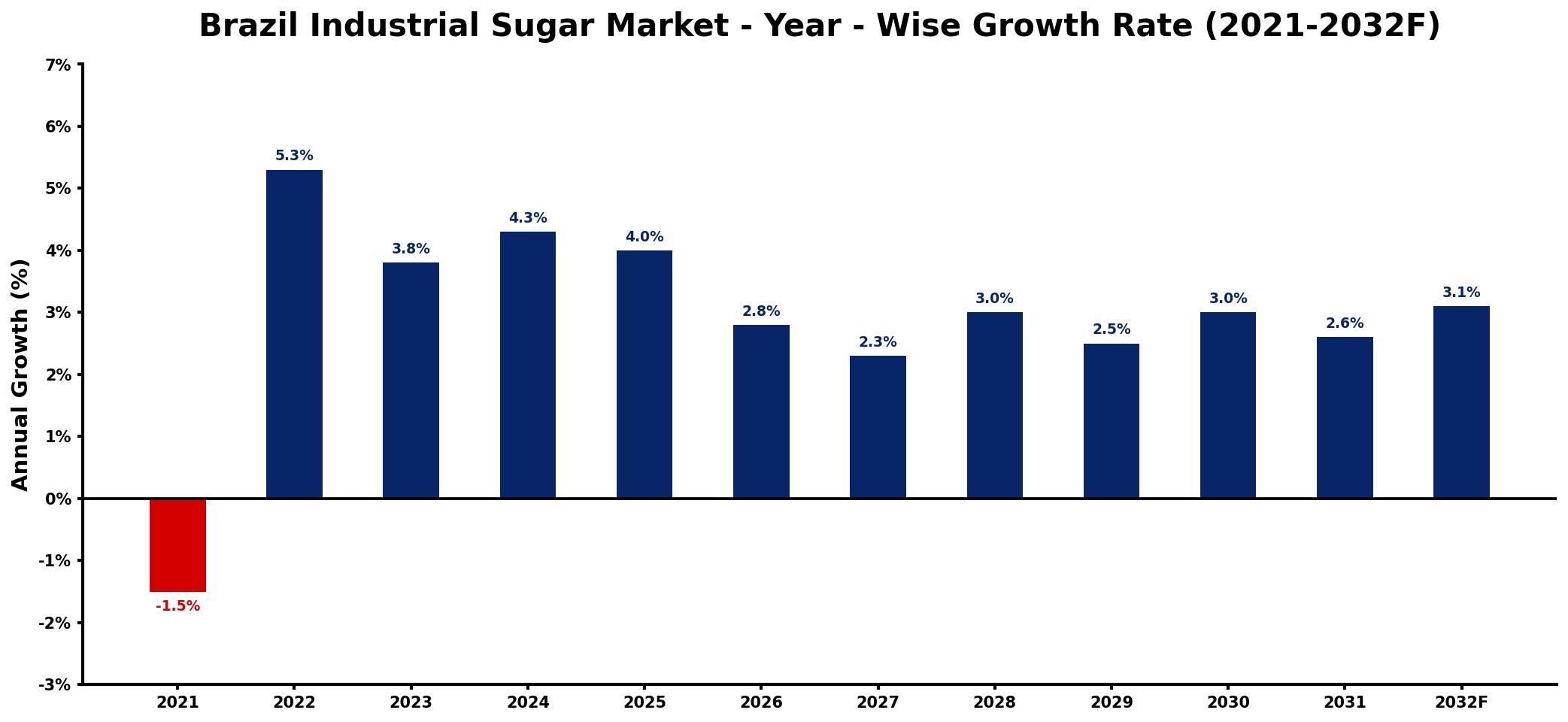
The table below presents the year‑wise growth rates along with the key drivers influencing the market
| Year | Growth Rate | Major Drivers |
| 2021 | -1.5% | decrease in production capacity |
| 2022 | 5.3% | rise in export opportunities |
| 2023 | 3.8% | increased domestic consumption levels |
| 2024 | 4.3% | expansion of processing facilities |
| 2025 | 4.0% | growing investment in technology |
| 2026 | 2.8% | enhanced supply chain efficiency |
| 2027 | 2.3% | demand from renewable energy sector |
| 2028 | 3.0% | growth in food processing industry |
| 2029 | 2.5% | increased use in beverages sector |
| 2030 | 3.0% | strengthening underlying market demand |
| 2031 | 2.6% | rising interest in biofuels |
| 2032 | 3.1% | development of sustainable sourcing |
Note: Market size estimations and growth projections presented in this report are based on 6Wresearch's proprietary forecasting methodology, utilizing the latest available industry data, government publications, and primary research inputs.
Brazil Industrial Sugar Market Synopsis
The strongest force shaping the Brazil Industrial Sugar Market currently is the dual demand from food industries and the renewable energy sector. With Brazil being a global leader in sugar production, the synergy between sugar for consumption and sugar for biofuel is creating a robust market environment.
Sustainability practices are also increasingly influencing market dynamics, as consumers demand responsibly sourced products. Brazilian producers are adopting innovative agricultural practices to enhance productivity while addressing environmental concerns, further driving growth.
Brazil Industrial Sugar Market Key Takeaways
- Brazil is one of the world's largest sugar producers, significantly impacting the global sugar market.
- The food & beverage and renewable energy sectors are primary demand drivers for industrial sugar.
- Investment in sustainable production practices is becoming critical to meet consumer expectations.
- Government policies play a vital role in supporting market growth through subsidies and infrastructure development.
- Market volatility, influenced by external factors like weather and global pricing, necessitates strategic risk management.
Evaluation of Restraints in Brazil Industrial Sugar Market
Despite the promising outlook, the Brazil Industrial Sugar Market faces significant restraints. Environmental sustainability is at the forefront, as producers are pressured to adopt practices that minimize water and energy usage. Furthermore, the inherent volatility in global sugar prices, which can be exacerbated by unpredictable weather patterns and changes in international demand, poses a constant challenge. Stakeholders must navigate these complexities with foresight and strategic planning to maintain their market position and profitability.
Brazil Industrial Sugar Market Trends
Emerging trends in the Brazil Industrial Sugar Market include a marked shift toward organic and sustainably produced sugar. As consumers become increasingly health-conscious, there is a rising preference for sugar alternatives that promise lower caloric content and natural sourcing. Additionally, advancements in production technology, such as precision agriculture and biotechnological innovations, are enhancing yield and quality while addressing sustainability concerns.
Brazil Industrial Sugar Market Opportunities
The industrial sugar market offers substantial growth opportunities, particularly in the realm of value-added products. Innovations in the production of sugar byproducts, such as bioethanol and specialty sugars, can open new revenue streams for producers. Additionally, expanding export markets in regions such as Asia and Europe present a chance for Brazilian producers to enhance their global footprint, capitalizing on Brazil's reputation for high-quality sugar.
Government Initiatives in the Brazil Industrial Sugar Market
The Brazilian government has implemented several initiatives aimed at bolstering the industrial sugar sector. These initiatives include providing financial incentives for sugarcane cultivation, investing in infrastructure to improve logistics and distribution channels, and fostering international trade agreements that enhance market access for Brazilian sugar products. Such efforts are designed to solidify Brazil's position as a leader in the global sugar market.
Future Insights of the Brazil Industrial Sugar Market
Looking ahead to 2026-2032, the Brazil Industrial Sugar Market is poised for continued growth, driven by both domestic and international demand for sugar and its derivatives. The focus on sustainability will likely intensify, pushing producers to innovate in their agricultural practices and processing techniques. Additionally, as global energy trends shift toward renewables, the biofuel sector's reliance on sugarcane is expected to present new opportunities, enhancing Brazil's role as a key player in this evolving market landscape.
Brazil Industrial Sugar Market Latest Developments (2025 - 2026)
Recent developments in the Brazil Industrial Sugar Market indicate a proactive approach to sustainability, with several initiatives launched focusing on reducing the carbon footprint of sugar production. Concurrently, the market has witnessed a surge in investments aimed at modernizing sugar processing facilities, thereby increasing efficiency and output. The integration of technology in supply chain management has also become a focal point, streamlining operations and enhancing product traceability.
Brazil Industrial Sugar Market - Key Attractiveness of the Report
- 10 Years of Market Numbers
- Historical Data Starting from 2022 to 2025
- Base Year: 2025
- Forecast Data until 2032
- Key Performance Indicators Impacting the Market
- Major Upcoming Developments and Projects
Key Highlights of the Report:
- Brazil Industrial Sugar Market Outlook
- Market Size of Brazil Industrial Sugar Market, 2025
- Forecast of Brazil Industrial Sugar Market, 2032
- Historical Data and Forecast of Brazil Industrial Sugar Revenues & Volume for the Period 2022-2032F
- Brazil Industrial Sugar Market Trend Evolution
- Brazil Industrial Sugar Market Drivers and Challenges
- Brazil Industrial Sugar Price Trends
- Brazil Industrial Sugar Porter's Five Forces
- Brazil Industrial Sugar Industry Life Cycle
- Historical Data and Forecast of Brazil Industrial Sugar Market Revenues & Volume By Type for the Period 2022-2032F
- Historical Data and Forecast of Brazil Industrial Sugar Market Revenues & Volume By White sugar for the Period 2022-2032F
- Historical Data and Forecast of Brazil Industrial Sugar Market Revenues & Volume By Brown sugar for the Period 2022-2032F
- Historical Data and Forecast of Brazil Industrial Sugar Market Revenues & Volume By Liquid sugar for the Period 2022-2032F
- Historical Data and Forecast of Brazil Industrial Sugar Market Revenues & Volume By Form for the Period 2022-2032F
- Historical Data and Forecast of Brazil Industrial Sugar Market Revenues & Volume By Granulated for the Period 2022-2032F
- Historical Data and Forecast of Brazil Industrial Sugar Market Revenues & Volume By Powdered for the Period 2022-2032F
- Historical Data and Forecast of Brazil Industrial Sugar Market Revenues & Volume By Syrup for the Period 2022-2032F
- Historical Data and Forecast of Brazil Industrial Sugar Market Revenues & Volume By Application for the Period 2022-2032F
- Historical Data and Forecast of Brazil Industrial Sugar Market Revenues & Volume By Dairy for the Period 2022-2032F
- Historical Data and Forecast of Brazil Industrial Sugar Market Revenues & Volume By Bakery for the Period 2022-2032F
- Historical Data and Forecast of Brazil Industrial Sugar Market Revenues & Volume By Confectionery for the Period 2022-2032F
- Historical Data and Forecast of Brazil Industrial Sugar Market Revenues & Volume By Beverage for the Period 2022-2032F
- Historical Data and Forecast of Brazil Industrial Sugar Market Revenues & Volume By Canned & frozen foods for the Period 2022-2032F
- Historical Data and Forecast of Brazil Industrial Sugar Market Revenues & Volume By Pharmaceuticals for the Period 2022-2032F
- Historical Data and Forecast of Brazil Industrial Sugar Market Revenues & Volume By Other food items for the Period 2022-2032F
- Historical Data and Forecast of Brazil Industrial Sugar Market Revenues & Volume By Source for the Period 2022-2032F
- Historical Data and Forecast of Brazil Industrial Sugar Market Revenues & Volume By Cane sugar for the Period 2022-2032F
- Historical Data and Forecast of Brazil Industrial Sugar Market Revenues & Volume By Beet sugar for the Period 2022-2032F
- Brazil Industrial Sugar Import Export Trade Statistics
- Market Opportunity Assessment By Type
- Market Opportunity Assessment By Form
- Market Opportunity Assessment By Application
- Market Opportunity Assessment By Source
- Brazil Industrial Sugar Top Companies Market Share
- Brazil Industrial Sugar Competitive Benchmarking By Technical and Operational Parameters
- Brazil Industrial Sugar Company Profiles
- Brazil Industrial Sugar Key Strategic Recommendations






































