Brazil IoT Security Market Size & Growth Rate (2026-2032)
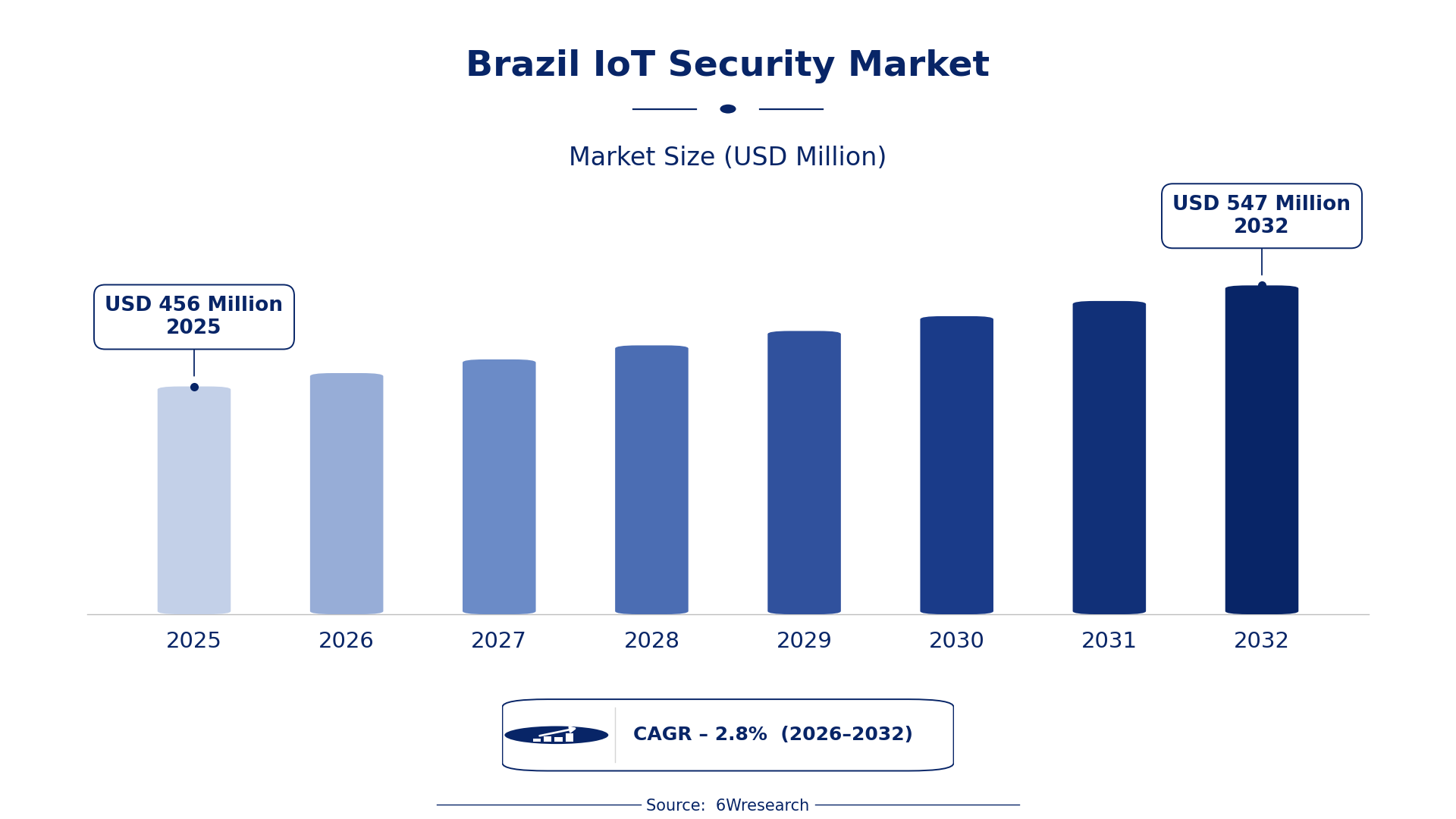
The Brazil IoT Security Market was estimated at USD 456 Million in 2025 and is projected to reach USD 547 Million by 2032, growing at a CAGR of 2.8% from 2026 to 2032.
Brazil IoT Security Market Synopsis
Brazil's IoT security market has witnessed a surge in recent years due to an explosion of connected devices. As industries rapidly embrace IoT solutions, the urgency to address cybersecurity vulnerabilities has escalated, creating a fertile ground for innovative security measures.
Looking ahead, the market is expected to evolve as organizations increasingly prioritize security protocols. With government regulations and rising awareness about cyber threats, the demand for comprehensive IoT security solutions will continue to grow, shaping the future of connected ecosystems in Brazil.
Brazil IoT Security Market Year-wise Growth Rate and Key Drivers
This graph illustrates the annual growth rates of the Brazil IoT Security Market from 2021 to 2032, highlighting a steady upward trajectory and projected expansion over the forecast period.
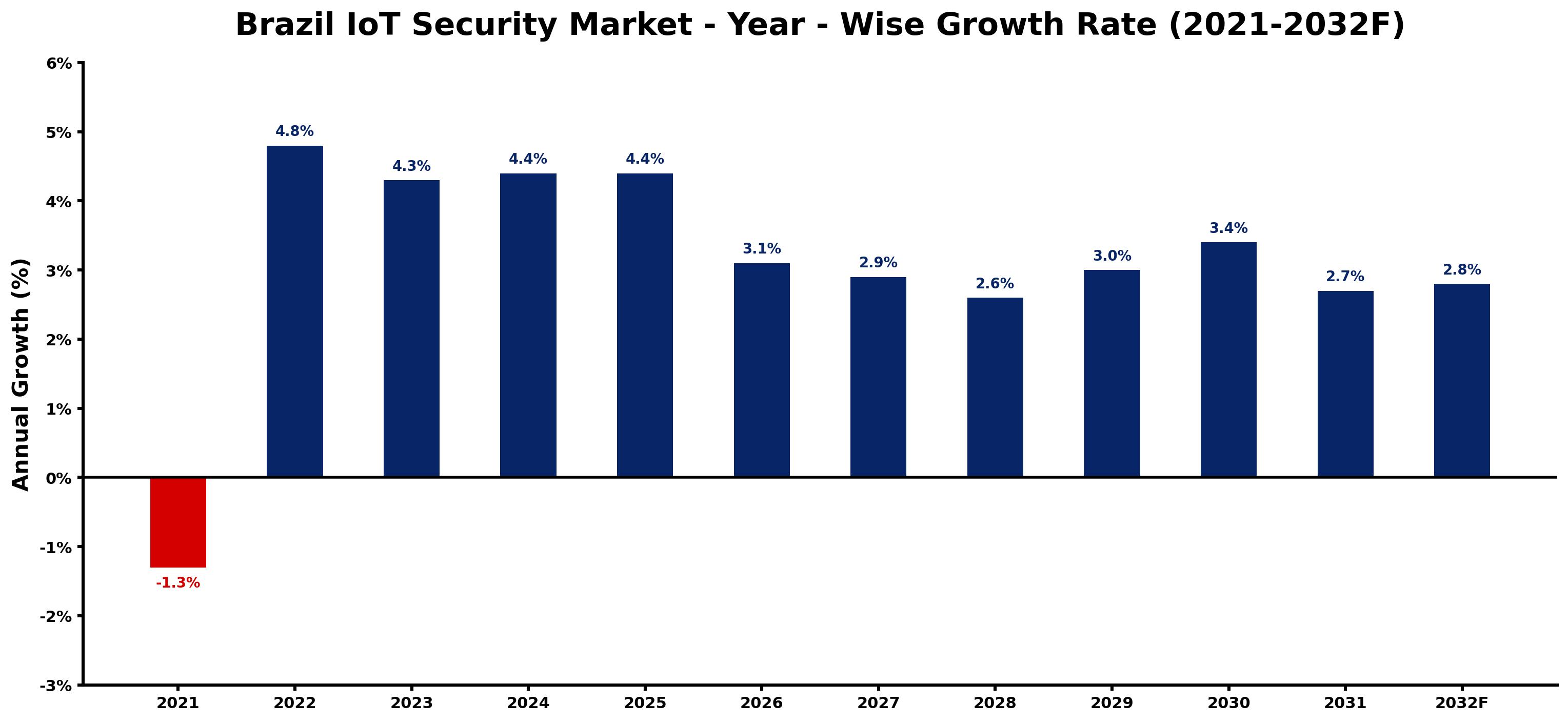
The table below presents the year‑wise growth rates along with the key drivers influencing the market
| Year | Growth Rate | Major Drivers |
| 2021 | -1.3% | Low adoption rates due to regulatory uncertainty from Anatel. |
| 2022 | 4.8% | Increased government focus on IoT cybersecurity regulations. |
| 2023 | 4.3% | Growth in smart city initiatives driving IoT security needs. |
| 2024 | 4.4% | Rise in connected agricultural technologies enhancing security demands. |
| 2025 | 4.4% | Telecom sector's 5G expansion boosting IoT device security focus. |
| 2026 | 3.1% | Launch of national IoT strategic plan fostering security investments. |
| 2027 | 2.9% | Evolving data privacy laws necessitating stronger IoT security measures. |
| 2028 | 2.6% | Surge in remote work leading to increased IoT vulnerabilities. |
| 2029 | 3.0% | Adoption of IoT in industrial sectors amplifying security concerns. |
| 2030 | 3.4% | Integration of IoT health technologies calls for enhanced security. |
| 2031 | 2.7% | Emergence of smart home devices increases consumer security awareness. |
| 2032 | 2.8% | Growing IoT start-ups focus on security solutions developing marketplace. |
Note: Market size estimations and growth projections presented in this report are based on 6Wresearch's proprietary forecasting methodology, utilizing the latest available industry data, government publications, and primary research inputs.
Brazil IoT Security Market Key Takeaways
Below are some of the specific key takeaways from the market, including:
- The market is driven by the increasing deployment of IoT devices across various sectors.
- Key challenges include vulnerabilities in devices and the absence of standardized security protocols.
- Government policies are enhancing the awareness and investment in IoT security solutions.
- Emerging technologies like AI and machine learning are being integrated into security solutions.
- Long-term growth will hinge on proactive measures against evolving cyber threats.
Evaluation of Restraints in Brazil IoT Security Market
Several factors are constraining the growth of the IoT security market in Brazil. A notable restraint is the prevalent inadequacy of security features within many connected devices. Manufacturers often prioritize functionality over security, leaving systems exposed to cyber threats. on top of that, the lack of cohesive security standards hinders the industry's ability to implement effective solutions uniformly. This fragmented approach complicates the development of comprehensive security measures, making it imperative for stakeholders to advocate for robust regulations and standards.
Brazil IoT Security Market Trends
The IoT security market in Brazil is currently witnessing several pivotal trends. A prominent trend is the integration of artificial intelligence and machine learning into security protocols, enabling real-time threat detection and response. Additionally, the shift towards cloud-based security solutions is gaining traction, driven by the need for scalable and flexible security measures. There is also a growing emphasis on data privacy, fueled by regulatory frameworks like the LGPD, compelling organizations to adopt stringent security practices.
Brazil IoT Security Market Opportunities
Opportunities for growth in the Brazil IoT security market are abundant. As businesses recognize the critical importance of cybersecurity, there is a rising demand for advanced encryption technologies and threat intelligence services. The implementation of smart city projects presents an avenue for substantial investment in security solutions tailored to protect public infrastructure. Additionally, as companies transition to digital platforms, the integration of IoT security into existing systems will become a priority, opening doors for innovative service providers.
Government Initiatives in the Brazil IoT Security Market
Government policies in Brazil are increasingly shaping the IoT security market, emphasizing the need for stringent cybersecurity measures. The focus on protecting data and infrastructure is driving investment and regulatory frameworks that ensure organizations prioritize security in their IoT deployments. Such initiatives are essential for fostering a secure digital environment, particularly as cyber threats become more sophisticated.
- A recently completed initiative involves the implementation of new cybersecurity standards for critical infrastructure, enhancing protection against potential cyber threats.
- Ongoing efforts include the establishment of a national cybersecurity strategy aimed at improving the overall security posture of IoT systems across various sectors.
- A planned public-private partnership is expected to launch by 2026, focusing on developing a framework for IoT security best practices.
- The government has introduced training programs for professionals to build expertise in IoT security, ensuring a skilled workforce is available.
Future Insights of the Brazil IoT Security Market
The outlook for the Brazil IoT security market from 2026 to 2032 indicates a steady evolution towards enhanced security measures. As more industries adopt IoT technologies, the importance of comprehensive security frameworks will become paramount. Organizations that proactively invest in security solutions will not only safeguard their assets but will also gain a competitive edge in the market. With continued regulatory support and advancements in technology, the future promises a more secure IoT ecosystem in Brazil.
Brazil IoT Security Market Latest Developments
In the past year, the Brazil IoT security market has experienced notable activity. Organizations are increasingly prioritizing cybersecurity as they expand their IoT infrastructures, reflecting a broader acknowledgment of the associated risks. This shift has prompted a wave of innovation among security vendors aiming to address the unique challenges posed by IoT deployments.
- A major technology vendor launched a new cloud-based IoT security platform in Q2 2025, designed to provide advanced threat detection capabilities.
- An initiative that began in early 2025 is currently underway to establish a national certification program for IoT devices, aimed at ensuring baseline security standards.
- Plans for a collaborative research project between academia and industry to explore IoT security vulnerabilities are expected to commence by late 2026.
- A partnership formed in early 2025 between local businesses aims to develop a shared cybersecurity framework for IoT applications.
Brazil IoT Security Market - Key Attractiveness of the Report
- 10 Years of Market Numbers
- Historical Data Starting from 2022 to 2025
- Base Year: 2025
- Forecast Data until 2032
- Key Performance Indicators Impacting the Market
- Major Upcoming Developments and Projects
Key Highlights of the Report:
- Brazil IoT Security Market Outlook
- Market Size of Brazil IoT Security Market, 2025
- Forecast of Brazil IoT Security Market, 2032
- Historical Data and Forecast of Brazil IoT Security Revenues & Volume for the Period 2022-2032F
- Brazil IoT Security Market Trend Evolution
- Brazil IoT Security Market Drivers and Challenges
- Brazil IoT Security Price Trends
- Brazil IoT Security Porter's Five Forces
- Brazil IoT Security Industry Life Cycle
- Historical Data and Forecast of Brazil IoT Security Market Revenues & Volume By Type for the Period 2022-2032F
- Historical Data and Forecast of Brazil IoT Security Market Revenues & Volume By Network Security for the Period 2022-2032F
- Historical Data and Forecast of Brazil IoT Security Market Revenues & Volume By Endpoint Security for the Period 2022-2032F
- Historical Data and Forecast of Brazil IoT Security Market Revenues & Volume By Application Security for the Period 2022-2032F
- Historical Data and Forecast of Brazil IoT Security Market Revenues & Volume By Cloud Security for the Period 2022-2032F
- Historical Data and Forecast of Brazil IoT Security Market Revenues & Volume By Other Security Types for the Period 2022-2032F
- Historical Data and Forecast of Brazil IoT Security Market Revenues & Volume By Deployment Mode for the Period 2022-2032F
- Historical Data and Forecast of Brazil IoT Security Market Revenues & Volume By Small and Medium Enterprises for the Period 2022-2032F
- Historical Data and Forecast of Brazil IoT Security Market Revenues & Volume By Large Enterprises for the Period 2022-2032F
- Historical Data and Forecast of Brazil IoT Security Market Revenues & Volume By Component for the Period 2022-2032F
- Historical Data and Forecast of Brazil IoT Security Market Revenues & Volume By Solutions for the Period 2022-2032F
- Historical Data and Forecast of Brazil IoT Security Market Revenues & Volume By Services for the Period 2022-2032F
- Historical Data and Forecast of Brazil IoT Security Market Revenues & Volume By Solution for the Period 2022-2032F
- Historical Data and Forecast of Brazil IoT Security Market Revenues & Volume By Identity and Access Management for the Period 2022-2032F
- Historical Data and Forecast of Brazil IoT Security Market Revenues & Volume By Data Encryption and Tokenization for the Period 2022-2032F
- Historical Data and Forecast of Brazil IoT Security Market Revenues & Volume By Intrusion Detection System/Intrusion Prevention System for the Period 2022-2032F
- Historical Data and Forecast of Brazil IoT Security Market Revenues & Volume By Device Authentication and Management for the Period 2022-2032F
- Historical Data and Forecast of Brazil IoT Security Market Revenues & Volume By Secure Communications for the Period 2022-2032F
- Historical Data and Forecast of Brazil IoT Security Market Revenues & Volume By PKI Lifecycle Management for the Period 2022-2032F
- Historical Data and Forecast of Brazil IoT Security Market Revenues & Volume By Distributed Denial of Service Protection for the Period 2022-2032F
- Historical Data and Forecast of Brazil IoT Security Market Revenues & Volume By Security Analytics for the Period 2022-2032F
- Historical Data and Forecast of Brazil IoT Security Market Revenues & Volume By Application Area for the Period 2022-2032F
- Historical Data and Forecast of Brazil IoT Security Market Revenues & Volume By Smart Manufacturing for the Period 2022-2032F
- Historical Data and Forecast of Brazil IoT Security Market Revenues & Volume By Smart Energy and Utilities for the Period 2022-2032F
- Historical Data and Forecast of Brazil IoT Security Market Revenues & Volume By Connected Logistics for the Period 2022-2032F
- Historical Data and Forecast of Brazil IoT Security Market Revenues & Volume By Smart Home and Consumer Electronics for the Period 2022-2032F
- Historical Data and Forecast of Brazil IoT Security Market Revenues & Volume By Connected Healthcare for the Period 2022-2032F
- Historical Data and Forecast of Brazil IoT Security Market Revenues & Volume By Smart Government and Defense for the Period 2022-2032F
- Historical Data and Forecast of Brazil IoT Security Market Revenues & Volume By Smart Retail for the Period 2022-2032F
- Historical Data and Forecast of Brazil IoT Security Market Revenues & Volume By Other Application Areas for the Period 2022-2032F
- Historical Data and Forecast of Brazil IoT Security Market Revenues & Volume By Organization Size for the Period 2022-2032F
- Historical Data and Forecast of Brazil IoT Security Market Revenues & Volume By Small and Medium-sized Enterprises for the Period 2022-2032F
- Historical Data and Forecast of Brazil IoT Security Market Revenues & Volume By Large Enterprises for the Period 2022-2032F
- Historical Data and Forecast of Brazil IoT Security Market Revenues & Volume By Service for the Period 2022-2032F
- Historical Data and Forecast of Brazil IoT Security Market Revenues & Volume By Professional Services for the Period 2022-2032F
- Historical Data and Forecast of Brazil IoT Security Market Revenues & Volume By Managed Services for the Period 2022-2032F
- Brazil IoT Security Import Export Trade Statistics
- Market Opportunity Assessment By Type
- Market Opportunity Assessment By Deployment Mode
- Market Opportunity Assessment By Component
- Market Opportunity Assessment By Solution
- Market Opportunity Assessment By Application Area
- Market Opportunity Assessment By Organization Size
- Market Opportunity Assessment By Service
- Brazil IoT Security Top Companies Market Share
- Brazil IoT Security Competitive Benchmarking By Technical and Operational Parameters
- Brazil IoT Security Company Profiles
- Brazil IoT Security Key Strategic Recommendations






































