Brazil IPTV Market Size, Share & Growth Rate
The Brazil IPTV Market was estimated at USD 236 Million in 2025 and is projected to reach USD 280 Million by 2032, growing at a CAGR of 2.5% from 2026 to 2032. This growth trajectory is fueled by the increasing consumer preference for on-demand and personalized content, as well as the expansion of high-speed broadband networks across the country. As audiences seek more flexibility in viewing options, IPTV solutions are emerging as viable alternatives to traditional broadcast services, contributing to the market's upward momentum.
Brazil IPTV Market Year-wise Growth Rate and Key Drivers
This graph highlights how the Brazil IPTV Market has steadily grown over the years, supported by major growth factors.
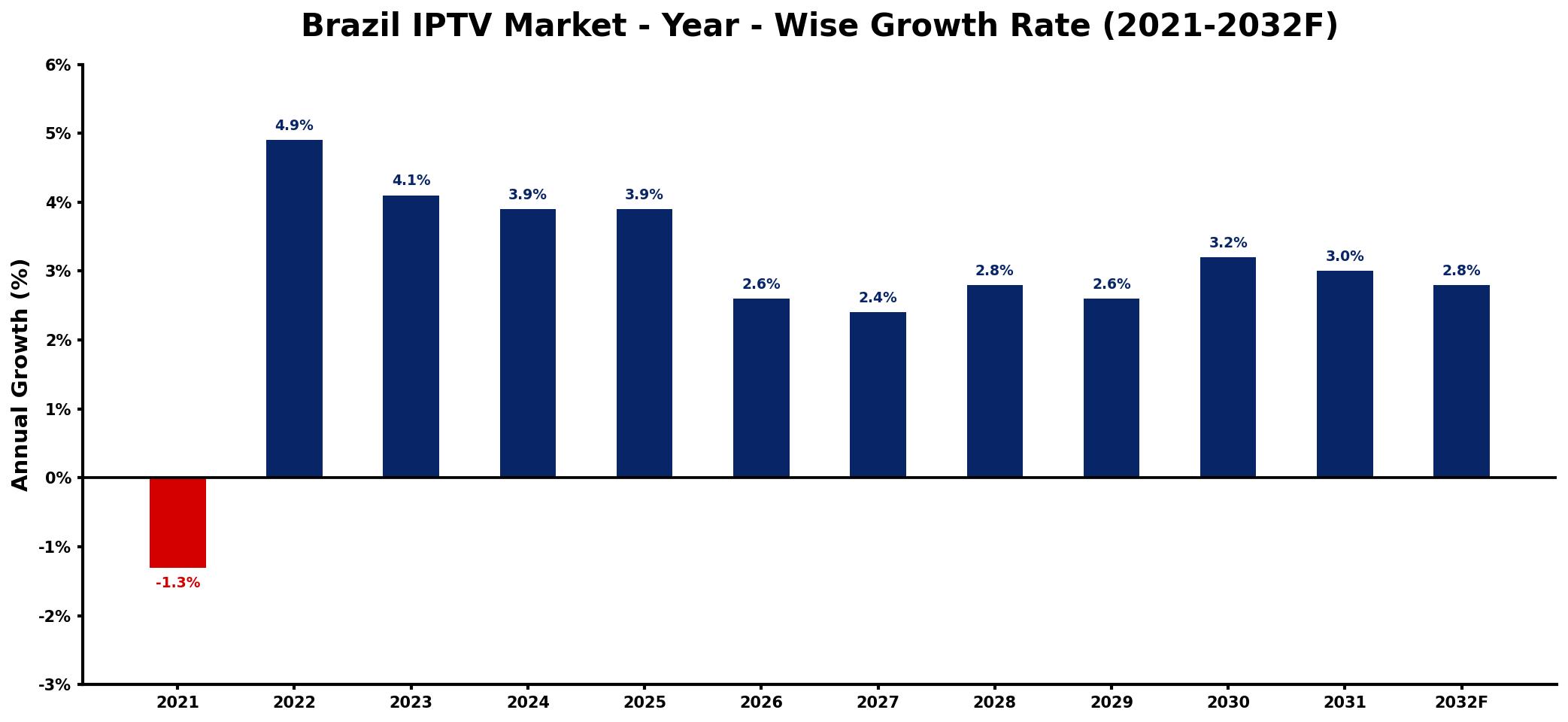
The table below presents the year‑wise growth rates along with the key drivers influencing the market
| Year | Growth Rate | Major Drivers |
| 2021 | -1.3% | Reduced investment in content acquisition |
| 2022 | 4.9% | Increased consumer demand for streaming |
| 2023 | 4.1% | Expansion of broadband infrastructure availability |
| 2024 | 3.9% | Rise in advertising revenue potential |
| 2025 | 3.9% | Enhanced user experience through technology |
| 2026 | 2.6% | Growth in bundled service offerings |
| 2027 | 2.4% | Increase in mobile device usage |
| 2028 | 2.8% | Development of original content production |
| 2029 | 2.6% | Emergence of niche content channels |
| 2030 | 3.2% | Adoption of advanced analytics tools |
| 2031 | 3.0% | Strengthened partnerships with telecom providers |
| 2032 | 2.8% | Broader global content distribution agreements |
Note: Market size estimations and growth projections presented in this report are based on 6Wresearch's proprietary forecasting methodology, utilizing the latest available industry data, government publications, and primary research inputs.
Brazil IPTV Market Synopsis
Recently, the Brazil IPTV market has gained traction, driven by technological advancements and a shift towards customized viewing experiences. However, looking ahead, the market faces critical challenges that need to be addressed to maintain this momentum.
Despite the optimistic growth outlook, hurdles such as bandwidth limitations and content licensing issues loom large. Providers must innovate continuously to adapt to evolving consumer preferences, ensuring they can deliver compelling, uninterrupted service.
Brazil IPTV Market Key Takeaways
- The market is evolving rapidly, driven by a growing demand for on-demand content.
- High-speed broadband expansion is a crucial facilitator of IPTV service adoption.
- IPTV offers a flexible alternative with personalized content, appealing to Brazilian consumers.
- Regulatory frameworks are shaping market dynamics and investment opportunities.
- Challenges such as bandwidth limitations and licensing issues need ongoing attention from providers.
Evaluation of Restraints in Brazil IPTV Market
The Brazilian IPTV market is grappling with several constraints that hinder its growth potential. One major challenge lies in network bandwidth limitations, which can lead to buffering and degraded service quality, frustrating end-users. Additionally, content licensing issues create significant barriers, as acquiring the necessary rights can be complex and costly. Moreover, the increasing competition from over-the-top (OTT) services forces IPTV providers to continually innovate and enhance their offerings to retain customers. Addressing these restraints is essential for IPTV providers looking to capture a larger market share and deliver a superior viewing experience.
Brazil IPTV Market Trends
Several trends are shaping the Brazilian IPTV landscape, with personalization and interactivity taking center stage. Consumers increasingly seek tailored content that fits their preferences, leading IPTV providers to enhance their service offerings with advanced features such as recommendation algorithms and interactive applications. Additionally, the rise of mobile consumption has prompted providers to ensure their platforms are compatible with various devices, facilitating viewing anytime, anywhere. This focus on accessibility and user engagement is driving the ongoing evolution of the market.
Brazil IPTV Market Opportunities
The Brazilian IPTV market is ripe with growth and investment opportunities, especially as broadband infrastructure continues to expand. Providers can capitalize on the rising demand for high-definition channels and interactive features to differentiate themselves in a crowded marketplace. Additionally, strategic partnerships with local content creators can enhance offerings and improve content diversity, catering to the tastes and preferences of Brazilian viewers. Furthermore, tapping into emerging technologies, such as artificial intelligence and machine learning, presents avenues for improving user experiences and operational efficiencies.
Government Initiatives in the Brazil IPTV Market
Government policies in Brazil play a significant role in shaping the IPTV market landscape. Regulatory frameworks focus on ensuring fair competition, enhancing quality standards, and facilitating content licensing processes. By establishing a supportive environment for investment in digital infrastructure, the government can encourage providers to expand their services, which, in turn, protects consumer interests. Continued public spending on telecommunications and media infrastructure can further bolster the growth of IPTV services throughout the country.
Future Insights of the Brazil IPTV Market
As we look towards 2026-2032, the Brazil IPTV market is set to evolve significantly. The anticipated increase in broadband accessibility will likely drive further penetration of IPTV services, while consumer preferences will continue to lean towards interactive and personalized content. The rise of smart home technology and integration with other digital services may create new avenues for IPTV providers, allowing them to enhance viewer engagement. Moreover, responding effectively to regulatory challenges and capitalizing on emerging technologies will be crucial for market players aiming to thrive in this dynamic environment.
Brazil IPTV Market Latest Developments (2025 - 2026)
In recent months, the Brazil IPTV market has seen notable developments driven by advancements in technology and shifts in consumer behavior. Various service providers are experimenting with new user interfaces and content personalization strategies to improve customer engagement. Additionally, collaborations with local content creators and distributors have emerged as providers seek to diversify their content offerings and cater to regional preferences. As the market continues to adapt, stakeholders are focusing on enhancing service quality and expanding their reach through innovative marketing strategies.
Brazil IPTV Market - Key Attractiveness of the Report
- 10 Years of Market Numbers
- Historical Data Starting from 2022 to 2025
- Base Year: 2025
- Forecast Data until 2032
- Key Performance Indicators Impacting the Market
- Major Upcoming Developments and Projects
Key Highlights of the Report:
- Brazil IPTV Market Outlook
- Market Size of Brazil IPTV Market, 2025
- Forecast of Brazil IPTV Market, 2032
- Historical Data and Forecast of Brazil IPTV Revenues & Volume for the Period 2022-2032F
- Brazil IPTV Market Trend Evolution
- Brazil IPTV Market Drivers and Challenges
- Brazil IPTV Price Trends
- Brazil IPTV Porter's Five Forces
- Brazil IPTV Industry Life Cycle
- Historical Data and Forecast of Brazil IPTV Market Revenues & Volume By Component for the Period 2022-2032F
- Historical Data and Forecast of Brazil IPTV Market Revenues & Volume By Hardware (Router, Set-top Box, Receiver, Encoder) for the Period 2022-2032F
- Historical Data and Forecast of Brazil IPTV Market Revenues & Volume By Services (In-house services, Managed services) for the Period 2022-2032F
- Historical Data and Forecast of Brazil IPTV Market Revenues & Volume By Software for the Period 2022-2032F
- Historical Data and Forecast of Brazil IPTV Market Revenues & Volume By Transmission Type for the Period 2022-2032F
- Historical Data and Forecast of Brazil IPTV Market Revenues & Volume By Wired for the Period 2022-2032F
- Historical Data and Forecast of Brazil IPTV Market Revenues & Volume By Wireless for the Period 2022-2032F
- Historical Data and Forecast of Brazil IPTV Market Revenues & Volume By Streaming Type for the Period 2022-2032F
- Historical Data and Forecast of Brazil IPTV Market Revenues & Volume By Non-Video Television for the Period 2022-2032F
- Historical Data and Forecast of Brazil IPTV Market Revenues & Volume By Video Television for the Period 2022-2032F
- Historical Data and Forecast of Brazil IPTV Market Revenues & Volume By Subscription Type for the Period 2022-2032F
- Historical Data and Forecast of Brazil IPTV Market Revenues & Volume By Subscription-based IPTV for the Period 2022-2032F
- Historical Data and Forecast of Brazil IPTV Market Revenues & Volume By Subscription free IPTV for the Period 2022-2032F
- Historical Data and Forecast of Brazil IPTV Market Revenues & Volume By Device Type for the Period 2022-2032F
- Historical Data and Forecast of Brazil IPTV Market Revenues & Volume By Smartphones and tablets for the Period 2022-2032F
- Historical Data and Forecast of Brazil IPTV Market Revenues & Volume By Smart TVs for the Period 2022-2032F
- Historical Data and Forecast of Brazil IPTV Market Revenues & Volume By Desktops and laptops for the Period 2022-2032F
- Historical Data and Forecast of Brazil IPTV Market Revenues & Volume By Application for the Period 2022-2032F
- Historical Data and Forecast of Brazil IPTV Market Revenues & Volume By Linear Television for the Period 2022-2032F
- Historical Data and Forecast of Brazil IPTV Market Revenues & Volume By Non-linear Television for the Period 2022-2032F
- Historical Data and Forecast of Brazil IPTV Market Revenues & Volume By End User for the Period 2022-2032F
- Historical Data and Forecast of Brazil IPTV Market Revenues & Volume By SMEs for the Period 2022-2032F
- Historical Data and Forecast of Brazil IPTV Market Revenues & Volume By Large Enterprises for the Period 2022-2032F
- Historical Data and Forecast of Brazil IPTV Market Revenues & Volume By Residential customers for the Period 2022-2032F
- Historical Data and Forecast of Brazil IPTV Market Revenues & Volume By Vertical for the Period 2022-2032F
- Historical Data and Forecast of Brazil IPTV Market Revenues & Volume By Advertising and marketing for the Period 2022-2032F
- Historical Data and Forecast of Brazil IPTV Market Revenues & Volume By Media and entertainment for the Period 2022-2032F
- Historical Data and Forecast of Brazil IPTV Market Revenues & Volume By Gaming for the Period 2022-2032F
- Historical Data and Forecast of Brazil IPTV Market Revenues & Volume By Online stores for the Period 2022-2032F
- Historical Data and Forecast of Brazil IPTV Market Revenues & Volume By Telecom and IT for the Period 2022-2032F
- Historical Data and Forecast of Brazil IPTV Market Revenues & Volume By Healthcare and medical for the Period 2022-2032F
- Historical Data and Forecast of Brazil IPTV Market Revenues & Volume By Other Verticals (education and manufacturing). for the Period 2022-2032F
- Brazil IPTV Import Export Trade Statistics
- Market Opportunity Assessment By Component
- Market Opportunity Assessment By Transmission Type
- Market Opportunity Assessment By Streaming Type
- Market Opportunity Assessment By Subscription Type
- Market Opportunity Assessment By Device Type
- Market Opportunity Assessment By Application
- Market Opportunity Assessment By End User
- Market Opportunity Assessment By Vertical
- Brazil IPTV Top Companies Market Share
- Brazil IPTV Competitive Benchmarking By Technical and Operational Parameters
- Brazil IPTV Company Profiles
- Brazil IPTV Key Strategic Recommendations






































