Brazil Ladders Market Size, Share & Growth Rate
The Brazil Ladders Market was estimated at USD 208 Million in 2025 and is projected to reach USD 248 Million by 2032, growing at a CAGR of 2.5% from 2026 to 2032. This growth trajectory is primarily driven by the robust expansion of the construction sector, coupled with increasing safety regulations that mandate the use of ladders across various industries. As urbanization continues to flourish in Brazil, the demand for high-quality, reliable ladder solutions remains strong, propelling market resilience amidst economic fluctuations.
Brazil Ladders Market Year-wise Growth Rate and Key Drivers
This graph highlights how the Brazil Ladders Market has steadily grown over the years, supported by major growth factors.
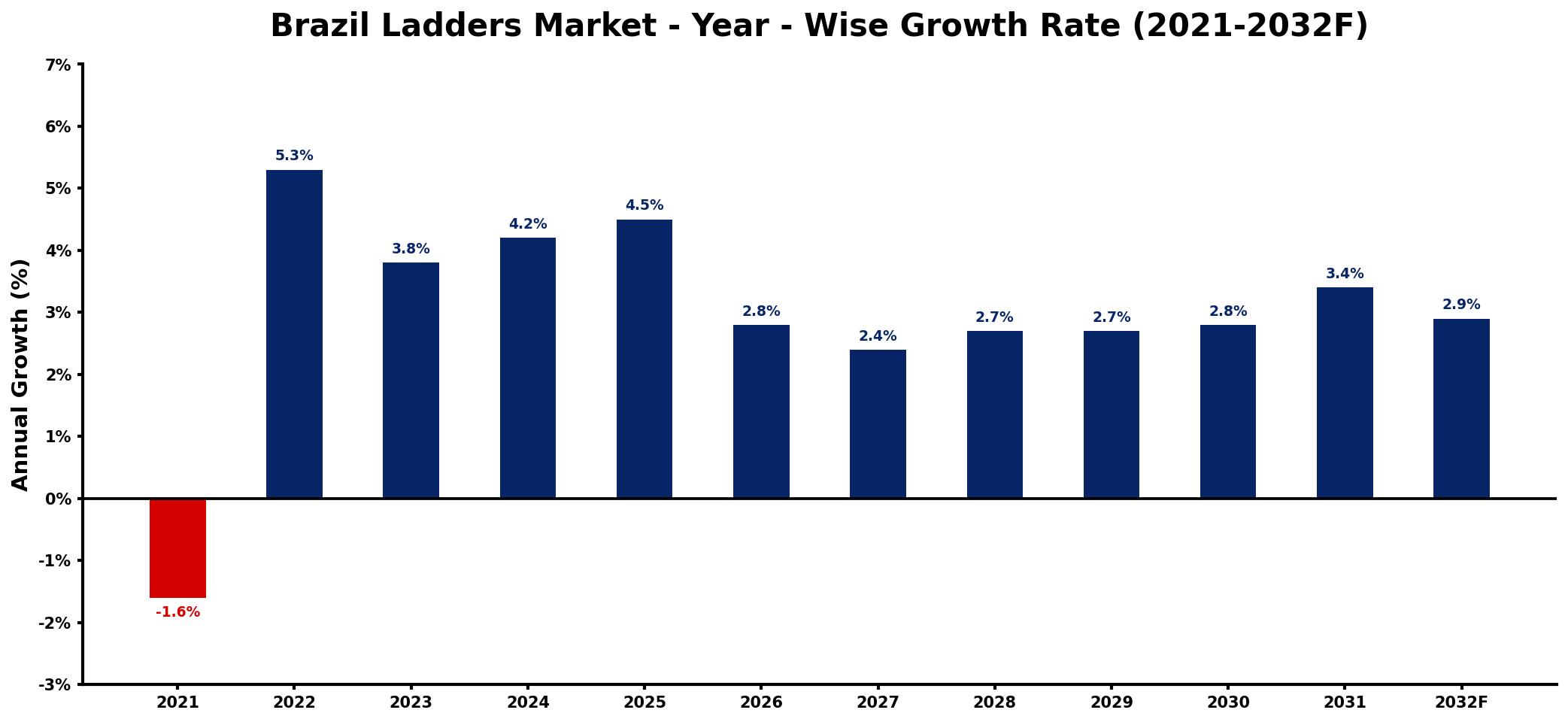
The table below presents the year‑wise growth rates along with the key drivers influencing the market
| Year | Growth Rate | Major Drivers |
| 2021 | -1.6% | Construction activity faced slowdown |
| 2022 | 5.3% | Residential projects drive demand |
| 2023 | 3.8% | Infrastructure investments boost market |
| 2024 | 4.2% | Increased home renovation projects |
| 2025 | 4.5% | Safety regulations enhance growth |
| 2026 | 2.8% | Commercial sector expands rapidly |
| 2027 | 2.4% | Rise in DIY culture observed |
| 2028 | 2.7% | Green building practices adopted |
| 2029 | 2.7% | Technological advancements in materials |
| 2030 | 2.8% | Urbanization increases construction needs |
| 2031 | 3.4% | Government initiatives support development |
| 2032 | 2.9% | E-commerce platforms enhance availability |
Note: Market size estimations and growth projections presented in this report are based on 6Wresearch's proprietary forecasting methodology, utilizing the latest available industry data, government publications, and primary research inputs.
Brazil Ladders Market Synopsis
Recent activity in the Brazil ladders market reflects a period of healthy growth, supported by ongoing construction and maintenance projects. However, as the market navigates economic uncertainty, future trajectories may hinge on external factors, such as governmental policies and infrastructural investments, which could either bolster or impede growth.
The market's dependence on the construction sector illustrates a dual narrative; while the current demand is robust, potential slowdowns could pose risks. Yet, the push for enhanced safety standards fosters innovation, encouraging manufacturers to develop new, safer designs that align with evolving regulatory requirements.
Brazil Ladders Market Key Takeaways
- The market is influenced significantly by the expansion of the construction industry and urban development.
- Government regulations are driving safety compliance and product innovation.
- The current economic climate introduces both opportunities and challenges for market players.
- Fluctuations in construction activity can directly impact ladder demand and sales.
- Manufacturers are focusing on high-quality materials and advanced designs to meet industry standards.
Evaluation of Restraints in Brazil Ladders Market
Despite the promising growth outlook, the Brazil ladders market is constrained by several factors. Economic instability can lead to inconsistent construction activity, hindering overall demand for ladders. Additionally, stringent safety regulations, while necessary, can pose challenges for manufacturers striving to meet compliance while keeping production costs manageable. This dynamic creates a complex environment where innovation must be balanced against economic realities, necessitating strategic planning and foresight from industry stakeholders.
Brazil Ladders Market Trends
Current trends in the Brazil ladders market include a growing emphasis on lightweight, durable materials that enhance usability without compromising safety. Additionally, the integration of smart technologies into ladder design is gaining traction, catering to a more tech-savvy workforce. These innovations not only improve safety and efficiency but also align with modern construction practices that prioritize sustainability and functionality.
Brazil Ladders Market Opportunities
Significant growth opportunities exist within the Brazil ladders market, especially in expanding urban areas. The ongoing government push for infrastructure development creates a fertile ground for investment in ladder manufacturing and design innovation. Furthermore, emerging sectors such as renewable energy and industrial maintenance present new avenues for ladder applications, potentially increasing demand for specialized ladder solutions.
Government Initiatives in the Brazil Ladders Market
The Brazilian government plays a crucial role in shaping the ladders market through policies that prioritize safety and quality in construction. Initiatives aimed at enhancing infrastructure not only support the ladders market but also promote local manufacturing. By fostering innovation and establishing standards, the government aims to ensure that all ladders meet essential safety regulations, thereby improving overall market integrity and consumer confidence.
Future Insights of the Brazil Ladders Market
Looking ahead to 2026-2032, the Brazil ladders market is poised for a phase of dynamic growth fueled by ongoing construction projects and heightened safety standards. The integration of advanced materials and designs will likely reshape product offerings, aligning with environmental considerations and user safety. As the construction sector continues to evolve, maintaining compliance with safety regulations while embracing innovation will be essential for manufacturers aiming to capture a larger market share.
Brazil Ladders Market Latest Developments (2025 - 2026)
In recent months, the Brazil ladders market has witnessed a surge in initiatives focusing on safety compliance and innovation. Manufacturers are increasingly prioritizing the development of products that meet stringent safety standards while incorporating modern materials. Additionally, collaborations between industry stakeholders and government entities are fostering a conducive environment for research and development, highlighting the industry's commitment to enhancing safety and efficiency in ladder design.
Brazil Ladders Market - Key Attractiveness of the Report
- 10 Years of Market Numbers
- Historical Data Starting from 2022 to 2025
- Base Year: 2025
- Forecast Data until 2032
- Key Performance Indicators Impacting the Market
- Major Upcoming Developments and Projects
Key Highlights of the Report:
- Brazil Ladders Market Outlook
- Market Size of Brazil Ladders Market, 2025
- Forecast of Brazil Ladders Market, 2032
- Historical Data and Forecast of Brazil Ladders Revenues & Volume for the Period 2022-2032F
- Brazil Ladders Market Trend Evolution
- Brazil Ladders Market Drivers and Challenges
- Brazil Ladders Price Trends
- Brazil Ladders Porter's Five Forces
- Brazil Ladders Industry Life Cycle
- Historical Data and Forecast of Brazil Ladders Market Revenues & Volume By Application for the Period 2022-2032F
- Historical Data and Forecast of Brazil Ladders Market Revenues & Volume By Industrial for the Period 2022-2032F
- Historical Data and Forecast of Brazil Ladders Market Revenues & Volume By Domestic for the Period 2022-2032F
- Historical Data and Forecast of Brazil Ladders Market Revenues & Volume By Commercial for the Period 2022-2032F
- Brazil Ladders Import Export Trade Statistics
- Market Opportunity Assessment By Application
- Brazil Ladders Top Companies Market Share
- Brazil Ladders Competitive Benchmarking By Technical and Operational Parameters
- Brazil Ladders Company Profiles
- Brazil Ladders Key Strategic Recommendations






































