Brazil Lithographic Printing for Packaging Market Summary
The brazil lithographic printing for packaging market was estimated at USD 231 Million in 2025 and is projected to reach USD 276 Million by 2032, growing at a CAGR of 2.8% from 2026 to 2032.
Brazil Lithographic Printing for Packaging Market Year-wise Growth Rate and Key Drivers
This graph highlights how the Brazil Lithographic Printing for Packaging Market has steadily grown over the past five years, supported by major growth factors.
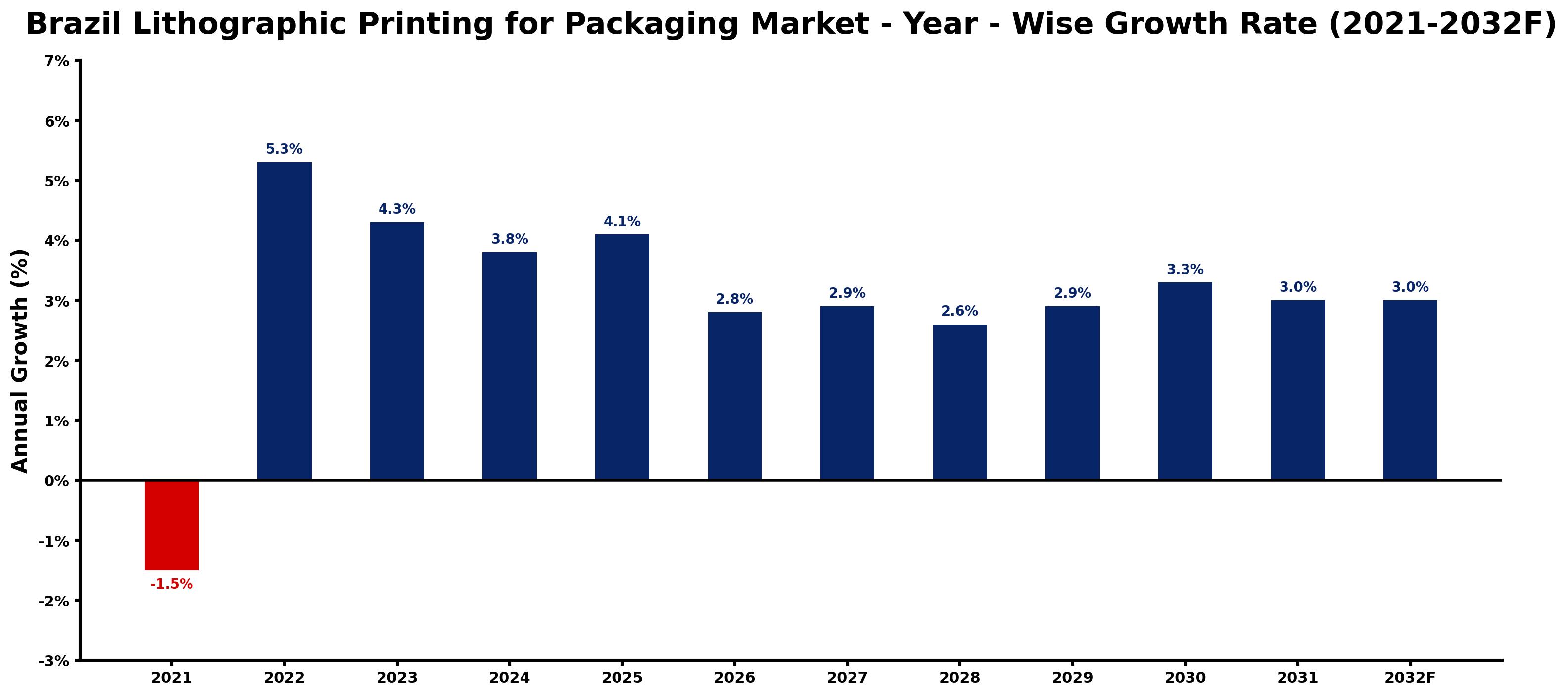
The table below presents the year wise growth rates along with the key drivers influencing the market
| Year | Growth Rate | Major Drivers |
| 2021 | -1.5% | Increased competition from digital alternatives eroded demand for traditional lithographic packaging solutions. |
| 2022 | 5.3% | Investments in sustainable materials become essential for brand differentiation and compliance. |
| 2023 | 4.3% | Technological upgrades in lithographic printing enhance production speed and quality assurance. |
| 2024 | 3.8% | Consumer preference shifts towards eco-friendly packaging, driving innovation in printing methods. |
| 2025 | 4.1% | Local manufacturers prioritize cost-effective packaging solutions amid economic fluctuations. |
| 2026 | 2.8% | Increased export opportunities stimulate competition among lithographic printing service providers. |
| 2027 | 2.9% | Collaboration between brands and printing firms focuses on customized packaging solutions. |
| 2028 | 2.6% | Urbanization trends lead to higher demand for diverse packaging formats in retail. |
| 2029 | 2.9% | Sustainability certifications become a key factor influencing buyer decisions in packaging. |
| 2030 | 3.3% | Digital transformation efforts streamline lithographic printing processes and enhance operational efficiency. |
| 2031 | 3.0% | Changing consumer lifestyles demand versatile packaging, prompting innovative design approaches. |
| 2032 | 3.0% | Integration of AI in printing processes optimizes production, reducing waste and costs. |
Note - Market size estimations and growth projections presented in this report are based on 6Wresearch's advanced forecasting approach, validated with industry datasets as of June 2026.
Brazil Lithographic Printing for Packaging Market Synopsis
The Brazil Lithographic Printing for Packaging Market is projected to reach 2.8% and witness significant growth during the forecast period (2026-2032). This market plays a crucial role in the broader packaging industry, serving key sectors such as food and beverage, pharmaceuticals, and consumer goods. The adoption of advanced printing technologies and innovative sustainability practices are reshaping the landscape, enabling manufacturers to leverage lithographic printing due to its unparalleled quality and versatility.
Brazil Lithographic Printing for Packaging Market Growth Drivers
Several key factors are fueling the growth of the Brazil Lithographic Printing for Packaging Market. The primary drivers include:
- The ongoing expansion of the packaging industry, which is directly linked to the growth of end-user sectors including food and beverages, pharmaceuticals, and cosmetics. Increased consumer demand for packaging that is both functional and visually appealing has elevated the prominence of lithographic printing.
- Improvements in printing technology, which have enhanced the quality and speed of lithographic printing, making it an attractive option for packaging manufacturers aiming for short lead times and high-resolution prints.
- Customization capabilities that lithographic printing offers, allowing brands to differentiate themselves in a competitive market. The ability to tailor packaging designs to specific marketing strategies enhances brand visibility and consumer engagement.
- The rising emphasis on sustainability, driving manufacturers to adopt eco-friendly printing inks and processes. Lithographic printing can meet environmentally-friendly criteria, especially with advancements in water-based inks and recyclable substrates.
- The growing trend of e-commerce, which necessitates innovative and secure packaging solutions. Lithographic printing supports the development of customized packaging that not only protects products during transit but also enhances the customer experience.
Brazil Lithographic Printing for Packaging Market Challenges and Restraints
Despite its growth potential, the Brazil Lithographic Printing for Packaging Market faces several challenges:
- The rise of digital printing technologies presents stiff competition, as digital methods offer quick turnaround times, minimal setup costs, and flexibility for short runs. This shift may limit demand for traditional lithographic printing.
- Growing consumer demand for environmentally friendly packaging solutions pressures manufacturers to adopt sustainable practices and materials, which may require significant investment.
- The rapid evolution of design trends and consumer expectations necessitates continuous innovation and adaptation. Companies that are slow to embrace these changes risk losing market relevance.
- Economic fluctuations and uncertainties can impact consumer spending patterns, subsequently affecting packaging volumes and demand for lithographic printing services.
- The regulatory landscape around environmental compliance is becoming increasingly complex, necessitating ongoing adaptations in production processes to align with government mandates.
Brazil Lithographic Printing for Packaging Market Investment Opportunities
Investment opportunities in the Brazil Lithographic Printing for Packaging Market are abundant as companies seek to enhance their capabilities. Areas of interest include:
- Investments in cutting-edge printing technologies, including hybrid systems that combine lithographic and digital printing to capitalize on the strengths of both methods.
- Research and development initiatives focused on sustainable materials and printing processes, aiming to meet the growing demand for eco-friendly packaging solutions.
- Expansion of packaging facilities to incorporate advanced lithographic printing capabilities, which can cater to larger volumes and more complex projects.
- Partnerships with technology providers that specialize in innovative packaging solutions, ensuring that manufacturers remain at the forefront of market trends.
- Exploration of new market segments, such as personalized or limited-edition packaging for niche products, which can command premium pricing and foster brand loyalty.
Brazil Lithographic Printing for Packaging Market Government Investment and Initiatives
The Brazilian government is actively promoting sustainable practices within the lithographic printing for packaging market. Key initiatives include:
- Implementation of guidelines aimed at increasing the use of eco-friendly materials and processes among packaging manufacturers, thereby reducing the environmental impact of the industry.
- Support for recycling initiatives that encourage the use of recyclable packaging materials, contributing to the overall reduction of waste in the packaging segment.
- Financial incentives for companies that invest in sustainable technologies and processes, making it economically viable for manufacturers to transition to greener practices.
- Public spending on infrastructure improvements in waste management systems, which directly benefit the packaging industry and encourage sustainable practices.
- Collaboration with industry stakeholders to facilitate knowledge sharing and the development of best practices for environmental sustainability within the packaging sector.
Brazil Lithographic Printing for Packaging Market Latest Developments (May 2025 - June 2026)
Recent developments in the Brazil Lithographic Printing for Packaging Market are indicative of a sector undergoing transformation. Key trends observed during this period include:
- An increasing emphasis on sustainability has led many manufacturers to adopt water-based inks and recyclable substrates, aligning with both consumer preferences and government regulations.
- Technological advancements are enabling faster production cycles and higher-quality prints, prompting businesses to upgrade their lithographic equipment to remain competitive.
- There has been a noticeable surge in demand for packaging solutions that cater to e-commerce, with companies investing in packaging that protects products during shipping while still presenting an appealing aesthetic to consumers.
- Collaborative efforts among industry players to develop innovative packaging solutions have increased, fostering an environment of shared advancements in lithographic printing technologies.
- The focus on customization has intensified, with firms exploring personalized packaging options that enhance brand connectivity and consumer engagement.
Brazil Lithographic Printing for Packaging Market - Key Attractiveness of the Report
- 10 Years of Market Numbers
- Historical Data Starting from 2022 to 2025
- Base Year: 2025
- Forecast Data until 2032
- Key Performance Indicators Impacting the Market
- Major Upcoming Developments and Projects
Key Highlights of the Report:
- Brazil Lithographic Printing for Packaging Market Outlook
- Market Size of Brazil Lithographic Printing for Packaging Market, 2025
- Forecast of Brazil Lithographic Printing for Packaging Market, 2032
- Historical Data and Forecast of Brazil Lithographic Printing for Packaging Revenues & Volume for the Period 2022-2032F
- Brazil Lithographic Printing for Packaging Market Trend Evolution
- Brazil Lithographic Printing for Packaging Market Drivers and Challenges
- Brazil Lithographic Printing for Packaging Price Trends
- Brazil Lithographic Printing for Packaging Porter's Five Forces
- Brazil Lithographic Printing for Packaging Industry Life Cycle
- Historical Data and Forecast of Brazil Lithographic Printing for Packaging Market Revenues & Volume By Printing Ink Types for the Period 2022-2032F
- Historical Data and Forecast of Brazil Lithographic Printing for Packaging Market Revenues & Volume By U.V based for the Period 2022-2032F
- Historical Data and Forecast of Brazil Lithographic Printing for Packaging Market Revenues & Volume By Aqueous for the Period 2022-2032F
- Historical Data and Forecast of Brazil Lithographic Printing for Packaging Market Revenues & Volume By Strikethrough for the Period 2022-2032F
- Historical Data and Forecast of Brazil Lithographic Printing for Packaging Market Revenues & Volume By Material for the Period 2022-2032F
- Historical Data and Forecast of Brazil Lithographic Printing for Packaging Market Revenues & Volume By Paper & Paperboard for the Period 2022-2032F
- Historical Data and Forecast of Brazil Lithographic Printing for Packaging Market Revenues & Volume By Plastic for the Period 2022-2032F
- Historical Data and Forecast of Brazil Lithographic Printing for Packaging Market Revenues & Volume By Application for the Period 2022-2032F
- Historical Data and Forecast of Brazil Lithographic Printing for Packaging Market Revenues & Volume By Food & Beverages for the Period 2022-2032F
- Historical Data and Forecast of Brazil Lithographic Printing for Packaging Market Revenues & Volume By Cosmetics & Toiletries for the Period 2022-2032F
- Historical Data and Forecast of Brazil Lithographic Printing for Packaging Market Revenues & Volume By Healthcare for the Period 2022-2032F
- Historical Data and Forecast of Brazil Lithographic Printing for Packaging Market Revenues & Volume By Other? for the Period 2022-2032F
- Brazil Lithographic Printing for Packaging Import Export Trade Statistics
- Market Opportunity Assessment By Printing Ink Types
- Market Opportunity Assessment By Material
- Market Opportunity Assessment By Application
- Brazil Lithographic Printing for Packaging Top Companies Market Share
- Brazil Lithographic Printing for Packaging Competitive Benchmarking By Technical and Operational Parameters
- Brazil Lithographic Printing for Packaging Company Profiles
- Brazil Lithographic Printing for Packaging Key Strategic Recommendations






































