Brazil Logistics Automation Market Size & Growth Rate (2026-2032)
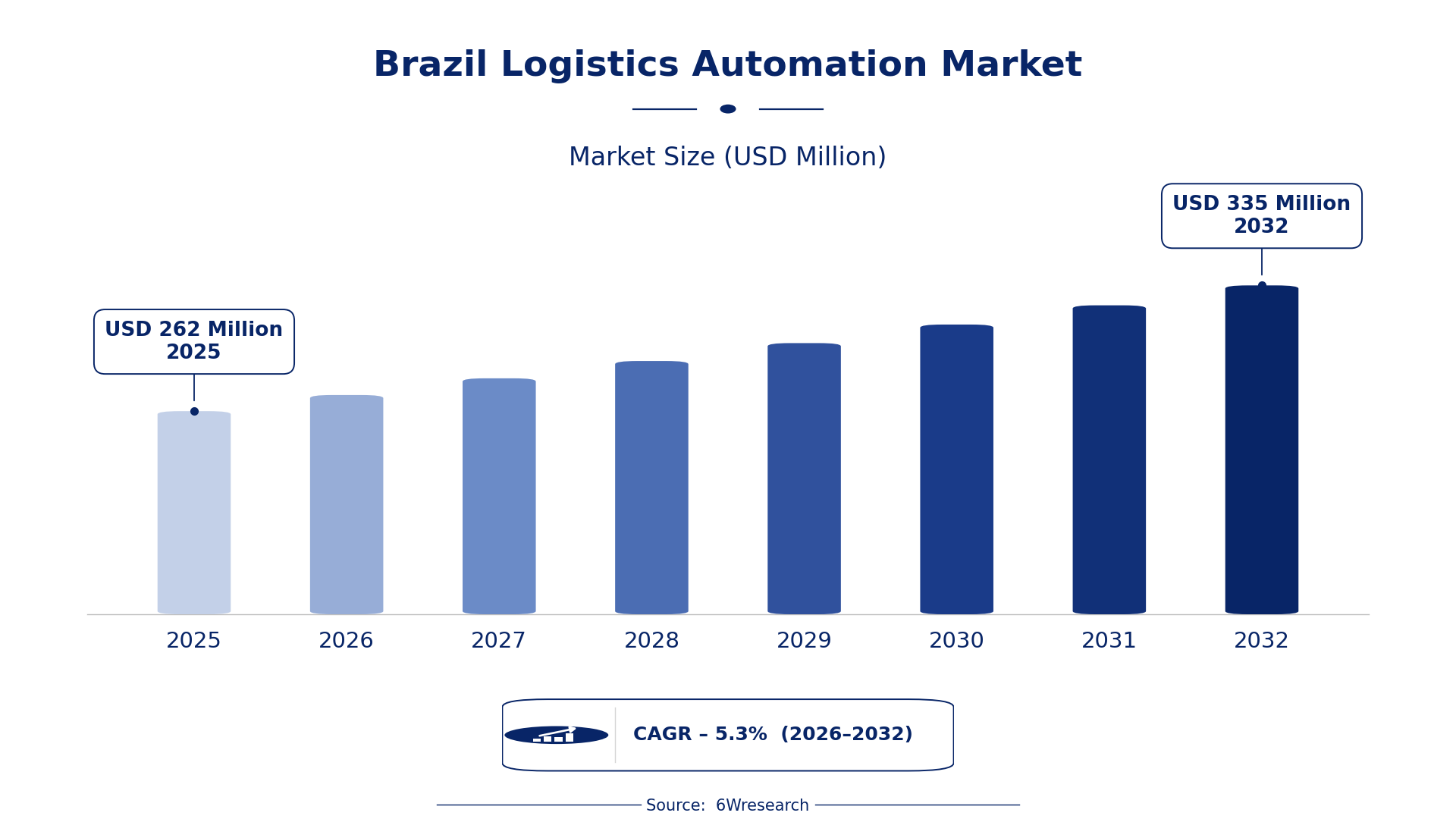
The Brazil Logistics Automation Market was estimated at USD 262 Million in 2025 and is projected to reach USD 335 Million by 2032, growing at a CAGR of 5.3% from 2026 to 2032.
Brazil Logistics Automation Market Synopsis
The most significant force shaping the Brazil Logistics Automation Market today is the relentless demand for efficiency in supply chain operations. As e-commerce continues to surge, logistics providers are compelled to integrate automation solutions to meet customer expectations for speed and accuracy.
With advanced technologies like robotics and artificial intelligence becoming commonplace, Brazilian companies are transforming their logistics operations. This shift not only streamlines processes but also enhances competitiveness in a market that is increasingly focused on fast, reliable delivery services.
Brazil Logistics Automation Market Year-wise Growth Rate and Key Drivers
This graph illustrates the annual growth rates of the Brazil Logistics Automation Market from 2021 to 2032, highlighting a steady upward trajectory and projected expansion over the forecast period.
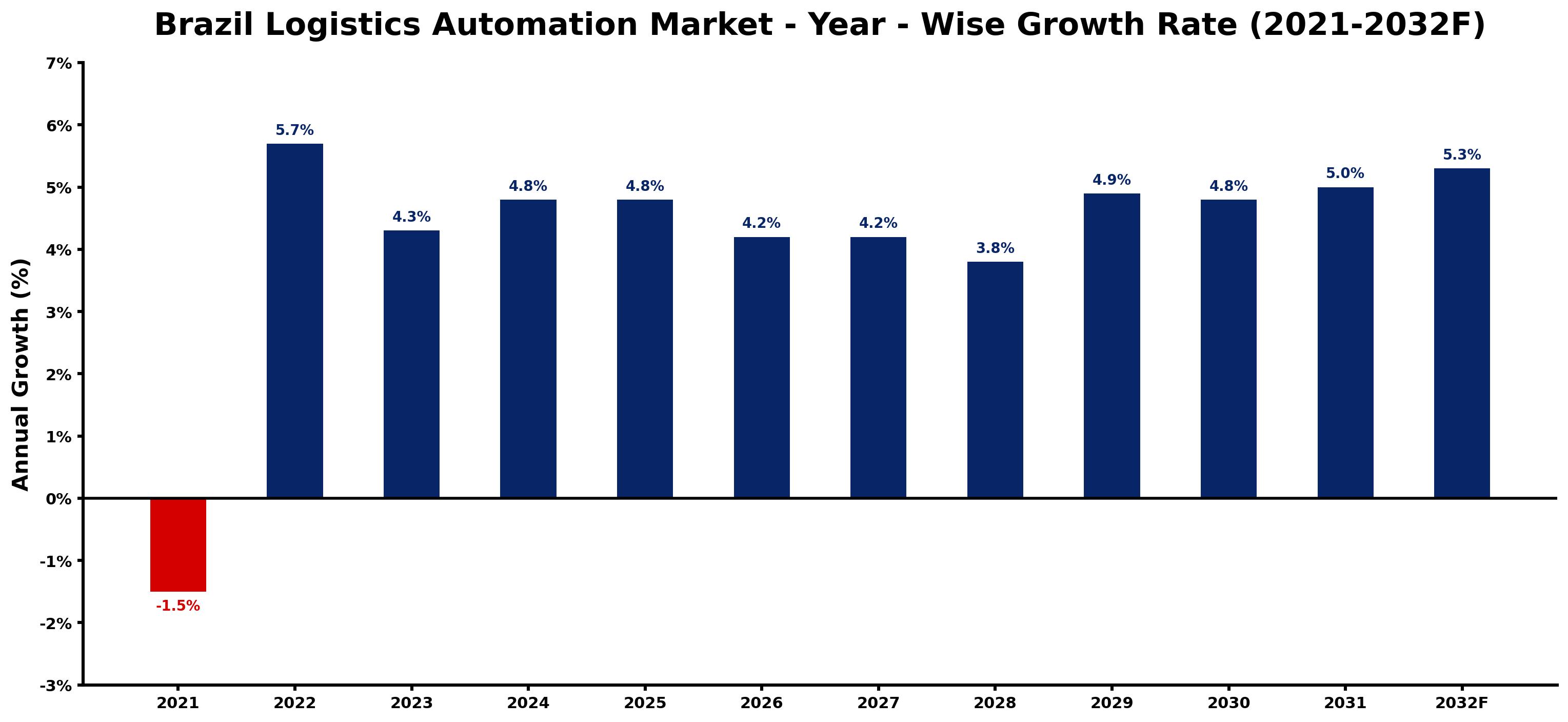
The table below presents the year‑wise growth rates along with the key drivers influencing the market
| Year | Growth Rate | Major Drivers |
| 2021 | -1.5% | High cargo taxes implemented by Brazilian federal government. |
| 2022 | 5.7% | Government tax incentives for automation adoption in logistics. |
| 2023 | 4.3% | Emergence of Brazilian e-commerce boosting warehouse automation needs. |
| 2024 | 4.8% | Investment in logistics tech from local fintech startups. |
| 2025 | 4.8% | Increased efficiency demands from major Brazilian supply chains. |
| 2026 | 4.2% | Adoption of IoT solutions by Brazilian logistics companies. |
| 2027 | 4.2% | Rising labor costs fueling automation technology investments. |
| 2028 | 3.8% | Growth of last-mile delivery services in urban areas. |
| 2029 | 4.9% | Regulatory support for digital transformation in logistics. |
| 2030 | 4.8% | Implementation of AI solutions to streamline operations. |
| 2031 | 5.0% | Partnerships between tech firms and logistics providers expanding. |
| 2032 | 5.3% | Focus on sustainability driving automated supply chain solutions. |
Note: Market size estimations and growth projections presented in this report are based on 6Wresearch's proprietary forecasting methodology, utilizing the latest available industry data, government publications, and primary research inputs.
Brazil Logistics Automation Market Key Takeaways
Below are some of the specific key takeaways from the market, including:
- Growing adoption of robotics and AI is reshaping logistics operations across Brazil.
- Infrastructure constraints and regulatory complexities are key challenges for automation implementation.
- Government policies are increasingly supportive of digital transformation in logistics.
- Investments in warehouse management systems are critical for improving operational efficiency.
- Market growth is driven by the need for enhanced order fulfillment and supply chain agility.
Evaluation of Restraints in Brazil Logistics Automation Market
While the Brazil Logistics Automation Market is on an upward trajectory, several constraints hinder its growth. Infrastructure limitations remain a pressing issue, as many logistics facilities require significant upgrades to accommodate automation technologies. Additionally, navigating the complex regulatory environment can be daunting for companies looking to invest in automation. Compliance with transportation, warehousing, and customs regulations is not just a hurdle; it’s a critical aspect of operational success that can stall progress if not properly managed.
Brazil Logistics Automation Market Trends
Several trends are shaping the future of logistics automation in Brazil. The integration of artificial intelligence into logistics processes is gaining traction, particularly for predictive analytics and demand forecasting. Autonomous vehicles are also becoming more prominent, offering new avenues for efficiency in last-mile delivery. on top of that, the push for sustainability is prompting logistics providers to adopt greener technologies, adding another layer to the automation narrative.
Brazil Logistics Automation Market Opportunities
The landscape is ripe with opportunities for investment and growth in the Brazil Logistics Automation Market. Companies that can capitalize on the demand for faster delivery services will find themselves at a distinct advantage. Investments in advanced warehouse management systems and robotics present significant avenues for operational improvement. Additionally, as the government continues to prioritize infrastructure enhancements, businesses that align their strategies with these initiatives can benefit from increased efficiencies and reduced costs.
Government Initiatives in the Brazil Logistics Automation Market
Government initiatives play a crucial role in shaping the Brazil Logistics Automation Market. The Brazilian government is actively working to improve logistics infrastructure while fostering an environment conducive to e-commerce growth. These initiatives aim to enhance the efficiency of supply chains and encourage the adoption of automation technologies among logistics providers.
- A national digital infrastructure upgrade programme was recently launched to enhance connectivity and support logistics automation.
- Current initiatives are focused on simplifying customs processes to facilitate smoother logistics operations.
- A regulatory framework introduced in 2025 mandates investment in green technologies for logistics providers.
- Upcoming plans include a public-private initiative aimed at expanding transportation networks across major urban centers.
- Ongoing investments in smart warehousing technologies are encouraged through government grants and incentives.
Future Insights of the Brazil Logistics Automation Market
Looking ahead to 2026-2032, the Brazil Logistics Automation Market is set to experience steady growth. As automation technologies become more accessible, smaller logistics providers will begin to adopt these solutions, further driving market expansion. The continued emphasis on customer-centric delivery models will push logistics companies to innovate and optimize their operations. In addition, as the regulatory environment evolves to support automation, businesses that adapt quickly will thrive in this dynamic market.
Brazil Logistics Automation Market Latest Developments
Recent activity in the Brazil Logistics Automation Market indicates a strong trend towards technological adoption and infrastructure improvement. Over the past year, logistics providers have intensified their efforts to integrate automation solutions, responding to growing consumer demands for efficiency and speed.
- A major technology vendor launched a new robotics solution aimed at optimizing warehouse operations in early 2025.
- An ongoing initiative by a leading regional operator focuses on implementing AI-driven supply chain management tools, which began in mid-2025 and remains underway.
- A significant partnership was announced in late 2025 to develop autonomous delivery vehicles, expected to reshape last-mile logistics.
- Plans for a comprehensive training program to equip logistics personnel with automation skills are set to commence in Q3 2026.
Brazil Logistics Automation Market - Key Attractiveness of the Report
- 10 Years of Market Numbers
- Historical Data Starting from 2022 to 2025
- Base Year: 2025
- Forecast Data until 2032
- Key Performance Indicators Impacting the Market
- Major Upcoming Developments and Projects
Key Highlights of the Report:
- Brazil Logistics Automation Market Outlook
- Market Size of Brazil Logistics Automation Market, 2025
- Forecast of Brazil Logistics Automation Market, 2032
- Historical Data and Forecast of Brazil Logistics Automation Revenues & Volume for the Period 2022-2032F
- Brazil Logistics Automation Market Trend Evolution
- Brazil Logistics Automation Market Drivers and Challenges
- Brazil Logistics Automation Price Trends
- Brazil Logistics Automation Porter's Five Forces
- Brazil Logistics Automation Industry Life Cycle
- Historical Data and Forecast of Brazil Logistics Automation Market Revenues & Volume By Function for the Period 2022-2032F
- Historical Data and Forecast of Brazil Logistics Automation Market Revenues & Volume By Inventory and Storage Management for the Period 2022-2032F
- Historical Data and Forecast of Brazil Logistics Automation Market Revenues & Volume By Transportation logistics for the Period 2022-2032F
- Historical Data and Forecast of Brazil Logistics Automation Market Revenues & Volume By Vertical for the Period 2022-2032F
- Historical Data and Forecast of Brazil Logistics Automation Market Revenues & Volume By Retail & eCommerce for the Period 2022-2032F
- Historical Data and Forecast of Brazil Logistics Automation Market Revenues & Volume By Manufacturing for the Period 2022-2032F
- Historical Data and Forecast of Brazil Logistics Automation Market Revenues & Volume By Healthcare & Pharmaceuticals for the Period 2022-2032F
- Historical Data and Forecast of Brazil Logistics Automation Market Revenues & Volume By Food & Beverages for the Period 2022-2032F
- Historical Data and Forecast of Brazil Logistics Automation Market Revenues & Volume By Automotive for the Period 2022-2032F
- Historical Data and Forecast of Brazil Logistics Automation Market Revenues & Volume By Aerospace and Defense for the Period 2022-2032F
- Historical Data and Forecast of Brazil Logistics Automation Market Revenues & Volume By Chemicals for the Period 2022-2032F
- Historical Data and Forecast of Brazil Logistics Automation Market Revenues & Volume By Other Verticals (paper and printing, and textiles and clothing) for the Period 2022-2032F
- Historical Data and Forecast of Brazil Logistics Automation Market Revenues & Volume By Organization Size for the Period 2022-2032F
- Historical Data and Forecast of Brazil Logistics Automation Market Revenues & Volume By SMES for the Period 2022-2032F
- Historical Data and Forecast of Brazil Logistics Automation Market Revenues & Volume By Large Enterprises for the Period 2022-2032F
- Historical Data and Forecast of Brazil Logistics Automation Market Revenues & Volume By Logistics Type for the Period 2022-2032F
- Historical Data and Forecast of Brazil Logistics Automation Market Revenues & Volume By Sales Logistics for the Period 2022-2032F
- Historical Data and Forecast of Brazil Logistics Automation Market Revenues & Volume By Production Logistics for the Period 2022-2032F
- Historical Data and Forecast of Brazil Logistics Automation Market Revenues & Volume By Recovery Logistics for the Period 2022-2032F
- Historical Data and Forecast of Brazil Logistics Automation Market Revenues & Volume By Procurement Logistics for the Period 2022-2032F
- Historical Data and Forecast of Brazil Logistics Automation Market Revenues & Volume By Software Application for the Period 2022-2032F
- Historical Data and Forecast of Brazil Logistics Automation Market Revenues & Volume By Inventory Management for the Period 2022-2032F
- Historical Data and Forecast of Brazil Logistics Automation Market Revenues & Volume By Order Management for the Period 2022-2032F
- Historical Data and Forecast of Brazil Logistics Automation Market Revenues & Volume By Yard Management for the Period 2022-2032F
- Historical Data and Forecast of Brazil Logistics Automation Market Revenues & Volume By Shipping Management for the Period 2022-2032F
- Historical Data and Forecast of Brazil Logistics Automation Market Revenues & Volume By Labor Management for the Period 2022-2032F
- Historical Data and Forecast of Brazil Logistics Automation Market Revenues & Volume By Vendor Management for the Period 2022-2032F
- Historical Data and Forecast of Brazil Logistics Automation Market Revenues & Volume By Customer Support for the Period 2022-2032F
- Brazil Logistics Automation Import Export Trade Statistics
- Market Opportunity Assessment By Function
- Market Opportunity Assessment By Vertical
- Market Opportunity Assessment By Organization Size
- Market Opportunity Assessment By Logistics Type
- Market Opportunity Assessment By Software Application
- Brazil Logistics Automation Top Companies Market Share
- Brazil Logistics Automation Competitive Benchmarking By Technical and Operational Parameters
- Brazil Logistics Automation Company Profiles
- Brazil Logistics Automation Key Strategic Recommendations






































