Brazil Loudspeakers Market Summary
The brazil loudspeakers market was estimated at USD 385 Million in 2025 and is projected to reach USD 463 Million by 2032, growing at a CAGR of 3.1% from 2026 to 2032.
Brazil Loudspeakers Market Year-wise Growth Rate and Key Drivers
This graph highlights how the Brazil Loudspeakers Market has steadily grown over the past five years, supported by major growth factors.
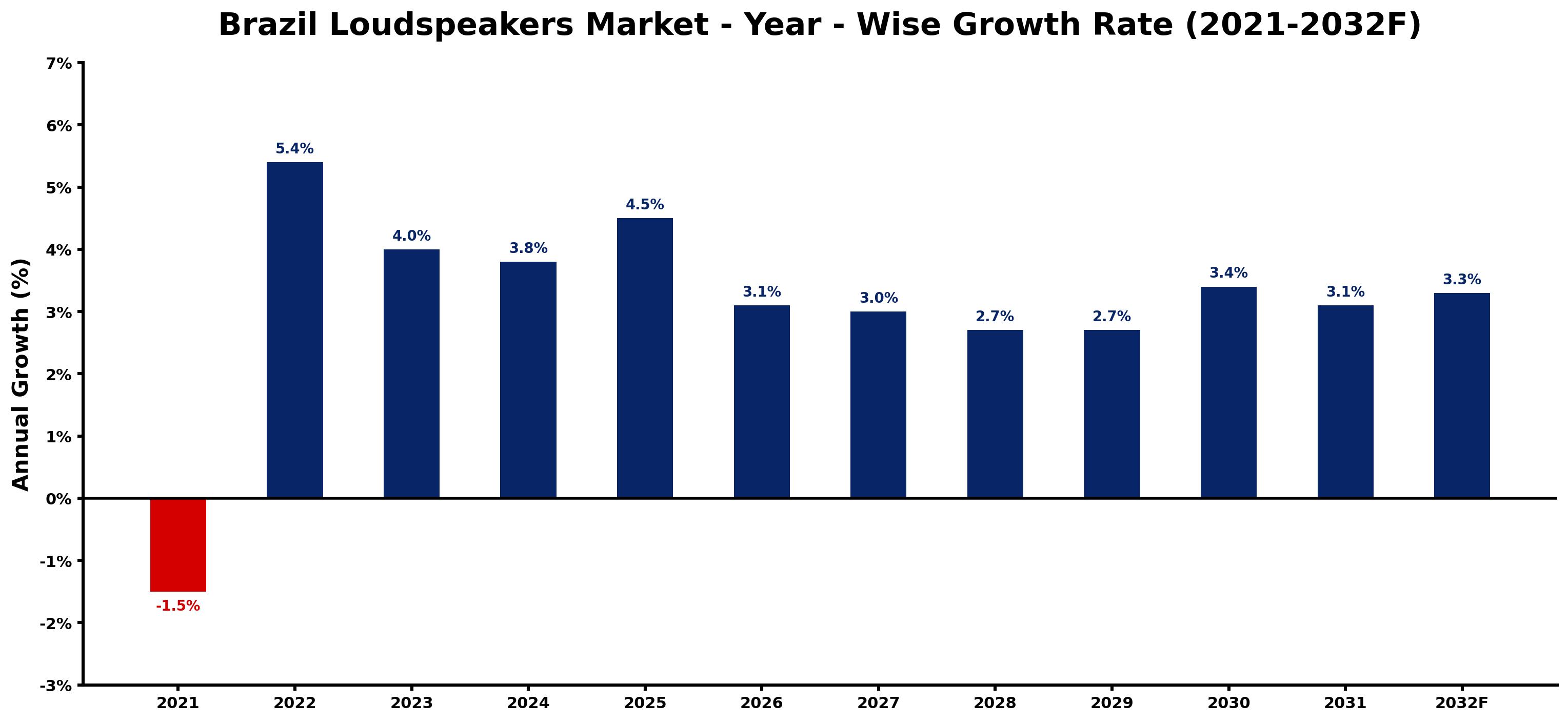
The table below presents the year wise growth rates along with the key drivers influencing the market
| Year | Growth Rate | Major Drivers |
| 2021 | -1.5% | Supply chain disruptions hindered product availability, leading to decreased sales in the Brazilian loudspeakers market. |
| 2022 | 5.4% | Increased urbanization leads to a greater reliance on sound systems for businesses. |
| 2023 | 4.0% | High-quality audio experiences become essential for social gatherings and events. |
| 2024 | 3.8% | Technological innovation improves affordability of premium loudspeaker options for consumers. |
| 2025 | 4.5% | Collaborations between local artists and brands enhance demand for specialized audio products. |
| 2026 | 3.1% | Emerging e-commerce platforms expand access to diverse loudspeaker brands across Brazil. |
| 2027 | 3.0% | Urban nightlife revitalization generates increased sales for professional sound equipment. |
| 2028 | 2.7% | Integration of smart home systems drives demand for connected loudspeaker technologies. |
| 2029 | 2.7% | Rising disposable incomes enable more households to invest in high-end audio solutions. |
| 2030 | 3.4% | Cultural events and festivals boost the need for portable loudspeakers in various regions. |
| 2031 | 3.1% | Sustainability trends influence consumer preferences toward eco-friendly audio products. |
| 2032 | 3.3% | Local manufacturing capabilities reduce import dependencies, enhancing product availability and pricing. |
Note - Market size estimations and growth projections presented in this report are based on 6Wresearch's advanced forecasting approach, validated with industry datasets as of June 2026.
Brazil Loudspeakers Market Synopsis
The Brazil Loudspeakers Market is projected to reach 3.1% and witness significant growth during the forecast period (2026-2032). This market is primarily influenced by evolving consumer preferences, advancements in audio technology, and the integration of loudspeakers in multiple applications such as home entertainment, automotive, and professional audio systems. The interplay of these elements contributes to the market's robustness and diversity, indicating a promising trajectory in the upcoming years.
Brazil Loudspeakers Market Growth Drivers
The growth of the Brazil Loudspeakers Market is being propelled by several key drivers:
- Increased consumer demand for high-quality audio solutions in various settings, from home entertainment systems to commercial venues, reflects a growing appreciation for sound clarity and quality.
- Technological advancements, including the development of more efficient and compact speaker systems, have made high-fidelity sound more accessible to consumers.
- The proliferation of smart devices, such as smartphones and smart home systems, creates a growing market for integrated audio solutions, pushing the demand for compatible loudspeakers.
- The rise in live events, concerts, and entertainment venues drives demand for professional audio systems, which in turn stimulates the overall loudspeakers market.
- Increasing disposable incomes among Brazilian consumers enable more spending on high-end audio equipment, thereby expanding the consumer base for premium loudspeakers.
Brazil Loudspeakers Market Challenges and Restraints
Despite the positive growth trajectory, the Brazil Loudspeakers Market faces significant challenges:
- Technological obsolescence necessitates continuous innovation from manufacturers to meet the evolving demands of consumers who seek the latest advancements in audio quality.
- Changing consumer preferences towards wireless audio solutions pose a threat to traditional loudspeakers, compelling manufacturers to adapt to trends favoring portability and convenience.
- The need for constant investment in research and development can strain resources, particularly for smaller manufacturers trying to compete against larger companies with more significant market share.
- Regulatory challenges, including compliance with safety and sound pollution standards, can complicate manufacturing processes and result in additional costs.
- Market saturation in specific segments may lead to price wars, affecting profit margins and overall sustainability of smaller players in the market.
Brazil Loudspeakers Market Trends and Opportunities
The Brazil Loudspeakers Market is currently seeing various trends that present opportunities for growth:
- The increasing adoption of smart home technology enhances the opportunity for integration of loudspeakers in home automation systems, paving the way for a new wave of consumer demand.
- Growing interest in eco-friendly and sustainable products among consumers is prompting manufacturers to consider using recyclable materials and energy-efficient processes.
- The rise of streaming platforms and content creation encourages the uptake of high-quality audio solutions for personal and professional use, expanding the customer base.
- Emergence of customized audio solutions tailored to specific consumer needs, such as themed parties or specialized events, presents new avenues for product development.
- Investment in local manufacturing may boost the Brazil Loudspeakers Market by reducing import dependency and addressing specific consumer preferences more effectively.
Brazil Loudspeakers Market Government Investment and Initiatives
Government policies in Brazil significantly influence the loudspeakers market. Initiatives aimed at enhancing product quality and safety standards ensure that manufacturers comply with strict regulations, fostering consumer confidence. Public spending on infrastructure projects, such as concert halls and recreational venues, directly impacts the demand for professional audio systems, including loudspeakers. Furthermore, efforts to promote fair trade practices and combat sound pollution further shape the landscape in which manufacturers operate. The government encourages environmentally sustainable production methods by offering incentives for companies that utilize eco-friendly materials and technologies in manufacturing processes.
Brazil Loudspeakers Market Latest Developments (May 2025 - June 2026)
Recent developments in the Brazil Loudspeakers Market from May 2025 to June 2026 indicate a shift towards innovation and sustainability. Manufacturers are increasingly focusing on developing advanced wireless technologies to cater to the growing preference for portable audio solutions. Additionally, events and trade exhibitions have showcased new audio products, highlighting trends in consumer technology integration. Initiatives promoting local manufacturing have gained traction, further bolstering the market environment by creating job opportunities and fostering economic growth. Efforts to regulate sound levels in urban areas have also influenced product design, pushing companies to create quieter and more efficient systems. Overall, these developments reflect the dynamic nature of the Brazil Loudspeakers Market as it adapts to consumer needs and regulatory landscapes.
Brazil Loudspeakers Market - Key Attractiveness of the Report
- 10 Years of Market Numbers
- Historical Data Starting from 2022 to 2025
- Base Year: 2025
- Forecast Data until 2032
- Key Performance Indicators Impacting the Market
- Major Upcoming Developments and Projects
Key Highlights of the Report:
- Brazil Loudspeakers Market Outlook
- Market Size of Brazil Loudspeakers Market, 2025
- Forecast of Brazil Loudspeakers Market, 2032
- Historical Data and Forecast of Brazil Loudspeakers Revenues & Volume for the Period 2022-2032F
- Brazil Loudspeakers Market Trend Evolution
- Brazil Loudspeakers Market Drivers and Challenges
- Brazil Loudspeakers Price Trends
- Brazil Loudspeakers Porter's Five Forces
- Brazil Loudspeakers Industry Life Cycle
- Historical Data and Forecast of Brazil Loudspeakers Market Revenues & Volume By Type for the Period 2022-2032F
- Historical Data and Forecast of Brazil Loudspeakers Market Revenues & Volume By Electric Loudspeaker for the Period 2022-2032F
- Historical Data and Forecast of Brazil Loudspeakers Market Revenues & Volume By Capacitive Loudspeaker for the Period 2022-2032F
- Historical Data and Forecast of Brazil Loudspeakers Market Revenues & Volume By Electromagnetic Loudspeaker for the Period 2022-2032F
- Historical Data and Forecast of Brazil Loudspeakers Market Revenues & Volume By Piezoelectric Loudspeaker for the Period 2022-2032F
- Historical Data and Forecast of Brazil Loudspeakers Market Revenues & Volume By Mounting for the Period 2022-2032F
- Historical Data and Forecast of Brazil Loudspeakers Market Revenues & Volume By Wall-mounted for the Period 2022-2032F
- Historical Data and Forecast of Brazil Loudspeakers Market Revenues & Volume By Portable for the Period 2022-2032F
- Historical Data and Forecast of Brazil Loudspeakers Market Revenues & Volume By Ceiling for the Period 2022-2032F
- Historical Data and Forecast of Brazil Loudspeakers Market Revenues & Volume By Bracket-mounted for the Period 2022-2032F
- Historical Data and Forecast of Brazil Loudspeakers Market Revenues & Volume By Flush-mounted for the Period 2022-2032F
- Historical Data and Forecast of Brazil Loudspeakers Market Revenues & Volume By Sound Level for the Period 2022-2032F
- Historical Data and Forecast of Brazil Loudspeakers Market Revenues & Volume By < 50dB for the Period 2022-2032F
- Historical Data and Forecast of Brazil Loudspeakers Market Revenues & Volume By 51 ? 80dB for the Period 2022-2032F
- Historical Data and Forecast of Brazil Loudspeakers Market Revenues & Volume By >81dB for the Period 2022-2032F
- Historical Data and Forecast of Brazil Loudspeakers Market Revenues & Volume By Applications for the Period 2022-2032F
- Historical Data and Forecast of Brazil Loudspeakers Market Revenues & Volume By Commercial for the Period 2022-2032F
- Historical Data and Forecast of Brazil Loudspeakers Market Revenues & Volume By Agricultural for the Period 2022-2032F
- Historical Data and Forecast of Brazil Loudspeakers Market Revenues & Volume By Educational Institutions for the Period 2022-2032F
- Brazil Loudspeakers Import Export Trade Statistics
- Market Opportunity Assessment By Type
- Market Opportunity Assessment By Mounting
- Market Opportunity Assessment By Sound Level
- Market Opportunity Assessment By Applications
- Brazil Loudspeakers Top Companies Market Share
- Brazil Loudspeakers Competitive Benchmarking By Technical and Operational Parameters
- Brazil Loudspeakers Company Profiles
- Brazil Loudspeakers Key Strategic Recommendations






































