Brazil Lubrication System Market Summary
The brazil lubrication system market was estimated at USD 247 Million in 2025 and is projected to reach USD 294 Million by 2032, growing at a CAGR of 2.9% from 2026 to 2032.
Brazil Lubrication System Market Year-wise Growth Rate and Key Drivers
This graph highlights how the Brazil Lubrication System Market has steadily grown over the past five years, supported by major growth factors.
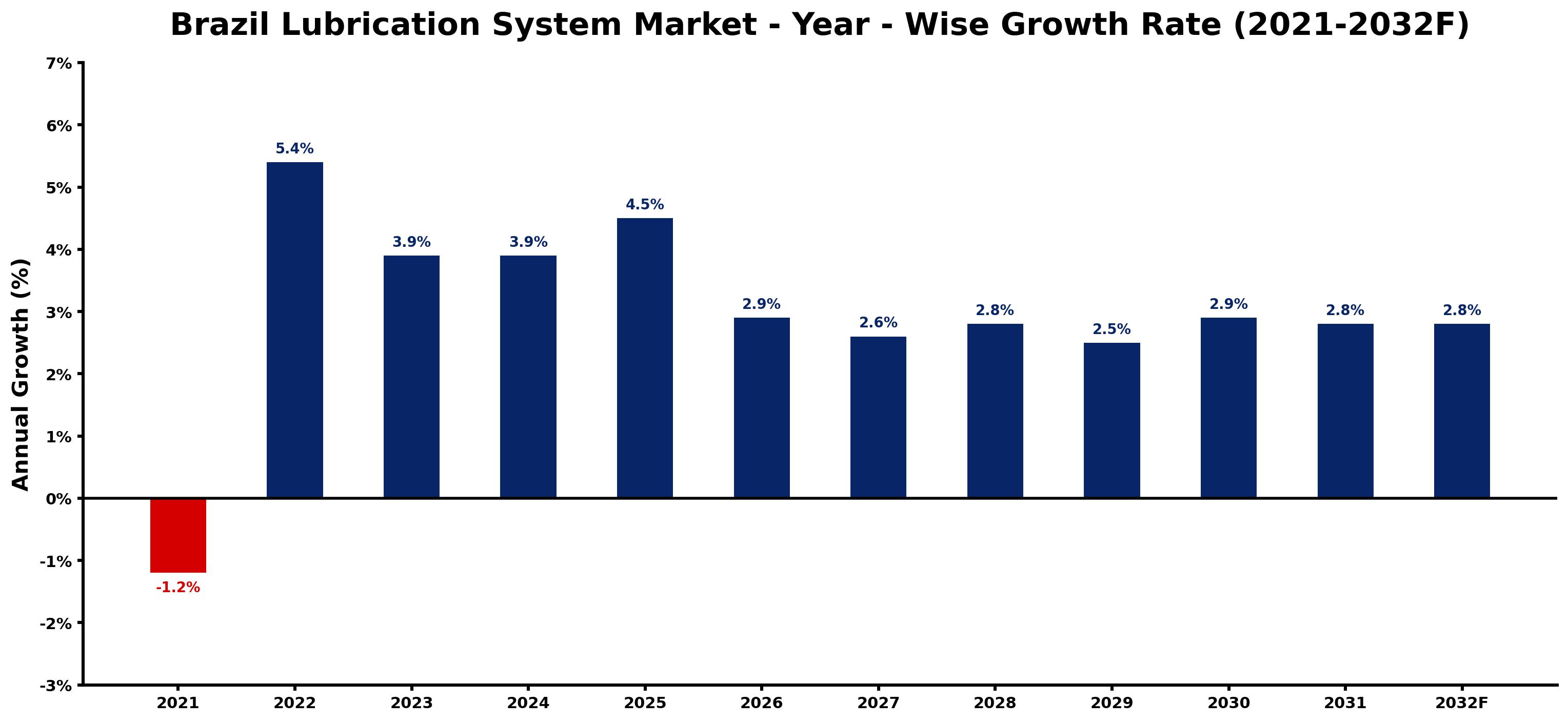
The table below presents the year wise growth rates along with the key drivers influencing the market
| Year | Growth Rate | Major Drivers |
| 2021 | -1.2% | Economic instability and fluctuating oil prices diminished investments in industrial and automotive lubrication systems. |
| 2022 | 5.4% | Local manufacturers optimized supply chains, enhancing efficiency in lubrication solutions. |
| 2023 | 3.9% | Sustainability practices became mainstream, increasing demand for environmentally friendly lubricants. |
| 2024 | 3.9% | Technological innovations in fluid dynamics improved performance in lubrication applications. |
| 2025 | 4.5% | Major infrastructural projects launched, creating opportunities for lubrication system suppliers. |
| 2026 | 2.9% | Increased vehicle production stimulated growth in automotive lubrication system requirements. |
| 2027 | 2.6% | Industrial automation trends led to heightened reliance on advanced lubrication technologies. |
| 2028 | 2.8% | Brazil's export markets expanded, requiring enhanced lubrication systems for compliance. |
| 2029 | 2.5% | Energy sector investments necessitated advanced lubrication for higher efficiency in operations. |
| 2030 | 2.9% | Growing focus on machinery longevity prompted demand for premium lubrication solutions. |
| 2031 | 2.8% | Workforce skills development programs improved maintenance practices for lubrication systems. |
| 2032 | 2.8% | Smart technologies integration became essential, driving innovation in lubrication management systems. |
Note - Market size estimations and growth projections presented in this report are based on 6Wresearch's advanced forecasting approach, validated with industry datasets as of June 2026.
Brazil Lubrication System Market Synopsis
The Brazil Lubrication System Market is projected to reach 2.9% and witness significant growth during the forecast period (2026-2032). This market is essential for optimizing the performance and longevity of machinery across various industries, including manufacturing, automotive, agriculture, and mining. As the demand for efficient machinery operation increases, the adoption of advanced lubrication technologies becomes critical, thereby shaping the overall dynamics of the market.
Brazil Lubrication System Market Growth Drivers
The growth of the Brazil Lubrication System Market is predominantly influenced by multiple factors:
- The increasing focus on machinery maintenance is central to market growth, as industries aim to minimize downtime and enhance productivity through effective lubrication solutions.
- The automotive and manufacturing sectors remain major consumers, continuously pushing for more sophisticated lubrication systems that cater to modern machinery requirements.
- Additionally, the mining industry's expansion necessitates advanced lubrication systems, which can withstand harsh operating conditions while ensuring equipment reliability.
- The rising adoption of automated lubrication systems is driven by their ability to reduce manual intervention, allowing for seamless operations and prolonged equipment lifespan.
- Environmental regulations promoting the use of sustainable and eco-friendly lubricants are becoming increasingly prevalent, encouraging manufacturers to innovate and adapt toward greener solutions.
Brazil Lubrication System Market Challenges and Restraints
Despite the promising growth prospects, the Brazil Lubrication System Market faces several challenges that could hinder its development:
- One significant challenge is the industry's transition towards sustainable solutions, with increasing scrutiny regarding the environmental impact of traditional lubricants and the disposal of used oils.
- Stricter regulations necessitate a shift towards bio-based and biodegradable lubricants, compelling manufacturers to invest in research and development to meet these demands.
- The need for advanced lubrication technologies that enhance equipment efficiency adds a layer of complexity, as companies must continuously innovate to stay competitive.
- Moreover, educating consumers about the benefits of modern lubrication systems and sustainable lubricants is essential for widespread adoption, which may require considerable marketing efforts and investment.
- Market players must also navigate the economic fluctuations and potential supply chain disruptions that can impact the availability of raw materials needed for lubrication system production.
Brazil Lubrication System Market Trends and Opportunities
The Brazil Lubrication System Market is witnessing several trends that present new opportunities for growth:
- There is a noticeable trend towards the automation of lubrication processes, with companies investing in centralized systems capable of delivering precise amounts of lubricant to various machinery parts.
- The increasing integration of IoT technologies into lubrication systems is enabling real-time monitoring and predictive maintenance, enhancing operational efficiency.
- As awareness of environmental issues grows, there is a significant opportunity for players offering eco-friendly lubricants, particularly those that are bio-based or biodegradable.
- Moreover, the push for energy efficiency in industrial operations creates a niche for lubrication systems that reduce friction and enhance machine performance.
- The expansion of the renewable energy sector, particularly in wind energy, is creating demand for specialized lubrication solutions that cater to the unique needs of this industry.
Brazil Lubrication System Market Government Investment and Initiatives
The Brazilian government is actively supporting the lubrication system market through various policies and initiatives aimed at improving product quality and workplace safety. Regulatory frameworks outline strict specifications not only for lubricants but also for their storage and distribution, ensuring compliance with environmental standards. Public spending is directed toward innovation in lubrication technologies, promoting industrial efficiency and competitiveness. Additionally, initiatives encourage research into sustainable alternatives, aligning economic growth with environmental preservation. Such government support is vital for nurturing a sustainable market ecosystem that meets both industrial needs and regulatory expectations.
Brazil Lubrication System Market Latest Developments (May 2025 - June 2026)
Recent developments within the Brazil Lubrication System Market indicate a dynamic evolution of technologies and practices that align with global trends. Companies are increasingly incorporating advanced technologies such as IoT and AI into lubrication systems, enhancing their functionality and providing real-time monitoring capabilities. Innovations in sustainable lubricant formulations are gaining traction, reflecting the growing emphasis on environmental responsibility. Industry collaborations and partnerships are emerging, aimed at pooling resources for research and development of cutting-edge lubrication solutions. Furthermore, there is a notable uptick in training and awareness programs directed at educating both industry professionals and end-users about the advantages of modern lubrication systems.
Brazil Lubrication System Market - Key Attractiveness of the Report
- 10 Years of Market Numbers
- Historical Data Starting from 2022 to 2025
- Base Year: 2025
- Forecast Data until 2032
- Key Performance Indicators Impacting the Market
- Major Upcoming Developments and Projects
Key Highlights of the Report:
- Brazil Lubrication System Market Outlook
- Market Size of Brazil Lubrication System Market, 2025
- Forecast of Brazil Lubrication System Market, 2032
- Historical Data and Forecast of Brazil Lubrication System Revenues & Volume for the Period 2022-2032F
- Brazil Lubrication System Market Trend Evolution
- Brazil Lubrication System Market Drivers and Challenges
- Brazil Lubrication System Price Trends
- Brazil Lubrication System Porter's Five Forces
- Brazil Lubrication System Industry Life Cycle
- Historical Data and Forecast of Brazil Lubrication System Market Revenues & Volume By Line Type for the Period 2022-2032F
- Historical Data and Forecast of Brazil Lubrication System Market Revenues & Volume By Manual Lubrication Systems for the Period 2022-2032F
- Historical Data and Forecast of Brazil Lubrication System Market Revenues & Volume By Automatic Lubrication Systems for the Period 2022-2032F
- Historical Data and Forecast of Brazil Lubrication System Market Revenues & Volume By Product Type for the Period 2022-2032F
- Historical Data and Forecast of Brazil Lubrication System Market Revenues & Volume By Single-Product Lubrication Systems for the Period 2022-2032F
- Historical Data and Forecast of Brazil Lubrication System Market Revenues & Volume By Dual-Product Lubrication Systems for the Period 2022-2032F
- Historical Data and Forecast of Brazil Lubrication System Market Revenues & Volume By Multi-Product Lubrication Systems for the Period 2022-2032F
- Historical Data and Forecast of Brazil Lubrication System Market Revenues & Volume By Series Progressive for the Period 2022-2032F
- Historical Data and Forecast of Brazil Lubrication System Market Revenues & Volume By Circulating Oil for the Period 2022-2032F
- Historical Data and Forecast of Brazil Lubrication System Market Revenues & Volume By Oil & Air for the Period 2022-2032F
- Historical Data and Forecast of Brazil Lubrication System Market Revenues & Volume By Application for the Period 2022-2032F
- Historical Data and Forecast of Brazil Lubrication System Market Revenues & Volume By Cement Plants for the Period 2022-2032F
- Historical Data and Forecast of Brazil Lubrication System Market Revenues & Volume By Steel Industry for the Period 2022-2032F
- Historical Data and Forecast of Brazil Lubrication System Market Revenues & Volume By Mining & Mineral Processing for the Period 2022-2032F
- Historical Data and Forecast of Brazil Lubrication System Market Revenues & Volume By Paper & Printing for the Period 2022-2032F
- Historical Data and Forecast of Brazil Lubrication System Market Revenues & Volume By Automotive for the Period 2022-2032F
- Historical Data and Forecast of Brazil Lubrication System Market Revenues & Volume By Industrial Machine & Machine Tools for the Period 2022-2032F
- Historical Data and Forecast of Brazil Lubrication System Market Revenues & Volume By Construction Machines Machines for the Period 2022-2032F
- Brazil Lubrication System Import Export Trade Statistics
- Market Opportunity Assessment By Line Type
- Market Opportunity Assessment By Product Type
- Market Opportunity Assessment By Application
- Brazil Lubrication System Top Companies Market Share
- Brazil Lubrication System Competitive Benchmarking By Technical and Operational Parameters
- Brazil Lubrication System Company Profiles
- Brazil Lubrication System Key Strategic Recommendations






































