Brazil Manganese Iodide Market Top 5 Importing Countries and Market Competition (HHI) Analysis
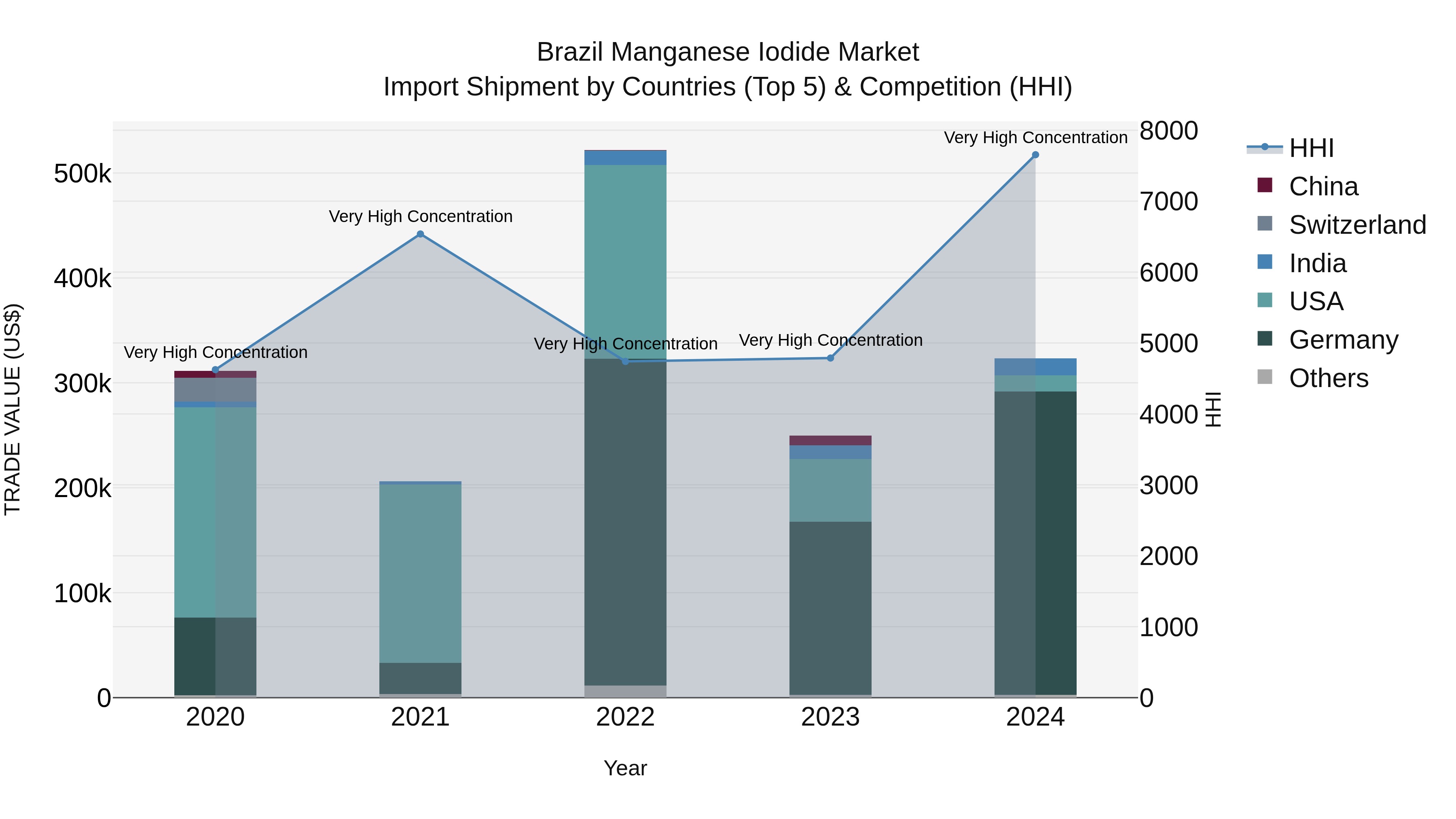
Brazil saw a significant increase in manganese iodide import shipments in 2024, with top exporting countries being Germany, India, USA, Japan, and Australia. Despite a high Herfindahl-Hirschman Index (HHI) indicating concentration, the compound annual growth rate (CAGR) of 0.94% from 2020 to 2024 reflects steady expansion. Notably, the growth rate spiked by 29.42% from 2023 to 2024, signaling a potential uptrend in demand for manganese iodide in the Brazilian market.
Brazil Manganese Iodide Market Overview
Manganese iodide, employed in chemical synthesis and pharmaceuticals, sees steady demand influenced by advancements in drug development and research activities.
Drivers of the market
Manganese iodide market dynamics in Brazil are shaped by factors such as its applications in the pharmaceutical industry, particularly in iodine supplements and medications, advancements in healthcare infrastructure, and regulatory changes impacting pharmaceutical manufacturing.
Challenges of the market
Challenges in the Brazil Manganese Iodide market include regulatory hurdles due to its classification as a hazardous chemical. Safety standards for handling and storage impose additional compliance requirements on market players. Fluctuations in demand from sectors such as pharmaceuticals and chemical synthesis further influence market dynamics.
Government Policy of the market
To ensure the responsible management of manganese iodide, the government has instituted policies to regulate its production and usage in Brazil. These regulations prioritize safety and environmental protection throughout the chemical`s lifecycle.
Key Highlights of the Report:
- Brazil Manganese Iodide Market Outlook
- Market Size of Brazil Manganese Iodide Market, 2024
- Forecast of Brazil Manganese Iodide Market, 2031
- Historical Data and Forecast of Brazil Manganese Iodide Revenues & Volume for the Period 2021-2031
- Brazil Manganese Iodide Market Trend Evolution
- Brazil Manganese Iodide Market Drivers and Challenges
- Brazil Manganese Iodide Price Trends
- Brazil Manganese Iodide Porter's Five Forces
- Brazil Manganese Iodide Industry Life Cycle
- Historical Data and Forecast of Brazil Manganese Iodide Market Revenues & Volume By Application for the Period 2021-2031
- Historical Data and Forecast of Brazil Manganese Iodide Market Revenues & Volume By For CVD / ALD for the Period 2021-2031
- Historical Data and Forecast of Brazil Manganese Iodide Market Revenues & Volume By For Lighting for the Period 2021-2031
- Historical Data and Forecast of Brazil Manganese Iodide Market Revenues & Volume By Other for the Period 2021-2031
- Historical Data and Forecast of Brazil Manganese Iodide Market Revenues & Volume By Type for the Period 2021-2031
- Historical Data and Forecast of Brazil Manganese Iodide Market Revenues & Volume By 99.5% Manganese Iodide for the Period 2021-2031
- Historical Data and Forecast of Brazil Manganese Iodide Market Revenues & Volume By 99.95% Manganese Iodide for the Period 2021-2031
- Historical Data and Forecast of Brazil Manganese Iodide Market Revenues & Volume By 99.999% Manganese Iodide for the Period 2021-2031
- Brazil Manganese Iodide Import Export Trade Statistics
- Market Opportunity Assessment By Application
- Market Opportunity Assessment By Type
- Brazil Manganese Iodide Top Companies Market Share
- Brazil Manganese Iodide Competitive Benchmarking By Technical and Operational Parameters
- Brazil Manganese Iodide Company Profiles
- Brazil Manganese Iodide Key Strategic Recommendations






































