Brazil Manual Pruning Shears Market Size, Share & Growth Rate
The Brazil Manual Pruning Shears Market was estimated at USD 200 Million in 2025 and is projected to reach USD 236 Million by 2032, growing at a CAGR of 2.4% from 2026 to 2032. This growth trajectory is largely fueled by the robust demand within the agricultural and horticultural sectors, where effective plant maintenance tools are essential for enhancing crop yields and ensuring landscape aesthetics. The rising trend in urban gardening and landscaping initiatives also significantly contributes to the expanding market, as consumers increasingly prioritize quality tools for optimal plant care.
Brazil Manual Pruning Shears Market Year-wise Growth Rate and Key Drivers
This graph highlights how the Brazil Manual Pruning Shears Market has steadily grown over the years, supported by major growth factors.
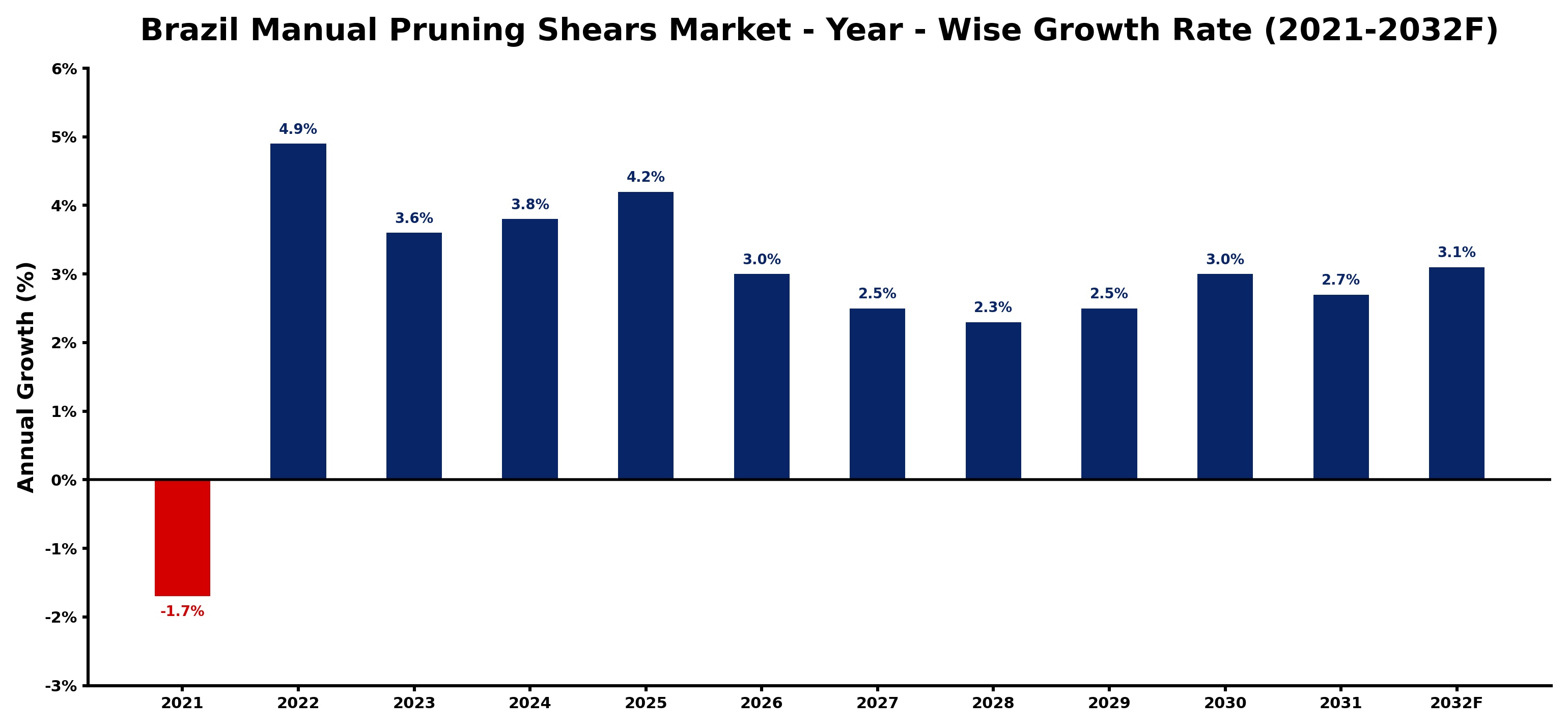
The table below presents the year‑wise growth rates along with the key drivers influencing the market
| Year | Growth Rate | Major Drivers |
| 2021 | -1.7% | Expansion of commercial construction activities |
| 2022 | 4.9% | Increasing industrial automation investments |
| 2023 | 3.6% | Expansion of manufacturing activities |
| 2024 | 3.8% | Expansion of commercial construction activities |
| 2025 | 4.2% | Rapid growth in telecom and data center sectors |
| 2026 | 3.0% | Rising electricity demand across industries |
| 2027 | 2.5% | Increasing adoption of advanced technologies |
| 2028 | 2.3% | Expansion of manufacturing activities |
| 2029 | 2.5% | Rapid growth in telecom and data center sectors |
| 2030 | 3.0% | Expansion of transportation and logistics networks |
| 2031 | 2.7% | Growing renewable energy integration projects |
| 2032 | 3.1% | Expansion of transportation and logistics networks |
Note - Market size estimations and growth projections presented in this report are based on 6Wresearch’s advanced forecasting approach, validated with industry datasets as of June 2026.
Brazil Manual Pruning Shears Market Synopsis
In Brazil, manual pruning shears are not merely tools; they are vital instruments for enhancing productivity in both urban gardens and expansive agricultural lands. Their unique designs, such as bypass and anvil pruners, are tailored to meet diverse pruning needs across various plant types, underscoring the importance of selecting the right tool for specific applications.
The increasing awareness around sustainable gardening practices is driving consumers to seek ergonomically designed and durable pruning shears. This trend is further amplified by government initiatives promoting efficient agricultural practices, where optimal tool selection directly influences productivity and plant health.
Brazil Manual Pruning Shears Market Key Takeaways
- The market is poised for steady growth driven by the agricultural and horticultural sectors.
- Urban gardening and landscaping trends are shaping consumer demand for high-quality pruning tools.
- Government policies are emphasizing ergonomic design and product safety in manual pruning shears.
- Market players face challenges related to product durability and competition from alternative tools.
- The emphasis on training and education in pruning techniques enhances market prospects.
Evaluation of Restraints in Brazil Manual Pruning Shears Market
Despite the optimistic growth forecasts, several restraints may hinder the Brazil Manual Pruning Shears Market. Ergonomic design challenges often plague manufacturers, as tools must not only be effective but also comfortable for extended use. Moreover, product durability and blade sharpness remain critical concerns for both consumers and vendors. The growing competition from alternative pruning solutions, such as electric trimmers, adds another layer of complexity, compelling traditional tool manufacturers to innovate and adapt their offerings. Pricing strategies and distribution channel efficiencies also play a vital role in market penetration and consumer adoption, indicating that strategic planning is essential for capturing market share.
Brazil Manual Pruning Shears Market Trends
Emerging trends in the Brazil Manual Pruning Shears Market reveal a shift towards environmentally friendly practices, with consumers increasingly favoring tools made from sustainable materials. The incorporation of advanced ergonomic designs is also becoming prominent, aimed at reducing user fatigue and enhancing precision. Additionally, as gardening continues to rise in popularity among urban dwellers, the demand for lightweight, versatile pruning shears is expected to grow, aligning with the needs of both novice gardeners and professional landscapers.
Brazil Manual Pruning Shears Market Opportunities
The Brazilian market presents genuine growth opportunities, particularly through innovation in tool design and material. Companies that prioritize research and development can capitalize on the increasing preference for user-friendly and durable tools. Additionally, the expanding e-commerce landscape offers manufacturers new channels to reach diverse consumer segments, enhancing visibility and sales potential. Collaborations with agricultural organizations and gardening communities to promote proper pruning techniques can also unlock further demand for high-quality manual pruning shears.
Government Initiatives in the Brazil Manual Pruning Shears Market
Government initiatives in Brazil significantly impact the manual pruning shears market. Regulatory frameworks are set in place to ensure safety, efficiency, and ergonomic standards in the design and manufacturing of these tools. Programs aimed at promoting best practices in agricultural productivity also encourage proper training in pruning techniques. Furthermore, public spending on agricultural research and education supports innovations that can enhance the functionality and effectiveness of manual pruning shears, ultimately contributing to improved agricultural outcomes.
Future Insights of the Brazil Manual Pruning Shears Market
Looking ahead to the period from 2026 to 2032, the Brazil Manual Pruning Shears Market is expected to evolve significantly. As consumer preferences continue to shift towards sustainability and ergonomic design, manufacturers will need to adapt to these changing demands. Moreover, the expansion of urban gardening and increased agricultural productivity initiatives will likely sustain the growth momentum. The convergence of technology with traditional gardening tools could also pave the way for innovative products that redefine user experience and efficiency in plant care.
Brazil Manual Pruning Shears Market Latest Developments (May 2025 - June 2026)
Recent developments in the Brazil Manual Pruning Shears Market indicate a growing focus on enhancing product offerings through innovative designs and materials. Manufacturers are exploring sustainable alternatives to traditional materials, responding to increasing consumer demand for eco-friendly products. Additionally, efforts to enhance distribution networks are underway, aimed at improving accessibility for both retail and online platforms. Workshops and training programs on proper pruning techniques are gaining traction, fostering a culture of knowledge-sharing that could lead to higher demand for quality tools.
Brazil Manual Pruning Shears Market - Key Attractiveness of the Report
- 10 Years of Market Numbers
- Historical Data Starting from 2022 to 2025
- Base Year: 2025
- Forecast Data until 2032
- Key Performance Indicators Impacting the Market
- Major Upcoming Developments and Projects
Key Highlights of the Report:
- Brazil Manual Pruning Shears Market Outlook
- Market Size of Brazil Manual Pruning Shears Market, 2025
- Forecast of Brazil Manual Pruning Shears Market, 2032
- Historical Data and Forecast of Brazil Manual Pruning Shears Revenues & Volume for the Period 2022-2032F
- Brazil Manual Pruning Shears Market Trend Evolution
- Brazil Manual Pruning Shears Market Drivers and Challenges
- Brazil Manual Pruning Shears Price Trends
- Brazil Manual Pruning Shears Porter's Five Forces
- Brazil Manual Pruning Shears Industry Life Cycle
- Historical Data and Forecast of Brazil Manual Pruning Shears Market Revenues & Volume By Type for the Period 2022-2032F
- Historical Data and Forecast of Brazil Manual Pruning Shears Market Revenues & Volume By Pruning Shears for the Period 2022-2032F
- Historical Data and Forecast of Brazil Manual Pruning Shears Market Revenues & Volume By Hedge Shears for the Period 2022-2032F
- Historical Data and Forecast of Brazil Manual Pruning Shears Market Revenues & Volume By Lopping Shears for the Period 2022-2032F
- Historical Data and Forecast of Brazil Manual Pruning Shears Market Revenues & Volume By Long Reach Pruners for the Period 2022-2032F
- Historical Data and Forecast of Brazil Manual Pruning Shears Market Revenues & Volume By Application for the Period 2022-2032F
- Historical Data and Forecast of Brazil Manual Pruning Shears Market Revenues & Volume By Household for the Period 2022-2032F
- Historical Data and Forecast of Brazil Manual Pruning Shears Market Revenues & Volume By Commercial Use for the Period 2022-2032F
- Brazil Manual Pruning Shears Import Export Trade Statistics
- Market Opportunity Assessment By Type
- Market Opportunity Assessment By Application
- Brazil Manual Pruning Shears Top Companies Market Share
- Brazil Manual Pruning Shears Competitive Benchmarking By Technical and Operational Parameters
- Brazil Manual Pruning Shears Company Profiles
- Brazil Manual Pruning Shears Key Strategic Recommendations






































