Brazil Meat Packaging Market Summary
The brazil meat packaging market was estimated at USD 480 Million in 2025 and is projected to reach USD 573 Million by 2032, growing at a CAGR of 2.7% from 2026 to 2032.
Brazil Meat Packaging Market Year-wise Growth Rate and Key Drivers
This graph highlights how the Brazil Meat Packaging Market has steadily grown over the past five years, supported by major growth factors.
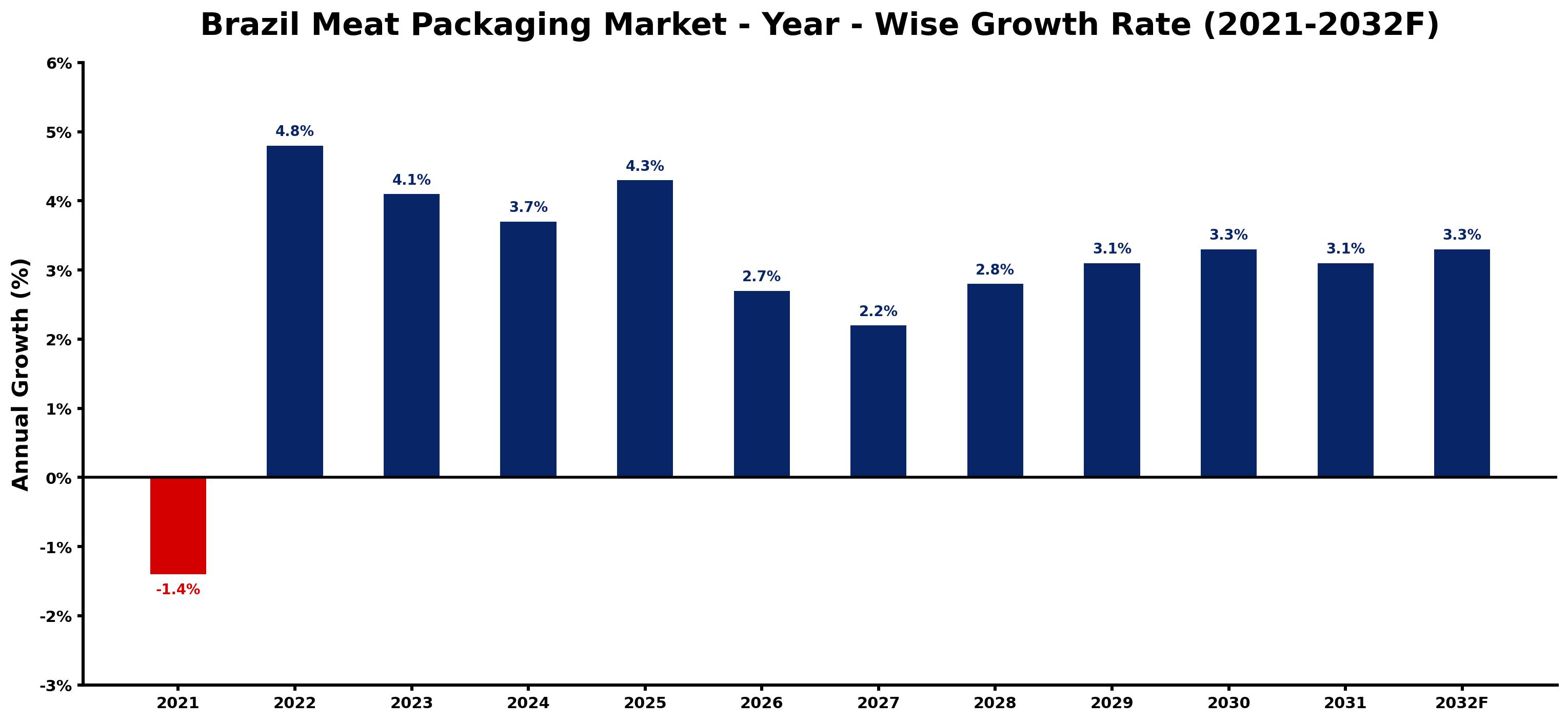
The table below presents the year wise growth rates along with the key drivers influencing the market
| Year | Growth Rate | Major Drivers |
| 2021 | -1.4% | Increased competition from plantbased alternatives undermined traditional meat consumption trends among healthconscious consumers. |
| 2022 | 4.8% | Emerging e-commerce platforms began to reshape meat distribution channels throughout Brazil. |
| 2023 | 4.1% | Innovations in meat packaging technology enhanced product freshness and extended shelf life. |
| 2024 | 3.7% | Sustainability trends prompted meat companies to explore eco-friendly packaging solutions. |
| 2025 | 4.3% | Rising health consciousness among consumers boosted demand for organic and premium meat products. |
| 2026 | 2.7% | Investments in logistics infrastructure improved supply chain efficiency for meat distribution. |
| 2027 | 2.2% | Consumer preference shifted towards ready-to-eat meat products as lifestyles became busier. |
| 2028 | 2.8% | Collaboration between meat producers and packaging firms increased the focus on customization. |
| 2029 | 3.1% | Technological integration into packaging systems streamlined production processes in meat facilities. |
| 2030 | 3.3% | Growing urbanization led to an increase in demand for conveniently packaged meat items. |
| 2031 | 3.1% | Public awareness campaigns highlighted the benefits of properly packaged, safe meat consumption. |
| 2032 | 3.3% | Global meat market fluctuations influenced local packaging strategies and innovation efforts. |
Note - Market size estimations and growth projections presented in this report are based on 6Wresearch's advanced forecasting approach, validated with industry datasets as of June 2026.
Brazil Meat Packaging Market Synopsis
The Brazil Meat Packaging Market is projected to reach 2.7% and witness significant growth during the forecast period (2026-2032). This growth is intricately tied to Brazil's esteemed status within the global meat industry, wherein packaging solutions must cater to the unique requirements of both fresh and processed meat products. Emphasizing hygiene, shelf life, and consumer convenience, the sector is evolving in response to stringent regulations and heightened consumer awareness.
Brazil Meat Packaging Market Growth Drivers
Several factors are propelling the Brazil Meat Packaging Market forward. The burgeoning meat industry creates robust demand for packaged and processed meat products, driven by shifting consumer lifestyles and preferences.
- The increasing preference for convenience foods is leading consumers to seek products that are easy to prepare, resulting in higher demand for well-packaged, ready-to-eat meat items.
- Heightened hygiene and safety concerns have prompted consumers to gravitate toward advanced packaging solutions that ensure product integrity and freshness.
- Technological innovations in packaging materials, including biodegradable options, are gaining traction as consumers become more environmentally conscious.
- Growing urbanization is contributing to changing dietary habits, which in turn is fostering a demand for processed meats packaged for extended shelf life.
- The rise in e-commerce and retail channels for meat distribution is further enhancing the significance of effective packaging to maintain quality during transit.
Brazil Meat Packaging Market Challenges and Restraints
Despite the favorable growth trajectory, the Brazil Meat Packaging Market faces several challenges that could impact its expansion.
- Compliance with stringent hygiene and safety standards remains a critical hurdle, requiring continuous investment in quality control measures.
- The push for sustainable and eco-friendly packaging solutions poses logistical challenges, as manufacturers must balance cost with environmental responsibility.
- Fluctuating meat prices can create uncertainty in the supply chain, affecting the packaging sector's stability and profitability.
- Consumer preferences increasingly lean towards minimalistic and informative packaging, requiring continuous adaptation by producers to meet expectations.
- The complexities of supply chain logistics in Brazil add pressure on the efficient distribution of packaged meats, potentially affecting freshness and quality.
Brazil Meat Packaging Market Government Investment and Initiatives
Government policies play a pivotal role in shaping the Brazil Meat Packaging Market, with a focus on food safety, traceability, and sustainability. Regulatory bodies enforce stringent quality control measures and packaging standards to ensure the integrity of meat products throughout the supply chain.
- The government actively promotes food safety initiatives, which include funding for research into innovative packaging technologies that enhance shelf life and reduce food waste.
- Public spending aimed at enhancing infrastructure in the meat processing and packaging sectors ensures better compliance with international standards.
- Incentives for adopting sustainable packaging materials are being offered, making it easier for producers to transition to eco-friendly alternatives.
- Collaboration between government agencies and industry stakeholders is encouraged to foster innovation in packaging design, addressing both consumer needs and regulatory requirements.
- Ongoing training programs for producers focus on the importance of packaging in maintaining product safety and quality, helping to elevate industry standards.
Brazil Meat Packaging Market Latest Developments (May 2025 - June 2026)
The Brazil Meat Packaging Market is witnessing a dynamic shift characterized by advancements in packaging technology and sustainability practices. During this period, there has been an increased focus on innovative materials that enhance product preservation while reducing environmental impact.
- Numerous initiatives have emerged aimed at integrating smart packaging solutions, enabling real-time monitoring of meat quality throughout the supply chain.
- There is a noticeable trend towards reusable and recyclable packaging options as companies strive to align with consumer preferences for sustainability.
- Regulatory updates have led to stricter compliance requirements, prompting companies to invest in state-of-the-art packaging machinery to meet high standards.
- Collaborative efforts between manufacturers and technology providers are fostering innovations in vacuum sealing and modified atmosphere packaging, vital for extending shelf life.
- Consumer education campaigns have begun to emphasize the importance of packaging in food safety, influencing buying decisions towards brands that prioritize quality packaging.
Brazil Meat Packaging Market - Key Attractiveness of the Report
- 10 Years of Market Numbers
- Historical Data Starting from 2022 to 2025
- Base Year: 2025
- Forecast Data until 2032
- Key Performance Indicators Impacting the Market
- Major Upcoming Developments and Projects
Key Highlights of the Report:
- Brazil Meat Packaging Market Outlook
- Market Size of Brazil Meat Packaging Market, 2025
- Forecast of Brazil Meat Packaging Market, 2032
- Historical Data and Forecast of Brazil Meat Packaging Revenues & Volume for the Period 2022-2032F
- Brazil Meat Packaging Market Trend Evolution
- Brazil Meat Packaging Market Drivers and Challenges
- Brazil Meat Packaging Price Trends
- Brazil Meat Packaging Porter's Five Forces
- Brazil Meat Packaging Industry Life Cycle
- Historical Data and Forecast of Brazil Meat Packaging Market Revenues & Volume By Material Type for the Period 2022-2032F
- Historical Data and Forecast of Brazil Meat Packaging Market Revenues & Volume By Plastic for the Period 2022-2032F
- Historical Data and Forecast of Brazil Meat Packaging Market Revenues & Volume By Rigid? for the Period 2022-2032F
- Historical Data and Forecast of Brazil Meat Packaging Market Revenues & Volume By Metal for the Period 2022-2032F
- Historical Data and Forecast of Brazil Meat Packaging Market Revenues & Volume By Meat Type for the Period 2022-2032F
- Historical Data and Forecast of Brazil Meat Packaging Market Revenues & Volume By Fresh and Frozen for the Period 2022-2032F
- Historical Data and Forecast of Brazil Meat Packaging Market Revenues & Volume By Processed for the Period 2022-2032F
- Historical Data and Forecast of Brazil Meat Packaging Market Revenues & Volume By Ready to Eat for the Period 2022-2032F
- Brazil Meat Packaging Import Export Trade Statistics
- Market Opportunity Assessment By Material Type
- Market Opportunity Assessment By Meat Type
- Brazil Meat Packaging Top Companies Market Share
- Brazil Meat Packaging Competitive Benchmarking By Technical and Operational Parameters
- Brazil Meat Packaging Company Profiles
- Brazil Meat Packaging Key Strategic Recommendations






































