Brazil Medical Gases Market Top 5 Importing Countries and Market Competition (HHI) Analysis
In 2024, Brazil`s medical gases import market saw significant growth, with the top exporting countries being the USA, China, Italy, Philippines, and Paraguay. The market concentration shifted from low to moderate, indicating increased competition among suppliers. The impressive compound annual growth rate (CAGR) of 21.71% from 2020 to 2024, coupled with a remarkable growth rate of 42.93% from 2023 to 2024, reflects a thriving market with expanding opportunities for both domestic and international players. Brazil`s medical gases import sector presents a promising landscape for stakeholders looking to capitalize on this upward trend.
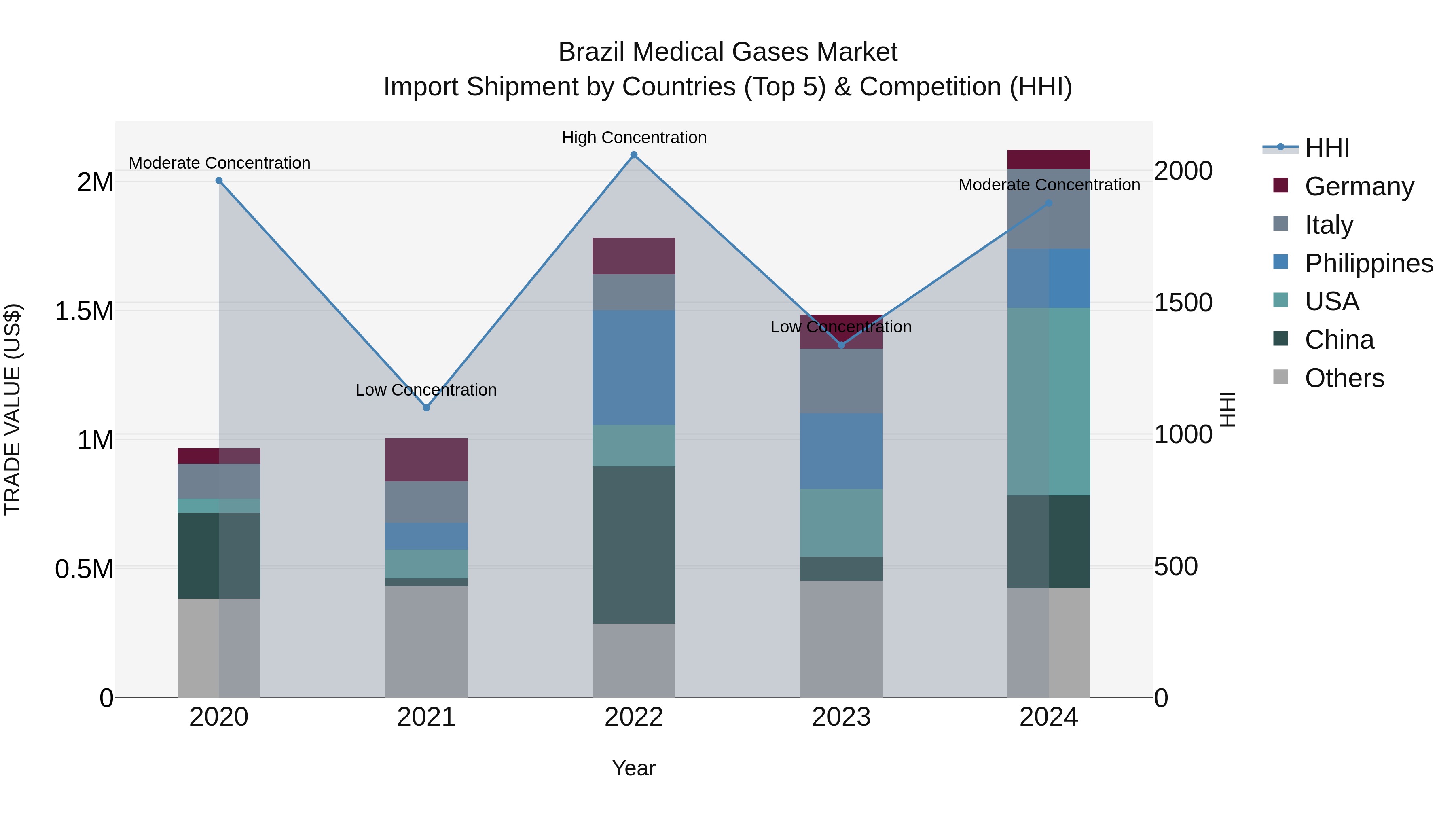
Brazil Medical Gases Market Overview
The Brazil medical gases market is witnessing steady growth driven by increasing healthcare facilities, growing awareness about the benefits of medical gases in various treatments, and the rising prevalence of chronic diseases. The market is primarily dominated by oxygen, nitrogen, carbon dioxide, and nitrous oxide, with oxygen holding the largest share due to its critical role in emergency care and surgeries. The demand for medical gases is also being fueled by the expanding geriatric population in Brazil, which requires medical gases for respiratory support and anesthesia. Additionally, advancements in healthcare infrastructure and the presence of key market players are expected to further propel the growth of the medical gases market in Brazil in the coming years.
Brazil Medical Gases Market Trends
The Brazil medical gases market is experiencing steady growth due to the increasing prevalence of chronic respiratory diseases and the rising demand for healthcare services. Key trends in the market include the adoption of technologically advanced medical gas delivery systems to ensure accurate and safe administration of gases, the growing popularity of home healthcare services driving the demand for portable medical gas cylinders, and the focus on ensuring a reliable supply chain for medical gases to meet the needs of healthcare facilities across the country. Additionally, there is a rising emphasis on the use of medical gases such as oxygen, nitrogen, and carbon dioxide in various medical procedures and treatments, further fueling market growth. Overall, the Brazil medical gases market is poised for expansion driven by these trends and the increasing healthcare infrastructure development in the country.
Brazil Medical Gases Market Challenges
In the Brazil medical gases market, some key challenges include regulatory complexities, high import tariffs on medical gas equipment and supplies, and a lack of standardized protocols for handling and storing medical gases. Additionally, the market faces issues related to infrastructure limitations, such as inadequate storage facilities and distribution networks for medical gases in certain regions. Ensuring the quality and safety of medical gases also poses a challenge, as maintaining proper storage conditions and preventing contamination require stringent monitoring and compliance measures. Furthermore, the competitive landscape in the medical gases market in Brazil is evolving rapidly, leading to pricing pressures and the need for companies to differentiate themselves through innovation and service offerings to gain a competitive edge in the market.
Brazil Medical Gases Market Investment Opportunities
The Brazil medical gases market presents significant investment opportunities due to the increasing demand for these gases in healthcare facilities across the country. With the rise in chronic respiratory diseases and the aging population, the need for medical gases such as oxygen, nitrogen, carbon dioxide, and nitrous oxide is expected to grow. Investors can explore opportunities in manufacturing and distribution of medical gases, as well as in related equipment and services. Additionally, advancements in technology and the growing focus on home healthcare services in Brazil create further avenues for investment in innovative solutions for medical gas delivery and monitoring. Overall, the Brazil medical gases market offers potential for growth and profitability for investors looking to capitalize on the expanding healthcare sector in the country.
Brazil Medical Gases Market Government Policy
In Brazil, the medical gases market is regulated by the National Health Surveillance Agency (ANVISA), which sets standards and regulations for the production, distribution, and use of medical gases. Companies operating in this market must comply with ANVISA`s Good Manufacturing Practices (GMP) to ensure the quality, safety, and efficacy of medical gases. Additionally, the Ministry of Health plays a key role in overseeing the healthcare sector and may implement policies that impact the medical gases market. Importantly, the Brazilian government has been focused on expanding access to healthcare services, which could drive demand for medical gases in the country. Overall, compliance with ANVISA regulations and staying informed about government healthcare policies are essential for companies operating in the Brazilian medical gases market.
Brazil Medical Gases Market Future Outlook
The future outlook for the Brazil medical gases market appears promising, driven by factors such as the increasing prevalence of chronic diseases, growth in the aging population, and rising healthcare infrastructure investments. The demand for medical gases, including oxygen, nitrogen, carbon dioxide, and nitrous oxide, is expected to rise as these gases are essential in various medical procedures and treatments. Furthermore, advancements in healthcare technology and the emphasis on improving patient care are likely to contribute to the market`s expansion. However, regulatory challenges and pricing pressures may present some obstacles. Overall, the Brazil medical gases market is anticipated to experience steady growth in the coming years, with opportunities for market players to innovate and expand their product offerings to meet the evolving healthcare needs in the region.
Key Highlights of the Report:
- Brazil Medical Gases Market Outlook
- Market Size of Brazil Medical Gases Market,2024
- Forecast of Brazil Medical Gases Market, 2031
- Historical Data and Forecast of Brazil Medical Gases Revenues & Volume for the Period 2021-2031
- Brazil Medical Gases Market Trend Evolution
- Brazil Medical Gases Market Drivers and Challenges
- Brazil Medical Gases Price Trends
- Brazil Medical Gases Porter's Five Forces
- Brazil Medical Gases Industry Life Cycle
- Historical Data and Forecast of Brazil Medical Gases Market Revenues & Volume By Technology Type for the Period 2021-2031
- Historical Data and Forecast of Brazil Medical Gases Market Revenues & Volume By Fractional Distillation for the Period 2021-2031
- Historical Data and Forecast of Brazil Medical Gases Market Revenues & Volume By Molecular Sieve for the Period 2021-2031
- Historical Data and Forecast of Brazil Medical Gases Market Revenues & Volume By Semipermeable Membrane for the Period 2021-2031
- Historical Data and Forecast of Brazil Medical Gases Market Revenues & Volume By Physical Separators for the Period 2021-2031
- Historical Data and Forecast of Brazil Medical Gases Market Revenues & Volume By Application Area for the Period 2021-2031
- Historical Data and Forecast of Brazil Medical Gases Market Revenues & Volume By Therapeutic Applications for the Period 2021-2031
- Historical Data and Forecast of Brazil Medical Gases Market Revenues & Volume By Pharmaceutical Manufacturing for the Period 2021-2031
- Historical Data and Forecast of Brazil Medical Gases Market Revenues & Volume By Diagnostic Applications for the Period 2021-2031
- Historical Data and Forecast of Brazil Medical Gases Market Revenues & Volume By Drug Discovery for the Period 2021-2031
- Historical Data and Forecast of Brazil Medical Gases Market Revenues & Volume By Quality Control for the Period 2021 - 2029
- Historical Data and Forecast of Brazil Medical Gases Market Revenues & Volume By End User for the Period 2021-2031
- Historical Data and Forecast of Brazil Medical Gases Market Revenues & Volume By Hospitals for the Period 2021-2031
- Historical Data and Forecast of Brazil Medical Gases Market Revenues & Volume By Home Healthcare for the Period 2021-2031
- Historical Data and Forecast of Brazil Medical Gases Market Revenues & Volume By Pharmaceutical Companies for the Period 2021-2031
- Historical Data and Forecast of Brazil Medical Gases Market Revenues & Volume By Academic Institutions for the Period 2021-2031
- Historical Data and Forecast of Brazil Medical Gases Market Revenues & Volume By Emergency Service Providers for the Period 2021 - 2029
- Historical Data and Forecast of Brazil Medical Gases Market Revenues & Volume By Product Type for the Period 2021-2031
- Historical Data and Forecast of Brazil Medical Gases Market Revenues & Volume By Oxygen Gases for the Period 2021-2031
- Historical Data and Forecast of Brazil Medical Gases Market Revenues & Volume By Carbon Dioxide Gases for the Period 2021-2031
- Historical Data and Forecast of Brazil Medical Gases Market Revenues & Volume By Nitrogen Gases for the Period 2021-2031
- Historical Data and Forecast of Brazil Medical Gases Market Revenues & Volume By Helium Gases for the Period 2021-2031
- Historical Data and Forecast of Brazil Medical Gases Market Revenues & Volume By Gas Mixtures for the Period 2021 - 2029
- Brazil Medical Gases Import Export Trade Statistics
- Market Opportunity Assessment By Technology Type
- Market Opportunity Assessment By Application Area
- Market Opportunity Assessment By End User
- Market Opportunity Assessment By Product Type
- Brazil Medical Gases Top Companies Market Share
- Brazil Medical Gases Competitive Benchmarking By Technical and Operational Parameters
- Brazil Medical Gases Company Profiles
- Brazil Medical Gases Key Strategic Recommendations






































