Brazil Medical Tubing Market Size, Share & Growth Rate
The Brazil Medical Tubing Market was estimated at USD 211 Million in 2025 and is projected to reach USD 252 Million by 2032, growing at a CAGR of 2.6% from 2026 to 2032. This upward trajectory is fueled by the burgeoning healthcare sector, which is increasingly leaning towards precision-engineered tubing solutions for various medical applications. As Brazil's healthcare system evolves, the focus on patient safety and the adoption of advanced medical technologies further catalyze the demand for specialized medical tubing products.
Brazil Medical Tubing Market Year-wise Growth Rate and Key Drivers
This graph highlights how the Brazil Medical Tubing Market has steadily grown over the years, supported by major growth factors.
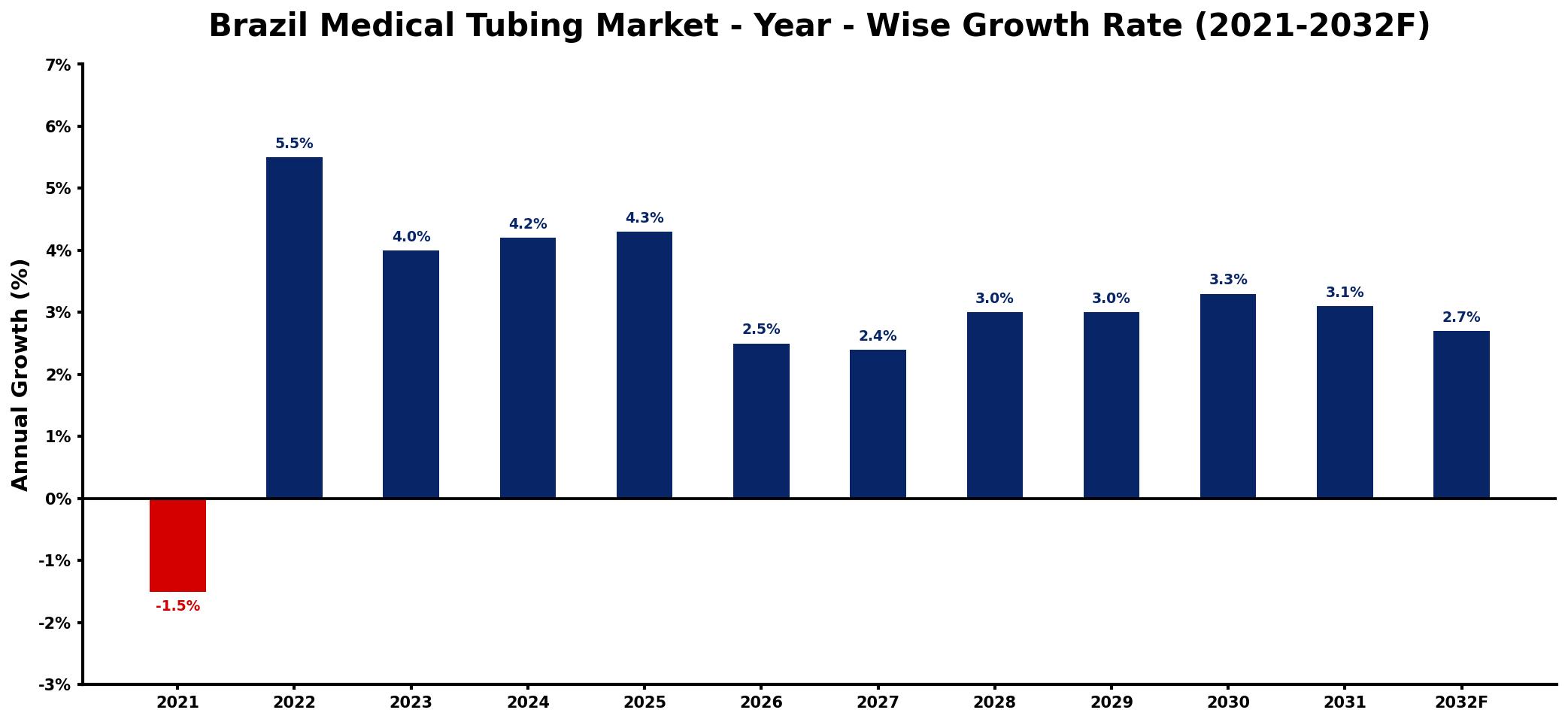
The table below presents the year‑wise growth rates along with the key drivers influencing the market
| Year | Growth Rate | Major Drivers |
| 2021 | -1.5% | Decreased healthcare investment levels |
| 2022 | 5.5% | Rising demand for healthcare services |
| 2023 | 4.0% | Expansion of healthcare infrastructure projects |
| 2024 | 4.2% | Increased focus on patient safety |
| 2025 | 4.3% | Growing adoption of advanced technologies |
| 2026 | 2.5% | Surge in outpatient procedures growth |
| 2027 | 2.4% | Investment in innovative manufacturing processes |
| 2028 | 3.0% | Rising prevalence of chronic diseases |
| 2029 | 3.0% | Increased regulatory compliance requirements |
| 2030 | 3.3% | Growing market for sustainable materials |
| 2031 | 3.1% | increased overall sector activity |
| 2032 | 2.7% | increased domestic production output |
Note: Market size estimations and growth projections presented in this report are based on 6Wresearch's proprietary forecasting methodology, utilizing the latest available industry data, government publications, and primary research inputs.
Brazil Medical Tubing Market Synopsis
One of the strongest forces shaping the Brazil Medical Tubing Market is the growing demand for minimally invasive surgical procedures. As these procedures gain traction, they require advanced medical tubing that meets high standards for precision and reliability. Furthermore, the continuous improvements in diagnostic technologies are prompting healthcare providers to seek innovative tubing solutions that enhance overall patient care.
Additionally, regulatory compliance is a key factor driving market dynamics. The Brazilian government emphasizes maintaining stringent medical device quality standards, which influences both manufacturing processes and material selection. Collaborations between medical device manufacturers and material suppliers are critical in ensuring the supply of effective and compliant medical tubing solutions.
Brazil Medical Tubing Market Key Takeaways
- The Brazil Medical Tubing Market is poised for stable growth, with a projected value increase from USD 211 Million in 2025 to USD 252 Million by 2032.
- Advancements in minimally invasive surgeries are significantly impacting the demand for specialized tubing solutions.
- Compliance with regulatory standards is vital for market players to maintain competitiveness and consumer trust.
- Innovations in diagnostic technologies are spurring the need for more advanced and precise medical tubing.
- Collaborative efforts between manufacturers and suppliers are shaping the future of medical tubing product offerings.
Evaluation of Restraints in Brazil Medical Tubing Market
The Brazil Medical Tubing Market faces several restraints that can hinder its growth trajectory. One primary concern is the stringent regulatory landscape, where manufacturers must navigate complex compliance requirements that dictate material specifications and sterilization processes. This can pose challenges, particularly for smaller firms lacking the resources to meet such standards. Moreover, the competitive pressure from international manufacturers adds another layer of complexity, forcing local players to constantly innovate and adapt to evolving healthcare demands.
Brazil Medical Tubing Market Trends
Several key trends are shaping the Brazil Medical Tubing Market. Firstly, the push towards patient-centered care has heightened the importance of patient safety, leading to increased investment in high-quality materials. There's also a growing preference for biocompatible materials, reflecting a broader trend in medical devices towards safer, more effective solutions. Furthermore, the rise in telemedicine and remote diagnostics is likely to spur demand for innovative tubing solutions that cater to new healthcare delivery models.
Brazil Medical Tubing Market Opportunities
Opportunities for growth in the Brazil Medical Tubing Market lie primarily in the development of next-generation materials that enhance performance and safety. Additionally, as the healthcare sector continues to expand, the need for reliable and efficient medical tubing solutions will grow, creating avenues for investment in R&D. Companies that can focus on sustainability and environmental compliance will also find increasing consumer preference, tapping into a market that values eco-friendly practices.
Government Initiatives in the Brazil Medical Tubing Market
The Brazilian government actively promotes policies that enhance the quality and safety of medical devices, including medical tubing. These initiatives include setting stringent material and manufacturing standards, as well as enforcing sterilization protocols to ensure the integrity of medical products. Public spending on healthcare infrastructure also plays a crucial role in fostering a conducive environment for market growth, paving the way for innovations in medical tubing and related technologies.
Future Insights of the Brazil Medical Tubing Market
Looking ahead to 2026-2032, the Brazil Medical Tubing Market is expected to witness significant advancements influenced by technological innovations and evolving healthcare paradigms. The increasing adoption of telehealth services will drive demand for versatile and efficient medical tubing solutions. Furthermore, as healthcare providers prioritize patient safety and procedural efficiency, the market is set to evolve with a focus on developing high-quality, compliant products that meet both regulatory standards and user expectations.
Brazil Medical Tubing Market Latest Developments (2025 - 2026)
In the past year, the Brazil Medical Tubing Market has seen a notable shift towards the incorporation of innovative materials and technologies to enhance product performance. Companies are investing in R&D to create tubing solutions that not only comply with stringent regulatory requirements but also offer enhanced biocompatibility and safety. The trend towards sustainability has also become prominent, with manufacturers seeking to develop eco-friendly alternatives in their product lines, aligning with global market demands.
Brazil Medical Tubing Market - Key Attractiveness of the Report
- 10 Years of Market Numbers
- Historical Data Starting from 2022 to 2025
- Base Year: 2025
- Forecast Data until 2032
- Key Performance Indicators Impacting the Market
- Major Upcoming Developments and Projects
Key Highlights of the Report:
- Brazil Medical Tubing Market Outlook
- Market Size of Brazil Medical Tubing Market, 2025
- Forecast of Brazil Medical Tubing Market, 2032
- Historical Data and Forecast of Brazil Medical Tubing Revenues & Volume for the Period 2022-2032F
- Brazil Medical Tubing Market Trend Evolution
- Brazil Medical Tubing Market Drivers and Challenges
- Brazil Medical Tubing Price Trends
- Brazil Medical Tubing Porter's Five Forces
- Brazil Medical Tubing Industry Life Cycle
- Historical Data and Forecast of Brazil Medical Tubing Market Revenues & Volume By Material for the Period 2022-2032F
- Historical Data and Forecast of Brazil Medical Tubing Market Revenues & Volume By Plastics for the Period 2022-2032F
- Historical Data and Forecast of Brazil Medical Tubing Market Revenues & Volume By Rubbers for the Period 2022-2032F
- Historical Data and Forecast of Brazil Medical Tubing Market Revenues & Volume By Specialty Polymers for the Period 2022-2032F
- Historical Data and Forecast of Brazil Medical Tubing Market Revenues & Volume By Structure for the Period 2022-2032F
- Historical Data and Forecast of Brazil Medical Tubing Market Revenues & Volume By Single-lumen for the Period 2022-2032F
- Historical Data and Forecast of Brazil Medical Tubing Market Revenues & Volume By Co-extruded for the Period 2022-2032F
- Historical Data and Forecast of Brazil Medical Tubing Market Revenues & Volume By Multi-lumen for the Period 2022-2032F
- Historical Data and Forecast of Brazil Medical Tubing Market Revenues & Volume By Tapered Or Bump Tubing for the Period 2022-2032F
- Historical Data and Forecast of Brazil Medical Tubing Market Revenues & Volume By Braided Tubing for the Period 2022-2032F
- Historical Data and Forecast of Brazil Medical Tubing Market Revenues & Volume By Application for the Period 2022-2032F
- Historical Data and Forecast of Brazil Medical Tubing Market Revenues & Volume By Bulk Disposable Tubing for the Period 2022-2032F
- Historical Data and Forecast of Brazil Medical Tubing Market Revenues & Volume By Catheters & Cannulas for the Period 2022-2032F
- Historical Data and Forecast of Brazil Medical Tubing Market Revenues & Volume By Drug Delivery System for the Period 2022-2032F
- Historical Data and Forecast of Brazil Medical Tubing Market Revenues & Volume By Special Applications for the Period 2022-2032F
- Brazil Medical Tubing Import Export Trade Statistics
- Market Opportunity Assessment By Material
- Market Opportunity Assessment By Structure
- Market Opportunity Assessment By Application
- Brazil Medical Tubing Top Companies Market Share
- Brazil Medical Tubing Competitive Benchmarking By Technical and Operational Parameters
- Brazil Medical Tubing Company Profiles
- Brazil Medical Tubing Key Strategic Recommendations






































