Brazil Metal Shredder Machine Market Size, Share & Growth Rate
The Brazil Metal Shredder Machine Market was estimated at USD 200 Million in 2025 and is projected to reach USD 239 Million by 2032, growing at a CAGR of 2.6% from 2026 to 2032. This growth trajectory is primarily driven by the increasing focus on sustainable waste management practices and the circular economy. As Brazil's recycling and waste management sectors expand, the demand for efficient shredding technologies becomes vital for processing scrap metals and minimizing environmental impact.
Brazil Metal Shredder Machine Market Year-wise Growth Rate and Key Drivers
This graph highlights how the Brazil Metal Shredder Machine Market has steadily grown over the years, supported by major growth factors.
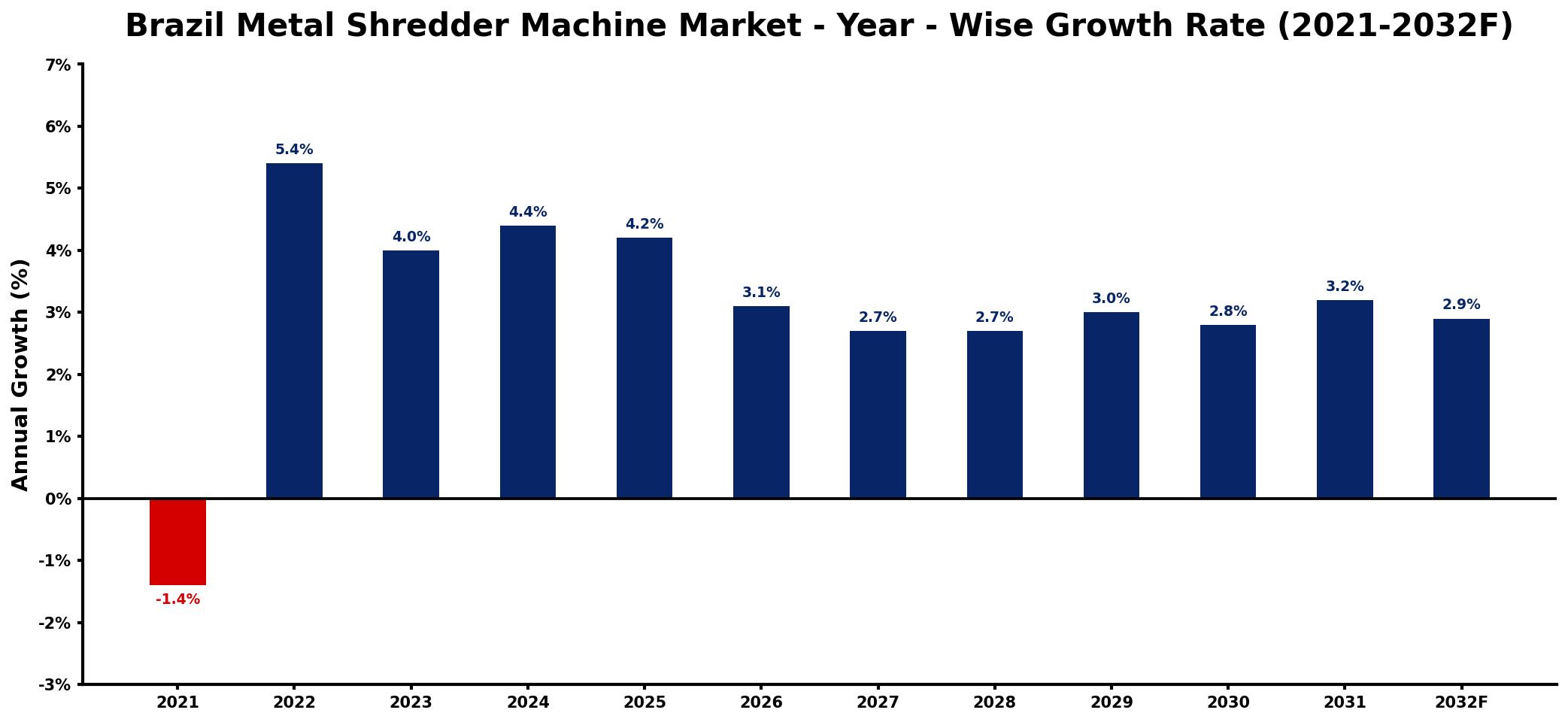
The table below presents the year‑wise growth rates along with the key drivers influencing the market
| Year | Growth Rate | Major Drivers |
| 2021 | -1.4% | decrease in recycling activities |
| 2022 | 5.4% | increased industrial waste generation |
| 2023 | 4.0% | higher demand for recycling solutions |
| 2024 | 4.4% | expansion of manufacturing sectors |
| 2025 | 4.2% | growing focus on sustainability initiatives |
| 2026 | 3.1% | rising investments in waste management |
| 2027 | 2.7% | enhanced regulatory support for recycling |
| 2028 | 2.7% | improved technological advancements adoption |
| 2029 | 3.0% | increased urbanization and infrastructure development |
| 2030 | 2.8% | growing awareness of environmental impact |
| 2031 | 3.2% | expanding industrial usage applications |
| 2032 | 2.9% | increased pharmaceutical industry usage |
Note: Market size estimations and growth projections presented in this report are based on 6Wresearch's proprietary forecasting methodology, utilizing the latest available industry data, government publications, and primary research inputs.
Brazil Metal Shredder Machine Market Synopsis
Recent trends in the Brazil Metal Shredder Machine Market highlight a burgeoning interest in advanced shredding technologies and robust recycling initiatives. This is contrasted by historical reliance on less efficient methods that hindered progress in waste management. As the market evolves, the emphasis on sustainable practices is reshaping operational strategies across the industry.
In the coming years, the Brazil Metal Shredder Machine Market is expected to witness a paradigm shift, increasingly integrating innovative technologies. This momentum is fueled by regulatory frameworks that encourage the adoption of advanced machines, bolstering efficiency and resource recovery, and aligning with global sustainability goals.
Brazil Metal Shredder Machine Market Key Takeaways
- Growing emphasis on recycling and sustainable waste management is driving demand.
- Technological advancements are enhancing the efficiency of metal shredding processes.
- Regulatory mandates are pushing for improved performance and emissions control in shredders.
- Increased investment in circular economy initiatives influences market dynamics.
- Ongoing challenges include the need for compliance with environmental regulations.
Evaluation of Restraints in Brazil Metal Shredder Machine Market
Despite the positive outlook, several restraints hinder the growth of the Brazil Metal Shredder Machine Market. Environmental regulations impose strict standards on shredder performance and emissions, compelling manufacturers to innovate while managing costs. The demand for quieter, low-emission machines adds another layer of complexity, requiring ongoing investment in research and development. Balancing regulatory compliance with operational efficiency remains a significant challenge for market players.
Brazil Metal Shredder Machine Market Trends
The market is currently seeing a trend towards the integration of smart technology within shredders. Innovations such as IoT connectivity and automation are being adopted to enhance performance monitoring and operational efficiency. Additionally, a growing number of facilities are looking to implement closed-loop systems to facilitate recycling, which increases demand for metal shredders capable of processing diverse materials. Environmental consciousness among consumers is further driving manufacturers to develop sustainable shredding solutions.
Brazil Metal Shredder Machine Market Opportunities
Opportunities abound in the Brazil Metal Shredder Machine Market as companies seek to capitalize on increased investments in recycling infrastructure. The potential for new product innovations, especially those that improve efficiency and reduce environmental impact, presents lucrative prospects. Furthermore, collaborations with governmental bodies and private enterprises focused on sustainability can yield significant advancements in technology adoption and market penetration.
Government Initiatives in the Brazil Metal Shredder Machine Market
Government policies play a crucial role in shaping the Brazil Metal Shredder Machine Market. Various initiatives are in place to promote recycling and resource recovery, including public spending on waste management infrastructure and incentives for environmentally friendly technologies. Regulatory measures aimed at improving waste diversion rates foster a supportive environment for the growth of metal shredder machinery, aligning public policy with broader sustainability goals.
Future Insights of the Brazil Metal Shredder Machine Market
Looking ahead to 2026-2032, the Brazil Metal Shredder Machine Market is poised for significant evolution. Continued advancements in technology are likely to redefine operational efficiency, while regulatory frameworks will increasingly encourage innovation in shredder design. The ongoing shift towards a circular economy will drive the development of sophisticated shredding solutions capable of handling various metal types, ultimately facilitating a more sustainable approach to waste management and resource recovery.
Brazil Metal Shredder Machine Market Latest Developments (2025 - 2026)
The Brazil Metal Shredder Machine Market is currently witnessing a surge in developments focused on enhancing machine efficiency and reducing environmental footprints. Stakeholders are actively pursuing advanced technologies that minimize noise and emissions during shredding processes. As Brazil's recycling industry evolves, strategic partnerships between manufacturers and recycling facilities are emerging, aimed at optimizing operational synergies and promoting sustainable practices across the sector.
Brazil Metal Shredder Machine Market - Key Attractiveness of the Report
- 10 Years of Market Numbers
- Historical Data Starting from 2022 to 2025
- Base Year: 2025
- Forecast Data until 2032
- Key Performance Indicators Impacting the Market
- Major Upcoming Developments and Projects
Key Highlights of the Report:
- Brazil Metal Shredder Machine Market Outlook
- Market Size of Brazil Metal Shredder Machine Market, 2025
- Forecast of Brazil Metal Shredder Machine Market, 2032
- Historical Data and Forecast of Brazil Metal Shredder Machine Revenues & Volume for the Period 2022-2032F
- Brazil Metal Shredder Machine Market Trend Evolution
- Brazil Metal Shredder Machine Market Drivers and Challenges
- Brazil Metal Shredder Machine Price Trends
- Brazil Metal Shredder Machine Porter's Five Forces
- Brazil Metal Shredder Machine Industry Life Cycle
- Historical Data and Forecast of Brazil Metal Shredder Machine Market Revenues & Volume By Type for the Period 2022-2032F
- Historical Data and Forecast of Brazil Metal Shredder Machine Market Revenues & Volume By Mechanical Shredder Machine for the Period 2022-2032F
- Historical Data and Forecast of Brazil Metal Shredder Machine Market Revenues & Volume By Shock Wave Shredder Machine for the Period 2022-2032F
- Historical Data and Forecast of Brazil Metal Shredder Machine Market Revenues & Volume By Application for the Period 2022-2032F
- Historical Data and Forecast of Brazil Metal Shredder Machine Market Revenues & Volume By Iron and Steel for the Period 2022-2032F
- Historical Data and Forecast of Brazil Metal Shredder Machine Market Revenues & Volume By Aluminum and Copper for the Period 2022-2032F
- Historical Data and Forecast of Brazil Metal Shredder Machine Market Revenues & Volume By Non-Ferrous Metals for the Period 2022-2032F
- Brazil Metal Shredder Machine Import Export Trade Statistics
- Market Opportunity Assessment By Type
- Market Opportunity Assessment By Application
- Brazil Metal Shredder Machine Top Companies Market Share
- Brazil Metal Shredder Machine Competitive Benchmarking By Technical and Operational Parameters
- Brazil Metal Shredder Machine Company Profiles
- Brazil Metal Shredder Machine Key Strategic Recommendations






































