Brazil Metalworking Machinery Market Size, Share & Growth Rate
The Brazil Metalworking Machinery Market was estimated at USD 207 Million in 2025 and is projected to reach USD 247 Million by 2032, growing at a CAGR of 2.6% from 2026 to 2032. This growth trajectory is driven by Brazil's ongoing industrial advancements and a marked shift towards automation and precision engineering. As sectors such as automotive, aerospace, and energy demand more sophisticated manufacturing processes, the need for advanced metalworking machinery becomes increasingly critical.
Brazil Metalworking Machinery Market Growth Rate Analysis (2021-2032)
The Brazil metalworking machinery market has shown a notable recovery following a challenging period, with a decline of 1.6% in 2021, attributed to pandemic-related disruptions. However, the sector rebounded strongly, achieving a growth rate of 5.2% in 2022, driven by increased domestic manufacturing needs and infrastructure investments. This upward trend is projected to continue, with growth rates stabilizing at approximately 4.3% in 2023 and 2024, as companies embrace digital technologies and automation to enhance productivity. As Brazil navigates energy transition initiatives, consumer demand for advanced machinery is expected to sustain momentum, although growth will gradually moderate to around 2.6% by 2032 as market maturity sets in.
Brazil Metalworking Machinery Market Year-wise Growth Rate and Key Drivers
This graph highlights how the Brazil Metalworking Machinery Market has steadily grown over the past five years, supported by major growth factors.
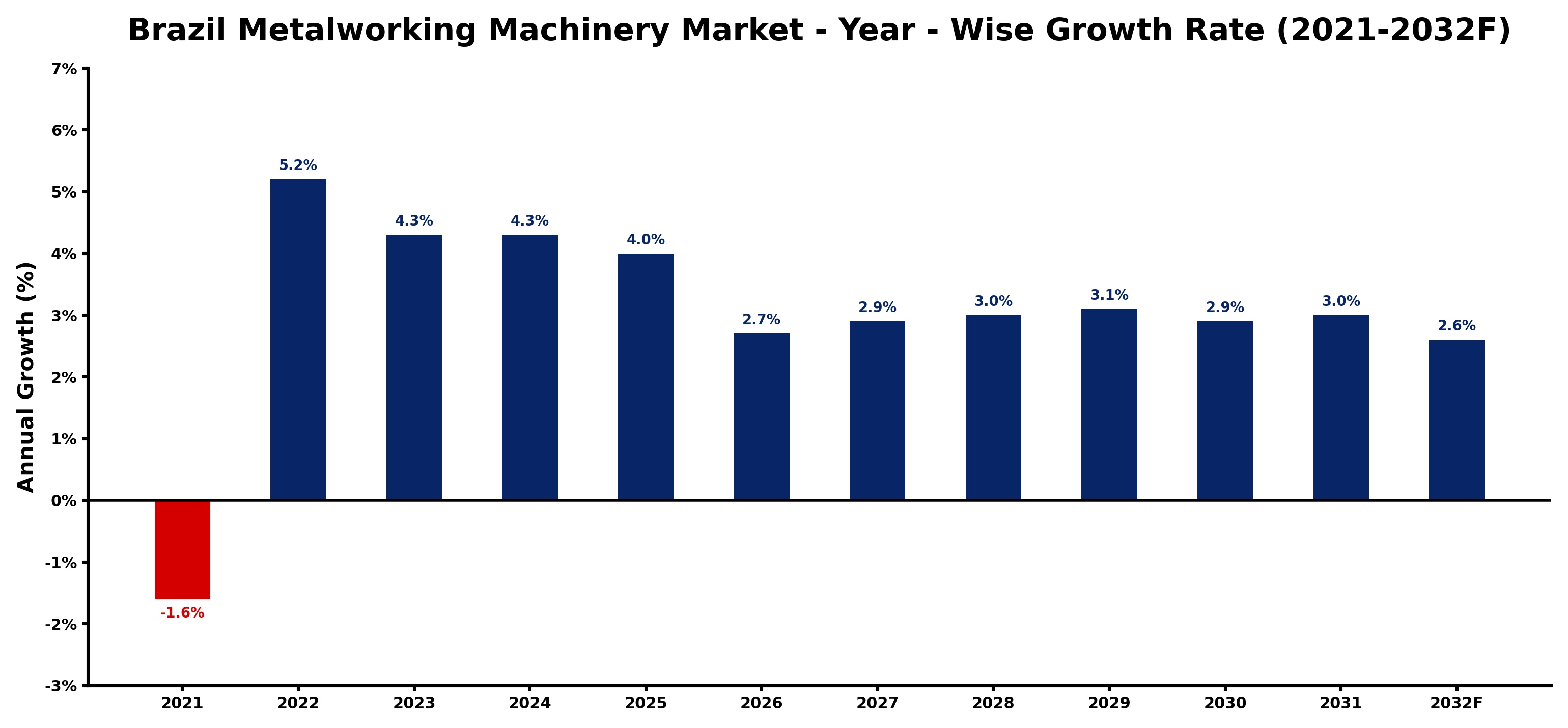
The table below presents the year‑wise growth rates along with the key drivers influencing the market
| Year | Growth Rate | Major Drivers |
| 2021 | -1.6% | Expansion of commercial construction activities |
| 2022 | 5.2% | Growing urbanization and commercial development |
| 2023 | 4.3% | Increasing industrial automation investments |
| 2024 | 4.3% | Government infrastructure modernization initiatives |
| 2025 | 4.0% | Government infrastructure modernization initiatives |
| 2026 | 2.7% | Growing urbanization and commercial development |
| 2027 | 2.9% | Increasing smart city development projects |
| 2028 | 3.0% | Increasing adoption of advanced technologies |
| 2029 | 3.1% | Growing urbanization and commercial development |
| 2030 | 2.9% | Increasing adoption of advanced technologies |
| 2031 | 3.0% | Rapid growth in telecom and data center sectors |
| 2032 | 2.6% | Expansion of manufacturing activities |
Note - Market size estimations and growth projections presented in this report are based on 6Wresearch's advanced forecasting approach, validated with industry datasets as of June 2026.
Brazil Metalworking Machinery Market Synopsis
Brazil's metalworking machinery sector is characterized by its diverse applications across various industries, particularly in automotive and consumer goods manufacturing. As companies strive for higher efficiency and quality, the integration of state-of-the-art technology is not just preferred but necessary for survival in a competitive landscape.
With rising global standards for product quality and sustainability, Brazilian manufacturers are under pressure to modernize their equipment. This necessity propels demand for machinery that not only enhances production capabilities but also minimizes waste and energy consumption, aligning with both economic and environmental goals.
Brazil Metalworking Machinery Market Key Takeaways
- The market is anticipated to grow steadily, driven by technological advancements and increased investments.
- Demand for high-precision machinery is on the rise, reflecting shifts in the industrial landscape.
- Government initiatives play a pivotal role in fostering modernization within the sector.
- Challenges such as skilled labor shortages must be addressed to sustain growth.
- Automation and digitalization trends are reshaping manufacturing processes across Brazil.
Evaluation of Restraints in Brazil Metalworking Machinery Market
Despite its growth potential, the Brazil Metalworking Machinery Market faces significant restraints. Chief among these is the ongoing need for continuous technological upgrades, as manufacturers must invest in the latest technologies to stay competitive. Additionally, a shortage of skilled labor presents a challenge, as many companies struggle to find workers adept in operating advanced machinery. Economic fluctuations also pose risks, impacting capital investment capabilities and slowing down the procurement of new equipment.
Brazil Metalworking Machinery Market Trends
Current trends in the Brazil Metalworking Machinery Market indicate a strong shift towards automation and Industry 4.0 technologies. Businesses are increasingly adopting smart manufacturing solutions that leverage data analytics and AI to optimize operations. Another notable trend is the growing emphasis on sustainability, driving investments in energy-efficient machinery that comply with stringent environmental regulations.
Brazil Metalworking Machinery Market Opportunities
The market offers substantial growth and investment opportunities, particularly in sectors focused on innovation and efficiency. Companies that can provide advanced manufacturing solutions, such as robotic systems and additive manufacturing technologies, are well-positioned to capture market share. Moreover, collaboration with educational institutions to develop training programs could help alleviate labor shortages and enhance workforce skills.
Government Initiatives in the Brazil Metalworking Machinery Market
The Brazilian government has initiated several policies to support the industrial sector, particularly in terms of technology adoption and workforce skill development. Public programs aimed at modernizing manufacturing processes, coupled with incentives for investment in advanced machinery, are crucial for stimulating growth. These initiatives not only encourage local production but also aim to attract foreign investment, further enhancing Brazil's competitive edge in the global market.
Future Insights of the Brazil Metalworking Machinery Market
Looking ahead to 2026-2032, the Brazil Metalworking Machinery Market is poised for continued evolution. Advancements in digital technologies, including the Internet of Things (IoT) and artificial intelligence, are expected to further revolutionize manufacturing processes. As companies prioritize productivity and quality, there will be an increasing demand for machinery that supports customization and rapid prototyping, enabling manufacturers to respond swiftly to market needs.
Brazil Metalworking Machinery Market Latest Developments (May 2025 - June 2026)
Recent industry developments indicate a trend towards partnerships and collaborations focused on technological innovation. Manufacturers are increasingly engaging in joint ventures aimed at leveraging shared expertise to accelerate the development of cutting-edge machinery. Additionally, there is a noticeable rise in events and conferences dedicated to showcasing advancements in metalworking technology, fostering a culture of knowledge exchange within the sector.
Brazil Metalworking Machinery Market - Key Attractiveness of the Report
- 10 Years of Market Numbers
- Historical Data Starting from 2022 to 2025
- Base Year: 2025
- Forecast Data until 2032
- Key Performance Indicators Impacting the Market
- Major Upcoming Developments and Projects
Key Highlights of the Report:
- Brazil Metalworking Machinery Market Outlook
- Market Size of Brazil Metalworking Machinery Market, 2025
- Forecast of Brazil Metalworking Machinery Market, 2032
- Historical Data and Forecast of Brazil Metalworking Machinery Revenues & Volume for the Period 2022-2032F
- Brazil Metalworking Machinery Market Trend Evolution
- Brazil Metalworking Machinery Market Drivers and Challenges
- Brazil Metalworking Machinery Price Trends
- Brazil Metalworking Machinery Porter's Five Forces
- Brazil Metalworking Machinery Industry Life Cycle
- Historical Data and Forecast of Brazil Metalworking Machinery Market Revenues & Volume By Type for the Period 2022-2032F
- Historical Data and Forecast of Brazil Metalworking Machinery Market Revenues & Volume By Special Die And Tool Die Set, Jig, And Fixture for the Period 2022-2032F
- Historical Data and Forecast of Brazil Metalworking Machinery Market Revenues & Volume By Machine Tool for the Period 2022-2032F
- Historical Data and Forecast of Brazil Metalworking Machinery Market Revenues & Volume By Industrial Mold for the Period 2022-2032F
- Historical Data and Forecast of Brazil Metalworking Machinery Market Revenues & Volume By Rolling Mill And Other Metalworking Machinery for the Period 2022-2032F
- Historical Data and Forecast of Brazil Metalworking Machinery Market Revenues & Volume By Cutting Tool And Machine Tool Accessory for the Period 2022-2032F
- Historical Data and Forecast of Brazil Metalworking Machinery Market Revenues & Volume By Applications for the Period 2022-2032F
- Historical Data and Forecast of Brazil Metalworking Machinery Market Revenues & Volume By Automotive for the Period 2022-2032F
- Historical Data and Forecast of Brazil Metalworking Machinery Market Revenues & Volume By Manufacturing for the Period 2022-2032F
- Historical Data and Forecast of Brazil Metalworking Machinery Market Revenues & Volume By Others for the Period 2022-2032F
- Historical Data and Forecast of Brazil Metalworking Machinery Market Revenues & Volume By Capacity for the Period 2022-2032F
- Historical Data and Forecast of Brazil Metalworking Machinery Market Revenues & Volume By Small for the Period 2022-2032F
- Historical Data and Forecast of Brazil Metalworking Machinery Market Revenues & Volume By Medium for the Period 2022-2032F
- Historical Data and Forecast of Brazil Metalworking Machinery Market Revenues & Volume By Large for the Period 2022-2032F
- Brazil Metalworking Machinery Import Export Trade Statistics
- Market Opportunity Assessment By Type
- Market Opportunity Assessment By Applications
- Market Opportunity Assessment By Capacity
- Brazil Metalworking Machinery Top Companies Market Share
- Brazil Metalworking Machinery Competitive Benchmarking By Technical and Operational Parameters
- Brazil Metalworking Machinery Company Profiles
- Brazil Metalworking Machinery Key Strategic Recommendations






































