Brazil Microscopy Market Size, Share & Growth Rate
The Brazil Microscopy Market was estimated at USD 459 Million in 2025 and is projected to reach USD 551 Million by 2032, growing at a CAGR of 2.6% from 2026 to 2032. This growth is primarily fueled by the surging demand for high-resolution imaging in various scientific disciplines, particularly as research activities increase. The continuous technological advancements in microscopy techniques also play a significant role in enhancing capabilities, ensuring that Brazil remains at the forefront of innovation in this essential sector.
Brazil Microscopy Market Year-wise Growth Rate and Key Drivers
This graph highlights how the Brazil Microscopy Market has steadily grown over the years, supported by major growth factors.
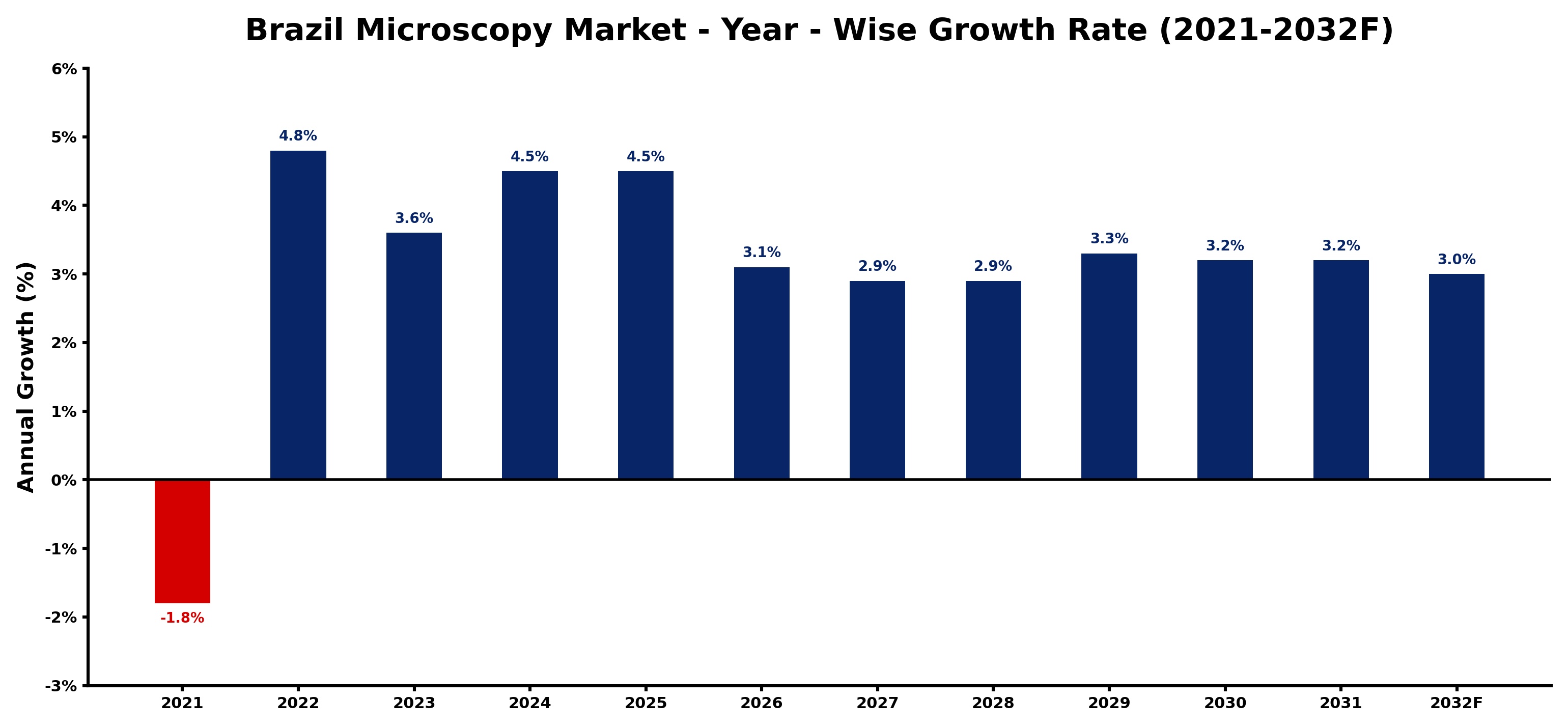
The table below presents the year‑wise growth rates along with the key drivers influencing the market
| Year | Growth Rate | Major Drivers |
| 2021 | -1.8% | Reduced export activity dampened domestic microscopy equipment production demand |
| 2022 | 4.8% | Higher domestic manufacturing investments bolster microscopy production capabilities |
| 2023 | 3.6% | Improved local foundry modernization drives precision component production efficiency |
| 2024 | 4.5% | Increased investment in microscopy tools boosts local manufacturing capabilities |
| 2025 | 4.5% | Technology integration boosts efficiency in microscopy manufacturing processes |
| 2026 | 3.1% | Higher capacity utilization drives domestic microscopy instrument production efficiency |
| 2027 | 2.9% | Foundry modernization projects boost demand for advanced microscopy equipment |
| 2028 | 2.9% | Modernized microscopy equipment boosts precision in domestic manufacturing processes |
| 2029 | 3.3% | Capacity utilization enhancements drove demand for advanced microscopy tools |
| 2030 | 3.2% | Export driven domestic manufacturing recovery boosted microscopy equipment investments |
| 2031 | 3.2% | Local manufacturers prioritize investments in advanced microscopy production technologies |
| 2032 | 3.0% | Improved domestic manufacturing recovery drives microscopy equipment demand |
Note - Market size estimations and growth projections presented in this report are based on 6Wresearch’s advanced forecasting approach, validated with industry datasets as of June 2026.
Brazil Microscopy Market Synopsis
In Brazil, the demand for microscopy is significantly driven by applications in biomedical research and materials science. The quest for precision in medical diagnostics and the analysis of complex biological samples make advanced microscopy indispensable for professionals in these fields.
Moreover, Brazil is witnessing an uptick in initiatives that integrate microscopy technologies into educational institutions. This trend is crucial for fostering a skilled workforce, enabling future scientists and technicians to harness the potential of advanced imaging techniques effectively.
Brazil Microscopy Market Key Takeaways
- The market is evolving due to increasing investment in research & development, particularly in healthcare and nanotechnology.
- Technological innovations in microscopy are driving demand for higher resolution and more versatile imaging capabilities.
- The integration of microscopy in educational settings is essential for cultivating skilled professionals in Brazil.
- Government policies promoting research grants and import incentives are vital for market growth.
- Strategic collaborations between academia and industry are becoming increasingly important to address market challenges.
Evaluation of Restraints in Brazil Microscopy Market
Despite the promising growth trajectory, the Brazil Microscopy Market faces notable constraints. The high cost associated with advanced microscopy technologies remains a significant barrier, limiting accessibility for smaller research institutions and hospitals. Furthermore, there is an acute need for skilled professionals capable of operating and maintaining these complex systems. As the market continues to evolve, addressing these challenges through targeted training programs and initiatives aimed at reducing equipment costs will be critical for broadening the user base.
Brazil Microscopy Market Trends
One of the prominent trends shaping the Brazil Microscopy Market is the shift towards automation and artificial intelligence in imaging processes. This advancement not only enhances the efficiency of data analysis but also improves the accuracy of diagnostic procedures. Additionally, the growing demand for 3D imaging techniques is leading to the development of more sophisticated microscopy systems that can cater to complex research needs.
Brazil Microscopy Market Opportunities
Significant investment opportunities lie in developing cost-effective microscopy solutions and expanding applications in emerging fields such as forensics and environmental science. The ongoing collaboration between government entities and private sectors also presents avenues for funding research initiatives, which could lead to groundbreaking discoveries in microscopy technology.
Government Initiatives in the Brazil Microscopy Market
The Brazilian government plays a pivotal role in fostering the growth of the microscopy market through various initiatives. Policies aimed at supporting research and development, as well as funding for educational institutions, are crucial for the advancement of this sector. Import regulations on high-tech equipment are continuously evaluated to facilitate access to cutting-edge microscopy technologies, while export incentives help promote Brazilian innovations on the global stage.
Future Insights of the Brazil Microscopy Market
Looking ahead to the period from 2026 to 2032, the Brazil Microscopy Market is expected to continue its upward trajectory. The integration of more affordable microscopy options will likely enhance accessibility across various sectors, especially in healthcare and education. As the demand for high-resolution imaging grows, companies that successfully navigate technological advancements and adapt to the evolving needs of the market will be well-positioned for success.
Brazil Microscopy Market Latest Developments (May 2025 - June 2026)
Recent developments in the Brazil Microscopy Market have highlighted a focus on fostering collaborations between research institutions and private enterprises. Innovative projects aimed at enhancing microscopy techniques are emerging, particularly in the context of healthcare diagnostics. Additionally, there is an ongoing push to make advanced microscopy training more accessible, ensuring that the workforce remains competitive and adept at utilizing new technologies.
Brazil Microscopy Market - Key Attractiveness of the Report
- 10 Years of Market Numbers
- Historical Data Starting from 2022 to 2025
- Base Year: 2025
- Forecast Data until 2032
- Key Performance Indicators Impacting the Market
- Major Upcoming Developments and Projects
Key Highlights of the Report:
- Brazil Microscopy Market Outlook
- Market Size of Brazil Microscopy Market, 2025
- Forecast of Brazil Microscopy Market, 2032
- Historical Data and Forecast of Brazil Microscopy Revenues & Volume for the Period 2022-2032F
- Brazil Microscopy Market Trend Evolution
- Brazil Microscopy Market Drivers and Challenges
- Brazil Microscopy Price Trends
- Brazil Microscopy Porter's Five Forces
- Brazil Microscopy Industry Life Cycle
- Historical Data and Forecast of Brazil Microscopy Market Revenues & Volume By Product for the Period 2022-2032F
- Historical Data and Forecast of Brazil Microscopy Market Revenues & Volume By Microscopes for the Period 2022-2032F
- Historical Data and Forecast of Brazil Microscopy Market Revenues & Volume By Software for the Period 2022-2032F
- Historical Data and Forecast of Brazil Microscopy Market Revenues & Volume By Accessories for the Period 2022-2032F
- Historical Data and Forecast of Brazil Microscopy Market Revenues & Volume By Type for the Period 2022-2032F
- Historical Data and Forecast of Brazil Microscopy Market Revenues & Volume By Optical Microscopes for the Period 2022-2032F
- Historical Data and Forecast of Brazil Microscopy Market Revenues & Volume By Electron Microscopes for the Period 2022-2032F
- Historical Data and Forecast of Brazil Microscopy Market Revenues & Volume By Scanning Probe Microscopes for the Period 2022-2032F
- Historical Data and Forecast of Brazil Microscopy Market Revenues & Volume By Other Microscopes for the Period 2022-2032F
- Historical Data and Forecast of Brazil Microscopy Market Revenues & Volume By Applications for the Period 2022-2032F
- Historical Data and Forecast of Brazil Microscopy Market Revenues & Volume By Semiconductors for the Period 2022-2032F
- Historical Data and Forecast of Brazil Microscopy Market Revenues & Volume By Life Sciences for the Period 2022-2032F
- Historical Data and Forecast of Brazil Microscopy Market Revenues & Volume By Material Sciences for the Period 2022-2032F
- Historical Data and Forecast of Brazil Microscopy Market Revenues & Volume By Nanotechnology for the Period 2022-2032F
- Historical Data and Forecast of Brazil Microscopy Market Revenues & Volume By Other Applications for the Period 2022-2032F
- Historical Data and Forecast of Brazil Microscopy Market Revenues & Volume By End-users for the Period 2022-2032F
- Historical Data and Forecast of Brazil Microscopy Market Revenues & Volume By Industries for the Period 2022-2032F
- Historical Data and Forecast of Brazil Microscopy Market Revenues & Volume By Research Institutes for the Period 2022-2032F
- Historical Data and Forecast of Brazil Microscopy Market Revenues & Volume By Other end-users for the Period 2022-2032F
- Brazil Microscopy Import Export Trade Statistics
- Market Opportunity Assessment By Product
- Market Opportunity Assessment By Type
- Market Opportunity Assessment By Applications
- Market Opportunity Assessment By End-users
- Brazil Microscopy Top Companies Market Share
- Brazil Microscopy Competitive Benchmarking By Technical and Operational Parameters
- Brazil Microscopy Company Profiles
- Brazil Microscopy Key Strategic Recommendations






































