Brazil Mirrors Market Summary
The brazil mirrors market was estimated at USD 162 Million in 2025 and is projected to reach USD 192 Million by 2032, growing at a CAGR of 2.6% from 2026 to 2032.
Brazil Mirrors Market Year-wise Growth Rate and Key Drivers
This graph highlights how the Brazil Mirrors Market has steadily grown over the years, supported by major growth factors.
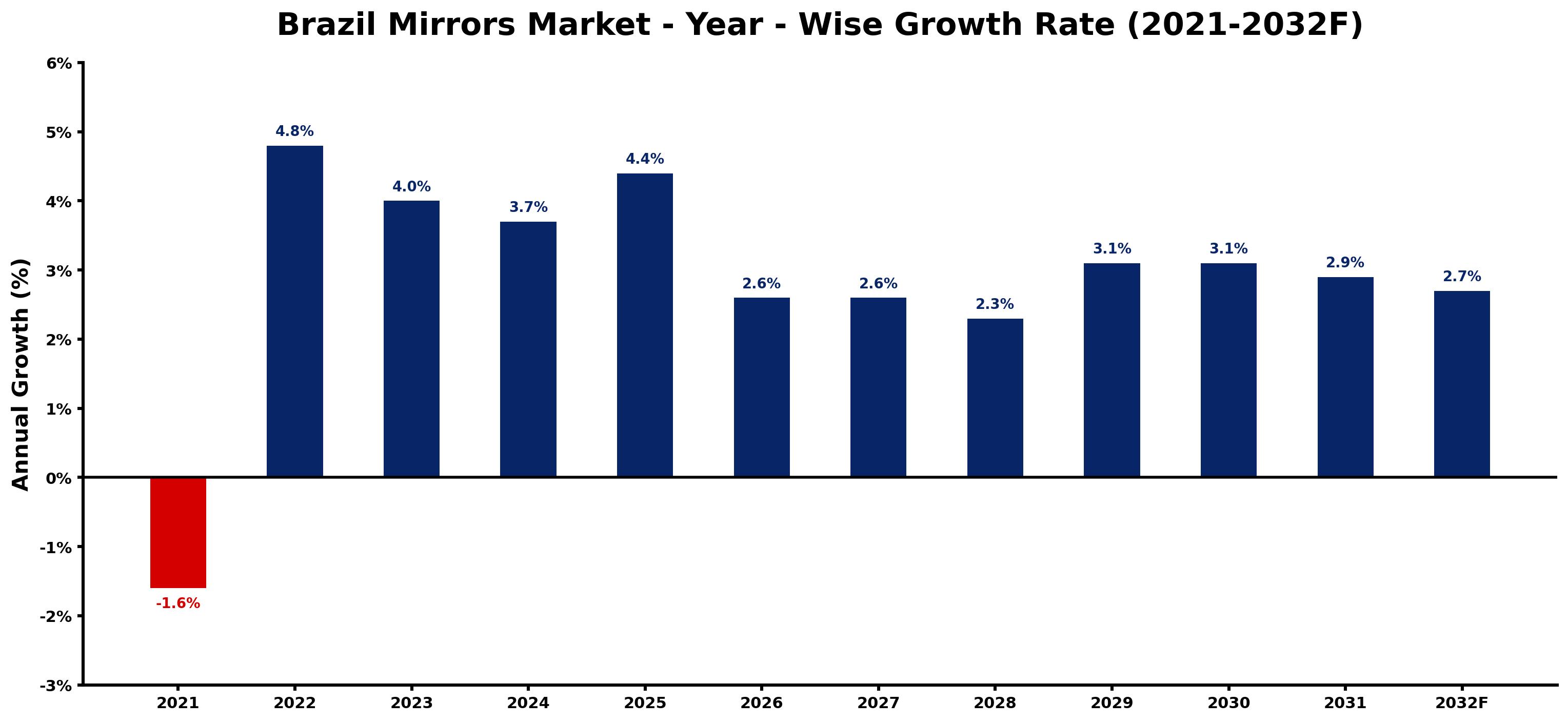
The table below presents the year wise growth rates along with the key drivers influencing the market
| Year | Growth Rate | Major Drivers |
| 2021 | -1.6% | Supply chain disruptions caused by the pandemic led to reduced availability and increased prices of mirrors. |
| 2022 | 4.8% | Urbanization trends in Brazilian cities led to higher demand for stylish mirror designs. |
| 2023 | 4.0% | E-commerce expansion enabled broader access to diverse mirror product offerings across Brazil. |
| 2024 | 3.7% | Home renovation activities surged as consumers prioritized personalizing living spaces effectively. |
| 2025 | 4.4% | Sustainable materials became a focal point, appealing to environmentally conscious consumers. |
| 2026 | 2.6% | Social media influencers showcased innovative mirror uses, capturing attention of younger demographics. |
| 2027 | 2.6% | Architectural trends favoring open spaces increased popularity of large decorative mirrors. |
| 2028 | 2.3% | Local artisans leveraging traditional techniques drew interest, promoting cultural heritage through mirrors. |
| 2029 | 3.1% | Technological innovations, such as smart mirrors, captured consumer interest in high-tech home gadgets. |
| 2030 | 3.1% | Luxury home market growth propelled demand for premium and custom mirror options significantly. |
| 2031 | 2.9% | Collaborations between designers and home brands led to unique, trendsetting mirror collections. |
| 2032 | 2.7% | The wellness movement encouraged the incorporation of mirrors in spaces promoting mental well-being. |
Note - Market size estimations and growth projections presented in this report are based on 6Wresearch's advanced forecasting approach, validated with industry datasets as of June 2026.
Brazil Mirrors Market Synopsis
The Brazil Mirrors Market is projected to reach 2.6% and witness significant growth during the forecast period (2026-2032). This market expansion reflects not only a shift in personal grooming preferences but also a pronounced focus on enhancing interior aesthetics. As consumer inclination towards decorative and customized mirrors rises, the market is set to evolve, presenting opportunities for both innovation and growth.
Brazil Mirrors Market Growth Drivers
The expansion of the Brazil Mirrors Market is primarily driven by several interrelated factors:
- Increased construction activities have led to a surge in demand for mirrors, integral to home decor, thus reshaping residential and commercial environments.
- Architectural trends emphasizing aesthetic space design have made mirrors essential for creating perception of spaciousness and elegance.
- Consumer demand for unique and customized mirror designs reflects a growing desire for personalized home decor, presenting avenues for designers and manufacturers.
- The rise of social media and influencer culture has influenced consumer behavior, with many seeking aesthetically pleasing environments that can be showcased online.
- Continued urbanization in Brazil has led to a greater focus on interior aesthetics, boosting the demand for decorative mirrors in various settings.
Brazil Mirrors Market Challenges and Restraints
Despite the positive growth trajectories, the Brazil Mirrors Market faces several challenges that may hinder its progress:
- The fragility of glass materials necessitates careful handling and transportation logistics, which can complicate distribution channels and increase costs.
- Shifting consumer preferences pose a challenge, as manufacturers must continually adapt to emerging styles and designs in the mirror segment.
- Competition from alternative decorative solutions could divert consumer attention away from traditional mirrors, affecting market growth.
- Economic fluctuations can impact consumer spending on non-essential home decor items, including mirrors, leading to unpredictable demand fluctuations.
- Cyclical nature of the construction industry may create volatility in demand, affecting long-term market stability.
Brazil Mirrors Market Government Investment and Initiatives
The mirrors market in Brazil has been positively influenced by government policies aimed at stimulating the housing and construction sectors. Various initiatives focused on housing development have indirectly spurred demand for mirrors in both residential and commercial spaces:
- Government incentives for home renovations and new constructions contribute to increased sales in the mirrors market as consumers enhance their living spaces.
- Policy frameworks that promote sustainable building practices encourage the use of eco-friendly materials in mirror production, aligning with modern consumer preferences.
- Investments in infrastructure development have resulted in a surge of new commercial spaces, increasing the need for decorative mirrors in offices and retail environments.
- The Brazilian government's support for local manufacturing and design initiatives boosts the domestic mirrors market, fostering innovation and creativity.
- Regulatory standards focusing on interior design quality have raised consumer expectations for home decor, including mirrors, thus elevating overall market standards.
Brazil Mirrors Market Latest Developments (May 2025 - June 2026)
During the period from May 2025 to June 2026, the Brazil Mirrors Market has witnessed notable developments that signal the industry's direction:
- Increased emphasis on sustainability has led to greater demand for eco-friendly mirror production techniques and materials, reflecting a broader trend towards environmentally responsible consumption.
- The rise in remote working has spurred home office decor innovations, with mirrors becoming popular items for creating visually appealing work environments.
- Technological advancements have introduced smart mirrors equipped with integrated lighting and digital displays, broadening the functionalities of traditional mirrors.
- Market players are increasingly focusing on online sales channels, providing consumers greater access to a diverse range of mirror styles and designs.
- Collaborative design projects between interior decorators and mirror manufacturers have emerged, emphasizing customized solutions tailored to specific consumer needs.
Brazil Mirrors Market - Key Attractiveness of the Report
- 10 Years of Market Numbers
- Historical Data Starting from 2022 to 2025
- Base Year: 2025
- Forecast Data until 2032
- Key Performance Indicators Impacting the Market
- Major Upcoming Developments and Projects
Key Highlights of the Report:
- Brazil Mirrors Market Outlook
- Market Size of Brazil Mirrors Market, 2025
- Forecast of Brazil Mirrors Market, 2032
- Historical Data and Forecast of Brazil Mirrors Revenues & Volume for the Period 2022-2032F
- Brazil Mirrors Market Trend Evolution
- Brazil Mirrors Market Drivers and Challenges
- Brazil Mirrors Price Trends
- Brazil Mirrors Porter's Five Forces
- Brazil Mirrors Industry Life Cycle
- Historical Data and Forecast of Brazil Mirrors Market Revenues & Volume By Types for the Period 2022-2032F
- Historical Data and Forecast of Brazil Mirrors Market Revenues & Volume By Silver Mirror for the Period 2022-2032F
- Historical Data and Forecast of Brazil Mirrors Market Revenues & Volume By Plated Mirror for the Period 2022-2032F
- Historical Data and Forecast of Brazil Mirrors Market Revenues & Volume By Others for the Period 2022-2032F
- Historical Data and Forecast of Brazil Mirrors Market Revenues & Volume By End-users for the Period 2022-2032F
- Historical Data and Forecast of Brazil Mirrors Market Revenues & Volume By Bathroom for the Period 2022-2032F
- Historical Data and Forecast of Brazil Mirrors Market Revenues & Volume By Make-up for the Period 2022-2032F
- Historical Data and Forecast of Brazil Mirrors Market Revenues & Volume By Dressing for the Period 2022-2032F
- Historical Data and Forecast of Brazil Mirrors Market Revenues & Volume By Decorative for the Period 2022-2032F
- Historical Data and Forecast of Brazil Mirrors Market Revenues & Volume By Advertising for the Period 2022-2032F
- Historical Data and Forecast of Brazil Mirrors Market Revenues & Volume By Others for the Period 2022-2032F
- Brazil Mirrors Import Export Trade Statistics
- Market Opportunity Assessment By Types
- Market Opportunity Assessment By End-users
- Brazil Mirrors Top Companies Market Share
- Brazil Mirrors Competitive Benchmarking By Technical and Operational Parameters
- Brazil Mirrors Company Profiles
- Brazil Mirrors Key Strategic Recommendations






































