Brazil Modular Kitchen Market Size, Share & Growth Rate
The Brazil Modular Kitchen Market was estimated at USD 254 Million in 2025 and is projected to reach USD 303 Million by 2032, growing at a CAGR of 2.6% from 2026 to 2032. This growth trajectory is primarily fueled by ongoing urbanization, which encourages modern kitchen solutions in compact living spaces. Additionally, the rising disposable incomes of Brazilian households enable consumers to invest in aesthetically appealing and efficient kitchen designs, reflecting a significant shift in lifestyle preferences.
Brazil Modular Kitchen Market Year-wise Growth Rate and Key Drivers
This graph highlights how the Brazil Modular Kitchen Market has steadily grown over the years, supported by major growth factors.
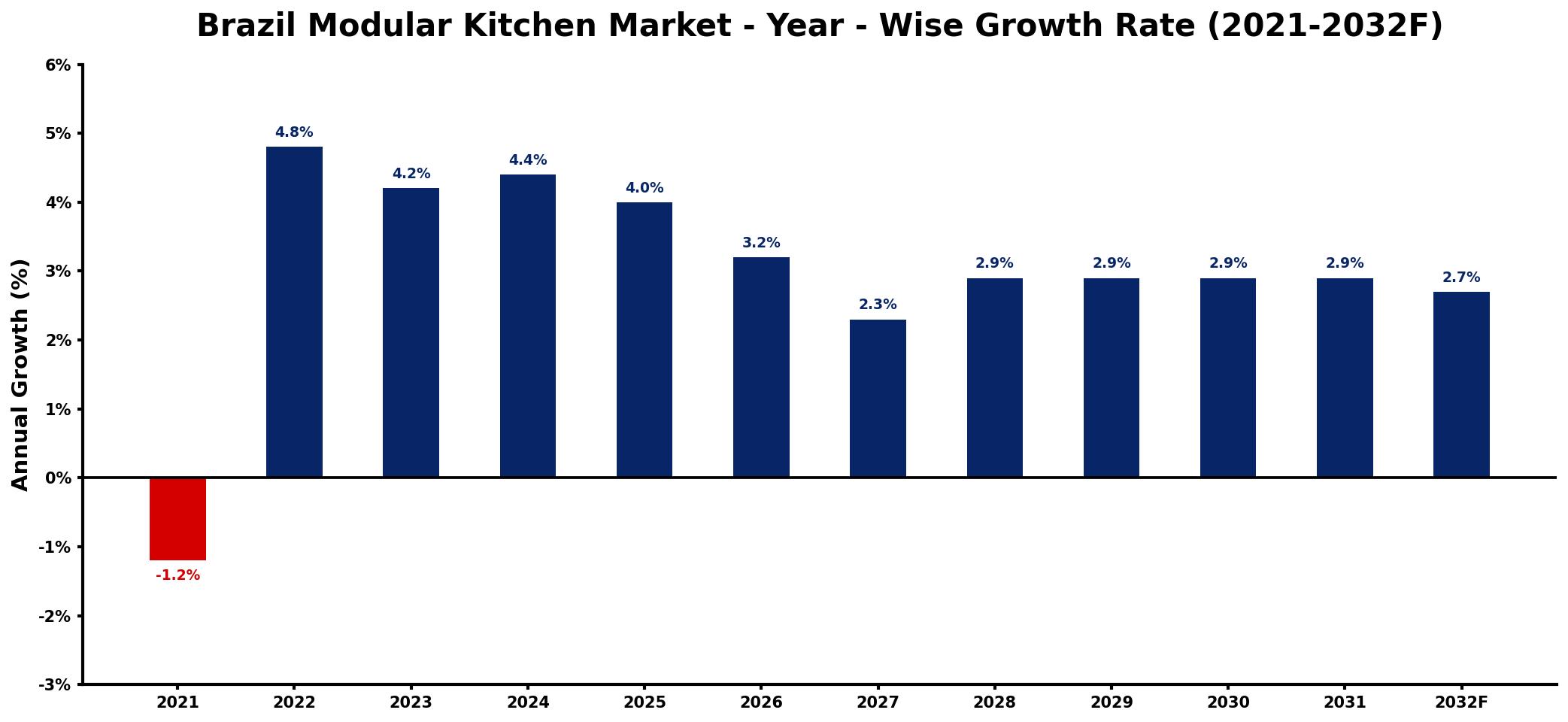
The table below presents the year‑wise growth rates along with the key drivers influencing the market
| Year | Growth Rate | Major Drivers |
| 2021 | -1.2% | Decrease in consumer spending power |
| 2022 | 4.8% | Rise in home renovation projects |
| 2023 | 4.2% | Increased focus on sustainability initiatives |
| 2024 | 4.4% | Growth in urban housing developments |
| 2025 | 4.0% | Expansion of online retail platforms |
| 2026 | 3.2% | Surge in disposable income levels |
| 2027 | 2.3% | Growing trend of open-concept designs |
| 2028 | 2.9% | Increase in real estate investments |
| 2029 | 2.9% | Rising demand for smart technologies |
| 2030 | 2.9% | increased overall sector activity |
| 2031 | 2.9% | expanding industrial usage applications |
| 2032 | 2.7% | rising end-use demand growth |
Note: Market size estimations and growth projections presented in this report are based on 6Wresearch's proprietary forecasting methodology, utilizing the latest available industry data, government publications, and primary research inputs.
Brazil Modular Kitchen Market Synopsis
Urbanization stands out as the most significant driving force in the Brazil Modular Kitchen Market. As more Brazilians relocate to urban centers, the demand for stylish, functional, and space-efficient kitchen solutions has soared. This shift emphasizes the growing preference for modern modular kitchens that cater to limited spaces without compromising on style.
Alongside urbanization, evolving lifestyle trends play a crucial role in shaping consumer demand. Today's consumers are leaning towards kitchens that offer both convenience and personalization, prompting manufacturers to innovate and provide customizable modular kitchen solutions. This trend is instrumental in driving the overall growth of the market.
Brazil Modular Kitchen Market Key Takeaways
- The modular kitchen market in Brazil is expanding due to urbanization and changing consumer lifestyles.
- Customization and aesthetic appeal are becoming critical factors for consumers when selecting modular kitchens.
- Government initiatives are fostering innovation and promoting sustainability in modular kitchen designs.
- Manufacturers are increasingly focusing on integrating advanced technologies in their products to meet consumer demands.
- The market is poised for steady growth, driven by rising disposable incomes and a preference for modern living spaces.
Evaluation of Restraints in Brazil Modular Kitchen Market
Despite the optimistic growth trajectory, the Brazil Modular Kitchen Market faces challenges in keeping up with rapidly evolving consumer preferences. As lifestyle trends shift, manufacturers must adapt quickly to ensure their offerings remain relevant and desirable. Additionally, there exists a level of price sensitivity among consumers, which can impact purchasing decisions. The ability to balance cost with quality and innovation will be pivotal for companies aiming to thrive in this competitive landscape.
Brazil Modular Kitchen Market Trends
Current trends in the Brazil Modular Kitchen Market reveal a strong consumer preference for eco-friendly materials and energy-efficient designs. As awareness of sustainability increases, consumers are seeking kitchens that are not only stylish but also contribute to environmental conservation. Additionally, the integration of smart technologies is emerging as a key trend, with more consumers showing interest in kitchens equipped with automated appliances and IoT capabilities, thereby enhancing functionality and convenience.
Brazil Modular Kitchen Market Opportunities
There are substantial growth opportunities within the Brazil Modular Kitchen Market, particularly in the realm of customization. As consumers increasingly desire kitchens that reflect their personal styles and meet their specific needs, manufacturers can capitalize on this demand by offering tailored solutions. Furthermore, leveraging technological advancements, such as augmented reality for virtual kitchen designs, can enhance the purchasing experience and provide a competitive edge in the market.
Government Initiatives in the Brazil Modular Kitchen Market
The Brazilian government is actively promoting the modular kitchen market through various initiatives aimed at standardizing quality and encouraging innovation. By partnering with industry stakeholders, the government is developing regulatory frameworks that ensure consumer safety and satisfaction. Additionally, incentives for research and development in sustainable materials and energy-efficient technologies align with Brazil's broader environmental goals, fostering a conducive environment for market growth.
Future Insights of the Brazil Modular Kitchen Market
Looking ahead to 2026-2032, the Brazil Modular Kitchen Market is expected to continue its upward trajectory, buoyed by ongoing urbanization and increasing household incomes. As consumer preferences evolve towards smart, efficient, and aesthetically pleasing solutions, manufacturers will need to focus on innovation and sustainability. With a growing emphasis on customization and technological integration, those companies that can adapt swiftly to market demands are likely to emerge as leaders in this dynamic landscape.
Brazil Modular Kitchen Market Latest Developments (2025 - 2026)
Recent industry developments indicate a shift towards more sustainable practices among manufacturers in the Brazilian modular kitchen market. Companies are increasingly focusing on eco-friendly materials and energy-efficient designs in response to consumer demand. Additionally, innovations in smart kitchen technologies are being prioritized, with many brands introducing automated systems and integration capabilities to enhance user experience. Overall, the industry is steering towards a future characterized by sustainability and technological advancement.
Brazil Modular Kitchen Market - Key Attractiveness of the Report
- 10 Years of Market Numbers
- Historical Data Starting from 2022 to 2025
- Base Year: 2025
- Forecast Data until 2032
- Key Performance Indicators Impacting the Market
- Major Upcoming Developments and Projects
Key Highlights of the Report:
- Brazil Modular Kitchen Market Outlook
- Market Size of Brazil Modular Kitchen Market, 2025
- Forecast of Brazil Modular Kitchen Market, 2032
- Historical Data and Forecast of Brazil Modular Kitchen Revenues & Volume for the Period 2022-2032F
- Brazil Modular Kitchen Market Trend Evolution
- Brazil Modular Kitchen Market Drivers and Challenges
- Brazil Modular Kitchen Price Trends
- Brazil Modular Kitchen Porter's Five Forces
- Brazil Modular Kitchen Industry Life Cycle
- Historical Data and Forecast of Brazil Modular Kitchen Market Revenues & Volume By Product for the Period 2022-2032F
- Historical Data and Forecast of Brazil Modular Kitchen Market Revenues & Volume By Floor Cabinet & Wall Cabinets for the Period 2022-2032F
- Historical Data and Forecast of Brazil Modular Kitchen Market Revenues & Volume By Tall Storage Cabinets for the Period 2022-2032F
- Historical Data and Forecast of Brazil Modular Kitchen Market Revenues & Volume By Others for the Period 2022-2032F
- Historical Data and Forecast of Brazil Modular Kitchen Market Revenues & Volume By End-User for the Period 2022-2032F
- Historical Data and Forecast of Brazil Modular Kitchen Market Revenues & Volume By Residential for the Period 2022-2032F
- Historical Data and Forecast of Brazil Modular Kitchen Market Revenues & Volume By Commercial for the Period 2022-2032F
- Historical Data and Forecast of Brazil Modular Kitchen Market Revenues & Volume By Distribution Channel for the Period 2022-2032F
- Historical Data and Forecast of Brazil Modular Kitchen Market Revenues & Volume By Offline (Contractors, Builders, and Others) for the Period 2022-2032F
- Historical Data and Forecast of Brazil Modular Kitchen Market Revenues & Volume By Online for the Period 2022-2032F
- Brazil Modular Kitchen Import Export Trade Statistics
- Market Opportunity Assessment By Product
- Market Opportunity Assessment By End-User
- Market Opportunity Assessment By Distribution Channel
- Brazil Modular Kitchen Top Companies Market Share
- Brazil Modular Kitchen Competitive Benchmarking By Technical and Operational Parameters
- Brazil Modular Kitchen Company Profiles
- Brazil Modular Kitchen Key Strategic Recommendations






































