Brazil Motorcycle components Market Size, Share & Growth Rate
The Brazil Motorcycle components Market was estimated at USD 227 Million in 2025 and is projected to reach USD 271 Million by 2032, growing at a CAGR of 2.6% from 2026 to 2032. This growth trajectory is fueled by increasing consumer preferences for motorcycles as a convenient mode of transport and rising disposable incomes. The evolution of the automotive landscape in Brazil further emphasizes technological advancements, particularly in lightweight materials and safety features, contributing significantly to the demand for motorcycle components.
Brazil Motorcycle components Market Year-wise Growth Rate and Key Drivers
This graph highlights how the Brazil Motorcycle components Market has steadily grown over the years, supported by major growth factors.
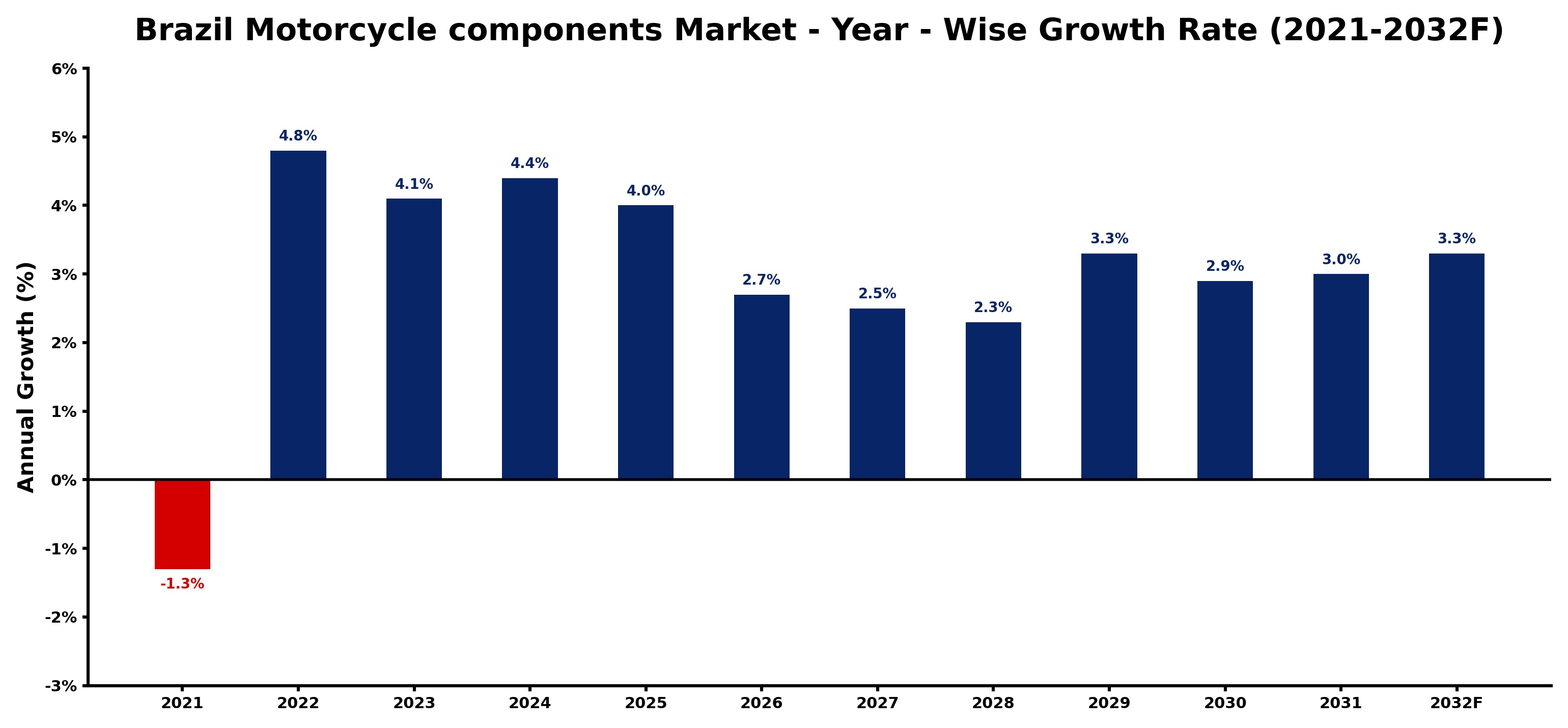
The table below presents the year‑wise growth rates along with the key drivers influencing the market
| Year | Growth Rate | Major Drivers |
| 2021 | -1.3% | Decreased motorcycle exports led to reduced component manufacturing orders |
| 2022 | 4.8% | Foundry modernization initiatives boosted local motorcycle component production efficiency |
| 2023 | 4.1% | Improved foundry modernization boosted domestic aluminum casting production efficiency |
| 2024 | 4.4% | Foundry modernization spurred domestic aluminum component production efficiency |
| 2025 | 4.0% | Domestic manufacturing recovery drives demand for advanced assembly technologies |
| 2026 | 2.7% | Domestic motorcycle component production aligns with local demand recovery |
| 2027 | 2.5% | Foundry modernization projects boost domestic motorcycle component production efficiency |
| 2028 | 2.3% | Foundry modernization projects boost capacity utilization for component production |
| 2029 | 3.3% | Foundry modernization projects boost domestic motorcycle parts production capacity |
| 2030 | 2.9% | Export driven foundry modernization boosted motorcycle component production efficiency |
| 2031 | 3.0% | Local demand surge drives motorcycle component manufacturing investments |
| 2032 | 3.3% | Domestic motorcycle component manufacturers boost investment in foundry upgrades |
Note - Market size estimations and growth projections presented in this report are based on 6Wresearch's advanced forecasting approach, validated with industry datasets as of June 2026.
Brazil Motorcycle components Market Synopsis
A remarkable aspect of the Brazil Motorcycle components market is the distinct consumer trend towards customization and enhanced safety features. As urban populations grow, the demand for motorcycles—seen as a flexible and efficient transportation solution—continues to escalate, driving the necessity for innovative components.
In light of recent developments, manufacturers are increasingly adopting advanced technologies to stay competitive. The push towards sustainability, coupled with the government's initiatives promoting eco-friendly practices, has seen a surge in the production of components that align with environmental standards.
Brazil Motorcycle components Market Key Takeaways
- The market is projected to reach USD 271 Million by 2032, indicating significant growth opportunities.
- Increasing consumer demand for motorcycles and advanced safety features drive the market forward.
- Technological innovations in lightweight materials are reshaping component production.
- Urban expansion necessitates convenient transport solutions, further boosting market dynamics.
- Government policies are supporting sustainable practices within the motorcycle components sector.
Evaluation of Restraints in Brazil Motorcycle components Market
Despite the overall positive outlook for the Brazil Motorcycle components market, several restraints hinder its growth potential. The competitive landscape has intensified, compelling manufacturers to invest in research and development to differentiate their offerings. Fluctuations in raw material prices present another obstacle, as they directly impact production costs and profit margins. Moreover, the need for continuous compliance with evolving safety standards creates additional burdens for manufacturers. Addressing these restraints is essential for maintaining competitiveness and catering effectively to market demands.
Brazil Motorcycle components Market Trends
A prominent trend in the Brazil Motorcycle components market is the increasing integration of technology, particularly in terms of safety and connectivity features. As consumers demand smarter and safer riding experiences, manufacturers are focusing on advanced braking systems and sensor technologies. Additionally, the shift towards electric motorcycles is gaining traction, pushing component suppliers to innovate in line with this eco-friendly paradigm.
Brazil Motorcycle components Market Opportunities
The Brazil Motorcycle components market presents myriad growth and investment opportunities, particularly for those willing to embrace sustainability and technological advancements. Companies that invest in developing lightweight and environmentally friendly materials will find a receptive market, especially as regulations tighten around emissions. The potential for exporting components to neighboring countries also offers strategic avenues for expansion, reinforcing Brazil's position in the regional motorcycle supply chain.
Government Initiatives in the Brazil Motorcycle components Market
Government initiatives aimed at promoting innovation and sustainability play a critical role in shaping the Brazil Motorcycle components market. Policies encouraging tax incentives for eco-friendly technologies are becoming more prevalent, supporting manufacturers in their transition towards greener practices. Furthermore, stringent regulations concerning product safety and environmental standards necessitate ongoing compliance, which can be both a challenge and an opportunity for growth in this sector.
Future Insights of the Brazil Motorcycle components Market
Looking forward to 2026-2032, the Brazil Motorcycle components market is poised for a dynamic evolution. The anticipated growth in urbanization will continue to fuel demand for motorcycles, leading to an increase in component innovation. As manufacturers adapt to new technologies and consumer preferences shift towards sustainability, we expect to see a wave of new entrants in the market, enhancing competition and driving further advancements in product offerings.
Brazil Motorcycle components Market Latest Developments (May 2025 - June 2026)
Recent industry developments indicate a significant shift towards embracing smart technologies within the motorcycle components sector. Many manufacturers are exploring partnerships to integrate IoT capabilities into their products, enhancing rider experience and safety. Additionally, the trend of adopting eco-friendly production practices is gaining momentum, reflecting a collective industry response to consumer demand for sustainability. The ongoing evolution of regulatory standards continues to shape manufacturing practices, ensuring that safety remains a priority.
Brazil Motorcycle components Market - Key Attractiveness of the Report
- 10 Years of Market Numbers
- Historical Data Starting from 2022 to 2025
- Base Year: 2025
- Forecast Data until 2032
- Key Performance Indicators Impacting the Market
- Major Upcoming Developments and Projects
Key Highlights of the Report:
- Brazil Motorcycle components Market Outlook
- Market Size of Brazil Motorcycle components Market, 2025
- Forecast of Brazil Motorcycle components Market, 2032
- Historical Data and Forecast of Brazil Motorcycle components Revenues & Volume for the Period 2022-2032F
- Brazil Motorcycle components Market Trend Evolution
- Brazil Motorcycle components Market Drivers and Challenges
- Brazil Motorcycle components Price Trends
- Brazil Motorcycle components Porter's Five Forces
- Brazil Motorcycle components Industry Life Cycle
- Historical Data and Forecast of Brazil Motorcycle components Market Revenues & Volume By Type for the Period 2022-2032F
- Historical Data and Forecast of Brazil Motorcycle components Market Revenues & Volume By Engine & Drivetrain for the Period 2022-2032F
- Historical Data and Forecast of Brazil Motorcycle components Market Revenues & Volume By Tires for the Period 2022-2032F
- Historical Data and Forecast of Brazil Motorcycle components Market Revenues & Volume By Structural for the Period 2022-2032F
- Historical Data and Forecast of Brazil Motorcycle components Market Revenues & Volume By Electrical and Electronic for the Period 2022-2032F
- Historical Data and Forecast of Brazil Motorcycle components Market Revenues & Volume By Other for the Period 2022-2032F
- Historical Data and Forecast of Brazil Motorcycle components Market Revenues & Volume By Applications for the Period 2022-2032F
- Historical Data and Forecast of Brazil Motorcycle components Market Revenues & Volume By Electric Bicycles for the Period 2022-2032F
- Historical Data and Forecast of Brazil Motorcycle components Market Revenues & Volume By Motorcycles for the Period 2022-2032F
- Brazil Motorcycle components Import Export Trade Statistics
- Market Opportunity Assessment By Type
- Market Opportunity Assessment By Applications
- Brazil Motorcycle components Top Companies Market Share
- Brazil Motorcycle components Competitive Benchmarking By Technical and Operational Parameters
- Brazil Motorcycle components Company Profiles
- Brazil Motorcycle components Key Strategic Recommendations






































