Brazil Music Recording Market Size, Share & Growth Rate
The Brazil Music Recording Market was estimated at USD 234 Million in 2025 and is projected to reach USD 278 Million by 2032, growing at a CAGR of 2.5% from 2026 to 2032. This growth trajectory is driven by the dynamic shift towards digital consumption, with streaming services rapidly gaining market share. Additionally, the rise of independent artists leveraging technology for production and distribution is reshaping traditional business models, fostering an environment ripe for innovation and growth.
Brazil Music Recording Market Year-wise Growth Rate and Key Drivers
This graph highlights how the Brazil Music Recording Market has steadily grown over the years, supported by major growth factors.
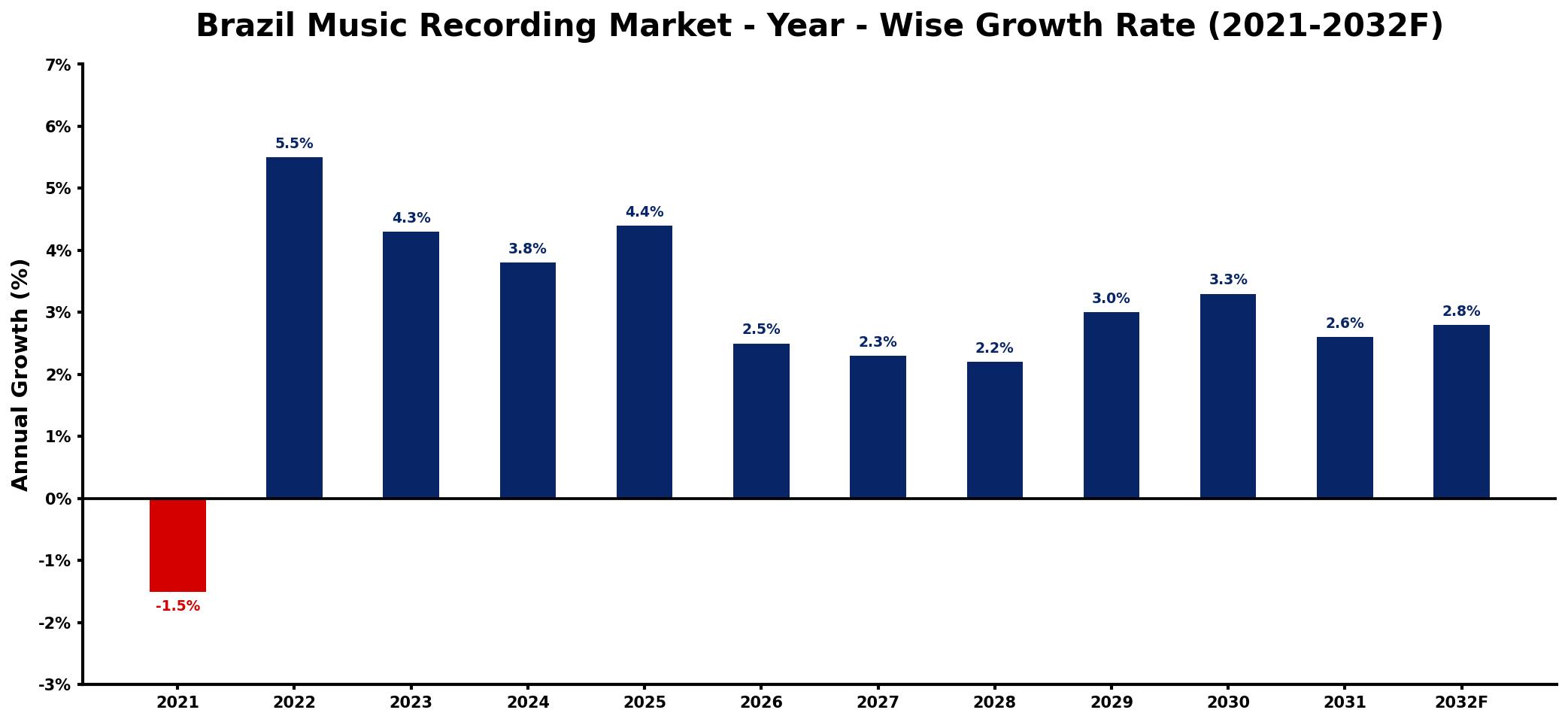
The table below presents the year‑wise growth rates along with the key drivers influencing the market
| Year | Growth Rate | Major Drivers |
| 2021 | -1.5% | decreased consumer spending on entertainment |
| 2022 | 5.5% | emerging artists gaining popularity rapidly |
| 2023 | 4.3% | rise in streaming subscription services |
| 2024 | 3.8% | increased investment in digital platforms |
| 2025 | 4.4% | growing demand for live performances |
| 2026 | 2.5% | expansion of local talent showcases |
| 2027 | 2.3% | enhanced collaboration with influencers |
| 2028 | 2.2% | diversification of revenue streams available |
| 2029 | 3.0% | increased focus on international markets |
| 2030 | 3.3% | growing interest in niche genres |
| 2031 | 2.6% | stronger distribution network expansion |
| 2032 | 2.8% | strengthened partnerships with technology firms |
Note: Market size estimations and growth projections presented in this report are based on 6Wresearch's proprietary forecasting methodology, utilizing the latest available industry data, government publications, and primary research inputs.
Brazil Music Recording Market Synopsis
The most significant force currently influencing the Brazil Music Recording Market is the proliferation of digital streaming platforms, which has changed the way consumers access and enjoy music. This shift not only democratizes music consumption but also fuels an increasing demand for new recording technologies and platforms that cater to independent artists.
Moreover, the resurgence of physical formats, particularly vinyl, underscores a duality in consumer preferences. This blend of old and new reflects Brazil's rich musical heritage while also embracing modern distribution methods, which are critical for sustaining market growth and artist exposure.
Brazil Music Recording Market Key Takeaways
- The market is expected to grow steadily due to increasing consumer preference for digital music.
- Independent artists are transforming the landscape through enhanced access to recording tools and distribution channels.
- Technological advancements in recording equipment and software are driving production efficiency.
- Intellectual property rights and cultural policies are crucial in protecting artists' interests amidst evolving market dynamics.
- The revival of vinyl records is indicative of a broader trend towards diverse music consumption formats.
Evaluation of Restraints in Brazil Music Recording Market
While the Brazil Music Recording Market exhibits promising growth potential, it is not without its constraints. Digital piracy remains a significant challenge, undermining revenue generation for artists and recording companies alike. Furthermore, the dominance of streaming services has resulted in complex revenue distribution models, often leading to inadequate compensation for musicians. Addressing these issues while remaining adaptable to technological advancements will be crucial for the industry's sustainability and long-term success.
Brazil Music Recording Market Trends
Current trends in the Brazil Music Recording Market highlight a growing preference for personalized music experiences driven by algorithm-based streaming services. Additionally, the integration of artificial intelligence in music production is beginning to reshape creative processes, making them more accessible to artists at all levels. Furthermore, collaborations across genres and cultural lines are becoming increasingly common, reflecting the diverse musical tapestry of Brazil.
Brazil Music Recording Market Opportunities
The market holds numerous opportunities, particularly in the realm of technology-driven solutions for music production and distribution. As independent artists seek more control over their creations, platforms that offer user-friendly recording tools and marketing support will thrive. Additionally, there is significant potential for local music festivals and events that promote Brazilian talent, thereby attracting investment and boosting the economy.
Government Initiatives in the Brazil Music Recording Market
Brazilian government policies increasingly focus on enhancing intellectual property rights for artists and promoting local cultural preservation. Initiatives aimed at supporting local music production and distribution underscore the government's commitment to fostering a vibrant music scene. These policies play a pivotal role in encouraging creativity and innovation while also safeguarding the interests of musicians in a rapidly changing market landscape.
Future Insights of the Brazil Music Recording Market
Looking forward to 2026-2032, the Brazil Music Recording Market is poised for continued evolution, driven by ongoing technological advancements and shifts in consumer behavior. The expected growth in digital streaming will likely pave the way for enhanced monetization strategies, benefiting both established and emerging artists. As the market adapts to these changes, an emphasis on protecting artist rights and embracing innovative distribution models will be essential for long-term sustainability.
Brazil Music Recording Market Latest Developments (2025 - 2026)
Recent developments in the Brazil Music Recording Market indicate a strong push towards integrating advanced technologies into production processes. Many recording studios are now adopting cloud-based solutions that allow for real-time collaboration across distances. Additionally, a surge in grassroots movements supporting local artists has led to increased public and private investment in music education and resources, which bodes well for the future of the industry.
Brazil Music Recording Market - Key Attractiveness of the Report
- 10 Years of Market Numbers
- Historical Data Starting from 2022 to 2025
- Base Year: 2025
- Forecast Data until 2032
- Key Performance Indicators Impacting the Market
- Major Upcoming Developments and Projects
Key Highlights of the Report:
- Brazil Music Recording Market Outlook
- Market Size of Brazil Music Recording Market, 2025
- Forecast of Brazil Music Recording Market, 2032
- Historical Data and Forecast of Brazil Music Recording Revenues & Volume for the Period 2022-2032F
- Brazil Music Recording Market Trend Evolution
- Brazil Music Recording Market Drivers and Challenges
- Brazil Music Recording Price Trends
- Brazil Music Recording Porter's Five Forces
- Brazil Music Recording Industry Life Cycle
- Historical Data and Forecast of Brazil Music Recording Market Revenues & Volume By Type for the Period 2022-2032F
- Historical Data and Forecast of Brazil Music Recording Market Revenues & Volume By Record Production for the Period 2022-2032F
- Historical Data and Forecast of Brazil Music Recording Market Revenues & Volume By Music Publishers for the Period 2022-2032F
- Historical Data and Forecast of Brazil Music Recording Market Revenues & Volume By Record Distribution for the Period 2022-2032F
- Historical Data and Forecast of Brazil Music Recording Market Revenues & Volume By Sound Recording Studios for the Period 2022-2032F
- Historical Data and Forecast of Brazil Music Recording Market Revenues & Volume By Application for the Period 2022-2032F
- Historical Data and Forecast of Brazil Music Recording Market Revenues & Volume By Mechanical for the Period 2022-2032F
- Historical Data and Forecast of Brazil Music Recording Market Revenues & Volume By Performance for the Period 2022-2032F
- Historical Data and Forecast of Brazil Music Recording Market Revenues & Volume By Synchronization for the Period 2022-2032F
- Historical Data and Forecast of Brazil Music Recording Market Revenues & Volume By Digital for the Period 2022-2032F
- Historical Data and Forecast of Brazil Music Recording Market Revenues & Volume By Others for the Period 2022-2032F
- Historical Data and Forecast of Brazil Music Recording Market Revenues & Volume By End-User for the Period 2022-2032F
- Historical Data and Forecast of Brazil Music Recording Market Revenues & Volume By Individual for the Period 2022-2032F
- Historical Data and Forecast of Brazil Music Recording Market Revenues & Volume By Commercial for the Period 2022-2032F
- Historical Data and Forecast of Brazil Music Recording Market Revenues & Volume By Genre for the Period 2022-2032F
- Historical Data and Forecast of Brazil Music Recording Market Revenues & Volume By Rock for the Period 2022-2032F
- Historical Data and Forecast of Brazil Music Recording Market Revenues & Volume By Hip Hop for the Period 2022-2032F
- Historical Data and Forecast of Brazil Music Recording Market Revenues & Volume By Pop for the Period 2022-2032F
- Historical Data and Forecast of Brazil Music Recording Market Revenues & Volume By Jazz for the Period 2022-2032F
- Historical Data and Forecast of Brazil Music Recording Market Revenues & Volume By Others for the Period 2022-2032F
- Brazil Music Recording Import Export Trade Statistics
- Market Opportunity Assessment By Type
- Market Opportunity Assessment By Application
- Market Opportunity Assessment By End-User
- Market Opportunity Assessment By Genre
- Brazil Music Recording Top Companies Market Share
- Brazil Music Recording Competitive Benchmarking By Technical and Operational Parameters
- Brazil Music Recording Company Profiles
- Brazil Music Recording Key Strategic Recommendations






































