Brazil Natural Gas Liquids Market (2025-2031) | Growth, Challenges, Analysis, Competitive, Drivers, Segments, Consumer Insights, Industry, Segmentation, Competition, Pricing Analysis, Opportunities, Restraints, Revenue, Share, Investment Trends, Trends, Forecast, Size, Companies, Outlook, Strategic Insights, Demand, Supply, Value, Strategy
Market Forecast By Type (Ethane, Propane, Butane, Isobutane, Natural Gasoline), By Application (Petrochemicals, Heating, Cooking, Aerosol Propellants, Blending), By Processing Stage (Fractionation, Gas Separation, Distillation, Refining, Recovery), By Storage Method (Pressurized Tanks, Cylinders, Bulk Storage, Containerized, Underground Caverns), By Transportation Mode (Pipelines, Tanker Trucks, Rail Transport, Ships, Pipelines) And Competitive Landscape
| Product Code: ETC12985602 | Publication Date: Apr 2025 | Updated Date: Oct 2025 | Product Type: Market Research Report | |
| Publisher: 6Wresearch | Author: Summon Dutta | No. of Pages: 65 | No. of Figures: 34 | No. of Tables: 19 |
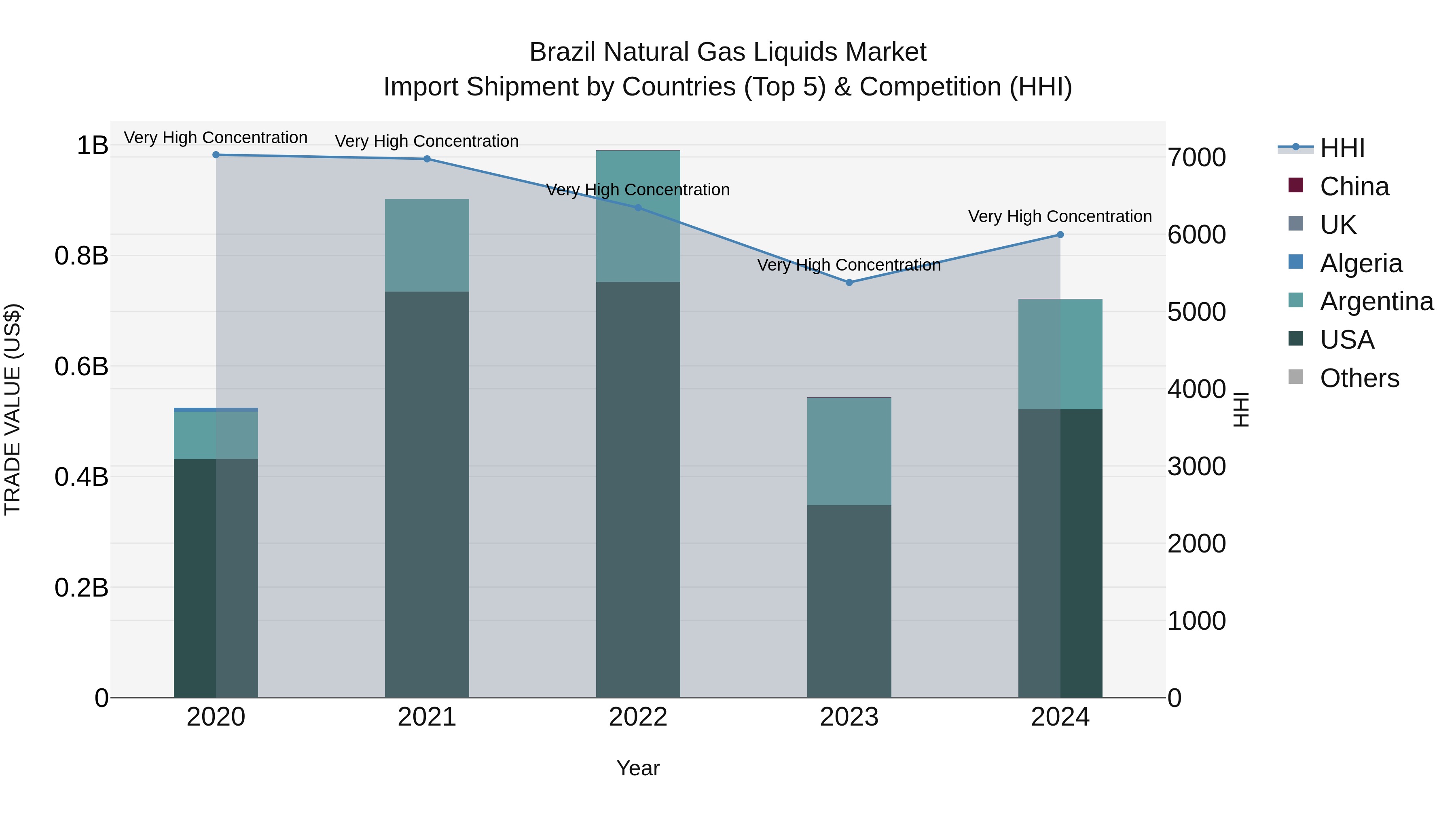
Brazil Natural Gas Liquids Market Top 5 Importing Countries and Market Competition (HHI) Analysis
Brazil`s natural gas liquids import market in 2024 continued to be dominated by key exporters such as the USA, Argentina, China, Italy, and South Korea. The High Herfindahl-Hirschman Index (HHI) indicates a concentrated market, with significant import volumes from these countries. The compound annual growth rate (CAGR) from 2020 to 2024 stood at a healthy 8.28%, with a notable growth rate spike of 32.74% in 2024 compared to the previous year. This data underscores the importance of these top exporting countries in meeting Brazil`s demand for natural gas liquids.
Brazil Natural Gas Liquids Market Overview
The Brazil natural gas liquids market is experiencing steady growth driven by increasing demand from various industries such as petrochemicals, refineries, and transportation. With Brazil being one of the largest natural gas producers in Latin America, the market for natural gas liquids like ethane, propane, and butane is expected to expand further. The country`s rich natural gas reserves and investments in infrastructure for gas processing and distribution are also contributing to the market`s growth. Additionally, the growing focus on cleaner energy sources and the development of the natural gas sector in Brazil are creating opportunities for new players to enter the market. Overall, the Brazil natural gas liquids market presents promising prospects for investors and stakeholders looking to capitalize on the country`s evolving energy landscape.
Brazil Natural Gas Liquids Market Trends
In the Brazil natural gas liquids market, a key trend is the increasing production and consumption of ethane and propane. With the growth of the petrochemical industry in Brazil, there is a rising demand for ethane as a feedstock for ethylene production. Additionally, the demand for propane is driven by its use in residential, commercial, and industrial applications such as heating and cooking. The expansion of natural gas processing facilities in Brazil is also contributing to the growth of the natural gas liquids market, providing a steady supply of ethane, propane, and other NGLs. As Brazil continues to develop its energy infrastructure and shift towards cleaner fuels, the natural gas liquids market is expected to experience further growth and diversification in the coming years.
Brazil Natural Gas Liquids Market Challenges
In the Brazil natural gas liquids market, some key challenges include regulatory uncertainties and fluctuations in global oil and gas prices. The regulatory environment in Brazil can be complex and subject to changes, which can impact the investment climate for natural gas liquids projects. Additionally, the market is vulnerable to price volatility in global oil and gas markets, which can affect the profitability and competitiveness of natural gas liquids producers and suppliers in Brazil. Other challenges include infrastructure limitations, such as insufficient pipeline capacity and storage facilities, which can hinder the efficient transportation and distribution of natural gas liquids within the country. Overall, navigating these challenges requires a deep understanding of the market dynamics and proactive strategies to mitigate risks and capitalize on opportunities in the Brazil natural gas liquids sector.
Brazil Natural Gas Liquids Market Investment Opportunities
Investment opportunities in the Brazil natural gas liquids market are promising due to the country`s vast reserves, growing demand for energy, and increasing focus on natural gas as a cleaner alternative to traditional fuels. Potential investments could include exploration and production companies operating in Brazil`s gas fields, midstream infrastructure projects such as pipelines and processing facilities, and downstream opportunities in the petrochemical industry for products derived from natural gas liquids. With Brazil`s government actively promoting investments in the energy sector and ongoing regulatory reforms to attract foreign capital, the natural gas liquids market presents opportunities for long-term growth and profitability for investors looking to capitalize on the country`s energy transition and economic development.
Brazil Natural Gas Liquids Market Government Policy
In Brazil, the government has implemented policies to promote the development and utilization of the natural gas liquids (NGL) market. These policies include measures to attract investment in NGL infrastructure and production facilities, such as tax incentives and regulatory reforms to encourage private sector participation. Additionally, the government has pursued initiatives to diversify the energy mix by increasing the use of NGLs in power generation and transportation sectors. Brazil has also focused on enhancing the competitiveness of its NGL industry by promoting technological innovation and improving the efficiency of extraction and processing operations. Overall, these government policies aim to stimulate growth in the NGL market, enhance energy security, and reduce greenhouse gas emissions through the use of cleaner fossil fuels.
Brazil Natural Gas Liquids Market Future Outlook
The future outlook for the Brazil natural gas liquids market appears promising, driven by sustained economic growth, increasing industrialization, and a growing demand for cleaner energy sources. As the country continues to develop its energy infrastructure and diversify its energy mix, natural gas liquids are expected to play a significant role in meeting the rising energy needs. Additionally, Brazil`s focus on environmental sustainability and reducing carbon emissions is likely to further boost the demand for natural gas liquids as a cleaner alternative to traditional fuels. With ongoing investments in exploration and production activities, as well as supportive government policies, the Brazil natural gas liquids market is anticipated to witness steady growth in the coming years, presenting opportunities for market players to capitalize on the expanding market potential.
Key Highlights of the Report:
- Brazil Natural Gas Liquids Market Outlook
- Market Size of Brazil Natural Gas Liquids Market,2024
- Forecast of Brazil Natural Gas Liquids Market, 2031
- Historical Data and Forecast of Brazil Natural Gas Liquids Revenues & Volume for the Period 2021-2031
- Brazil Natural Gas Liquids Market Trend Evolution
- Brazil Natural Gas Liquids Market Drivers and Challenges
- Brazil Natural Gas Liquids Price Trends
- Brazil Natural Gas Liquids Porter's Five Forces
- Brazil Natural Gas Liquids Industry Life Cycle
- Historical Data and Forecast of Brazil Natural Gas Liquids Market Revenues & Volume By Type for the Period 2021-2031
- Historical Data and Forecast of Brazil Natural Gas Liquids Market Revenues & Volume By Ethane for the Period 2021-2031
- Historical Data and Forecast of Brazil Natural Gas Liquids Market Revenues & Volume By Propane for the Period 2021-2031
- Historical Data and Forecast of Brazil Natural Gas Liquids Market Revenues & Volume By Butane for the Period 2021-2031
- Historical Data and Forecast of Brazil Natural Gas Liquids Market Revenues & Volume By Isobutane for the Period 2021-2031
- Historical Data and Forecast of Brazil Natural Gas Liquids Market Revenues & Volume By Natural Gasoline for the Period 2021 - 2029
- Historical Data and Forecast of Brazil Natural Gas Liquids Market Revenues & Volume By Application for the Period 2021-2031
- Historical Data and Forecast of Brazil Natural Gas Liquids Market Revenues & Volume By Petrochemicals for the Period 2021-2031
- Historical Data and Forecast of Brazil Natural Gas Liquids Market Revenues & Volume By Heating for the Period 2021-2031
- Historical Data and Forecast of Brazil Natural Gas Liquids Market Revenues & Volume By Cooking for the Period 2021-2031
- Historical Data and Forecast of Brazil Natural Gas Liquids Market Revenues & Volume By Aerosol Propellants for the Period 2021-2031
- Historical Data and Forecast of Brazil Natural Gas Liquids Market Revenues & Volume By Blending for the Period 2021 - 2029
- Historical Data and Forecast of Brazil Natural Gas Liquids Market Revenues & Volume By Processing Stage for the Period 2021-2031
- Historical Data and Forecast of Brazil Natural Gas Liquids Market Revenues & Volume By Fractionation for the Period 2021-2031
- Historical Data and Forecast of Brazil Natural Gas Liquids Market Revenues & Volume By Gas Separation for the Period 2021-2031
- Historical Data and Forecast of Brazil Natural Gas Liquids Market Revenues & Volume By Distillation for the Period 2021-2031
- Historical Data and Forecast of Brazil Natural Gas Liquids Market Revenues & Volume By Refining for the Period 2021-2031
- Historical Data and Forecast of Brazil Natural Gas Liquids Market Revenues & Volume By Recovery for the Period 2021 - 2029
- Historical Data and Forecast of Brazil Natural Gas Liquids Market Revenues & Volume By Storage Method for the Period 2021-2031
- Historical Data and Forecast of Brazil Natural Gas Liquids Market Revenues & Volume By Pressurized Tanks for the Period 2021-2031
- Historical Data and Forecast of Brazil Natural Gas Liquids Market Revenues & Volume By Cylinders for the Period 2021-2031
- Historical Data and Forecast of Brazil Natural Gas Liquids Market Revenues & Volume By Bulk Storage for the Period 2021-2031
- Historical Data and Forecast of Brazil Natural Gas Liquids Market Revenues & Volume By Containerized for the Period 2021-2031
- Historical Data and Forecast of Brazil Natural Gas Liquids Market Revenues & Volume By Underground Caverns for the Period 2021 - 2029
- Historical Data and Forecast of Brazil Natural Gas Liquids Market Revenues & Volume By Transportation Mode for the Period 2021-2031
- Historical Data and Forecast of Brazil Natural Gas Liquids Market Revenues & Volume By Pipelines for the Period 2021-2031
- Historical Data and Forecast of Brazil Natural Gas Liquids Market Revenues & Volume By Tanker Trucks for the Period 2021-2031
- Historical Data and Forecast of Brazil Natural Gas Liquids Market Revenues & Volume By Rail Transport for the Period 2021-2031
- Historical Data and Forecast of Brazil Natural Gas Liquids Market Revenues & Volume By Ships for the Period 2021 - 2029
- Historical Data and Forecast of Brazil Natural Gas Liquids Market Revenues & Volume By Pipelines for the Period 2021 - 2029
- Brazil Natural Gas Liquids Import Export Trade Statistics
- Market Opportunity Assessment By Type
- Market Opportunity Assessment By Application
- Market Opportunity Assessment By Processing Stage
- Market Opportunity Assessment By Storage Method
- Market Opportunity Assessment By Transportation Mode
- Brazil Natural Gas Liquids Top Companies Market Share
- Brazil Natural Gas Liquids Competitive Benchmarking By Technical and Operational Parameters
- Brazil Natural Gas Liquids Company Profiles
- Brazil Natural Gas Liquids Key Strategic Recommendations
Frequently Asked Questions About the Market Study (FAQs):
6Wresearch actively monitors the Brazil Natural Gas Liquids Market and publishes its comprehensive annual report, highlighting emerging trends, growth drivers, revenue analysis, and forecast outlook. Our insights help businesses to make data-backed strategic decisions with ongoing market dynamics. Our analysts track relevent industries related to the Brazil Natural Gas Liquids Market, allowing our clients with actionable intelligence and reliable forecasts tailored to emerging regional needs.
Yes, we provide customisation as per your requirements. To learn more, feel free to contact us on sales@6wresearch.com
1 Executive Summary |
2 Introduction |
2.1 Key Highlights of the Report |
2.2 Report Description |
2.3 Market Scope & Segmentation |
2.4 Research Methodology |
2.5 Assumptions |
3 Brazil Natural Gas Liquids Market Overview |
3.1 Brazil Country Macro Economic Indicators |
3.2 Brazil Natural Gas Liquids Market Revenues & Volume, 2021 & 2031F |
3.3 Brazil Natural Gas Liquids Market - Industry Life Cycle |
3.4 Brazil Natural Gas Liquids Market - Porter's Five Forces |
3.5 Brazil Natural Gas Liquids Market Revenues & Volume Share, By Type, 2021 & 2031F |
3.6 Brazil Natural Gas Liquids Market Revenues & Volume Share, By Application, 2021 & 2031F |
3.7 Brazil Natural Gas Liquids Market Revenues & Volume Share, By Processing Stage, 2021 & 2031F |
3.8 Brazil Natural Gas Liquids Market Revenues & Volume Share, By Storage Method, 2021 & 2031F |
3.9 Brazil Natural Gas Liquids Market Revenues & Volume Share, By Transportation Mode, 2021 & 2031F |
4 Brazil Natural Gas Liquids Market Dynamics |
4.1 Impact Analysis |
4.2 Market Drivers |
4.2.1 Increasing demand for petrochemicals and plastics |
4.2.2 Growth in industrial activities and infrastructure development |
4.2.3 Government initiatives to promote natural gas as a cleaner alternative fuel |
4.3 Market Restraints |
4.3.1 Fluctuating crude oil prices affecting natural gas liquids pricing |
4.3.2 Regulatory challenges and environmental concerns |
4.3.3 Infrastructure limitations for natural gas liquids transportation and storage |
5 Brazil Natural Gas Liquids Market Trends |
6 Brazil Natural Gas Liquids Market, By Types |
6.1 Brazil Natural Gas Liquids Market, By Type |
6.1.1 Overview and Analysis |
6.1.2 Brazil Natural Gas Liquids Market Revenues & Volume, By Type, 2021 - 2031F |
6.1.3 Brazil Natural Gas Liquids Market Revenues & Volume, By Ethane, 2021 - 2031F |
6.1.4 Brazil Natural Gas Liquids Market Revenues & Volume, By Propane, 2021 - 2031F |
6.1.5 Brazil Natural Gas Liquids Market Revenues & Volume, By Butane, 2021 - 2031F |
6.1.6 Brazil Natural Gas Liquids Market Revenues & Volume, By Isobutane, 2021 - 2031F |
6.1.7 Brazil Natural Gas Liquids Market Revenues & Volume, By Natural Gasoline, 2021 - 2031F |
6.2 Brazil Natural Gas Liquids Market, By Application |
6.2.1 Overview and Analysis |
6.2.2 Brazil Natural Gas Liquids Market Revenues & Volume, By Petrochemicals, 2021 - 2031F |
6.2.3 Brazil Natural Gas Liquids Market Revenues & Volume, By Heating, 2021 - 2031F |
6.2.4 Brazil Natural Gas Liquids Market Revenues & Volume, By Cooking, 2021 - 2031F |
6.2.5 Brazil Natural Gas Liquids Market Revenues & Volume, By Aerosol Propellants, 2021 - 2031F |
6.2.6 Brazil Natural Gas Liquids Market Revenues & Volume, By Blending, 2021 - 2031F |
6.3 Brazil Natural Gas Liquids Market, By Processing Stage |
6.3.1 Overview and Analysis |
6.3.2 Brazil Natural Gas Liquids Market Revenues & Volume, By Fractionation, 2021 - 2031F |
6.3.3 Brazil Natural Gas Liquids Market Revenues & Volume, By Gas Separation, 2021 - 2031F |
6.3.4 Brazil Natural Gas Liquids Market Revenues & Volume, By Distillation, 2021 - 2031F |
6.3.5 Brazil Natural Gas Liquids Market Revenues & Volume, By Refining, 2021 - 2031F |
6.3.6 Brazil Natural Gas Liquids Market Revenues & Volume, By Recovery, 2021 - 2031F |
6.4 Brazil Natural Gas Liquids Market, By Storage Method |
6.4.1 Overview and Analysis |
6.4.2 Brazil Natural Gas Liquids Market Revenues & Volume, By Pressurized Tanks, 2021 - 2031F |
6.4.3 Brazil Natural Gas Liquids Market Revenues & Volume, By Cylinders, 2021 - 2031F |
6.4.4 Brazil Natural Gas Liquids Market Revenues & Volume, By Bulk Storage, 2021 - 2031F |
6.4.5 Brazil Natural Gas Liquids Market Revenues & Volume, By Containerized, 2021 - 2031F |
6.4.6 Brazil Natural Gas Liquids Market Revenues & Volume, By Underground Caverns, 2021 - 2031F |
6.5 Brazil Natural Gas Liquids Market, By Transportation Mode |
6.5.1 Overview and Analysis |
6.5.2 Brazil Natural Gas Liquids Market Revenues & Volume, By Pipelines, 2021 - 2031F |
6.5.3 Brazil Natural Gas Liquids Market Revenues & Volume, By Tanker Trucks, 2021 - 2031F |
6.5.4 Brazil Natural Gas Liquids Market Revenues & Volume, By Rail Transport, 2021 - 2031F |
6.5.5 Brazil Natural Gas Liquids Market Revenues & Volume, By Ships, 2021 - 2031F |
6.5.6 Brazil Natural Gas Liquids Market Revenues & Volume, By Pipelines, 2021 - 2031F |
7 Brazil Natural Gas Liquids Market Import-Export Trade Statistics |
7.1 Brazil Natural Gas Liquids Market Export to Major Countries |
7.2 Brazil Natural Gas Liquids Market Imports from Major Countries |
8 Brazil Natural Gas Liquids Market Key Performance Indicators |
8.1 Number of new petrochemical plants or expansions in Brazil |
8.2 Energy efficiency improvements in natural gas liquids extraction and processing facilities |
8.3 Investment in pipeline infrastructure for natural gas liquids transportation |
9 Brazil Natural Gas Liquids Market - Opportunity Assessment |
9.1 Brazil Natural Gas Liquids Market Opportunity Assessment, By Type, 2021 & 2031F |
9.2 Brazil Natural Gas Liquids Market Opportunity Assessment, By Application, 2021 & 2031F |
9.3 Brazil Natural Gas Liquids Market Opportunity Assessment, By Processing Stage, 2021 & 2031F |
9.4 Brazil Natural Gas Liquids Market Opportunity Assessment, By Storage Method, 2021 & 2031F |
9.5 Brazil Natural Gas Liquids Market Opportunity Assessment, By Transportation Mode, 2021 & 2031F |
10 Brazil Natural Gas Liquids Market - Competitive Landscape |
10.1 Brazil Natural Gas Liquids Market Revenue Share, By Companies, 2024 |
10.2 Brazil Natural Gas Liquids Market Competitive Benchmarking, By Operating and Technical Parameters |
11 Company Profiles |
12 Recommendations |
13 Disclaimer |
Pricing
- Single User License$ 1,995
- Department License$ 2,400
- Site License$ 3,120
- Global License$ 3,795

Search
Thought Leadership and Analyst Meet





Our Clients








Related Reports
- Canada Oil and Gas Market (2026-2032) | Share, Segmentation, Value, Industry, Trends, Forecast, Analysis, Size & Revenue, Growth, Competitive Landscape, Outlook, Companies
- Germany Breakfast Food Market (2026-2032) | Industry, Share, Growth, Size, Companies, Value, Analysis, Revenue, Trends, Forecast & Outlook
- Australia Briquette Market (2025-2031) | Growth, Size, Revenue, Forecast, Analysis, Trends, Value, Share, Industry & Companies
- Vietnam System Integrator Market (2025-2031) | Size, Companies, Analysis, Industry, Value, Forecast, Growth, Trends, Revenue & Share
- ASEAN and Thailand Brain Health Supplements Market (2025-2031) | Strategy, Consumer Insights, Analysis, Investment Trends, Opportunities, Growth, Size, Share, Industry, Revenue, Segments, Value, Segmentation, Supply, Forecast, Restraints, Outlook, Competition, Drivers, Trends, Demand, Pricing Analysis, Competitive, Strategic Insights, Companies, Challenges
- ASEAN Bearings Market (2025-2031) | Strategy, Consumer Insights, Analysis, Investment Trends, Opportunities, Growth, Size, Share, Industry, Revenue, Segments, Value, Segmentation, Supply, Forecast, Restraints, Outlook, Competition, Drivers, Trends, Demand, Pricing Analysis, Competitive, Strategic Insights, Companies, Challenges
- Europe Flooring Market (2025-2031) | Outlook, Share, Industry, Trends, Forecast, Companies, Revenue, Size, Analysis, Growth & Value
- Saudi Arabia Manlift Market (2025-2031) | Outlook, Size, Growth, Trends, Companies, Industry, Revenue, Value, Share, Forecast & Analysis
- Uganda Excavator, Crane, and Wheel Loaders Market (2025-2031) | Strategy, Consumer Insights, Analysis, Investment Trends, Opportunities, Growth, Size, Share, Industry, Revenue, Segments, Value, Segmentation, Supply, Forecast, Restraints, Outlook, Competition, Drivers, Trends, Demand, Pricing Analysis, Competitive, Strategic Insights, Companies, Challenges
- Rwanda Excavator, Crane, and Wheel Loaders Market (2025-2031) | Strategy, Consumer Insights, Analysis, Investment Trends, Opportunities, Growth, Size, Share, Industry, Revenue, Segments, Value, Segmentation, Supply, Forecast, Restraints, Outlook, Competition, Drivers, Trends, Demand, Pricing Analysis, Competitive, Strategic Insights, Companies, Challenges
Industry Events and Analyst Meet

Stationery & Paper Expo Saudi Arabia 2026

Kids & Toys Expo Saudi Arabia 2026

Gifts & Homeware Expo Saudi Arabia 2026

Smart Home Expo 2026

Industrial Facilities Management Expo 2025
Whitepaper
- Middle East & Africa Commercial Security Market Click here to view more.
- Middle East & Africa Fire Safety Systems & Equipment Market Click here to view more.
- GCC Drone Market Click here to view more.
- Middle East Lighting Fixture Market Click here to view more.
- GCC Physical & Perimeter Security Market Click here to view more.
6WResearch In News
- Doha a strategic location for EV manufacturing hub: IPA Qatar
- Demand for luxury TVs surging in the GCC, says Samsung
- Empowering Growth: The Thriving Journey of Bangladesh’s Cable Industry
- Demand for luxury TVs surging in the GCC, says Samsung
- Video call with a traditional healer? Once unthinkable, it’s now common in South Africa
- Intelligent Buildings To Smooth GCC’s Path To Net Zero


