Brazil Nickel-copper Market Size, Share & Growth Rate
The Brazil Nickel-copper Market was estimated at USD 328 Million in 2025 and is projected to reach USD 392 Million by 2032, growing at a CAGR of 2.6% from 2026 to 2032. This growth trajectory is driven by the increasing demand for nickel and copper in critical sectors such as electronics, automotive, and infrastructure development. Additionally, Brazil's commitment to sustainable mining practices and technological advancements are pivotal in positioning the market for long-term viability.
Brazil Nickel-copper Market Year-wise Growth Rate and Key Drivers
This graph highlights how the Brazil Nickel-copper Market has steadily grown over the years, supported by major growth factors.
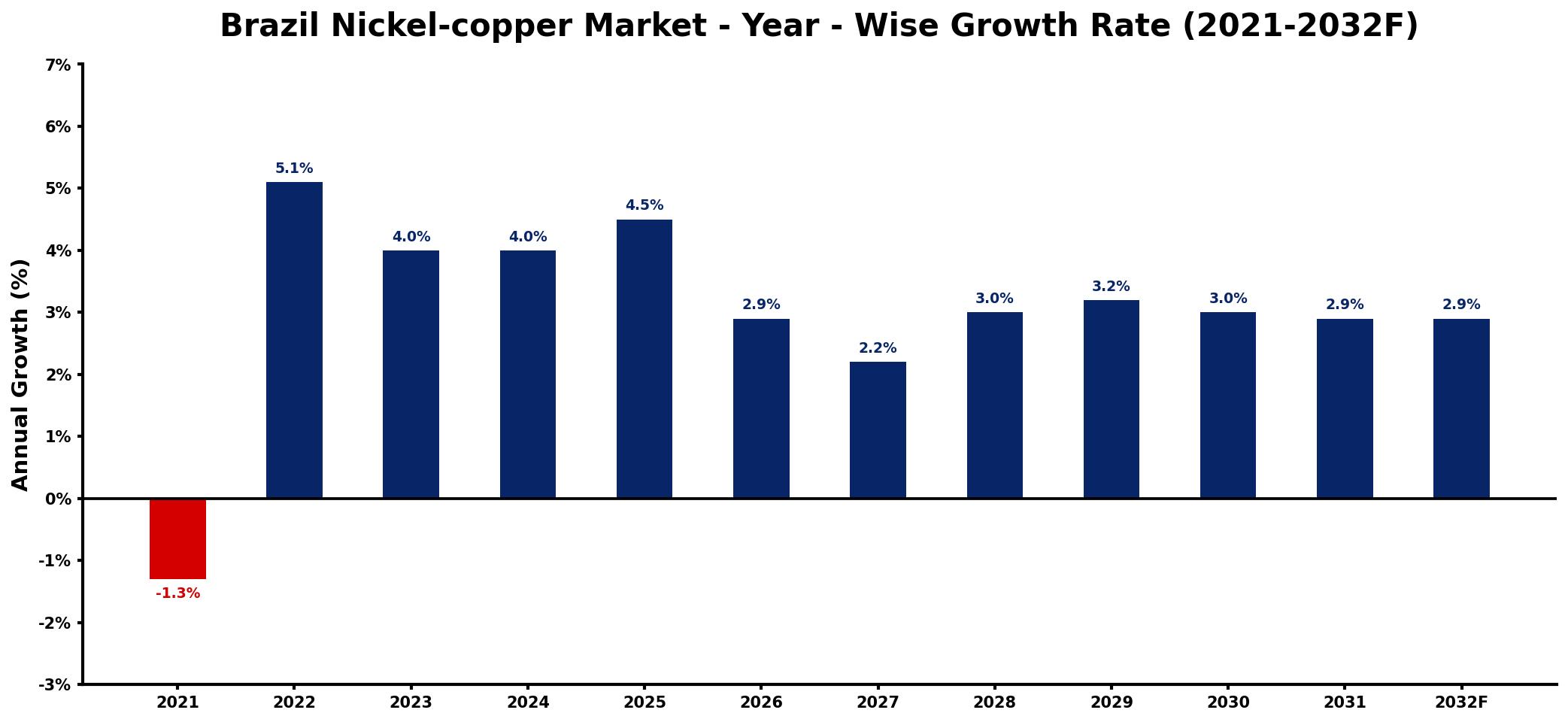
The table below presents the year‑wise growth rates along with the key drivers influencing the market
| Year | Growth Rate | Major Drivers |
| 2021 | -1.3% | declining procurement volume trends |
| 2022 | 5.1% | Rising industrial demand for electrification |
| 2023 | 4.0% | Increased investment in renewable energy |
| 2024 | 4.0% | Automotive sector adoption accelerates growth |
| 2025 | 4.5% | Technological advancements drive production efficiency |
| 2026 | 2.9% | Construction industry experiences expansion boom |
| 2027 | 2.2% | rising demand from electronics |
| 2028 | 3.0% | Investment in infrastructure projects increases |
| 2029 | 3.2% | Sustainability initiatives promote material usage |
| 2030 | 3.0% | Emerging markets enhance consumption patterns |
| 2031 | 2.9% | Technological innovations improve recycling rates |
| 2032 | 2.9% | increased pharmaceutical industry usage |
Note: Market size estimations and growth projections presented in this report are based on 6Wresearch's proprietary forecasting methodology, utilizing the latest available industry data, government publications, and primary research inputs.
Brazil Nickel-copper Market Synopsis
Brazil's nickel-copper market is characterized by its strategic significance in the country's metallurgical sector, essential for numerous industrial applications. As global industries shift towards more environmentally friendly practices, the demand for sustainably sourced nickel and copper is surging, creating a robust opportunity for Brazilian producers.
The country's diverse geography supports rich deposits of nickel and copper, which can be harnessed to meet both domestic and international demand. Furthermore, Brazil's evolving regulatory framework fosters innovation in mining technologies, ensuring that extraction processes align with environmental protection standards.
Brazil Nickel-copper Market Key Takeaways
- The Brazil Nickel-copper Market is set to grow steadily, reflecting broader trends in sustainability and technological advancements.
- Government policies are increasingly focused on fostering environmentally responsible mining practices.
- The electronics and automotive industries are the primary drivers of demand for nickel and copper in Brazil.
- Geopolitical tensions and commodity price fluctuations remain influential factors in market dynamics.
- Investment in innovative extraction techniques is critical for enhancing the competitiveness of the Brazilian nickel-copper sector.
Evaluation of Restraints in Brazil Nickel-copper Market
The Brazil Nickel-copper market faces several restraints that can impede its growth. Market volatility driven by global commodity prices creates unpredictability in production costs, challenging companies to maintain competitive pricing. Moreover, geopolitical factors can result in supply chain disruptions, which impact the industry's ability to respond to fluctuating demand. Navigating these complexities requires strategic planning and adaptability from market participants, making resilience a key component of their operational strategies.
Brazil Nickel-copper Market Trends
Current trends indicate a strong pivot towards the use of technology in both extraction and processing of nickel and copper. Automation and digitization are becoming increasingly prevalent, streamlining operations and enhancing productivity. Moreover, there is a rising emphasis on circular economy principles, encouraging the recycling of nickel and copper, which aligns with global sustainability goals.
Brazil Nickel-copper Market Opportunities
The Brazilian nickel-copper market presents substantial opportunities for growth, particularly in the context of electrification trends in the automotive industry and renewable energy sectors. As electric vehicles gain traction, the demand for high-purity nickel for batteries is poised to rise significantly. Additionally, investments in infrastructure development and a burgeoning focus on renewable energy technologies are likely to create new avenues for market expansion.
Government Initiatives in the Brazil Nickel-copper Market
Brazilian government initiatives are shaping the nickel-copper market through policies aimed at promoting sustainable mining practices and environmental responsibility. Incentives for technological innovation in extraction and processing are designed to enhance the value addition of raw materials. These regulatory frameworks support the competitiveness of Brazil's metallurgical sector, ensuring that mining activities align with national sustainability goals.
Future Insights of the Brazil Nickel-copper Market
Looking ahead to the period between 2026 and 2032, the Brazil Nickel-copper market is likely to experience steady growth supported by increasing global demand for environmentally sourced metals. The strategic focus on sustainability and technological advancements will empower Brazilian producers to enhance their market position internationally. As industries pivot towards decarbonization, Brazil's rich reserves and innovative approaches to mining will likely play a crucial role in meeting future demand.
Brazil Nickel-copper Market Latest Developments (2025 - 2026)
Recent developments in the Brazil Nickel-copper market reflect a growing commitment to sustainable mining practices, with new regulations promoting cleaner extraction processes. Innovations in mining technology have also been adopted, enhancing efficiency and productivity. Furthermore, various strategic partnerships are emerging, aimed at bolstering research and development efforts to advance the mining sector, ensuring long-term growth and competitiveness in a rapidly evolving global market.
Brazil Nickel-copper Market - Key Attractiveness of the Report
- 10 Years of Market Numbers
- Historical Data Starting from 2022 to 2025
- Base Year: 2025
- Forecast Data until 2032
- Key Performance Indicators Impacting the Market
- Major Upcoming Developments and Projects
Key Highlights of the Report:
- Brazil Nickel-copper Market Outlook
- Market Size of Brazil Nickel-copper Market, 2025
- Forecast of Brazil Nickel-copper Market, 2032
- Historical Data and Forecast of Brazil Nickel-copper Revenues & Volume for the Period 2022-2032F
- Brazil Nickel-copper Market Trend Evolution
- Brazil Nickel-copper Market Drivers and Challenges
- Brazil Nickel-copper Price Trends
- Brazil Nickel-copper Porter's Five Forces
- Brazil Nickel-copper Industry Life Cycle
- Historical Data and Forecast of Brazil Nickel-copper Market Revenues & Volume By Product Type for the Period 2022-2032F
- Historical Data and Forecast of Brazil Nickel-copper Market Revenues & Volume By Round Wire for the Period 2022-2032F
- Historical Data and Forecast of Brazil Nickel-copper Market Revenues & Volume By Flat Wire for the Period 2022-2032F
- Historical Data and Forecast of Brazil Nickel-copper Market Revenues & Volume By Square Wire for the Period 2022-2032F
- Historical Data and Forecast of Brazil Nickel-copper Market Revenues & Volume By Bars for the Period 2022-2032F
- Historical Data and Forecast of Brazil Nickel-copper Market Revenues & Volume By Shaped Profiles for the Period 2022-2032F
- Historical Data and Forecast of Brazil Nickel-copper Market Revenues & Volume By Applications for the Period 2022-2032F
- Historical Data and Forecast of Brazil Nickel-copper Market Revenues & Volume By Resistors for the Period 2022-2032F
- Historical Data and Forecast of Brazil Nickel-copper Market Revenues & Volume By Home Appliances for the Period 2022-2032F
- Historical Data and Forecast of Brazil Nickel-copper Market Revenues & Volume By Industrial for the Period 2022-2032F
- Brazil Nickel-copper Import Export Trade Statistics
- Market Opportunity Assessment By Product Type
- Market Opportunity Assessment By Applications
- Brazil Nickel-copper Top Companies Market Share
- Brazil Nickel-copper Competitive Benchmarking By Technical and Operational Parameters
- Brazil Nickel-copper Company Profiles
- Brazil Nickel-copper Key Strategic Recommendations






































