Brazil Non-volatile Memory Market Top 5 Importing Countries and Market Competition (HHI) Analysis
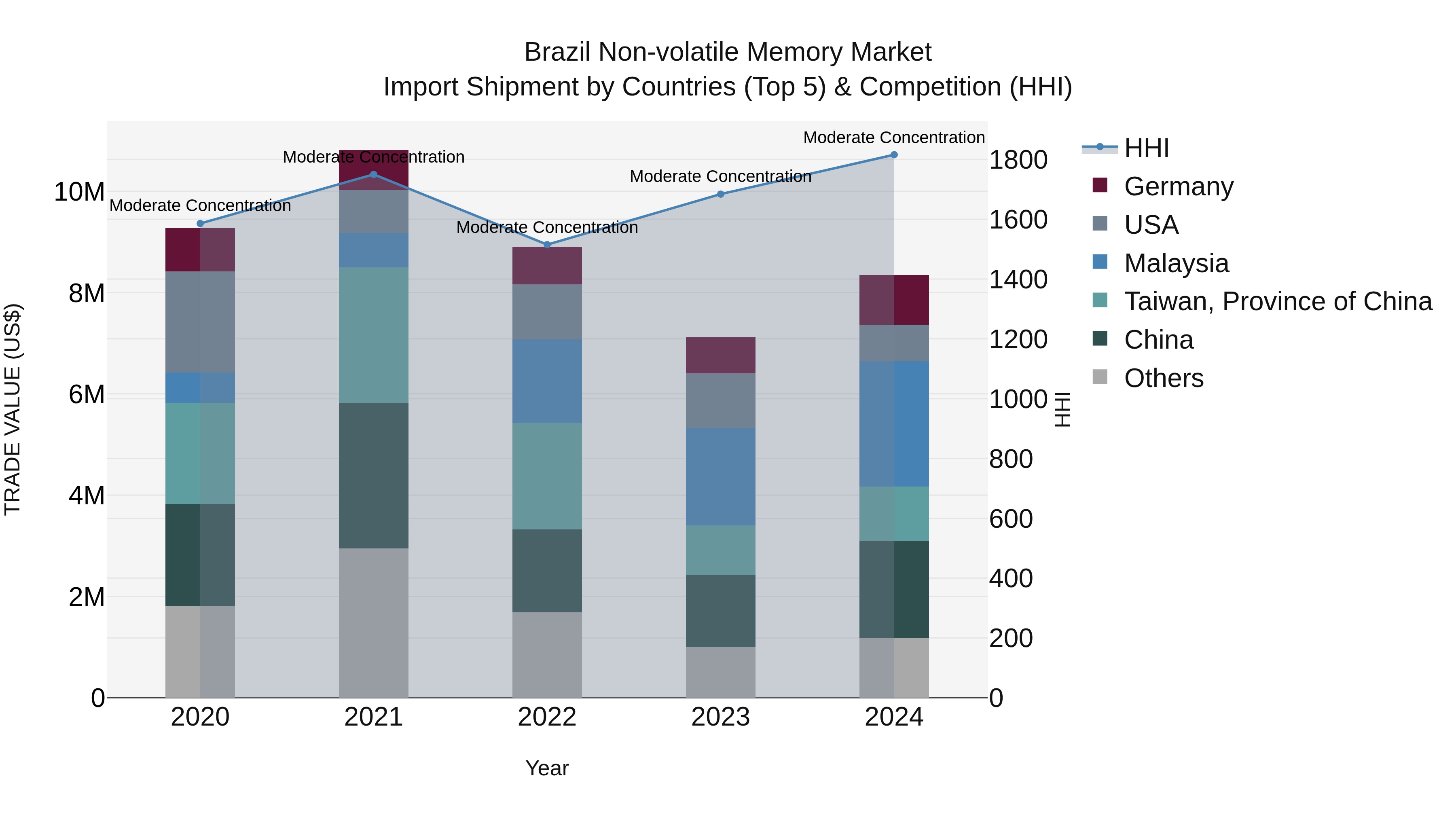
Brazil`s non-volatile memory import shipments in 2024 continued to be dominated by key exporters such as Malaysia, China, Taiwan, Germany, and the USA. Despite moderate concentration levels based on the Herfindahl-Hirschman Index (HHI), the market saw a decline in CAGR from 2020 to 2024 at -2.58%. However, there was a notable growth spike from 2023 to 2024 with a growth rate of 17.34%, indicating a potential shift in market dynamics and opportunities for further exploration in the coming years.
Brazil Non Volatile Memory Market Overview
The Non-Volatile Memory market in Brazil is evolving as industries adopt non-volatile memory technologies such as NAND flash, NOR flash, and emerging memory types for data storage, consumer electronics, and automotive applications. Non-volatile memories retain stored data even when power is removed, providing fast access and high endurance for various devices and systems. With the increasing demand for high-density storage and fast data access, the Non-Volatile Memory market is growing in Brazil to support applications in smartphones, solid-state drives (SSDs), and IoT devices.
Drivers of the market
The non-volatile memory market in Brazil encounters challenges related to the high cost of advanced memory technologies and the limited availability of fabrication facilities capable of producing cutting-edge memory chips. Intellectual property concerns and regulatory hurdles also impede market growth.
Challenges of the market
The Brazil Non-Volatile Memory Market is propelled by the increasing demand for data storage and processing solutions in consumer electronics, data centers, and IoT devices. Non-volatile memory technologies, such as NAND flash and emerging memories like MRAM and ReRAM, offer high-speed data access, low power consumption, and robust data retention, addressing the needs of diverse applications. With Brazil digitalization initiatives, the proliferation of connected devices, and the expansion of cloud computing infrastructure, the demand for non-volatile memory solutions is growing, driven by data-driven industries, AI applications, and the need for reliable storage solutions in harsh environments.
Government Policy of the market
The Brazil government`s focus on technology innovation and digital transformation is driving the growth of the non-volatile memory market. Policies supporting research funding, technology standards compliance, and industry collaboration are encouraging semiconductor companies and electronics manufacturers to invest in non-volatile memory technologies for applications in data storage, embedded systems, and consumer electronics.
Key Highlights of the Report:
- Brazil Non-Volatile Memory Market Outlook
- Market Size of Brazil Non-Volatile Memory Market, 2024
- Forecast of Brazil Non-Volatile Memory Market, 2031
- Historical Data and Forecast of Brazil Non-Volatile Memory Revenues & Volume for the Period 2021-2031
- Brazil Non-Volatile Memory Market Trend Evolution
- Brazil Non-Volatile Memory Market Drivers and Challenges
- Brazil Non-Volatile Memory Price Trends
- Brazil Non-Volatile Memory Porter's Five Forces
- Brazil Non-Volatile Memory Industry Life Cycle
- Historical Data and Forecast of Brazil Non-Volatile Memory Market Revenues & Volume By Type for the Period 2021-2031
- Historical Data and Forecast of Brazil Non-Volatile Memory Market Revenues & Volume By Traditional for the Period 2021-2031
- Historical Data and Forecast of Brazil Non-Volatile Memory Market Revenues & Volume By Emerging for the Period 2021-2031
- Historical Data and Forecast of Brazil Non-Volatile Memory Market Revenues & Volume By Wafer Size for the Period 2021-2031
- Historical Data and Forecast of Brazil Non-Volatile Memory Market Revenues & Volume By 200 mm for the Period 2021-2031
- Historical Data and Forecast of Brazil Non-Volatile Memory Market Revenues & Volume By 300mm for the Period 2021-2031
- Historical Data and Forecast of Brazil Non-Volatile Memory Market Revenues & Volume By End-User for the Period 2021-2031
- Historical Data and Forecast of Brazil Non-Volatile Memory Market Revenues & Volume By Consumer Electronics for the Period 2021-2031
- Historical Data and Forecast of Brazil Non-Volatile Memory Market Revenues & Volume By Enterprise Storage for the Period 2021-2031
- Historical Data and Forecast of Brazil Non-Volatile Memory Market Revenues & Volume By Automotive & Transportation for the Period 2021-2031
- Historical Data and Forecast of Brazil Non-Volatile Memory Market Revenues & Volume By Military & Aerospace for the Period 2021-2031
- Historical Data and Forecast of Brazil Non-Volatile Memory Market Revenues & Volume By Industrial for the Period 2021-2031
- Historical Data and Forecast of Brazil Non-Volatile Memory Market Revenues & Volume By Telecommunication for the Period 2021-2031
- Historical Data and Forecast of Brazil Non-Volatile Memory Market Revenues & Volume By Energy & Power for the Period 2021-2031
- Historical Data and Forecast of Brazil Non-Volatile Memory Market Revenues & Volume By Healthcare for the Period 2021-2031
- Brazil Non-Volatile Memory Import Export Trade Statistics
- Market Opportunity Assessment By Type
- Market Opportunity Assessment By Wafer Size
- Market Opportunity Assessment By End-User
- Brazil Non-Volatile Memory Top Companies Market Share
- Brazil Non-Volatile Memory Competitive Benchmarking By Technical and Operational Parameters
- Brazil Non-Volatile Memory Company Profiles
- Brazil Non-Volatile Memory Key Strategic Recommendations






































