Brazil Oil And Fuel Filter Market Size, Share & Growth Rate
The Brazil Oil And Fuel Filter Market was estimated at USD 198 Million in 2025 and is projected to reach USD 236 Million by 2032, growing at a CAGR of 2.5% from 2026 to 2032. This growth trajectory is primarily influenced by stringent environmental regulations that necessitate advanced filtration systems to meet emission standards. Furthermore, the increasing vehicle fleet in Brazil, coupled with a heightened focus on engine performance and longevity, continues to drive demand for oil and fuel filters.
Brazil Oil And Fuel Filter Market Year-wise Growth Rate and Key Drivers
This graph highlights how the Brazil Oil And Fuel Filter Market has steadily grown over the years, supported by major growth factors.
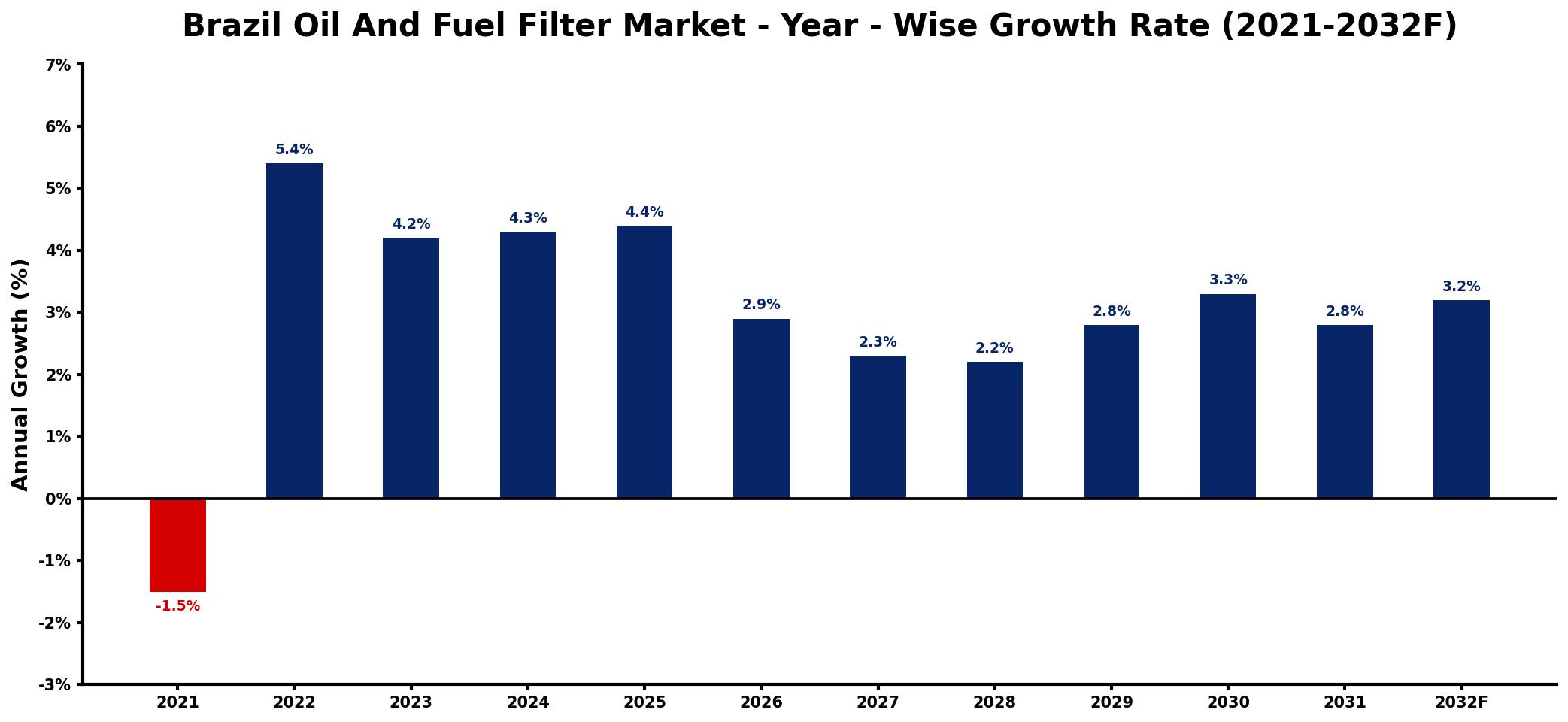
The table below presents the year‑wise growth rates along with the key drivers influencing the market
| Year | Growth Rate | Major Drivers |
| 2021 | -1.5% | decreased automotive production levels |
| 2022 | 5.4% | increased vehicle maintenance awareness |
| 2023 | 4.2% | growing industrial machinery investments |
| 2024 | 4.3% | rising demand for transportation services |
| 2025 | 4.4% | expansion of renewable energy sectors |
| 2026 | 2.9% | higher automotive aftermarket spending |
| 2027 | 2.3% | increased adoption of hybrid vehicles |
| 2028 | 2.2% | growing e-commerce logistics requirements |
| 2029 | 2.8% | surge in construction activities |
| 2030 | 3.3% | advancements in automotive technologies |
| 2031 | 2.8% | increased focus on sustainability initiatives |
| 2032 | 3.2% | strong growth in transportation networks |
Note: Market size estimations and growth projections presented in this report are based on 6Wresearch's proprietary forecasting methodology, utilizing the latest available industry data, government publications, and primary research inputs.
Brazil Oil And Fuel Filter Market Synopsis
Brazil's automotive landscape is undergoing significant transformation as the country embraces cleaner technologies. Recent policy shifts have resulted in a surge in demand for high-quality oil and fuel filters that are capable of enhancing engine efficiency while adhering to strict environmental standards. This shift is crucial, especially in a market that ranks as one of the largest in Latin America.
As the vehicle fleet expands, so does the need for effective maintenance solutions, with oil and fuel filters playing a pivotal role. They are essential in safeguarding engine components against harmful contaminants, thereby improving overall operational efficiency and extending the life of vehicles. This dynamic environment sets the stage for robust market opportunities.
Brazil Oil And Fuel Filter Market Key Takeaways
- The market is experiencing consistent growth driven by rising vehicle numbers and environmental regulations.
- Investment in advanced filtration technologies is critical for companies to remain competitive.
- Electric vehicle adoption presents challenges that could reshape traditional filtration demand.
- Government initiatives are pushing for stricter compliance with emission and efficiency standards.
- Technological innovations are paving the way for new product developments in the filtration sector.
Evaluation of Restraints in Brazil Oil And Fuel Filter Market
Despite the growth potential, the Brazil Oil And Fuel Filter Market faces several challenges. The accelerating shift towards electric vehicles is a major factor, as this transition reduces reliance on traditional combustion engines and, consequently, their filtration needs. Additionally, the rapid pace of technological advancements in filter materials and designs could disrupt established market dynamics, requiring manufacturers to adapt swiftly to changing consumer preferences and technological standards.
Brazil Oil And Fuel Filter Market Trends
Current trends in the Brazil Oil And Fuel Filter Market are predominantly characterized by a move towards high-performance filtration systems. This includes the adoption of synthetic materials and multi-stage filtration processes designed to enhance fuel efficiency and reduce emissions. Moreover, there's an increased focus on sustainability, with companies exploring eco-friendly filter solutions that not only meet regulatory standards but also appeal to environmentally conscious consumers.
Brazil Oil And Fuel Filter Market Opportunities
The market presents genuine growth opportunities, particularly in the realm of innovation. There is significant potential for companies to develop new filtration technologies that address the unique demands of both conventional and emerging vehicle types, including hybrids and electric models. Furthermore, the industrial filtration segment offers an avenue for diversification, enabling manufacturers to leverage their expertise in a broader range of applications beyond automotive, potentially capturing a larger market share.
Government Initiatives in the Brazil Oil And Fuel Filter Market
The Brazilian government is actively enforcing policies aimed at improving vehicle emissions and fuel efficiency through stringent regulations. Agencies such as CONAMA (Conselho Nacional do Meio Ambiente) play a pivotal role in shaping the market landscape by setting guidelines for pollution control and encouraging investment in high-quality filtration systems. Such government initiatives not only foster compliance but also stimulate demand for advanced oil and fuel filters across the automotive industry.
Future Insights of the Brazil Oil And Fuel Filter Market
Looking ahead to 2026-2032, the Brazil Oil And Fuel Filter Market is poised for a period of significant evolution. As regulatory frameworks continue to tighten, and vehicle technology advances, the emphasis on sophisticated filtration solutions will only intensify. Companies that are agile and responsive to these changes, leveraging innovation and sustainability, will likely gain a competitive edge, positioning themselves favorably within the marketplace.
Brazil Oil And Fuel Filter Market Latest Developments (2025 - 2026)
Recent developments in the Brazil Oil And Fuel Filter Market indicate a shift towards greater collaboration between manufacturers and government bodies. Innovations in product design aimed at improving efficiency and reducing emissions have become increasingly prominent. Additionally, stakeholders are focusing on expanding their product portfolios to include solutions tailored for emerging vehicle technologies, aligning with the broader trend of sustainability in the automotive sector.
Brazil Oil And Fuel Filter Market - Key Attractiveness of the Report
- 10 Years of Market Numbers
- Historical Data Starting from 2022 to 2025
- Base Year: 2025
- Forecast Data until 2032
- Key Performance Indicators Impacting the Market
- Major Upcoming Developments and Projects
Key Highlights of the Report:
- Brazil Oil And Fuel Filter Market Outlook
- Market Size of Brazil Oil And Fuel Filter Market, 2025
- Forecast of Brazil Oil And Fuel Filter Market, 2032
- Historical Data and Forecast of Brazil Oil And Fuel Filter Revenues & Volume for the Period 2022-2032F
- Brazil Oil And Fuel Filter Market Trend Evolution
- Brazil Oil And Fuel Filter Market Drivers and Challenges
- Brazil Oil And Fuel Filter Price Trends
- Brazil Oil And Fuel Filter Porter's Five Forces
- Brazil Oil And Fuel Filter Industry Life Cycle
- Historical Data and Forecast of Brazil Oil And Fuel Filter Market Revenues & Volume By Vehicle Type for the Period 2022-2032F
- Historical Data and Forecast of Brazil Oil And Fuel Filter Market Revenues & Volume By Passenger Car for the Period 2022-2032F
- Historical Data and Forecast of Brazil Oil And Fuel Filter Market Revenues & Volume By LCV (Light Commercial Vehicle) for the Period 2022-2032F
- Historical Data and Forecast of Brazil Oil And Fuel Filter Market Revenues & Volume By HCV (Heavy Commercial Vehicle) for the Period 2022-2032F
- Historical Data and Forecast of Brazil Oil And Fuel Filter Market Revenues & Volume By Sales Channel for the Period 2022-2032F
- Historical Data and Forecast of Brazil Oil And Fuel Filter Market Revenues & Volume By OEM for the Period 2022-2032F
- Historical Data and Forecast of Brazil Oil And Fuel Filter Market Revenues & Volume By Ftermarket for the Period 2022-2032F
- Historical Data and Forecast of Brazil Oil And Fuel Filter Market Revenues & Volume By Filter Type for the Period 2022-2032F
- Historical Data and Forecast of Brazil Oil And Fuel Filter Market Revenues & Volume By Oil Filter for the Period 2022-2032F
- Historical Data and Forecast of Brazil Oil And Fuel Filter Market Revenues & Volume By Fuel Filter for the Period 2022-2032F
- Historical Data and Forecast of Brazil Oil And Fuel Filter Market Revenues & Volume By Filter Media for the Period 2022-2032F
- Historical Data and Forecast of Brazil Oil And Fuel Filter Market Revenues & Volume By Cellulose for the Period 2022-2032F
- Historical Data and Forecast of Brazil Oil And Fuel Filter Market Revenues & Volume By Synthetic-laminated for the Period 2022-2032F
- Historical Data and Forecast of Brazil Oil And Fuel Filter Market Revenues & Volume By Pure Glass for the Period 2022-2032F
- Brazil Oil And Fuel Filter Import Export Trade Statistics
- Market Opportunity Assessment By Vehicle Type
- Market Opportunity Assessment By Sales Channel
- Market Opportunity Assessment By Filter Type
- Market Opportunity Assessment By Filter Media
- Brazil Oil And Fuel Filter Top Companies Market Share
- Brazil Oil And Fuel Filter Competitive Benchmarking By Technical and Operational Parameters
- Brazil Oil And Fuel Filter Company Profiles
- Brazil Oil And Fuel Filter Key Strategic Recommendations






































