Brazil Optical Instrument And Lens Market Size, Share & Growth Rate
The Brazil Optical Instrument And Lens Market was estimated at USD 156 Million in 2025 and is projected to reach USD 186 Million by 2032, growing at a CAGR of 2.5% from 2026 to 2032. This growth trajectory is primarily driven by significant advancements in healthcare technologies, alongside increasing applications in consumer electronics and aerospace. As the Brazilian middle class expands, a heightened demand for innovative optical solutions is becoming increasingly evident, further propelling the market forward.
Brazil Optical Instrument And Lens Market Year-wise Growth Rate and Key Drivers
This graph highlights how the Brazil Optical Instrument And Lens Market has steadily grown over the years, supported by major growth factors.
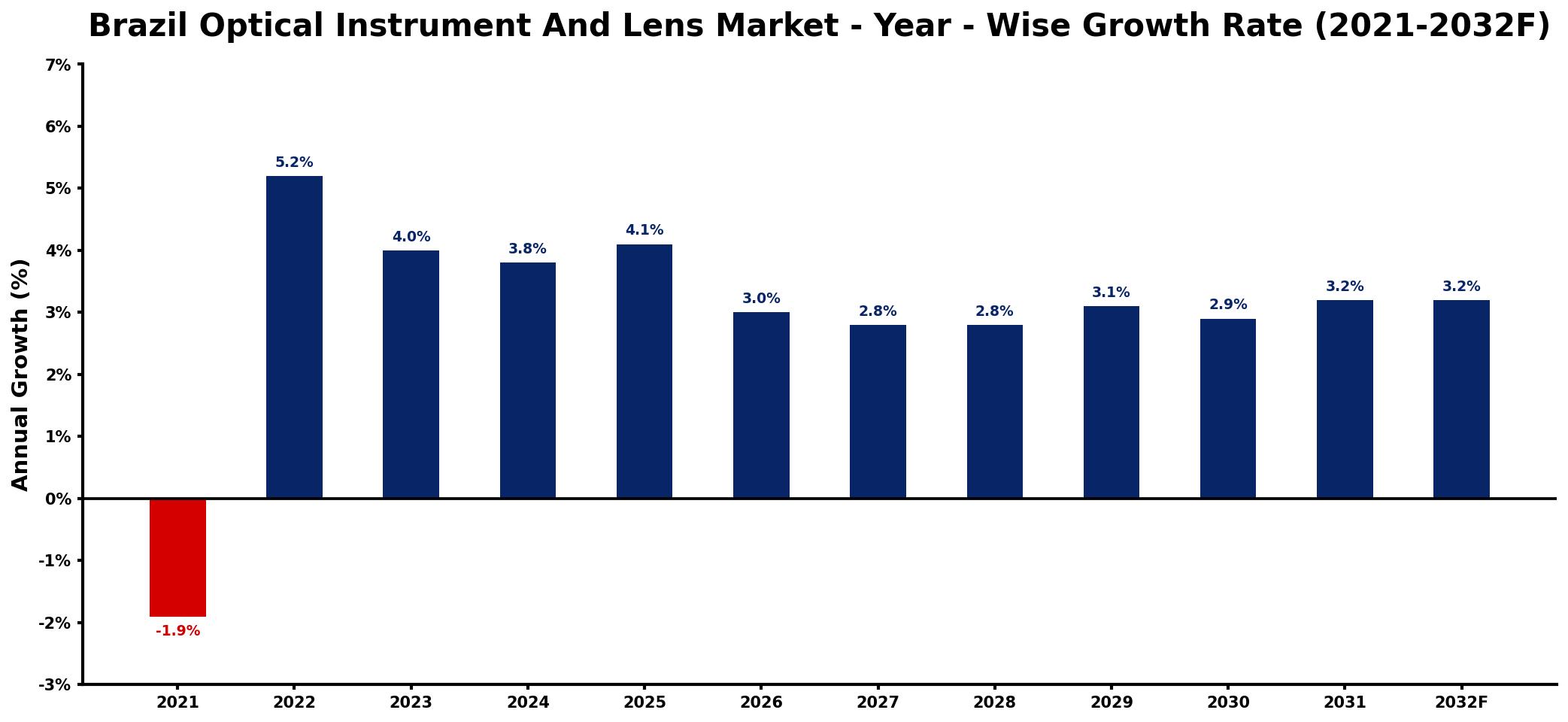
The table below presents the year‑wise growth rates along with the key drivers influencing the market
| Year | Growth Rate | Major Drivers |
| 2021 | -1.9% | decreased consumer spending trends |
| 2022 | 5.2% | rising demand for healthcare services |
| 2023 | 4.0% | increased investments in technology |
| 2024 | 3.8% | growth in aging population demographics |
| 2025 | 4.1% | expansion of e-commerce platforms |
| 2026 | 3.0% | improvements in manufacturing processes |
| 2027 | 2.8% | surge in telehealth adoption rates |
| 2028 | 2.8% | enhanced awareness of eye care |
| 2029 | 3.1% | development of innovative solutions |
| 2030 | 2.9% | growing disposable income levels |
| 2031 | 3.2% | increased focus on preventive care |
| 2032 | 3.2% | expanding industrial usage applications |
Note: Market size estimations and growth projections presented in this report are based on 6Wresearch's proprietary forecasting methodology, utilizing the latest available industry data, government publications, and primary research inputs.
Brazil Optical Instrument And Lens Market Synopsis
Technological innovation stands out as the most powerful force shaping the Brazil Optical Instrument And Lens Market. With rapid developments in optical technologies, various sectors, including healthcare and automotive, are embracing sophisticated optical instruments that enhance functionality and performance.
Furthermore, growing consumer awareness about the importance of high-quality optical products is influencing purchasing decisions. This awareness is coupled with government support for research and development, which reinforces the market's upward trajectory and enhances its potential.
Brazil Optical Instrument And Lens Market Key Takeaways
- The market is poised for steady growth, reflecting a robust investment in optical technologies.
- Healthcare advancements are driving demand for high-precision optical instruments.
- Consumer electronics are a significant contributor to market expansion.
- Government initiatives play a crucial role in fostering R&D within the optical sector.
- Technological advancements challenge manufacturers to innovate while managing costs.
Evaluation of Restraints in Brazil Optical Instrument And Lens Market
Despite its growth prospects, the Brazil Optical Instrument And Lens Market faces notable restraints. The rapid pace of technological advancement can outstrip the capabilities of manufacturers, forcing them to continuously innovate. Additionally, managing production costs while keeping pace with emerging technologies remains a significant challenge. Companies must navigate a complex landscape where consumer expectations for high-quality products are constantly evolving, making strategic investment decisions critical for long-term viability.
Brazil Optical Instrument And Lens Market Trends
Several trends are emerging in the Brazil Optical Instrument And Lens Market. First, the integration of advanced imaging technologies in various applications, from healthcare diagnostics to industrial inspections, is reshaping demand. Second, there is a noticeable shift towards sustainable and eco-friendly materials in the manufacturing of optical products, driven by increasing environmental awareness among consumers. Third, the growth of e-commerce is facilitating access to a wider range of optical products, thereby influencing market dynamics.
Brazil Optical Instrument And Lens Market Opportunities
The Brazil Optical Instrument And Lens Market presents genuine growth opportunities, particularly in the healthcare sector. The rising demand for telemedicine and remote diagnostics is pushing the need for high-quality optical instruments. Additionally, the automotive industrys focus on advanced driver-assistance systems (ADAS) opens doors for innovative optical solutions. Companies that prioritize research and development and align their offerings with these emerging trends will likely capture significant market share.
Government Initiatives in the Brazil Optical Instrument And Lens Market
Government initiatives are positively influencing the Brazil Optical Instrument And Lens Market. Policies that support research and development in optical technologies are crucial for fostering innovation. Public investments in healthcare infrastructure, including the adoption of advanced diagnostic tools, are encouraging the utilization of optical instruments. Furthermore, collaborations between government bodies and private enterprises aim to enhance technological capabilities, contributing to an overall favorable environment for market growth.
Future Insights of the Brazil Optical Instrument And Lens Market
Looking ahead to 2026-2032, the Brazil Optical Instrument And Lens Market is anticipated to flourish, driven by continuous technological advancements and growing applications across various sectors. The healthcare and automotive industries, in particular, are expected to lead in demand due to their reliance on precision optical solutions. Moreover, as consumer preferences shift towards high-quality, eco-friendly products, companies that adapt to these changes will be well-positioned for success in an increasingly competitive landscape.
Brazil Optical Instrument And Lens Market Latest Developments (2025 - 2026)
Recent developments in the Brazil Optical Instrument And Lens Market indicate a strong trend towards collaboration between technology firms and research institutions. These collaborations aim to enhance product offerings and accelerate innovation cycles. Additionally, various industry players are expanding their portfolios to include smart optical solutions that integrate artificial intelligence and machine learning, aiming to improve functionality and efficiency across multiple applications.
Brazil Optical Instrument And Lens Market - Key Attractiveness of the Report
- 10 Years of Market Numbers
- Historical Data Starting from 2022 to 2025
- Base Year: 2025
- Forecast Data until 2032
- Key Performance Indicators Impacting the Market
- Major Upcoming Developments and Projects
Key Highlights of the Report:
- Brazil Optical Instrument And Lens Market Outlook
- Market Size of Brazil Optical Instrument And Lens Market, 2025
- Forecast of Brazil Optical Instrument And Lens Market, 2032
- Historical Data and Forecast of Brazil Optical Instrument And Lens Revenues & Volume for the Period 2022-2032F
- Brazil Optical Instrument And Lens Market Trend Evolution
- Brazil Optical Instrument And Lens Market Drivers and Challenges
- Brazil Optical Instrument And Lens Price Trends
- Brazil Optical Instrument And Lens Porter's Five Forces
- Brazil Optical Instrument And Lens Industry Life Cycle
- Historical Data and Forecast of Brazil Optical Instrument And Lens Market Revenues & Volume By Product for the Period 2022-2032F
- Historical Data and Forecast of Brazil Optical Instrument And Lens Market Revenues & Volume By Binoculars for the Period 2022-2032F
- Historical Data and Forecast of Brazil Optical Instrument And Lens Market Revenues & Volume By Microscopes for the Period 2022-2032F
- Historical Data and Forecast of Brazil Optical Instrument And Lens Market Revenues & Volume By Telescopes for the Period 2022-2032F
- Historical Data and Forecast of Brazil Optical Instrument And Lens Market Revenues & Volume By Others for the Period 2022-2032F
- Historical Data and Forecast of Brazil Optical Instrument And Lens Market Revenues & Volume By Category for the Period 2022-2032F
- Historical Data and Forecast of Brazil Optical Instrument And Lens Market Revenues & Volume By Optical Instruments for the Period 2022-2032F
- Historical Data and Forecast of Brazil Optical Instrument And Lens Market Revenues & Volume By Interchangeable Camera Lenses for the Period 2022-2032F
- Historical Data and Forecast of Brazil Optical Instrument And Lens Market Revenues & Volume By Application for the Period 2022-2032F
- Historical Data and Forecast of Brazil Optical Instrument And Lens Market Revenues & Volume By Medical for the Period 2022-2032F
- Historical Data and Forecast of Brazil Optical Instrument And Lens Market Revenues & Volume By Astronomy for the Period 2022-2032F
- Historical Data and Forecast of Brazil Optical Instrument And Lens Market Revenues & Volume By Commercial for the Period 2022-2032F
- Historical Data and Forecast of Brazil Optical Instrument And Lens Market Revenues & Volume By Defense for the Period 2022-2032F
- Historical Data and Forecast of Brazil Optical Instrument And Lens Market Revenues & Volume By Others for the Period 2022-2032F
- Brazil Optical Instrument And Lens Import Export Trade Statistics
- Market Opportunity Assessment By Product
- Market Opportunity Assessment By Category
- Market Opportunity Assessment By Application
- Brazil Optical Instrument And Lens Top Companies Market Share
- Brazil Optical Instrument And Lens Competitive Benchmarking By Technical and Operational Parameters
- Brazil Optical Instrument And Lens Company Profiles
- Brazil Optical Instrument And Lens Key Strategic Recommendations






































