Brazil Paint Stripper Market Size, Share & Growth Rate
The Brazil Paint Stripper Market was estimated at USD 187 Million in 2025 and is projected to reach USD 257 Million by 2032, growing at a CAGR of 4.6% from 2026 to 2032. This growth trajectory is primarily driven by the robust activities in construction and automotive repair sectors, where effective paint removal solutions are increasingly sought after. Additionally, the rising consumer preference for eco-friendly products further fuels the market, aligning with stringent regulatory mandates that prioritize environmental sustainability.
Brazil Paint Stripper Market Year-wise Growth Rate and Key Drivers
This graph highlights how the Brazil Paint Stripper Market has steadily grown over the years, supported by major growth factors.
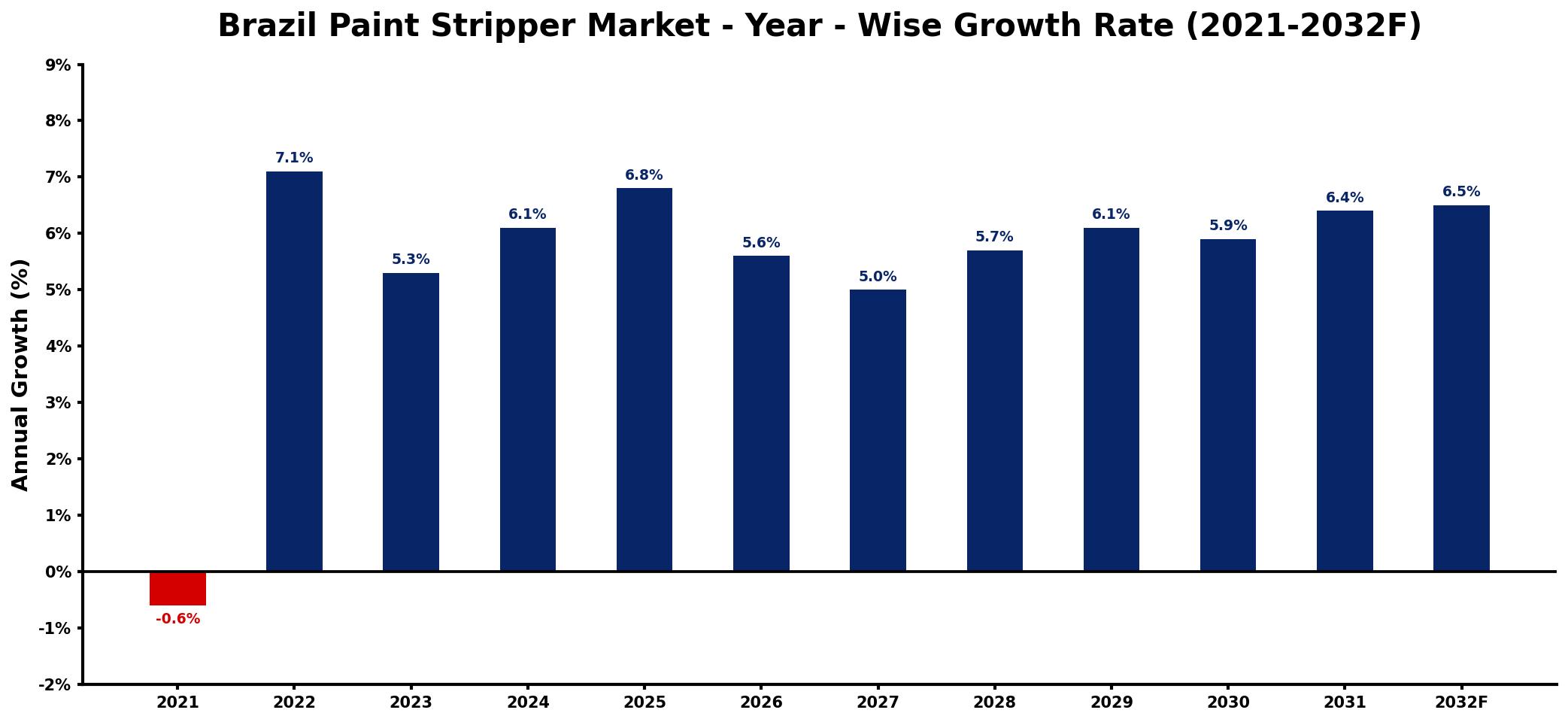
The table below presents the year‑wise growth rates along with the key drivers influencing the market
| Year | Growth Rate | Major Drivers |
| 2021 | -0.6% | decreased construction activity levels |
| 2022 | 7.1% | increased renovation project investments |
| 2023 | 5.3% | growing DIY home improvement trends |
| 2024 | 6.1% | expansion of industrial manufacturing sectors |
| 2025 | 6.8% | rising demand for eco-friendly solutions |
| 2026 | 5.6% | enhanced regulatory support measures |
| 2027 | 5.0% | increased urban redevelopment initiatives |
| 2028 | 5.7% | surge in furniture restoration projects |
| 2029 | 6.1% | growth of automotive refinishing services |
| 2030 | 5.9% | rising popularity of home decor |
| 2031 | 6.4% | improved processing technologies adoption |
| 2032 | 6.5% | increased focus on sustainable practices |
Note: Market size estimations and growth projections presented in this report are based on 6Wresearch's proprietary forecasting methodology, utilizing the latest available industry data, government publications, and primary research inputs.
Brazil Paint Stripper Market Synopsis
In recent years, the Brazil Paint Stripper Market has experienced a notable upswing, largely due to increased renovation efforts across various sectors. However, as the market matures, it is set to encounter evolving dynamics shaped by both regulatory changes and technological advancements in paint removal solutions. Stakeholders are navigating these shifts while striving to meet emerging consumer demands for safer and more effective products.
As the focus on sustainability intensifies, manufacturers are exploring innovative formulations that comply with stricter environmental guidelines. This strategic pivot not only addresses regulatory pressures but also aligns with consumer expectations for greener alternatives. Consequently, the market outlook remains optimistic, driven by a combination of traditional demand drivers and the push towards sustainable practices.
Brazil Paint Stripper Market Key Takeaways
- The market is experiencing moderate growth fueled by the construction and automotive sectors.
- Increasing demand for eco-friendly paint stripping solutions is reshaping product development.
- Regulatory compliance is becoming a pivotal consideration for market participants.
- Technological innovations are expected to enhance the efficiency and safety of paint strippers.
- Investment in R&D will be critical to address safety and environmental concerns.
Evaluation of Restraints in Brazil Paint Stripper Market
Despite the positive growth trajectory, the Brazil Paint Stripper Market faces several restraints that could impede its full potential. Regulatory scrutiny remains high, with government bodies closely monitoring the health and environmental impacts associated with traditional paint stripping chemicals. This scrutiny is necessitating the development of innovative formulations, which can be a resource-intensive endeavor for many manufacturers. Furthermore, growing consumer awareness of safety concerns also compels companies to adapt swiftly, often requiring significant investment in research and development. The interplay of these factors creates a challenging yet compelling landscape for industry stakeholders.
Brazil Paint Stripper Market Trends
A noticeable trend in the Brazil Paint Stripper Market is the increasing inclination toward bio-based and environmentally friendly paint removers. As consumers become more environmentally conscious, demand is shifting towards formulations that minimize harmful emissions and toxic waste. Additionally, advancements in technology are facilitating the development of more efficient application methods, significantly reducing time and labor costs associated with paint removal. Such innovations not only improve operational efficiency but also enhance the safety profile of paint strippers in various applications.
Brazil Paint Stripper Market Opportunities
The Brazil Paint Stripper Market presents genuine growth opportunities, particularly in the realm of eco-friendly product development. Companies that invest in research to create sustainable formulations stand to capture a significant share of the market, especially as consumers and regulatory bodies alike prioritize environmental considerations. Furthermore, emerging markets within Brazil's expanding urban areas offer a fertile ground for new entrants and innovations, providing a platform for tailored solutions that address local needs. Embracing this shift towards sustainability and efficiency will be vital for stakeholders looking to thrive in an increasingly competitive landscape.
Government Initiatives in the Brazil Paint Stripper Market
Government initiatives in Brazil are focusing on product safety, environmental protection, and occupational health as they pertain to the paint stripper market. Regulatory frameworks established by agencies such as the Ministry of Environment and IBAMA seek to enforce standards regarding manufacturing processes, labeling, and worker training. These initiatives aim to minimize environmental pollution and ensure public health, creating an essential backdrop against which market players must operate. Programs designed to promote eco-friendly practices and technologies are likely to foster further innovation within the sector.
Future Insights of the Brazil Paint Stripper Market
Looking ahead to the years 2026-2032, the Brazil Paint Stripper Market is poised for sustained growth fueled by ongoing advancements in product formulations and regulatory compliance. The rising consumer demand for safer, more environmentally sustainable options will drive innovation, prompting manufacturers to refine their offerings continuously. Additionally, as urbanization accelerates, the demand for renovation and refurbishment in the residential and commercial sectors will keep the market active. Overall, the future landscape of the Brazil Paint Stripper Market will be shaped by the convergence of sustainability, technological advancement, and regulatory evolution.
Brazil Paint Stripper Market Latest Developments (2025 - 2026)
Recent industry developments indicate a strong push towards the introduction of innovative, eco-friendly paint stripping solutions as companies respond to both consumer demand and regulatory pressures. Manufacturers are increasingly collaborating with research institutions to enhance product formulations, ensuring compliance with the latest environmental standards. Furthermore, investments in educational initiatives about safe handling practices are on the rise, highlighting the industry's commitment to worker safety and public health. These efforts represent a significant shift towards a more responsible and forward-thinking market approach.
Brazil Paint Stripper Market - Key Attractiveness of the Report
- 10 Years of Market Numbers
- Historical Data Starting from 2022 to 2025
- Base Year: 2025
- Forecast Data until 2032
- Key Performance Indicators Impacting the Market
- Major Upcoming Developments and Projects
Key Highlights of the Report:
- Brazil Paint Stripper Market Outlook
- Market Size of Brazil Paint Stripper Market, 2025
- Forecast of Brazil Paint Stripper Market, 2032
- Historical Data and Forecast of Brazil Paint Stripper Revenues & Volume for the Period 2022-2032F
- Brazil Paint Stripper Market Trend Evolution
- Brazil Paint Stripper Market Drivers and Challenges
- Brazil Paint Stripper Price Trends
- Brazil Paint Stripper Porter's Five Forces
- Brazil Paint Stripper Industry Life Cycle
- Historical Data and Forecast of Brazil Paint Stripper Market Revenues & Volume By Product Type for the Period 2022-2032F
- Historical Data and Forecast of Brazil Paint Stripper Market Revenues & Volume By Caustic Paint Stripper for the Period 2022-2032F
- Historical Data and Forecast of Brazil Paint Stripper Market Revenues & Volume By Solvent-based Paint Stripper for the Period 2022-2032F
- Historical Data and Forecast of Brazil Paint Stripper Market Revenues & Volume By Biochemical Paint Stripper for the Period 2022-2032F
- Historical Data and Forecast of Brazil Paint Stripper Market Revenues & Volume By End-Users for the Period 2022-2032F
- Historical Data and Forecast of Brazil Paint Stripper Market Revenues & Volume By Vehicle Maintenance for the Period 2022-2032F
- Historical Data and Forecast of Brazil Paint Stripper Market Revenues & Volume By Aerospace for the Period 2022-2032F
- Historical Data and Forecast of Brazil Paint Stripper Market Revenues & Volume By Renovations for the Period 2022-2032F
- Historical Data and Forecast of Brazil Paint Stripper Market Revenues & Volume By Furniture Refinishing for the Period 2022-2032F
- Historical Data and Forecast of Brazil Paint Stripper Market Revenues & Volume By Industrial Repairs for the Period 2022-2032F
- Historical Data and Forecast of Brazil Paint Stripper Market Revenues & Volume By Others for the Period 2022-2032F
- Brazil Paint Stripper Import Export Trade Statistics
- Market Opportunity Assessment By Product Type
- Market Opportunity Assessment By End-Users
- Brazil Paint Stripper Top Companies Market Share
- Brazil Paint Stripper Competitive Benchmarking By Technical and Operational Parameters
- Brazil Paint Stripper Company Profiles
- Brazil Paint Stripper Key Strategic Recommendations






































