Brazil Palm Oil Market Size Growth Rate
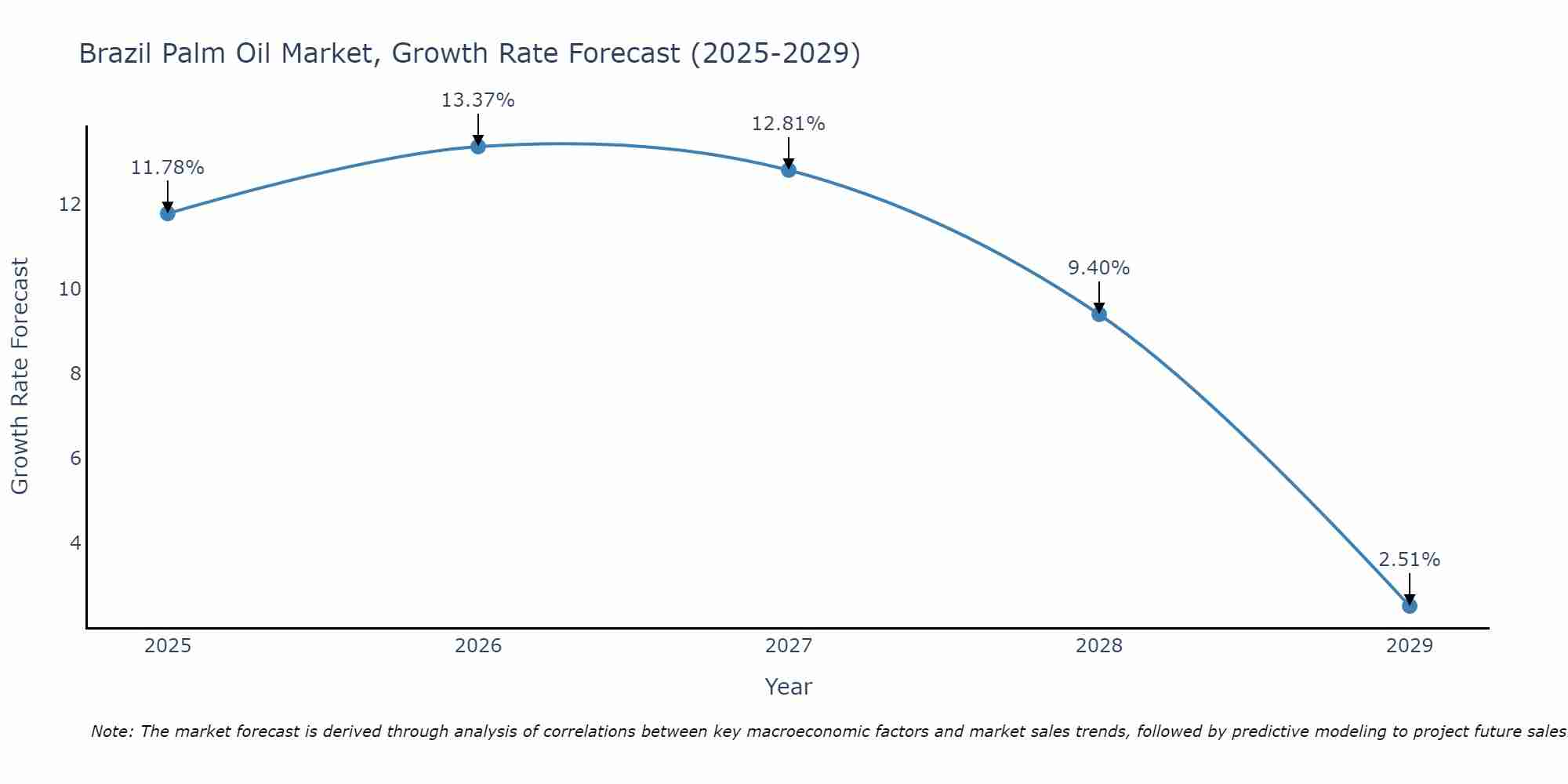
The Brazil Palm Oil Market is projected to witness mixed growth rate patterns during 2025 to 2029. Growth accelerates to 13.37% in 2026, following an initial rate of 11.78%, before easing to 2.51% at the end of the period.
Brazil Palm Oil Market Highlights
| Report Name | Brazil Palm Oil Market |
| Forecast Period | 2025-2029 |
| CAGR | 2.51% |
| Growing Sector | Personal care & Cosmetics |
Topics Covered in the Brazil Palm Oil Market Report
The Brazil Palm Oil Market report thoroughly covers the market by Nature, by Product and by End-users. The market report provides an unbiased and detailed analysis of the ongoing market trends, opportunities/high growth areas, and market drivers which would help the stakeholders to devise and align their market strategies according to the current and future market dynamics.
Brazil Palm Oil Market Synopsis
Brazil Palm Oil Market holds a significant position in the agro-industrial landscape of the Brazil who serves major sectors such as food & beverage, biofuels, personal care, and pharmaceuticals. Both domestic producers and global players are actively participating, the market continues to evolve with a growing focus on sustainable practices and certification standards.
Brazil Palm Oil Market is predicted to expand at a substantial CAGR of 2.51% during the forecast period 2025-2029. There are numerous growth factors which are contributing in the expansion of the market. Most of the demand comes from the industries, particularly food & beverage, biofuels, and personal care. Renewable energy is mainly focused by the manufactures of the palm oil, due to which gained momentum as a feedstock for biodiesel under the RenovaBio program, creating significant growth potential. The increasing consumer shift toward plant-based ingredients and natural oils in cosmetics and pharmaceuticals further supports market expansion.
Despite its potential, the Brazil Palm Oil Market has few notable challenges due to which growth of market affects. Particularly, environmental and sustainability concerns are need to be addressed. Palm oil cultivation is expanding that often raises fears of deforestation and biodiversity loss, which has brought stricter environmental regulations from IBAMA. Also, production costs, volatile global palm oil prices, and dependence on imports for certain derivatives also hinder profitability. Further competition is growing from alternative vegetable oils such as soybean and sunflower oil puts additional pressure on the industry, furthermore limiting the pace of expansion in Brazil.
Brazil Palm Oil Market Trends
Brazil Palm Oil Market is witnessing notable growth in the recent years with strong trends which include the rising demand in the food & beverage sector and increasing use in biofuels. Further, sustainability concerns are pushing producers toward eco-friendly and certified practices. Advancements are occurring in technology, especially in refining and processing which are improving efficiency and product quality. Further, growing consumer awareness about plant-based oils is fuelling broader adoption across industries.
Investment Opportunities in the Brazil Palm Oil Market
There are several opportunities in the Brazil palm oil market lie, especially in sustainable cultivation and value-added product manufacturing. Expansion is occurring into biofuel production presents strong potential as Brazil promotes renewable energy initiatives. There is also scope for investment in personal care and cosmetics, where palm derivatives are in high demand. Further, the partnerships with local producers can enhance supply chain integration and market reach.
Leading Players of the Brazil Palm Oil Market
Brazil Palm Oil Market is reshaped by the presence of key players including both domestic and international players who are majorly focusing on capacity expansion and sustainable practices. Some of those leading companies are Agropalma S.A., Palmaplan S/A, and global firms like Cargill Inc., Archer Daniels Midland (ADM), and Bunge Limited. These players are investing in certification programs to meet the RSPO (Roundtable on Sustainable Palm Oil) standards. Further, strategic alliances and acquisitions are further shaping the competitive landscape.
Government Regulations Introduced in the Brazil Palm Oil Market
According to Brazilian Government Data, regulations and policies implemented in the Brazil Palm Oil Market to ensure sustainability and fair trade. The Agro-Ecological Zoning of Oil Palm (ZAE Palm) policy restricts the plantations to degraded lands, which reduce the risk of deforestation. Compliance with the National Biofuels Policy (RenovaBio) also supports palm oil’s role in clean energy initiatives. Further, alignment with Environmental Licensing Regulations (IBAMA guidelines) ensures the strict adherence to ecological preservation. Further, Agro-Ecological Zoning of Oil Palm (ZAE Palm) encourage sustainable cultivation on degraded lands, attracting investments and promoting long-term growth.
Future Insights of the Brazil Palm Oil Market
The Brazil palm oil market is projected to expand gradually between 2025 and 2029. As the emphasis is growing on sustainable cultivation and certified production, the market is continued to rise. Renewable energy policies are set to support the demand for palm-based biofuels, further will gain momentum. Innovations in processing technologies and diversification into high-value derivatives will enhance the profitability. The future outlook remains optimistic, provided environmental challenges are addressed effectively.
Market Segmentation Analysis
The report offers a comprehensive study of the subsequent market segments and their leading categories.
Organic Palm Oil to Dominate the Market – By Nature
According to Sachin, Senior Research Analyst, 6Wresearch, organic palm oil is expected to gain traction in the market due to increasing consumer preference for natural and chemical-free products. Cosmetics segments where demand for premium, sustainable products is growing. Conventional palm oil continues to dominate overall consumption given its cost-effectiveness and wide-scale availability for industrial applications.
CPO to Dominate the Market – By Product
Among product types, Crude Palm Oil (CPO) is projected to dominate the Brazil palm oil market as it forms the raw material base for food, biofuel, and industrial uses. RBD Palm Oil (Refined, Bleached, and Deodorized) is also gaining significant demand due to its use in edible oil and processed foods.
Food & Beverage to Dominate the Market – By End-use
Food & beverage sector is set to capture the largest Brazil Palm Oil Market share, due to widespread use of palm oil in cooking oils, processed foods, and bakery products. Personal care & cosmetics is another fast-growing segment with palm oil derivatives being widely used in soaps, shampoos, and skincare items.
Key Attractiveness of the Report
- 10 Years of Market Numbers.
- Historical Data Starting from 2021 to 2024.
- Base Year: 2024
- Forecast Data until 2029.
- Key Performance Indicators Impacting the Market.
- Major Upcoming Developments and Projects.
Key Highlights of the Report:
- Brazil Palm Oil Market Outlook
- Market Size of Brazil Palm Oil Market, 2024
- Forecast of Brazil Palm Oil Market, 2029
- Historical Data and Forecast of Brazil Palm Oil Revenues & Volume for the Period 2019 - 2029F
- Brazil Palm Oil Market Trend Evolution
- Brazil Palm Oil Market Drivers and Challenges
- Brazil Palm Oil Price Trends
- Brazil Palm Oil Porter's Five Forces
- Brazil Palm Oil Industry Life Cycle
- Historical Data and Forecast of Brazil Palm Oil Market Revenues & Volume By Nature for the Period 2019 - 2029F
- Historical Data and Forecast of Brazil Palm Oil Market Revenues & Volume By Organic for the Period 2019 - 2029F
- Historical Data and Forecast of Brazil Palm Oil Market Revenues & Volume By Conventional for the Period 2019 - 2029F
- Historical Data and Forecast of Brazil Palm Oil Market Revenues & Volume By Product for the Period 2019 - 2029F
- Historical Data and Forecast of Brazil Palm Oil Market Revenues & Volume By CPO for the Period 2019 - 2029F
- Historical Data and Forecast of Brazil Palm Oil Market Revenues & Volume By RBD Palm Oil for the Period 2019 - 2029F
- Historical Data and Forecast of Brazil Palm Oil Market Revenues & Volume By Palm Kernel Oil for the Period 2019 - 2029F
- Historical Data and Forecast of Brazil Palm Oil Market Revenues & Volume By Fractionated Palm Oil for the Period 2019 - 2029F
- Historical Data and Forecast of Brazil Palm Oil Market Revenues & Volume By End-use for the Period 2019 - 2029F
- Historical Data and Forecast of Brazil Palm Oil Market Revenues & Volume By Food & Beverage for the Period 2019 - 2029F
- Historical Data and Forecast of Brazil Palm Oil Market Revenues & Volume By Personal Care & Cosmetics for the Period 2019 - 2029F
- Historical Data and Forecast of Brazil Palm Oil Market Revenues & Volume By Biofuel & Energy for the Period 2019 - 2029F
- Historical Data and Forecast of Brazil Palm Oil Market Revenues & Volume By Pharmaceuticals for the Period 2019 - 2029F
- Historical Data and Forecast of Brazil Palm Oil Market Revenues & Volume By Others for the Period 2019 - 2029F
- Brazil Palm Oil Import Export Trade Statistics
- Market Opportunity Assessment By Nature
- Market Opportunity Assessment By Product
- Market Opportunity Assessment By End-use
- Brazil Palm Oil Top Companies Market Share
- Brazil Palm Oil Competitive Benchmarking By Technical and Operational Parameters
- Brazil Palm Oil Company Profiles
- Brazil Palm Oil Key Strategic Recommendations
Market Covered
The report has been segmented and sub-segmented into the following categories:
By Nature
- Organic
- Conventional
By Product
- CPO (Crude Palm Oil)
- RBD Palm Oil (Refined, Bleached, and Deodorized)
- Palm Kernel Oil
- Fractionated Palm Oil
By End-use
- Food & Beverage
- Personal Care & Cosmetics
- Biofuel & Energy
- Pharmaceuticals
- Others






































