Brazil Parking Management Market Size & Growth Rate (2026-2032)
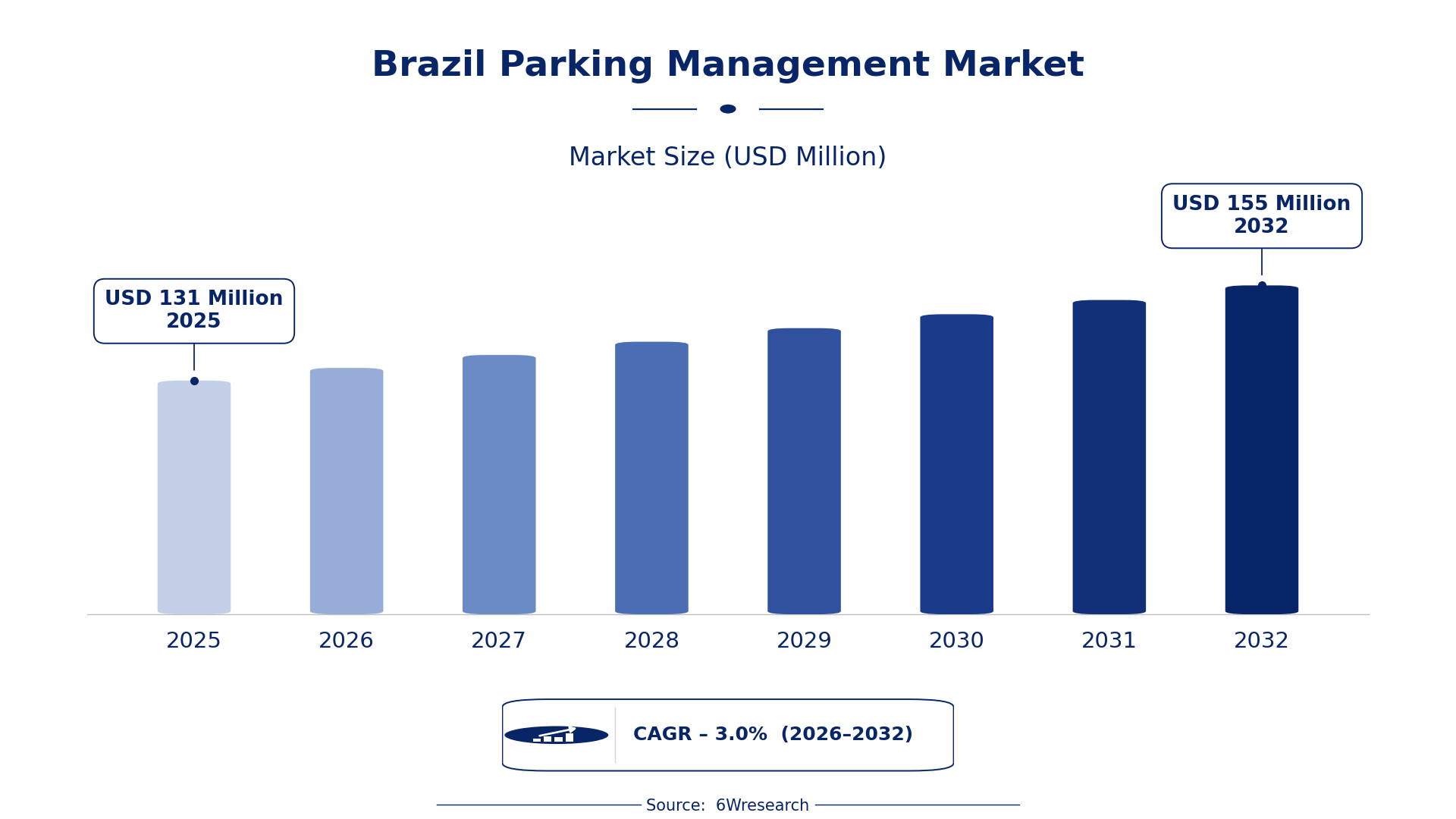
The Brazil Parking Management Market was estimated at USD 131 Million in 2025 and is projected to reach USD 155 Million by 2032, growing at a CAGR of 3.0% from 2026 to 2032.
Brazil Parking Management Market Synopsis
As Brazil grapples with urban congestion and a growing vehicle population, the parking management sector is evolving. Recent momentum reflects a shift towards smart parking solutions that enhance operational efficiency while addressing the real challenges of parking availability and traffic flow.
Looking ahead, the market is set to expand as municipalities increasingly adopt technology-driven solutions. These innovations promise to optimize space utilization and streamline payment processes, positioning Brazil as a leader in urban mobility solutions in the coming years.
Brazil Parking Management Market Year-wise Growth Rate and Key Drivers
This graph illustrates the annual growth rates of the Brazil Parking Management Market from 2021 to 2032, highlighting a steady upward trajectory and projected expansion over the forecast period.
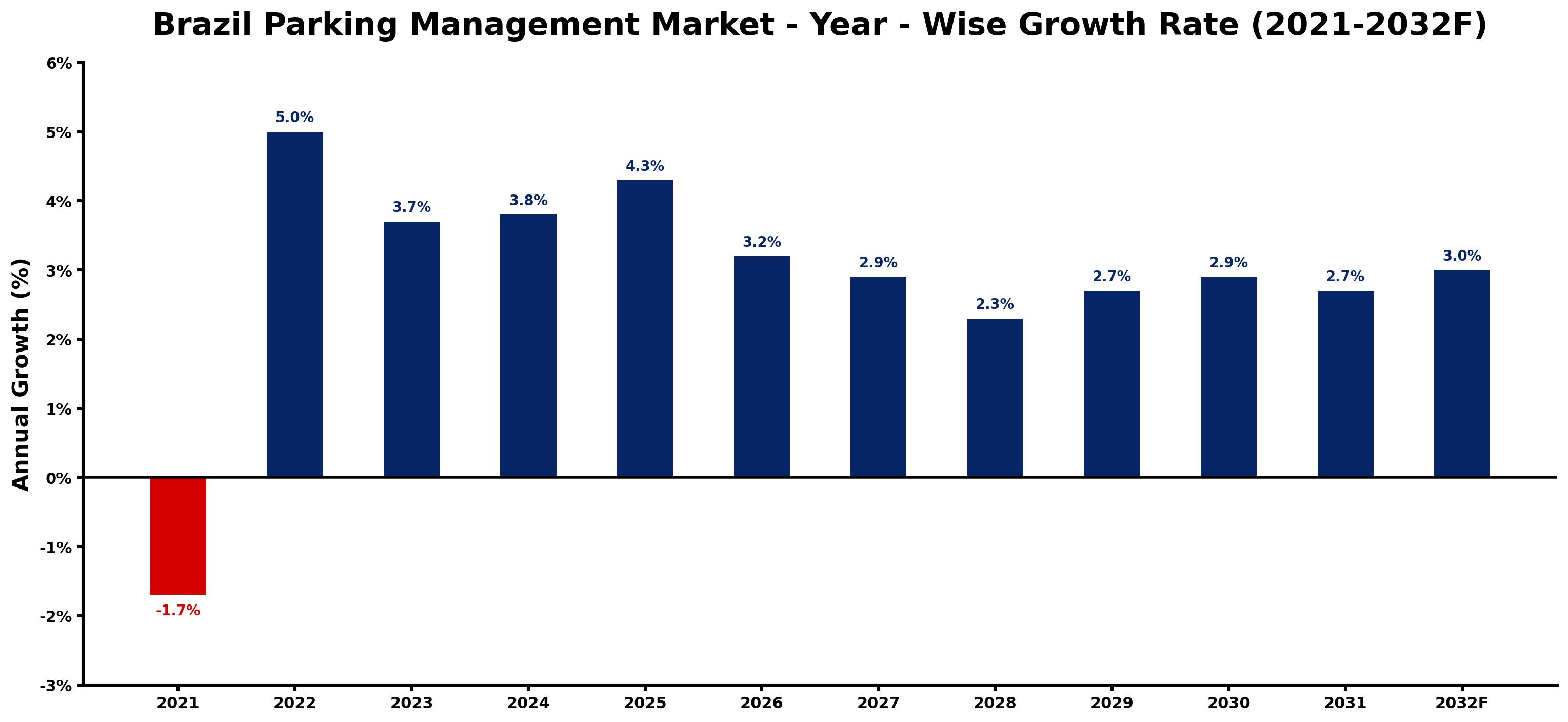
The table below presents the year‑wise growth rates along with the key drivers influencing the market
| Year | Growth Rate | Major Drivers |
| 2021 | -1.7% | Shift to home office reduced parking demand significantly. |
| 2022 | 5.0% | Increased urbanization leading to higher parking demands. |
| 2023 | 3.7% | Government incentives for smart city parking technologies. |
| 2024 | 3.8% | Growing usage of contactless payment in parking services. |
| 2025 | 4.3% | Enhanced parking regulation enforcement by local authorities. |
| 2026 | 3.2% | Surge in remote work boosting urban residential parking needs. |
| 2027 | 2.9% | Local mobile apps simplifying parking space reservations. |
| 2028 | 2.3% | Environmental policies promoting sustainable parking solutions. |
| 2029 | 2.7% | Integration of IoT in parking space management solutions. |
| 2030 | 2.9% | Rise in shared mobility services influencing parking trends. |
| 2031 | 2.7% | Emerging digital signage for efficient parking navigation. |
| 2032 | 3.0% | Increased government funding for urban parking infrastructure. |
Note: Market size estimations and growth projections presented in this report are based on 6Wresearch's proprietary forecasting methodology, utilizing the latest available industry data, government publications, and primary research inputs.
Brazil Parking Management Market Key Takeaways
Below are some of the specific key takeaways from the market, including:
- The market is experiencing a shift towards smart parking technologies to enhance user convenience and efficiency.
- Urbanization and population growth are major drivers for the adoption of advanced parking management systems.
- Integration with smart city initiatives is crucial for the effective deployment of parking solutions.
- Payment automation and occupancy monitoring are essential features that enhance revenue management.
- Challenges in user-friendly payment systems remain a significant hurdle for many parking operators.
Evaluation of Restraints in Brazil Parking Management Market
The Brazil Parking Management Market faces several restraints that could hinder growth. One primary concern is the optimization of parking space utilization. As urban areas become denser, the limited availability of parking spots complicates effective management. Additionally, integration with existing smart city infrastructure remains a challenge, as many municipalities lack the necessary frameworks for seamless operation. Payment system usability is another critical area where many providers struggle to meet user expectations, potentially limiting adoption rates.
Brazil Parking Management Market Trends
Emerging trends indicate a strong shift towards smart technology integration. Features such as mobile payment applications and real-time occupancy monitoring are becoming standard. The focus on sustainability is also prominent, as cities aim to minimize environmental impacts through efficient parking solutions. on top of that, the increased use of data analytics is helping municipalities refine their parking strategies, leading to improved user experience and revenue management.
Brazil Parking Management Market Opportunities
Growth opportunities abound in the Brazil Parking Management Market. The push towards smart city initiatives creates a favorable environment for innovative parking solutions. Investment in infrastructure upgrades and technology integration presents a significant opportunity for companies looking to expand their footprint in this sector. on top of that, with the increasing number of vehicles, there's a pressing need for solutions that can manage parking effectively while enhancing user convenience.
Government Initiatives in the Brazil Parking Management Market
Government policy is playing an essential role in shaping the Brazil Parking Management Market. Focused on enhancing urban mobility and transportation efficiency, Brazilian authorities are promoting smart city initiatives that necessitate advanced parking solutions. These policies encourage municipalities to invest in innovative management systems, ultimately aiming to alleviate congestion and optimize urban spaces.
- A national initiative launched in early 2025 aimed at integrating digital payment systems across urban parking facilities.
- Currently ongoing projects support the development of real-time parking guidance systems in major cities like São Paulo.
- A planned regulatory framework expected to be introduced by late 2026 will mandate improved transparency in parking fees and payment processes.
- Municipalities are actively investing in smart parking solutions to streamline operations and enhance the user experience.
- Upcoming infrastructure upgrades are set to roll out by mid-2027, focusing on enhancing existing parking facilities with advanced technology.
Future Insights of the Brazil Parking Management Market
From 2026 to 2032, the Brazil Parking Management Market is likely to witness considerable advancements driven by technological innovation and urban demands. As cities continue to expand, the need for efficient parking management will only intensify. Companies that can develop solutions that integrate seamlessly with smart city frameworks will find themselves well-positioned to capitalize on this growing demand.
Brazil Parking Management Market Latest Developments
In the last 12-14 months, the Brazil Parking Management Market has seen notable advancements, particularly in smart technology adoption. Municipalities are increasingly focusing on integrating innovative solutions to tackle urban parking issues. This trend is set to reshape how parking facilities operate and engage with users.
- A major technology vendor launched a new mobile app in Q1 2025, enhancing user experience with features like real-time parking availability and easy payment options.
- An initiative that began in mid-2025 aims to install advanced occupancy sensors in various urban parking facilities, currently underway.
- By early 2026, a partnership between local governments and technology firms is expected to introduce smart parking meters with integrated payment systems.
- In Q3 2025, a significant upgrade to existing parking management software was completed, improving analytics and reporting capabilities for municipalities.
- A rollout expected to begin in late 2026 focuses on expanding the use of automated enforcement systems to improve compliance and revenue collection.
Brazil Parking Management Market - Key Attractiveness of the Report
- 10 Years of Market Numbers
- Historical Data Starting from 2022 to 2025
- Base Year: 2025
- Forecast Data until 2032
- Key Performance Indicators Impacting the Market
- Major Upcoming Developments and Projects
Key Highlights of the Report:
- Brazil Parking Management Market Outlook
- Market Size of Brazil Parking Management Market, 2025
- Forecast of Brazil Parking Management Market, 2032
- Historical Data and Forecast of Brazil Parking Management Revenues & Volume for the Period 2022-2032F
- Brazil Parking Management Market Trend Evolution
- Brazil Parking Management Market Drivers and Challenges
- Brazil Parking Management Price Trends
- Brazil Parking Management Porter's Five Forces
- Brazil Parking Management Industry Life Cycle
- Historical Data and Forecast of Brazil Parking Management Market Revenues & Volume By Offering for the Period 2022-2032F
- Historical Data and Forecast of Brazil Parking Management Market Revenues & Volume By Solutions for the Period 2022-2032F
- Historical Data and Forecast of Brazil Parking Management Market Revenues & Volume By Services for the Period 2022-2032F
- Historical Data and Forecast of Brazil Parking Management Market Revenues & Volume By Parking Site for the Period 2022-2032F
- Historical Data and Forecast of Brazil Parking Management Market Revenues & Volume By Off-street Parking for the Period 2022-2032F
- Historical Data and Forecast of Brazil Parking Management Market Revenues & Volume By On-street Parking for the Period 2022-2032F
- Historical Data and Forecast of Brazil Parking Management Market Revenues & Volume By Deployment Type for the Period 2022-2032F
- Historical Data and Forecast of Brazil Parking Management Market Revenues & Volume By Cloud for the Period 2022-2032F
- Historical Data and Forecast of Brazil Parking Management Market Revenues & Volume By On-premises for the Period 2022-2032F
- Brazil Parking Management Import Export Trade Statistics
- Market Opportunity Assessment By Offering
- Market Opportunity Assessment By Parking Site
- Market Opportunity Assessment By Deployment Type
- Brazil Parking Management Top Companies Market Share
- Brazil Parking Management Competitive Benchmarking By Technical and Operational Parameters
- Brazil Parking Management Company Profiles
- Brazil Parking Management Key Strategic Recommendations






































