Brazil Passenger Car Motor Oil Market Top 5 Importing Countries and Market Competition (HHI) Analysis
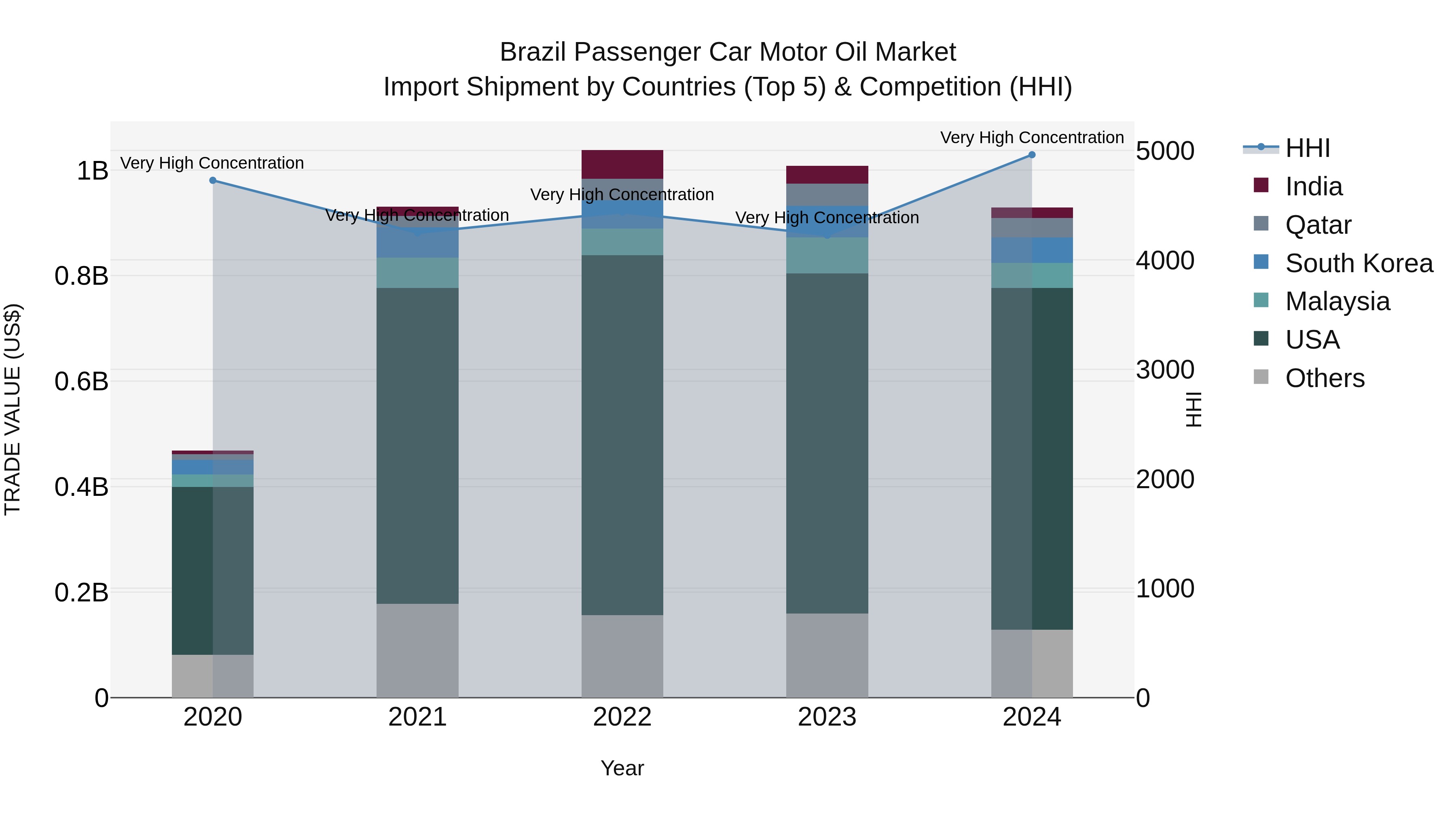
In 2024, Brazil`s passenger car motor oil import market continued to show a high level of concentration, with the top exporting countries being the USA, South Korea, Malaysia, Bahrain, and Qatar. Despite a slight decline in growth rate from 2023 to 2024, the compound annual growth rate (CAGR) for the period 2020-2024 remained strong at 18.68%. This suggests a steady demand for imported motor oil in Brazil, with key players maintaining their positions in the market. The market dynamics and competitive landscape will be important to monitor for future trends and opportunities in the industry.
Brazil Passenger Car Motor Oil Market Overview
The Brazil passenger car motor oil market is witnessing steady growth driven by factors such as increasing vehicle ownership rates, expanding automotive aftermarket industry, and rising demand for high-quality lubricants. The market is competitive, with key players like Petrobras, Shell, and ExxonMobil holding significant market shares. Synthetic motor oils are gaining popularity due to their superior performance and longer lifespan, especially in urban areas with heavy traffic conditions. The market is also influenced by government regulations promoting energy efficiency and environmental sustainability. E-commerce platforms are emerging as a preferred distribution channel, offering convenience and a wide range of product options to consumers. Overall, the Brazil passenger car motor oil market is expected to continue growing as the automotive sector expands and consumers prioritize vehicle maintenance and performance.
Brazil Passenger Car Motor Oil Market Trends
The Brazil passenger car motor oil market is witnessing several key trends. Firstly, there is a growing demand for synthetic motor oils due to their superior performance and longer change intervals, driven by increasing consumer awareness of the benefits of these products. Secondly, there is a shift towards environmentally-friendly and sustainable motor oil options, with a focus on products that are bio-based or meet stricter environmental standards. Additionally, there is a trend towards customization, with consumers seeking motor oils that are specifically formulated for their vehicle type or driving conditions. Finally, the market is seeing increased competition among manufacturers, leading to innovations in product formulations and packaging to attract and retain customers in this competitive landscape.
Brazil Passenger Car Motor Oil Market Challenges
In the Brazil passenger car motor oil market, some key challenges include intense competition among major oil companies and local players, fluctuating oil prices impacting production costs and pricing strategies, and the need to meet stringent environmental regulations. Additionally, consumer preferences are shifting towards more fuel-efficient and environmentally friendly products, requiring companies to innovate and develop advanced motor oil formulations. Distribution and logistics issues, such as inadequate infrastructure and transportation networks in certain regions of Brazil, also pose challenges in reaching customers effectively. Overall, navigating these challenges requires market players to stay abreast of industry trends, invest in research and development, and adapt their strategies to meet evolving consumer demands and regulatory requirements in the Brazilian market.
Brazil Passenger Car Motor Oil Market Investment Opportunities
The Brazil passenger car motor oil market presents promising investment opportunities due to the growing automotive industry and increasing vehicle ownership in the country. With the expanding middle class and improving economic conditions, there is a rising demand for high-quality motor oils to maintain and enhance the performance of vehicles. Investors can explore opportunities in developing and supplying innovative motor oil formulations that cater to the specific needs of Brazilian car owners, such as products designed for high-performance vehicles or those that improve fuel efficiency. Additionally, investing in marketing and distribution channels to reach a wider customer base and establishing partnerships with local automotive manufacturers can also prove to be lucrative strategies in tapping into the growing market for passenger car motor oils in Brazil.
Brazil Passenger Car Motor Oil Market Government Policy
Government policies related to the Brazil passenger car motor oil market focus on environmental regulations, quality standards, and import tariffs. The Brazilian government has implemented strict environmental regulations to promote the use of eco-friendly motor oils that reduce emissions and minimize environmental impact. Quality standards set by regulatory bodies ensure that motor oils meet specific performance and safety criteria for use in passenger vehicles. Import tariffs are also imposed on foreign motor oil products to protect and promote the domestic manufacturing industry. Overall, these policies aim to ensure the sustainability, safety, and competitiveness of the passenger car motor oil market in Brazil while also aligning with global environmental standards.
Brazil Passenger Car Motor Oil Market Future Outlook
The future outlook for the Brazil passenger car motor oil market appears promising, driven by several factors such as increasing vehicle ownership rates, growing demand for high-performance lubricants, and expanding automotive aftermarket services. The market is expected to witness steady growth as consumers prioritize vehicle maintenance and manufacturers develop innovative oil formulations to meet stringent emission regulations. The rise of electric vehicles may pose a challenge in the long term, but the traditional internal combustion engine vehicles will continue to dominate the market for the foreseeable future. Key players are likely to focus on product diversification, strategic partnerships, and marketing initiatives to capitalize on the expanding opportunities in the passenger car motor oil segment in Brazil.
Key Highlights of the Report:
- Brazil Passenger Car Motor Oil Market Outlook
- Market Size of Brazil Passenger Car Motor Oil Market,2024
- Forecast of Brazil Passenger Car Motor Oil Market, 2031
- Historical Data and Forecast of Brazil Passenger Car Motor Oil Revenues & Volume for the Period 2021-2031
- Brazil Passenger Car Motor Oil Market Trend Evolution
- Brazil Passenger Car Motor Oil Market Drivers and Challenges
- Brazil Passenger Car Motor Oil Price Trends
- Brazil Passenger Car Motor Oil Porter's Five Forces
- Brazil Passenger Car Motor Oil Industry Life Cycle
- Historical Data and Forecast of Brazil Passenger Car Motor Oil Market Revenues & Volume By Type for the Period 2021-2031
- Historical Data and Forecast of Brazil Passenger Car Motor Oil Market Revenues & Volume By Synthetic for the Period 2021-2031
- Historical Data and Forecast of Brazil Passenger Car Motor Oil Market Revenues & Volume By Conventional for the Period 2021-2031
- Historical Data and Forecast of Brazil Passenger Car Motor Oil Market Revenues & Volume By Semi-Synthetic for the Period 2021-2031
- Historical Data and Forecast of Brazil Passenger Car Motor Oil Market Revenues & Volume By High-Mileage for the Period 2021-2031
- Historical Data and Forecast of Brazil Passenger Car Motor Oil Market Revenues & Volume By Viscosity Grade for the Period 2021-2031
- Historical Data and Forecast of Brazil Passenger Car Motor Oil Market Revenues & Volume By 5W-30 for the Period 2021-2031
- Historical Data and Forecast of Brazil Passenger Car Motor Oil Market Revenues & Volume By 10W-40 for the Period 2021-2031
- Historical Data and Forecast of Brazil Passenger Car Motor Oil Market Revenues & Volume By 15W-50 for the Period 2021-2031
- Historical Data and Forecast of Brazil Passenger Car Motor Oil Market Revenues & Volume By 0W-20 for the Period 2021-2031
- Historical Data and Forecast of Brazil Passenger Car Motor Oil Market Revenues & Volume By Application for the Period 2021-2031
- Historical Data and Forecast of Brazil Passenger Car Motor Oil Market Revenues & Volume By High Performance for the Period 2021-2031
- Historical Data and Forecast of Brazil Passenger Car Motor Oil Market Revenues & Volume By Standard Driving for the Period 2021-2031
- Historical Data and Forecast of Brazil Passenger Car Motor Oil Market Revenues & Volume By Long Mileage for the Period 2021-2031
- Historical Data and Forecast of Brazil Passenger Car Motor Oil Market Revenues & Volume By Fuel Efficiency for the Period 2021-2031
- Historical Data and Forecast of Brazil Passenger Car Motor Oil Market Revenues & Volume By End Use for the Period 2021-2031
- Historical Data and Forecast of Brazil Passenger Car Motor Oil Market Revenues & Volume By Car Owners for the Period 2021-2031
- Historical Data and Forecast of Brazil Passenger Car Motor Oil Market Revenues & Volume By Dealerships for the Period 2021-2031
- Historical Data and Forecast of Brazil Passenger Car Motor Oil Market Revenues & Volume By Service Centers for the Period 2021-2031
- Historical Data and Forecast of Brazil Passenger Car Motor Oil Market Revenues & Volume By Automotive for the Period 2021-2031
- Brazil Passenger Car Motor Oil Import Export Trade Statistics
- Market Opportunity Assessment By Type
- Market Opportunity Assessment By Viscosity Grade
- Market Opportunity Assessment By Application
- Market Opportunity Assessment By End Use
- Brazil Passenger Car Motor Oil Top Companies Market Share
- Brazil Passenger Car Motor Oil Competitive Benchmarking By Technical and Operational Parameters
- Brazil Passenger Car Motor Oil Company Profiles
- Brazil Passenger Car Motor Oil Key Strategic Recommendations






































