Brazil Pharmaceutical Glass Vials and Ampoules Market Size, Share & Growth Rate
The Brazil Pharmaceutical Glass Vials and Ampoules Market was estimated at USD 162 Million in 2025 and is projected to reach USD 192 Million by 2032, growing at a CAGR of 2.5% from 2026 to 2032. This steady growth trajectory is fueled by the expansion of Brazil's pharmaceutical sector, which is increasingly leaning towards reliable packaging solutions to ensure product integrity. The rising demand for vaccines and medications, combined with stringent regulatory frameworks, is driving the need for high-quality glass packaging.
Brazil Pharmaceutical Glass Vials and Ampoules Market Year-wise Growth Rate and Key Drivers
This graph highlights how the Brazil Pharmaceutical Glass Vials and Ampoules Market has steadily grown over the years, supported by major growth factors.
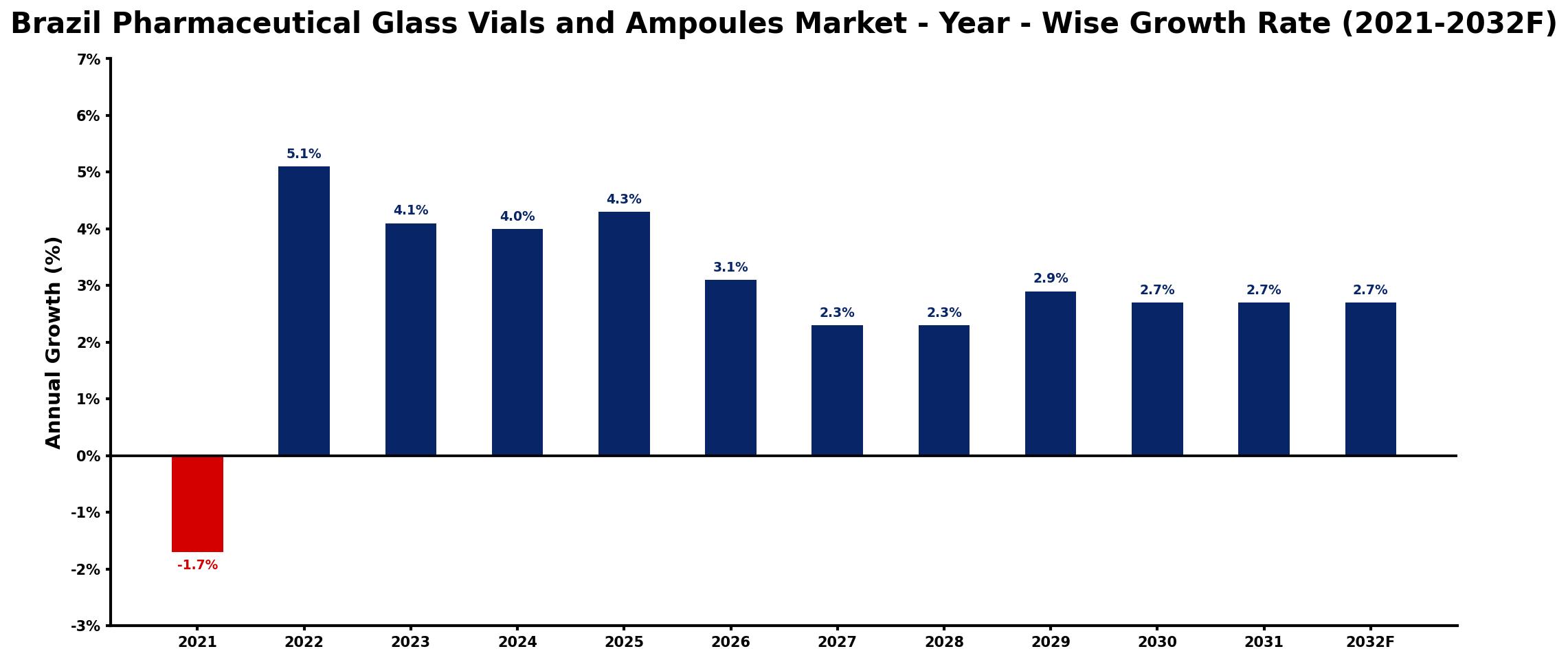
The table below presents the year‑wise growth rates along with the key drivers influencing the market
| Year | Growth Rate | Major Drivers |
| 2021 | -1.7% | Decreased demand in healthcare sector |
| 2022 | 5.1% | Increased investments in biotechnology |
| 2023 | 4.1% | Rising healthcare expenditure nationwide |
| 2024 | 4.0% | Growing trend of personalized medicine |
| 2025 | 4.3% | Expansion in research laboratories capacity |
| 2026 | 3.1% | Emergence of new therapeutic solutions |
| 2027 | 2.3% | Advancements in drug delivery systems |
| 2028 | 2.3% | Strengthened regulatory compliance measures |
| 2029 | 2.9% | Surge in global health initiatives |
| 2030 | 2.7% | Increased focus on sustainability practices |
| 2031 | 2.7% | Growing popularity of preventive healthcare |
| 2032 | 2.7% | Expansion of clinical trial activities |
Note: Market size estimations and growth projections presented in this report are based on 6Wresearch's proprietary forecasting methodology, utilizing the latest available industry data, government publications, and primary research inputs.
Brazil Pharmaceutical Glass Vials and Ampoules Market Synopsis
In recent years, the Brazilian market for pharmaceutical glass vials and ampoules has witnessed significant momentum, propelled by the healthcare sector's rapid growth and the escalating demand for effective drug delivery systems. Looking ahead, this market is poised for further development, as technological advancements and evolving regulatory standards continue to shape packaging solutions.
While the market enjoys a favorable growth outlook, challenges persist, particularly in terms of compliance with stringent quality assurance regulations. Ensuring that packaging solutions not only meet but exceed these standards will be critical for manufacturers seeking to maintain a competitive edge in the Brazilian pharmaceutical landscape.
Brazil Pharmaceutical Glass Vials and Ampoules Market Key Takeaways
- The market is driven by the robust growth of the pharmaceutical sector in Brazil.
- Stringent regulations regarding quality and safety are reshaping packaging standards.
- Increased demand for vaccines is contributing significantly to market expansion.
- Continuous innovations in packaging technology are essential for future growth.
- Quality assurance and compliance remain primary focal points for industry stakeholders.
Evaluation of Restraints in Brazil Pharmaceutical Glass Vials and Ampoules Market
The Brazilian pharmaceutical glass vials and ampoules market faces notable restraints, particularly in the area of quality assurance and compliance with rigorous regulatory standards. Manufacturers are challenged to maintain stringent quality controls throughout the production process, which can be resource-intensive and complex. Additionally, fluctuations in raw material costs and the necessity for continual upgrades in manufacturing technology can further limit market growth. Stakeholders must navigate these constraints while remaining focused on innovation and regulatory adherence to ensure product integrity and safety.
Brazil Pharmaceutical Glass Vials and Ampoules Market Trends
Emerging trends in the Brazilian pharmaceutical glass vials and ampoules market include a shift towards eco-friendly and sustainable packaging solutions. There is also a growing preference for customized vials and ampoules that enhance user-friendliness and safety. Technological advancements are enabling the integration of smart features into packaging, such as tamper-evident seals and dosage indicators, further driving demand.
Brazil Pharmaceutical Glass Vials and Ampoules Market Opportunities
The market is ripe for genuine growth and investment opportunities, particularly in the area of innovation. Companies that invest in research and development for new glass formulations and packaging designs stand to benefit significantly. Additionally, partnerships with pharmaceutical firms to provide tailored packaging solutions can enhance competitive positioning. The increasing focus on vaccine production also presents a lucrative avenue for growth, as demand for high-quality vials and ampoules surges.
Government Initiatives in the Brazil Pharmaceutical Glass Vials and Ampoules Market
Brazilian government policies regarding pharmaceutical packaging place a strong emphasis on product safety and integrity. Regulatory frameworks are designed to ensure that manufacturers adhere to strict quality standards throughout the production process. Public spending on healthcare initiatives, particularly those focused on improving access to medications and vaccines, further supports the demand for reliable packaging solutions in the pharmaceutical sector.
Future Insights of the Brazil Pharmaceutical Glass Vials and Ampoules Market
Looking towards 2026-2032, the Brazil Pharmaceutical Glass Vials and Ampoules Market is expected to undergo transformative changes driven by technological advancements and an increasingly competitive landscape. Enhanced focus on sustainable packaging practices, coupled with the adoption of digital technologies in manufacturing and supply chain operations, will likely propel the market forward. Additionally, as Brazil continues to invest in healthcare infrastructure, the demand for innovative, high-quality packaging solutions is anticipated to grow substantially, positioning the market for sustained success.
Brazil Pharmaceutical Glass Vials and Ampoules Market Latest Developments (2025 - 2026)
Recent developments within the Brazil Pharmaceutical Glass Vials and Ampoules Market indicate a shift towards enhanced safety features and innovative designs in packaging solutions. Companies are increasingly adopting advanced manufacturing technologies, resulting in improved production efficiency and quality. Additionally, collaborations between packaging suppliers and pharmaceutical companies are fostering the development of customized solutions tailored to specific product requirements, enhancing overall market competitiveness.
Brazil Pharmaceutical Glass Vials and Ampoules Market - Key Attractiveness of the Report
- 10 Years of Market Numbers
- Historical Data Starting from 2022 to 2025
- Base Year: 2025
- Forecast Data until 2032
- Key Performance Indicators Impacting the Market
- Major Upcoming Developments and Projects
Key Highlights of the Report:
- Brazil Pharmaceutical Glass Vials and Ampoules Market Outlook
- Market Size of Brazil Pharmaceutical Glass Vials and Ampoules Market, 2025
- Forecast of Brazil Pharmaceutical Glass Vials and Ampoules Market, 2032
- Historical Data and Forecast of Brazil Pharmaceutical Glass Vials and Ampoules Revenues & Volume for the Period 2022-2032F
- Brazil Pharmaceutical Glass Vials and Ampoules Market Trend Evolution
- Brazil Pharmaceutical Glass Vials and Ampoules Market Drivers and Challenges
- Brazil Pharmaceutical Glass Vials and Ampoules Price Trends
- Brazil Pharmaceutical Glass Vials and Ampoules Porter's Five Forces
- Brazil Pharmaceutical Glass Vials and Ampoules Industry Life Cycle
- Historical Data and Forecast of Brazil Pharmaceutical Glass Vials and Ampoules Market Revenues & Volume By Type for the Period 2022-2032F
- Historical Data and Forecast of Brazil Pharmaceutical Glass Vials and Ampoules Market Revenues & Volume By 2ml for the Period 2022-2032F
- Historical Data and Forecast of Brazil Pharmaceutical Glass Vials and Ampoules Market Revenues & Volume By 3ml to 5ml for the Period 2022-2032F
- Historical Data and Forecast of Brazil Pharmaceutical Glass Vials and Ampoules Market Revenues & Volume By 6ml to 8ml for the Period 2022-2032F
- Historical Data and Forecast of Brazil Pharmaceutical Glass Vials and Ampoules Market Revenues & Volume By 8ml or more for the Period 2022-2032F
- Historical Data and Forecast of Brazil Pharmaceutical Glass Vials and Ampoules Market Revenues & Volume By Application for the Period 2022-2032F
- Historical Data and Forecast of Brazil Pharmaceutical Glass Vials and Ampoules Market Revenues & Volume By Pharmaceutical for the Period 2022-2032F
- Historical Data and Forecast of Brazil Pharmaceutical Glass Vials and Ampoules Market Revenues & Volume By Chemical Reagent for the Period 2022-2032F
- Brazil Pharmaceutical Glass Vials and Ampoules Import Export Trade Statistics
- Market Opportunity Assessment By Type
- Market Opportunity Assessment By Application
- Brazil Pharmaceutical Glass Vials and Ampoules Top Companies Market Share
- Brazil Pharmaceutical Glass Vials and Ampoules Competitive Benchmarking By Technical and Operational Parameters
- Brazil Pharmaceutical Glass Vials and Ampoules Company Profiles
- Brazil Pharmaceutical Glass Vials and Ampoules Key Strategic Recommendations






































