Brazil Piperonal Market Size, Share & Growth Rate
The Brazil Piperonal Market was estimated at USD 351 Million in 2025 and is projected to reach USD 420 Million by 2032, growing at a CAGR of 2.6% from 2026 to 2032. This growth is significantly attributed to the increasing consumer preferences for unique and high-quality fragrances in perfumes and cosmetics. Furthermore, the surge in demand for flavored food products enhances the market's expansion, reinforcing piperonal's indispensable role in Brazil's vibrant fragrance and flavor sector.
Brazil Piperonal Market Year-wise Growth Rate and Key Drivers
This graph highlights how the Brazil Piperonal Market has steadily grown over the years, supported by major growth factors.
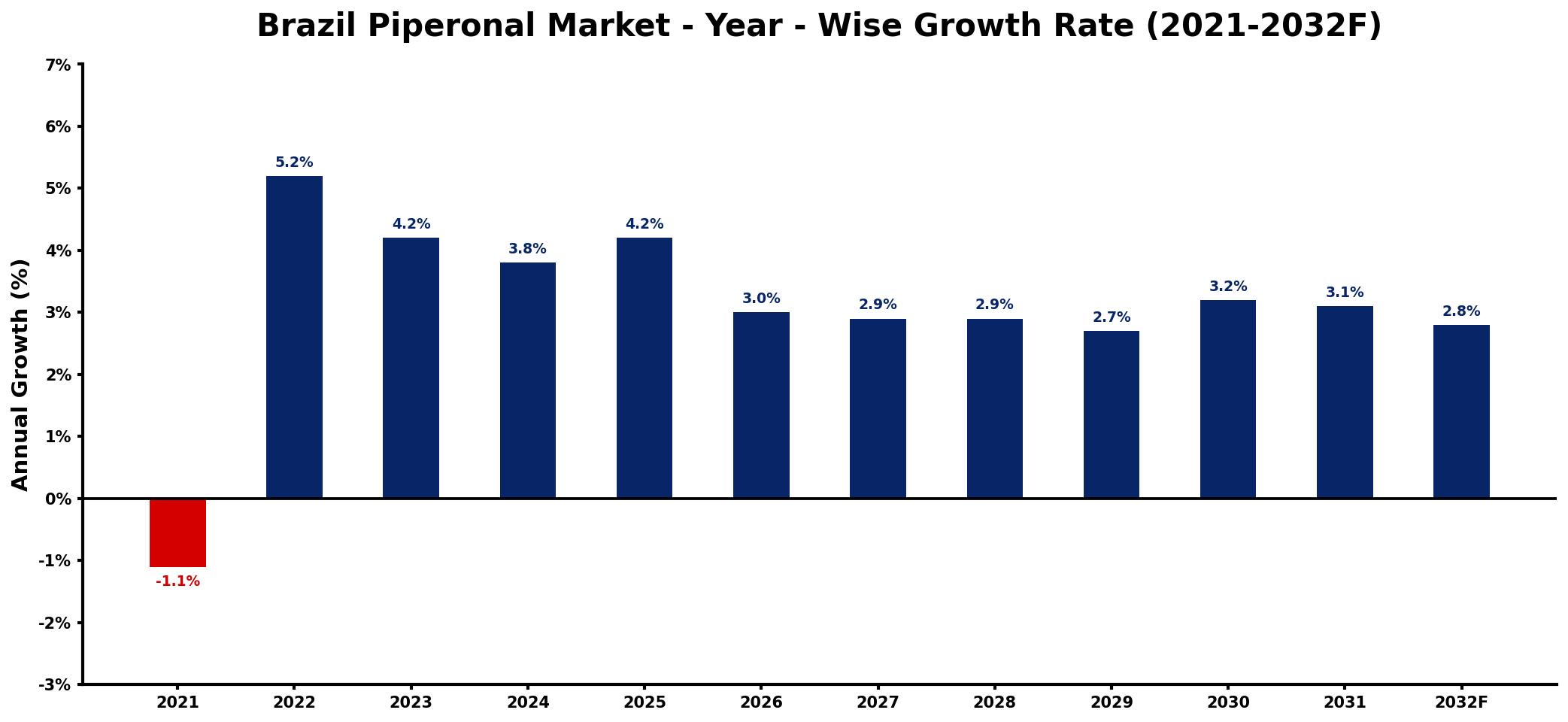
The table below presents the year‑wise growth rates along with the key drivers influencing the market
| Year | Growth Rate | Major Drivers |
| 2021 | -1.1% | fluctuating consumer purchasing behavior |
| 2022 | 5.2% | rising demand for natural flavors |
| 2023 | 4.2% | increased investment in fragrances |
| 2024 | 3.8% | growing popularity of organic products |
| 2025 | 4.2% | expansion of cosmetic applications |
| 2026 | 3.0% | emerging markets adopting new trends |
| 2027 | 2.9% | enhanced production efficiency technologies |
| 2028 | 2.9% | growing interest in sustainable sourcing |
| 2029 | 2.7% | increased export opportunities in Asia |
| 2030 | 3.2% | development of innovative formulations |
| 2031 | 3.1% | strengthened supply chain networks |
| 2032 | 2.8% | rising consumer awareness for quality |
Note: Market size estimations and growth projections presented in this report are based on 6Wresearch's proprietary forecasting methodology, utilizing the latest available industry data, government publications, and primary research inputs.
Brazil Piperonal Market Synopsis
The strongest force currently shaping the Brazil Piperonal Market is the rising demand for natural ingredients in personal care and food applications. As consumers become more health-conscious and seek authenticity in products, piperonals natural floral aroma positions it as a favorable choice among manufacturers.
Additionally, innovation in fragrance technology is creating new avenues for piperonal use, particularly in sustainable perfumery. These advancements are expected to further drive the demand, creating a dynamic landscape for market stakeholders.
Brazil Piperonal Market Key Takeaways
- Steady growth anticipated in the fragrance and flavor sectors, driven by evolving consumer preferences.
- Natural and sustainable ingredients are increasingly favored, elevating piperonal's market position.
- Technological innovations in fragrance applications present new opportunities for product development.
- Regulatory frameworks focus on product safety and quality, ensuring consumer health protection.
- Supply chain management and product differentiation are critical for maintaining competitive advantage.
Evaluation of Restraints in Brazil Piperonal Market
Despite its growth potential, the Brazil Piperonal Market faces notable restraints. Supply chain disruptions can impact the availability of high-quality raw materials, complicating production processes. Quality control issues also pose risks, as maintaining the purity and authenticity of piperonal is essential for consumer trust. Furthermore, competition from synthetic alternatives may challenge the market, as producers strive to emphasize the natural characteristics that set piperonal apart. Addressing these issues will be crucial for market stakeholders aiming to sustain growth and profitability.
Brazil Piperonal Market Trends
Key trends in the Brazil Piperonal Market include a shift towards eco-friendly and sustainably sourced ingredients. Consumers are increasingly prioritizing products that align with their values regarding environmental responsibility. Additionally, the rise of e-commerce and online retail platforms is transforming distribution channels, making it easier for consumers to access a wider range of piperonal-infused products. These trends are expected to shape the landscape of the market significantly in the coming years.
Brazil Piperonal Market Opportunities
The Brazil Piperonal Market presents genuine opportunities for growth and investment, particularly in the area of product innovation. Companies can explore new formulations that cater to health-conscious consumers, as well as expand into untapped markets such as organic and vegan fragrance lines. Collaborations with local artisans and niche brands can also foster creativity and authenticity, appealing to a discerning consumer base eager for unique products.
Government Initiatives in the Brazil Piperonal Market
Government policies impacting the Brazil Piperonal Market focus primarily on ensuring product safety and quality standards. Regulatory agencies like the National Health Surveillance Agency (ANVISA) and the Ministry of Agriculture implement guidelines that dictate production processes, labeling, and distribution. These regulations are designed to protect consumer health and encourage market integrity by preventing the sale of adulterated or substandard products. Thus, government initiatives play a pivotal role in shaping the market's operational framework.
Future Insights of the Brazil Piperonal Market
Looking ahead to 2026-2032, the Brazil Piperonal Market is poised for progressive transformation. The anticipated rise in demand for personalized fragrances and natural flavorings will likely enhance piperonal's appeal. Moreover, as consumers become more engaged with sustainability, companies that innovate and align with these values will thrive. The combination of technological advancements and changing consumer expectations indicates a vibrant future for this sector, encouraging both investment and product diversification.
Brazil Piperonal Market Latest Developments (2025 - 2026)
Recent industry developments in the Brazil Piperonal Market point towards a consolidation of efforts in sustainability and product innovation. Manufacturers are increasingly prioritizing eco-friendly sourcing practices while exploring novel applications of piperonal in emerging product lines. The market is also witnessing collaborative initiatives aimed at enhancing awareness about the benefits of natural ingredients, which is expected to resonate well with the evolving consumer mindset.
Brazil Piperonal Market - Key Attractiveness of the Report
- 10 Years of Market Numbers
- Historical Data Starting from 2022 to 2025
- Base Year: 2025
- Forecast Data until 2032
- Key Performance Indicators Impacting the Market
- Major Upcoming Developments and Projects
Key Highlights of the Report:
- Brazil Piperonal Market Outlook
- Market Size of Brazil Piperonal Market, 2025
- Forecast of Brazil Piperonal Market, 2032
- Historical Data and Forecast of Brazil Piperonal Revenues & Volume for the Period 2022-2032F
- Brazil Piperonal Market Trend Evolution
- Brazil Piperonal Market Drivers and Challenges
- Brazil Piperonal Price Trends
- Brazil Piperonal Porter's Five Forces
- Brazil Piperonal Industry Life Cycle
- Historical Data and Forecast of Brazil Piperonal Market Revenues & Volume By Type for the Period 2022-2032F
- Historical Data and Forecast of Brazil Piperonal Market Revenues & Volume By Natural Piperonal for the Period 2022-2032F
- Historical Data and Forecast of Brazil Piperonal Market Revenues & Volume By Synthetic Piperonal for the Period 2022-2032F
- Historical Data and Forecast of Brazil Piperonal Market Revenues & Volume By Application for the Period 2022-2032F
- Historical Data and Forecast of Brazil Piperonal Market Revenues & Volume By Flavors and Fragrances for the Period 2022-2032F
- Historical Data and Forecast of Brazil Piperonal Market Revenues & Volume By Food Industry for the Period 2022-2032F
- Historical Data and Forecast of Brazil Piperonal Market Revenues & Volume By Others for the Period 2022-2032F
- Brazil Piperonal Import Export Trade Statistics
- Market Opportunity Assessment By Type
- Market Opportunity Assessment By Application
- Brazil Piperonal Top Companies Market Share
- Brazil Piperonal Competitive Benchmarking By Technical and Operational Parameters
- Brazil Piperonal Company Profiles
- Brazil Piperonal Key Strategic Recommendations






































