Brazil Planes, Helicopters, and Spacecraft Market Size, Share & Growth Rate
The Brazil Planes, Helicopters, and Spacecraft Market was estimated at USD 149 Million in 2025 and is projected to reach USD 177 Million by 2032, growing at a CAGR of 2.5% from 2026 to 2032. This growth trajectory is largely fueled by increasing economic development in Brazil, which drives demand for enhanced air transport services. Additionally, military and defense requirements are prompting investments in aircraft and spacecraft to modernize capabilities and strengthen national security.
Brazil Planes, Helicopters, and Spacecraft Market Year-wise Growth Rate and Key Drivers
This graph highlights how the Brazil Planes, Helicopters, and Spacecraft Market has steadily grown over the years, supported by major growth factors.
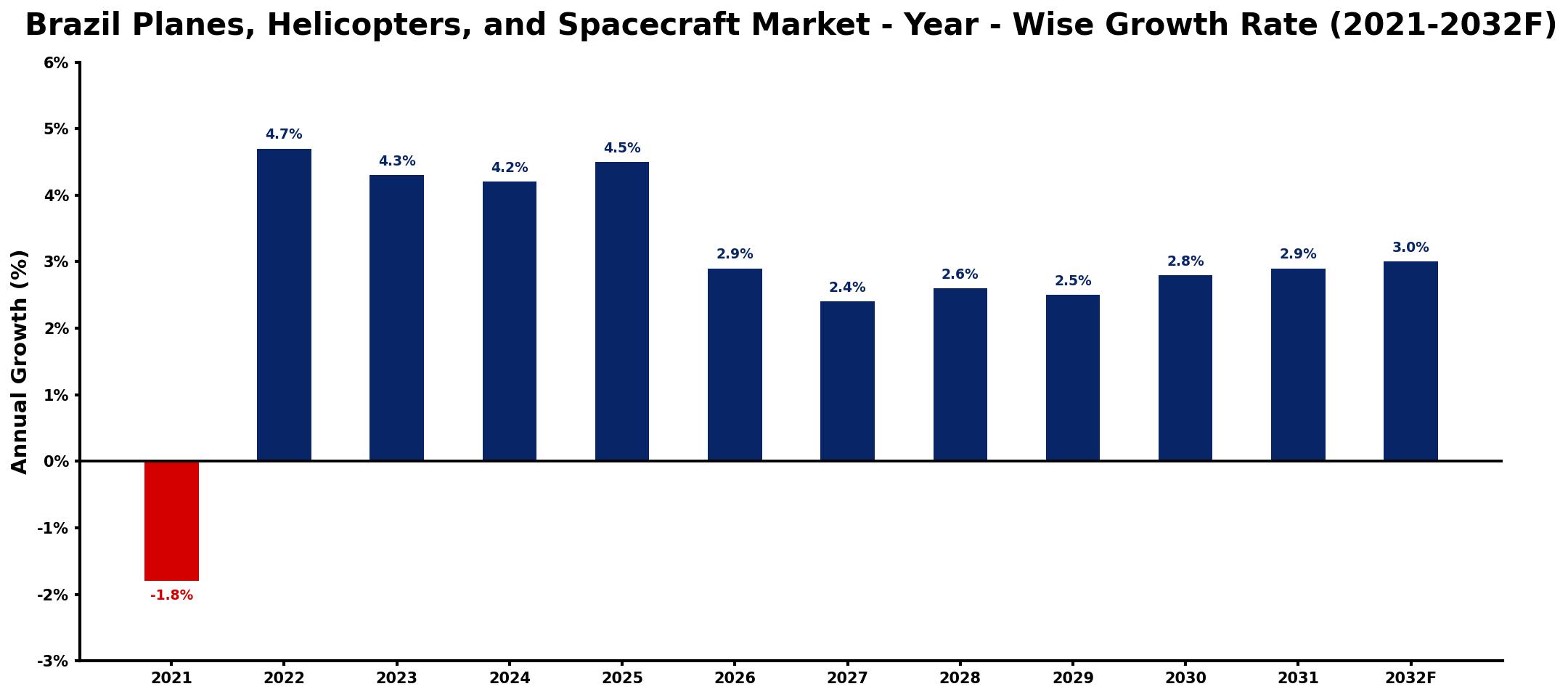
The table below presents the year‑wise growth rates along with the key drivers influencing the market
| Year | Growth Rate | Major Drivers |
| 2021 | -1.8% | decrease in government investments |
| 2022 | 4.7% | rising demand for air transport |
| 2023 | 4.3% | growing tourism and travel sector |
| 2024 | 4.2% | increased military modernization initiatives |
| 2025 | 4.5% | expansion of regional aerospace facilities |
| 2026 | 2.9% | higher investment in R&D projects |
| 2027 | 2.4% | enhanced focus on sustainability practices |
| 2028 | 2.6% | emerging technologies adoption accelerates |
| 2029 | 2.5% | more public-private partnerships formed |
| 2030 | 2.8% | increased international trade activities |
| 2031 | 2.9% | growing urban air mobility solutions |
| 2032 | 3.0% | strengthening of aerospace supply chains |
Note: Market size estimations and growth projections presented in this report are based on 6Wresearch's proprietary forecasting methodology, utilizing the latest available industry data, government publications, and primary research inputs.
Brazil Planes, Helicopters, and Spacecraft Market Synopsis
Currently, the Brazil Planes, Helicopters, and Spacecraft Market is at a critical juncture, reflecting both civil aviation expansion and robust defense initiatives. Notably, the ongoing collaborations with international aerospace companies indicate a shift towards more sophisticated technologies and capabilities.
Despite challenges like high acquisition costs and stringent regulatory requirements, the market is poised for growth. The increasing need for sustainable aviation practices and technological innovation is shaping the strategies of stakeholders in this sector, setting the stage for future advancements.
Brazil Planes, Helicopters, and Spacecraft Market Key Takeaways
- The market reflects a balanced growth driven by both civil and military aviation needs.
- Strategic partnerships with global aerospace companies are pivotal for technological advancement.
- Environmental regulations are influencing the development of sustainable aviation solutions.
- Skilled personnel shortages present challenges for continued industry expansion.
- Government policies are facilitating the growth of indigenous aerospace technologies.
Evaluation of Restraints in Brazil Planes, Helicopters, and Spacecraft Market
Several restraints are impacting the Brazil Planes, Helicopters, and Spacecraft Market, primarily revolving around high upfront acquisition costs and complex regulatory frameworks. The financial burden associated with purchasing and maintaining advanced aircraft can deter smaller operators from entering the market. Additionally, the need for ongoing investment in skilled personnel and training is crucial, as technological advancements require a workforce adept in new systems and practices. Global economic uncertainties further complicate demand forecasts, as fluctuations can significantly affect the operational budgets of both civil and military aviation sectors.
Brazil Planes, Helicopters, and Spacecraft Market Trends
Several trends are emerging that are reshaping the Brazil Planes, Helicopters, and Spacecraft Market. A strong focus on sustainability is leading to the integration of greener technologies in aircraft design and operation. Additionally, advancements in unmanned aerial vehicles (UAVs) are becoming increasingly relevant for both civilian and military applications. Furthermore, digitalization and data analytics are improving operational efficiency, enhancing safety measures, and optimizing maintenance schedules. This trend towards modernization indicates a forward-thinking approach that reflects a global shift in the aerospace industry.
Brazil Planes, Helicopters, and Spacecraft Market Opportunities
The Brazil Planes, Helicopters, and Spacecraft Market presents significant opportunities for growth and investment. The increasing defense budget and a push for modernization within the Brazilian military provide fertile ground for new aircraft and technology developments. Moreover, the burgeoning demand for air transport services within Brazil supports the expansion of commercial aviation and regional connectivity. Partnerships with international players are creating pathways for technology transfer, facilitating innovation and competitive advantages in aerospace capabilities.
Government Initiatives in the Brazil Planes, Helicopters, and Spacecraft Market
Government policies significantly influence the Brazil Planes, Helicopters, and Spacecraft Market, focusing on enhancing both civil and military aviation capacities. Initiatives often include incentives for developing indigenous aerospace technologies, which bolster local industry growth. Regulatory frameworks aim to ensure safety and environmental standards while fostering international collaborations that enhance technological exchange. Such strategic policymaking plays a crucial role in navigating the complexities of dual-use aerospace technologies, maintaining a delicate balance between defense needs and civil aviation objectives.
Future Insights of the Brazil Planes, Helicopters, and Spacecraft Market
Looking ahead to 2026-2032, the Brazil Planes, Helicopters, and Spacecraft Market is expected to evolve significantly. The combination of increasing investments in defense modernization and a growing demand for commercial air travel will shape market dynamics. Moreover, ongoing advancements in aerospace technology, along with an emphasis on sustainability, will likely become more pronounced. Strategic collaborations and government initiatives aimed at fostering local innovation will further support growth and establish Brazil as a competitive player in the global aerospace landscape.
Brazil Planes, Helicopters, and Spacecraft Market Latest Developments (2025 - 2026)
In recent months, the Brazil Planes, Helicopters, and Spacecraft Market has seen heightened activity as stakeholders focus on integrating advanced technologies and addressing environmental concerns. Developments in partnerships with international aerospace firms are paving the way for innovative projects, while local manufacturers are ramping up efforts to enhance their technological capabilities. The emphasis on sustainable aviation practices is also gaining traction, influencing design and operational strategies across the board.
Brazil Planes, Helicopters, and Spacecraft Market - Key Attractiveness of the Report
- 10 Years of Market Numbers
- Historical Data Starting from 2022 to 2025
- Base Year: 2025
- Forecast Data until 2032
- Key Performance Indicators Impacting the Market
- Major Upcoming Developments and Projects
Key Highlights of the Report:
- Brazil Planes, Helicopters, and Spacecraft Market Outlook
- Market Size of Brazil Planes, Helicopters, and Spacecraft Market, 2025
- Forecast of Brazil Planes, Helicopters, and Spacecraft Market, 2032
- Historical Data and Forecast of Brazil Planes, Helicopters, and Spacecraft Revenues & Volume for the Period 2022-2032F
- Brazil Planes, Helicopters, and Spacecraft Market Trend Evolution
- Brazil Planes, Helicopters, and Spacecraft Market Drivers and Challenges
- Brazil Planes, Helicopters, and Spacecraft Price Trends
- Brazil Planes, Helicopters, and Spacecraft Porter's Five Forces
- Brazil Planes, Helicopters, and Spacecraft Industry Life Cycle
- Historical Data and Forecast of Brazil Planes, Helicopters, and Spacecraft Market Revenues & Volume By End User for the Period 2022-2032F
- Historical Data and Forecast of Brazil Planes, Helicopters, and Spacecraft Market Revenues & Volume By Aviation for the Period 2022-2032F
- Historical Data and Forecast of Brazil Planes, Helicopters, and Spacecraft Market Revenues & Volume By Military for the Period 2022-2032F
- Historical Data and Forecast of Brazil Planes, Helicopters, and Spacecraft Market Revenues & Volume By Private for the Period 2022-2032F
- Historical Data and Forecast of Brazil Planes, Helicopters, and Spacecraft Market Revenues & Volume By Others for the Period 2022-2032F
- Brazil Planes, Helicopters, and Spacecraft Import Export Trade Statistics
- Market Opportunity Assessment By End User
- Brazil Planes, Helicopters, and Spacecraft Top Companies Market Share
- Brazil Planes, Helicopters, and Spacecraft Competitive Benchmarking By Technical and Operational Parameters
- Brazil Planes, Helicopters, and Spacecraft Company Profiles
- Brazil Planes, Helicopters, and Spacecraft Key Strategic Recommendations






































